The morning had promised sunshine, and for once the promise had held. Light spilled across the wide lawns of Ashenford Hall in long golden strips, warming the tops of the yew hedges, and the polished stones of the terrace. A soft wind carried the smell of cut grass and roses, and beneath that the sharper, sweeter smell of lemon cakes set out on the long linen table. Miss Vivienne Ashcombe stood a little apart from the crowd, her gloved hands folded before her and watched the party from the edge of the rose walk. She was not hiding.
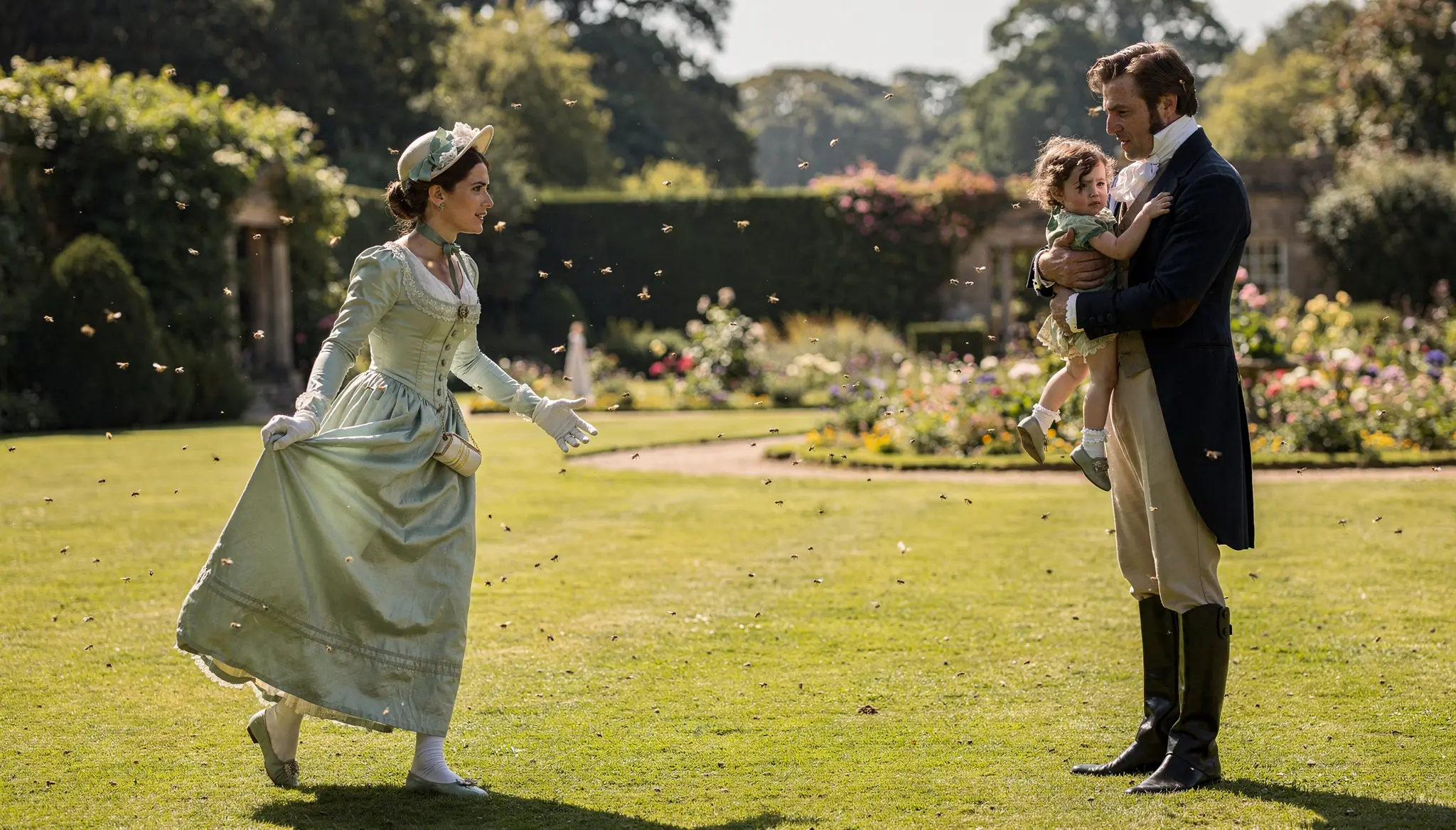
She was simply standing where she could see without being seen too much. It was a trick she had learned early, and it had served her well. The garden party at Ashenford was the event of the summer. Everyone said so. The Duke of Ashenford had not opened his gates to society for nearly 3 years, and now, without warning, invitations had gone out across half of England.
Mothers had polished their daughters and pressed their best silks. Fathers had reminded sons to bow properly. Carriages had lined the drive since 10:00 in the morning. Vivienne had come with her aunt, who had already vanished into the crowd. That suited Vivienne.
She had no wish to be paraded. She was seven-and-twenty, unmarried, and as her aunt reminded her often, not the sort of girl a duke would notice. Vivienne did not mind. She had come for the gardens. She had heard the Ashenford roses were the finest in the county, and she had wanted to see them for herself.
She lifted her face to the sun and closed her eyes for a moment. The warmth was gentle on her cheeks. From somewhere behind the hedge came the small sound of a child laughing quick and bright, then cut off. Vivienne opened her eyes. She wondered whose child it was.
There were not many children at these things. She had barely finished the thought when she saw him. The Duke of Ashenford stood at the top of the terrace steps, one hand resting lightly on the stone balustrade. He was not what she had expected. He was tall, yes, and dressed in dark blue with a plain white cravat, but there was nothing showy about him.
He looked like a man who had been asked to attend his own party and had agreed only because there was no polite way to refuse. His eyes moved over the crowd with a quiet, careful attention, as though he were counting something. Vivienne looked away. She did not want to be caught staring. She turned toward the rose walk instead and began to move slowly along it, brushing her fingers just above the petals without touching them.
The scent was thick and warm here, layered like heavy cloth. Somewhere a bee droned past her ear, and she smiled. She loved bees. Her father had kept them before he died. She had helped him tend the hives as a girl, wrapped in a long veil that smelled of smoke and honey.
She remembered the low, steady hum of the hive, and the way her father would speak to the bees in a soft voice, telling them the news of the family. "Tell the bees," he used to say. "If you do not tell the bees, they will leave." She had not told the bees when he died. There had been no bees left to tell. A movement caught her eye.
A small girl, perhaps six years old, was crouched at the far end of the rose walk. She was dressed in white muslin with a pale green sash, and her dark curls had come partly loose from their ribbon. She was staring at something in the grass with fierce concentration. Vivienne walked toward her slowly so as not to startle her. "What have you found?" she asked, keeping her voice low.
The child looked up. She had large, serious eyes and a scratch on one cheek that had already begun to heal. She did not smile. She simply studied Vivienne for a long moment, as though deciding whether to answer. "A bee," the child said at last.
"It cannot fly." Vivienne knelt down carefully, spreading her skirts around her. On a flat stone at the edge of the path lay a single honeybee, its wings damp, its small body still. It was not dead. Vivienne could see the faint tremble of one leg. "It got wet, I think," the child said.