The tearing sound was surprisingly small.
A short rip of heavy fabric.
That was all.
But on the wet obstacle field outside the Pine Ridge Federal Crisis Response Academy, two hundred exhausted trainees heard it as clearly as if every other sound had vanished.
Marcus Caldwell’s hand was still wrapped around the shoulder of Maya Reeves’s muddy training jacket.
One second earlier, his face had been twisted with anger.
The next, it went completely blank.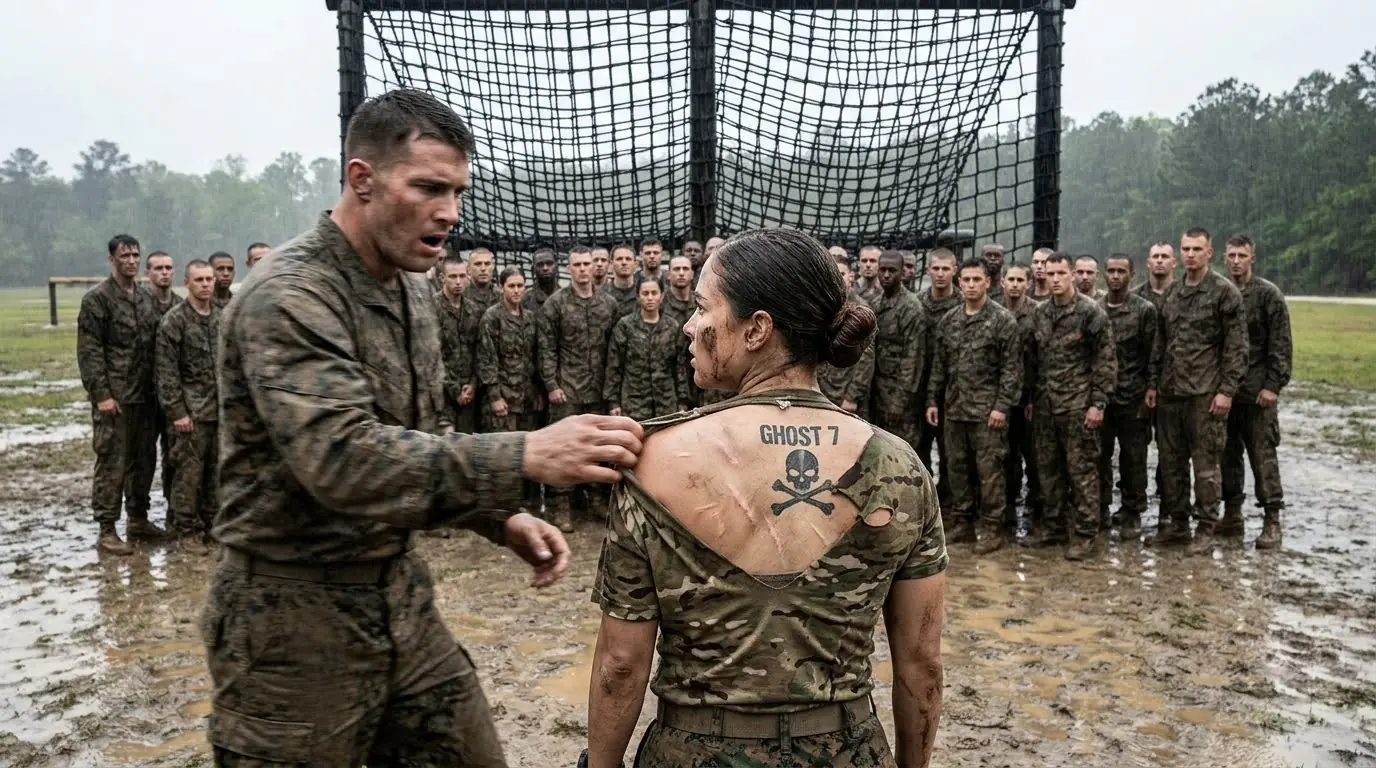
The torn fabric had fallen away from Maya’s upper shoulder and part of her back, exposing old pale scars that crossed her skin in uneven lines.
Between them was black ink.
A skull inside a broken circle.
Seven vertical marks beneath it.
And two words.
GHOST 7.
Marcus stopped breathing.
Several trainees behind him leaned forward.
Someone whispered:
“No way.”
Maya stood perfectly still.
She was five feet four inches tall, lean, athletic, and soaked from the morning rain. Mud covered her boots, her dark brown hair had begun slipping loose from the tight bun at the back of her head, and one sleeve of her academy jacket was now hanging crookedly because Marcus had pulled the stitching apart.
She did not look at the tattoo.
She did not need to.
She knew exactly what everyone could see.
Below GHOST 7 were smaller letters.
NIGHTFALL.
And underneath that was a line of numbers.
Coordinates.
A place Maya had spent eighteen months trying not to dream about.
Marcus slowly released the fabric.
“What is that?”
Maya looked at him.
Her face carried no anger.
That unsettled him more than shouting would have.
“You really should’ve left my jacket alone.”
Behind them, the entire field had gone quiet.
The obstacle course spread across nearly forty acres of North Carolina mud, rope nets, concrete barriers, water trenches, suspended platforms, steel ladders, and wooded navigation sections. Normally the place never stopped making noise. Instructors shouted times, trainees encouraged teammates, boots hit timber, ropes snapped against posts, and whistles sounded from one station to the next.
Now nothing moved.
Marcus glanced around.
Two hundred people were staring at Maya’s shoulder.
For nine days he had been telling anyone who would listen that she did not belong there.
Now something in their expressions told him he might have made the worst assumption of his life.
Three weeks earlier, nobody at Pine Ridge knew who Maya Reeves was.
That was exactly how she wanted it.
She had arrived carrying one black duffel bag, one thin medical folder, and an administrative document identifying her simply as a returning federal employee assigned to complete updated certification requirements.
No job title.
No departmental history.
No list of prior assignments.
Nothing anyone could use to understand why a thirty-two-year-old woman with old scars and a partially reconstructed right shoulder had suddenly appeared among a class dominated by firefighters, emergency medics, industrial-rescue specialists, wilderness responders, federal crisis technicians, and disaster-management candidates.
Maya preferred anonymity.
Anonymity came with fewer questions.
Questions led to stories.
Stories led to Nightfall.
She had spent enough time talking about Nightfall with doctors, psychologists, investigators, review boards, disability examiners, insurance specialists, and federal administrators.
She did not want to explain it to strangers in a cafeteria.
So when Marcus Caldwell first saw her eating alone in the Pine Ridge dining hall, she kept her head down.
Marcus did not.
He was twenty-six, six feet two, nearly two hundred twenty pounds, and built like the former state-level wrestler he proudly reminded people he had once been. He had worked four years in industrial emergency response before entering the Pine Ridge advanced federal certification track, and nearly everyone in the class assumed he would finish near the top.
Marcus encouraged that assumption.
He was strong.
Fast.
Technically capable.
Competitive to a degree that sometimes became exhausting.
He also had the particular confidence of a man who had rarely entered a room without immediately understanding where he stood in its social hierarchy.
At Pine Ridge, Marcus believed he stood near the top.
Then Maya appeared.
He watched her carrying her tray toward an empty table.
Her limp was almost invisible unless someone knew to look.
Marcus noticed.
He noticed the scars near her collar.
He noticed the stiffness when she reached for a cup with her right hand.
And he smiled.
“This section’s for people who can actually keep up, sweetheart.”
Several trainees looked toward him.
Maya stopped.
Marcus nodded toward a smaller table near the wall.
“Maybe try the beginner section.”
There was no beginner section.
That was the joke.
A few people laughed awkwardly.
Maya looked at Marcus for perhaps two seconds.
Then sat exactly where she had intended to sit.
No comeback.
No embarrassment.
Nothing.
Marcus hated being ignored.
He leaned backward.
“Just trying to help.”
Maya opened a packet of mustard.
“Then practice quietly.”
Three people at the table coughed to hide laughter.
Marcus’s smile tightened.
That was the beginning.
The jokes arrived gradually.
Someone called Maya “Frankenstein” because of the surgical lines along her shoulder.
Marcus preferred “Frankenstein’s bride.”
Another trainee started a joking pool over how quickly Maya would withdraw from the program.
Ten dollars for one week.
Twenty for two.
Someone claimed Marcus put fifty dollars on “before the advanced obstacle course.”
Maya heard all of it.
She said nothing.
She had learned years earlier that certain people interpreted explanation as surrender.
She had nothing to prove to Marcus Caldwell.
At least that was what she told herself.
The first week focused on baseline testing.
Cardiovascular endurance.
Water confidence.
Strength.
Equipment handling.
Navigation.
Rescue systems.
Team extraction.
Stress decision-making.
Maya performed well but never spectacularly.
That was deliberate.
She had not entered Pine Ridge to dominate anyone.
Federal policy required her to recertify before returning to operational crisis-response work because eighteen months of medical rehabilitation had made several older credentials expire.
The bureaucracy was frustrating.
The logic was reasonable.
Her body had changed.
Her shoulder had been rebuilt twice.
Two pieces of metal remained near her left hip because surgeons decided removing them would create more damage than leaving them.
Her right leg had lost some explosiveness.
Her grip occasionally weakened after prolonged strain.
Maya needed to know whether she could still do the work.
That question frightened her more than Marcus ever could.
For years before Nightfall, competence had been the simplest thing in Maya’s life.
She trained.
She performed.
People trusted her.
Then one night took all certainty away.
She survived.
Everyone called survival a victory.
Maya had never experienced it that way.
Fourteen people had entered the underground complex with her.
Only Maya came out.
People gave her certificates.
A national award.
A medal.
A private ceremony she barely remembered.
Then they sent her home with surgical drains in her side and instructions to begin physical therapy.
Survival felt less like victory and more like an unpaid debt.
At Pine Ridge, Maya wanted one answer.
Could she still function when someone else’s life depended on her?
Everything else was noise.
Marcus became part of that noise.
Then came the equipment test.
Lead instructor Tessa Tanaka placed six disassembled breathing apparatus units, emergency harnesses, and field communications systems on long tables.
The exercise was simple.
Identify faults.
Reassemble each system.
Conduct inspection.
Time mattered.
Accuracy mattered more.
Marcus finished his first system in forty-one seconds.
He looked toward Maya.
She had not started.
She was studying the equipment.
Marcus smirked.
“Need instructions?”
Maya ignored him.
Tanaka called:
“Begin.”
Maya’s hands moved.
The transformation was immediate.
Until that moment, she had looked careful.
Almost hesitant.
Now every movement became economical.
No wasted motion.
No checking after she had already verified something.
Valve.
Seal.
Connector.
Harness.
Radio assembly.
Pressure lock.
Marcus watched.
Twenty-eight seconds.
First system complete.
Second.
Thirty-one.
Third.
Twenty-six.
By the final station, nobody was watching Marcus.
Maya finished.
Tanaka checked everything.
No errors.
Marcus folded his arms.
“Seen those systems before.”
Maya looked at him.
“Yes.”
That answer annoyed him.
“Where?”
“Work.”
“What work?”
Maya packed the equipment.
“The kind where equipment failing is inconvenient.”
Someone laughed.
Marcus did not.
The next day involved a precision search-and-identification exercise inside a simulated collapsed building.
Trainees had to enter a darkened structure filled with smoke machines, alarms, heat, moving obstacles, and actors portraying casualties.
The evaluation tested memory under stress.
Participants had ninety seconds inside.
Then they exited and listed everything they observed.
Marcus recorded fourteen critical details.
Best score so far.
Maya entered.
The instructors watched through cameras.
She moved differently from everyone else.
Slow where others rushed.
Fast where others hesitated.
She touched the wall twice.
Stopped beneath a broken stairwell.
Turned her head toward a sound almost nobody else had noticed.
Then exited after eighty-seven seconds.
Tanaka handed her a clipboard.
Maya wrote.
Twenty-three critical observations.
Four secondary hazards.
Two details the instructors had not included in the scoring sheet but verified afterward.
Tanaka stared.
“You noticed the damaged electrical conduit behind the smoke curtain?”
“Yes.”
“How?”
“The smoke moved differently.”
Tanaka studied her.
“Who trained you?”
Maya smiled faintly.
“A lot of patient people.”
Marcus overheard.
His irritation grew.
He had decided Maya was weak.
Every new piece of evidence threatening that conclusion became something he needed to explain away.
Experience.
Luck.
Special treatment.
Different standards.
Anything except the possibility that his first judgment had simply been wrong.
By the second week, Maya was no longer invisible.
People asked questions.
She avoided them politely.
Where did you work?
Federal response.
Which branch?
Different places.
What happened to your shoulder?
Old injury.
Why are you recertifying?
Paperwork.
Marcus interpreted secrecy as arrogance.
“You know she’s doing it on purpose,” he told his friend Derek Sloan one evening.
Derek shrugged.
“Doing what?”
“Acting mysterious.”
“She barely talks.”
“Exactly.”
Derek laughed.
“You’re angry because somebody’s being quiet?”
“She thinks she’s better than everyone.”
“You sure?”
Marcus looked toward Maya across the cafeteria.
She was helping a younger trainee adjust a wrist brace.
“No.”
He frowned.
“But I’m going to find out.”
The physical skills assessment gave him another opportunity.
Pine Ridge included controlled defensive movement training because rescue teams sometimes operated inside unstable crowds, evacuations, industrial disputes, prison medical emergencies, and other environments where responders might need to protect themselves without escalating violence.
Marcus excelled.
He had wrestled since childhood.
The instructor paired candidates by size whenever possible.
Marcus volunteered to demonstrate.
Then he pointed toward Maya.
“With her.”
Instructor Aaron James frowned.
“She’s sixty pounds lighter.”
“That’s the point.”
Maya looked up.
“No.”
Marcus smiled.
“Scared?”
“No.”