"Come on, sweetheart. What's your call sign? Bambi, Princess, Daisy—don't be shy. Give us a call sign for the camera right now, right here. Friday night training. Ma'am, stand and deliver."
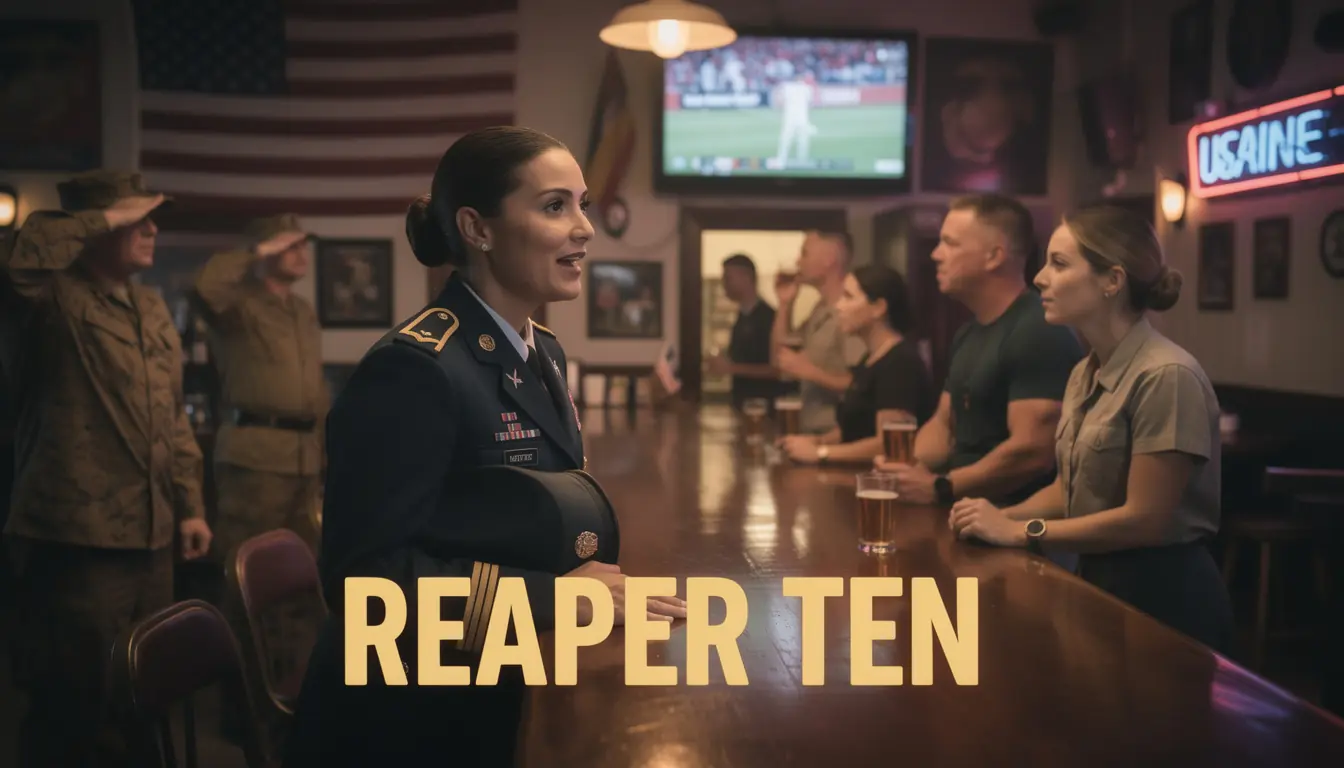 "Captain. Captain, wait—don't lead her. Let her give you one for free."The first words at The Bowline that night were a captain's, leaning on the wood inside a stranger's elbow space. The second words were a first lieutenant's behind him, phone up, framing.The bar sat two miles outside the main gate of Marine Corps Base Camp Lejeune: a working-class watering hole on a state route. Scratched wood. 22 stools. Three televisions on a wordless mute. A back booth. A corner of regulars. A kitchen pass with a single waitress moving slow.Hot Friday night, just past 2200 hours. Country music low on the speakers, sodium light through the windows.At the last stool on the left side of the door, with her back to the wall, sat a woman alone: faded jeans, brown boots, a plain charcoal henley under a working field jacket, blonde hair pulled back at the nape, no rings, no earrings, no jewelry of any kind—a small black plastic watch turned face inward to the wrist. One club soda on the wood in front of her, untouched for two minutes. $16.40 counted out in exact change on the bar beside the glass.She did not move when the front door opened. She did not move when three sets of Marine Corps boots crossed the floor in three different cadences. She did not move when Captain Brody Whitlock, 28, United States Marine Corps—an infantry company commander at Lejeune for a four-week leadership course—walked the length of the bar and leaned against the wood six inches from her left elbow.She had already looked at him. She had already looked at the lieutenants behind him: First Lieutenant Holt Rivera, 25, phone up; Second Lieutenant Calder Brim, 24, hands in his pockets, a half-smile—he was already losing.She had already looked at the front door, the back hallway, the kitchen pass, and the two televisions on mute. She had already counted 22 stools and seven civilians. She had already clocked the back booth—two off-duty Marines in plain clothes who clocked her back. She had already inventoried Whitlock's left hip (no holster) and his right pocket (square shape, green pocket notebook). She had already decided, in the three seconds it took him to cross the threshold, that the second lieutenant was already gone. She did not look at him again.Whitlock laughed—a long laugh, paragraph length. He had been three rounds in at the gate 20 minutes before. He had decided the joke before he walked in; the joke had a camera attached to it."All right," he said, louder than he needed to. "All right, different question: what do you do for work, ma'am?""I serve." Two words, flat. She lifted the glass. Sip. Set. The rhythm did not break.He laughed again. He turned half to Rivera's phone and laughed for the lens. Rivera laughed because the captain laughed. Brim did not laugh—Brim had clocked the inward-turned watch.