“Twenty-seven years in uniform, Officer Mercer, and this is how you chose to end them.”
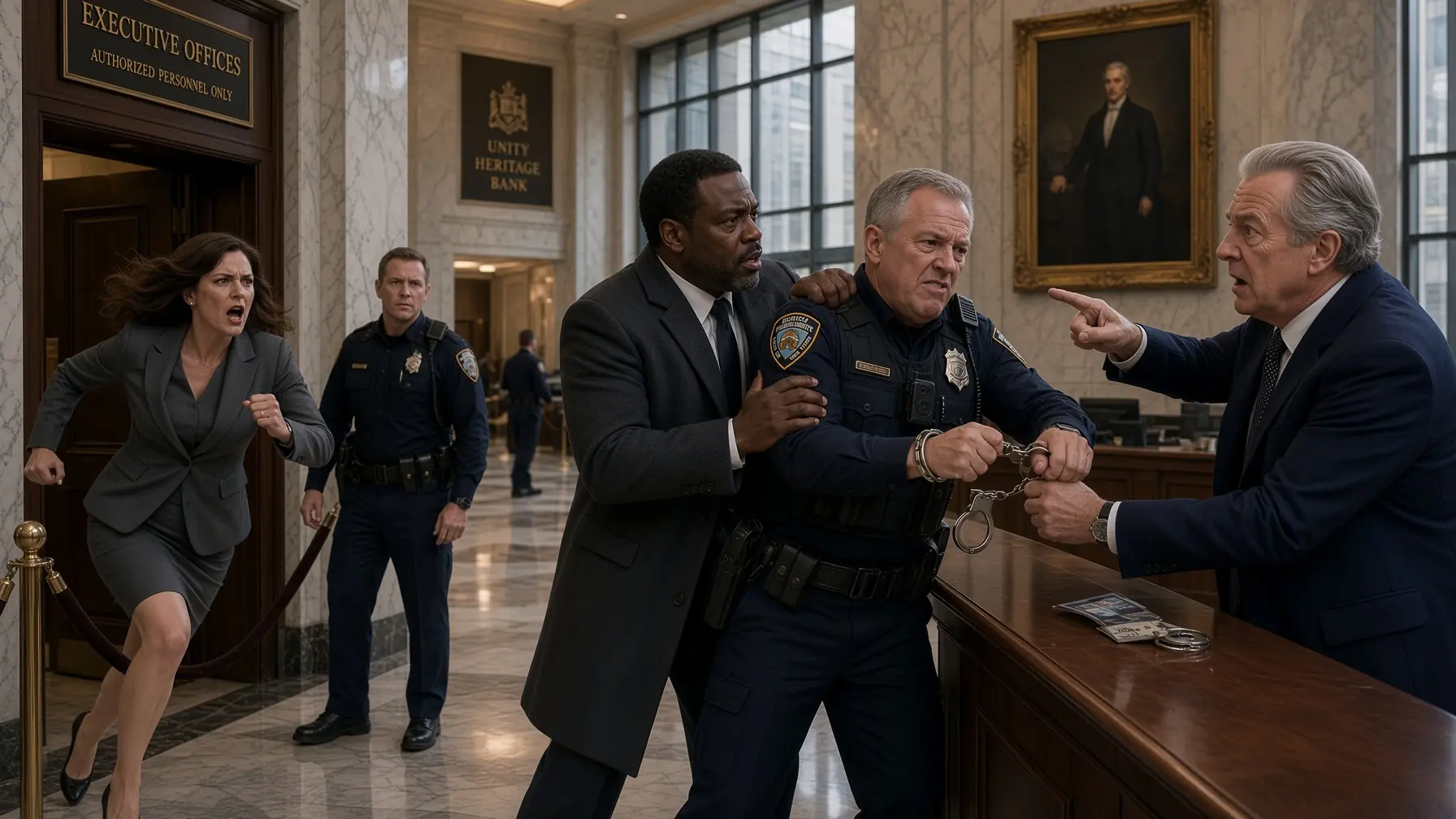
Chief Rebecca Hayes did not raise her voice.
She did not need to.
The marble lobby of Unity Heritage Bank had gone almost completely silent. Customers stood behind velvet ropes and polished counters with phones still in their hands. Employees had stopped pretending to work. Near the entrance, on a dark walnut table, rested Officer Daniel Mercer’s badge, his service weapon, and the duty equipment he had been ordered to surrender.
Mercer stared at them as though they belonged to another man.
Three months earlier, he had started counting the days until retirement.
Now he was standing beside two Internal Affairs investigators while the city police chief waited for him to explain why a Black man had been handcuffed inside a private bank after the branch director, another officer, bank records, an executive credential, and even a framed photograph on the wall had all confirmed that he belonged there.
Behind Mercer stood Marcus Reed.
Forty-eight years old.
Black.
Charcoal coat slightly wrinkled.
Faint red marks around both wrists.
Founder and chief executive officer of Unity Heritage Bank.
The man Mercer had treated like an intruder less than fifteen minutes earlier.
What unsettled Mercer most was not Marcus’s title.
It was his expression.
Marcus did not look triumphant.
He was not smiling.
He did not appear pleased that the balance of power had changed.
He looked disappointed.
Mercer swallowed.
“Chief, you know my record.”
Hayes said nothing.
“You know how long I’ve served. Three months. I’m three months from retirement.”
Hayes raised one hand.
Mercer stopped.
A younger officer named Ryan Collins stood several feet away. His body camera was still recording. He had obeyed Hayes’s instruction not to shut it off.
Beside the teller counter, branch director Elena Torres held a tablet displaying three different security-camera angles of everything that had happened.
Mercer looked toward Marcus.
“Mr. Reed, I made a mistake.”
Marcus finally met his eyes.
“A mistake is taking the wrong exit.”
Mercer’s face tightened.
Marcus continued.
“A choice is being given the correct information repeatedly and deciding you prefer the story you started with.”
Nobody moved.
Mercer looked at his badge again.
For nearly three decades, that small piece of metal had opened doors, ended arguments, and made strangers step aside.
That morning, he had treated it as something else.
Permission to decide which facts deserved to count.
Nine minutes earlier, Marcus had still been in handcuffs.
Twenty-five minutes before that, nobody in the building had any reason to believe the morning would become important at all.
Marcus Reed entered Unity Heritage Bank at 8:34 carrying a paper cup of coffee and a slim leather folder.
No entourage.
No security detail.
No assistant.
He had deliberately left his driver two blocks away.
That afternoon the board was scheduled to consider an $80 million lending initiative aimed at small businesses in neighborhoods that traditional commercial lenders often overlooked. Marcus had spent nearly a year helping structure it.
He could have arrived for the board meeting through the executive garage.
Instead he came early through the front doors.
He wanted to see the branch before everyone knew the CEO was watching.
Not as a secret test.
Not some elaborate corporate trap.
Marcus simply believed institutions often looked different from the lobby than they did from the boardroom.
He wanted the lobby.
Morning sunlight poured through the tall glass windows and stretched across the marble floor. A teller counted bills behind reinforced glass. A printer hummed near the mortgage desk. Customers filled out forms beneath pendant lights designed to make the entire room feel more like an upscale hotel than a financial institution.
Near the information desk, an elderly woman dropped a stack of papers.
Marcus set down his coffee.
“Let me get those.”
The woman tried to bend.
“No, no, I’ve got them.”
He gathered the pages before they slid underneath a row of chairs.
“Thank you.”
“You’re welcome.”
A young employee hurried over.
“Mrs. Coleman, I’m sorry. I should’ve seen that.”
Marcus recognized the employee’s name tag.
JORDAN PRICE.
“How long have you worked here, Jordan?”
“About six months.”
“You like it?”
Jordan glanced toward the management offices, as though trying to determine whether this stranger was asking a dangerous question.
“Mostly.”
Marcus smiled.
“Mostly is usually the honest answer.”
Jordan relaxed.
“The training’s good. Staffing gets thin around lunch.”
“Management listen when you mention that?”
“Sometimes.”
Marcus nodded.
“Good to know.”
Jordan had no idea who he was talking to.
Marcus preferred it that way.
Across the lobby, another customer noticed the exchange.
Richard Voss.
Sixty-two.
Private-banking client.
Successful commercial real-estate investor.
Navy overcoat despite the mild morning.
The type of customer employees recognized before he reached the desk because he had spent twenty years making sure they did.
Voss was waiting for a meeting with Elena Torres.
He watched Marcus speak to Jordan.
Then watched Marcus walk toward a small brass door beside the executive hallway.
AUTHORIZED PERSONNEL ONLY.
Marcus removed a black access card from his wallet.
Tapped it.
The lock clicked.
He entered.
Voss did not see the card.
He saw only a Black man dressed more casually than the executives he expected to use that hallway.
Instead of asking Jordan who the man was, Voss took out his phone.
His 911 call lasted ninety-three seconds.
The recording would later matter almost as much as the bank video.
“I’m at Unity Heritage downtown. There’s a suspicious man going into the private offices.”
The dispatcher asked, “Do you work there?”
“No. I’m a customer.”
“Did he force entry?”
“I couldn’t tell.”
“Does he have a weapon?”
“I don’t know.”
“Did anyone ask him to leave?”
“Employees looked uncomfortable.”
That was not true.
Jordan had smiled at Marcus.
The receptionist had greeted him.
Elena Torres had been waiting behind the restricted door.
But Voss kept going.
“He’s looking around a lot. Nervous.”
Marcus had not looked nervous.
“Race and clothing description?”
Voss gave both.
Black male.
Late forties.
Dark coat.
White shirt.
The dispatcher classified the call as suspicious-person activity at a financial institution.
Seven minutes later, Officer Daniel Mercer entered the bank with Ryan Collins behind him.
Mercer was fifty-six.
Twenty-seven years on the department.
Three commendations.
Two lifesaving awards.
Dozens of ordinary years doing difficult work without becoming famous for either success or failure.
That history would matter later.
So would the complaints.
But at 8:47, none of it was visible.
He walked through the bank doors, spotted Richard Voss immediately, and asked, “Caller?”
Voss nodded.
“That’s him.”
Marcus had just returned from the executive hallway with Elena beside him.
Voss pointed.
“He walked right back there like he owned the place.”
Marcus heard that.
Elena did too.
She looked at Voss.
Then at the officers.
“Is there a problem?”
Mercer ignored her.
“Sir, step away from the restricted door.”
Marcus stopped.
“Officer, I’m authorized to be here.”
“That’s what we’re going to determine.”
Elena stepped forward.
“There’s nothing to determine. Mr. Reed is authorized.”
Mercer raised one hand.
“Ma’am, give me some room.”
Her eyebrows lifted.
“I’m Elena Torres. I run this branch.”
“Then let me handle the police matter.”
“It concerns my employee access area.”
“Ma’am.”
His voice changed.
“I said step back.”
Marcus saw the shift immediately.
Elena had given Mercer information that should have reduced uncertainty.
It did not.
So Marcus removed his executive credential slowly.
“This should help.”
Mercer took it.
The card contained Marcus’s photograph, name, corporate identification number, and title.
MARCUS B. REED
CHIEF EXECUTIVE OFFICER
Mercer turned it over.
“This could be fake.”
Elena stared.
“It isn’t.”
Collins leaned slightly toward the card.
“Sir, there’s an authentication strip.”
Mercer handed it back.
“People fake those too.”
Marcus looked at him for several seconds.
“You received a call. I understand why you came.”
Mercer said nothing.
“But now the branch director has identified me. I’ve provided identification. Your partner is telling you the credential has security features.”
Marcus’s voice remained calm.
“What fact are you still trying to establish?”
Mercer’s jaw tightened.
“Don’t tell me how to conduct an investigation.”
“I’m asking what you’re investigating.”
“Unauthorized access.”
Elena answered.
“He used a valid access card.”
Mercer turned toward her.
“Did you see it?”
“Yes.”
“You sure?”
“I met him on the other side of the door.”
Collins had opened the department mobile database.
“Let me run the name.”
Mercer glanced over.
The screen loaded a municipal partnership record.
MARCUS REED — UNITY HERITAGE BANK
A photograph appeared.
Collins started to speak.
“Sir—”
Mercer lowered the terminal screen with one hand.
“I’ve got this.”
Collins frowned.
“The system—”
“I said I’ve got it.”
Then Mercer looked at Marcus.
“What were you doing in that hallway?”
“Meeting with Ms. Torres.”
“About what?”
“Bank business.”
“What kind?”
“Confidential business.”
Mercer laughed.
“So now you’re refusing to answer?”
“I’m declining to discuss confidential corporate documents with you because nothing you’ve described requires me to.”
The word requires irritated him.
Marcus saw it.
Mercer stepped closer.
“You know, men like you always think talking like a lawyer means the rules change.”
Elena inhaled sharply.
Marcus held his gaze.
“Men like me?”
Mercer hesitated.
Then gestured vaguely toward him.
“People who think money means they get to decide how officers do their jobs.”
That was not what he had originally started to say.
Everybody nearby knew it.
Marcus did not push.
He did not need to.
Instead he asked, “Is your body camera recording?”
Mercer touched it instinctively.
Red indicator.
“Yes.”
“Good.”
The answer came too quickly.
Marcus said, “Please leave it on.”
Mercer gave a short laugh.