My name is Colette, and at 60 years old, I never imagined I would be wearing a polyester uniform, my feet aching in cheap shoes, carrying plates of food to strangers who barely looked at me.
But life has a way of humbling you when you least expect it.
The Murphy's Diner uniform was two sizes too big, the red fabric faded from countless washes. The name tag read Colette in peeling white letters, and every time I caught my reflection in the coffee pot, I saw a stranger.
This wasn't supposed to be my story.
I was supposed to be enjoying retirement. Maybe traveling with my late husband's pension, watching my grandchildren grow up. Instead, here I was, learning to balance plates on my arm and smile at customers who treated me like I was invisible.
It had been three weeks since I started working at Murphy's. Three weeks since my world fell apart completely.
The other waitresses were kind enough, especially Ruth, who had been working there for fifteen years. She showed me how to carry four plates at once without dropping them, how to remember orders without writing everything down, and, most importantly, how to keep smiling even when your feet felt like they were on fire.
“You'll get used to it, honey,” Ruth told me on my first day, her weathered hands adjusting my apron. “Takes about a month for your body to stop screaming at you.”
But it wasn't my body that was screaming.
It was my heart.
The morning rush was always the worst. Business people grabbing coffee and rushing out. Construction workers wanting hearty breakfasts before their shifts. Elderly couples sharing quiet conversations over pancakes.
I watched them all, wondering if any of them had children who loved them, who would never dream of betraying them the way mine had.
I tried not to think about Carlton and Rebecca, but they haunted every moment. My son and daughter. The children I had sacrificed everything for. The ones I had worked double shifts to put through college. The ones I had trusted with every penny I had saved over forty years of marriage.
The betrayal still felt fresh, like a wound that refused to heal.
They had convinced me to sign papers. Said it would help with taxes, make things easier when I got older. I was so tired then, still grieving my husband Robert's death six months earlier, that I barely read the documents.
I trusted them.
They were my children.
But those papers weren't about taxes.
They were about transferring my assets, my house, my savings, everything Robert and I had built together over four decades.
By the time I realized what had happened, they had sold the house, emptied my accounts, and left me with nothing but a pile of debts they had accumulated using my credit.
“Mom, we're helping you,” Rebecca had said when I confronted them, her voice dripping with false concern. “You don't need all that space anyway. This will force you to downsize, live more simply.”
Carlton had been crueler.
“You would have just wasted it anyway, Mom. At least this way, the money stays in the family.”
Family.
The word tasted bitter in my mouth now.
So here I was, in a studio apartment that cost $1,200 a month, working ten-hour shifts at Murphy's Diner to pay rent and buy groceries. The apartment was tiny, with thin walls that let me hear every argument from my neighbors and a heating system that sounded like a dying animal.
But it was mine.
The only thing in my life that truly belonged to me anymore.
The lunch rush had started, and I was refilling coffee cups when I noticed him for the first time.
An elderly man, probably in his seventies, sitting alone at the corner table by the window.
He was thin, with silver hair and hands that trembled slightly as he lifted his coffee cup. His clothes were clean but worn, the kind that had seen better days. What struck me most was how he ate slowly, deliberately, like someone savoring every bite because he wasn't sure when the next meal would come.
I recognized that carefulness, that appreciation for simple food.
It was the same way I had been eating since my children left me with nothing.
He ordered the cheapest thing on the menu, a cup of coffee and a piece of toast.
$2.50.
I watched him count out exact change from a small coin purse, his fingers shaking slightly as he placed each quarter on the table.
Something about him reminded me of my father, who had worked construction until his hands were too arthritic to hold tools anymore. The same dignity in his posture. The same quiet resignation in his eyes.
When I brought him his order, he looked up at me with clear blue eyes and said, “Thank you, dear.”
His voice was soft, educated, with just a hint of an accent I couldn't place.
“You're welcome,” I replied, and meant it more than I had with any customer since I started working there.
Throughout the lunch rush, I found myself glancing at his table. He sat there for over an hour, making that single piece of toast and coffee last as long as possible.
When he finally got up to leave, I noticed he left a dollar tip on a $2.50 bill.
Forty percent.
More than some customers left on $50 orders.
That evening, as I soaked my aching feet in Epsom salt water in my tiny bathroom, I couldn't stop thinking about him. There was something in his eyes that I recognized.
The look of someone who had lost everything important to them.
The next day, he was there again.
Same table. Same order.
Toast and coffee. $2.50.
This time, I brought him extra butter without him asking, and he smiled at me like I had given him a gift.
“That's very kind of you,” he said, his voice warm despite the tremor in his hands.
“We all need a little extra kindness,” I replied, surprising myself with how easily the words came.
He nodded slowly, like he understood exactly what I meant.
Over the following days, he became a regular part of my routine. He would arrive at exactly 11:30 every morning, order the same thing, and sit at the same table.
I learned that his name was Lance when I heard him give it to Ruth for a phone call.
By the end of my first month at Murphy's, I had developed a strange protective feeling toward Lance.
Maybe it was because he reminded me of my father.
Or maybe it was because I saw my own situation reflected in his careful counting of coins, his appreciation for small kindnesses.
One particularly busy Thursday, I noticed Lance hadn't touched his toast. He was just sitting there, staring out the window, his hands folded in his lap.
Something was wrong.
I walked over to his table during a brief lull in orders.
“Is everything all right, Lance?”
He looked up at me, and I saw something in his eyes that made my heart clench.
Loss.
Deep, profound loss that I knew all too well.
“Just thinking about my children,” he said quietly. “Sometimes I wonder if they think about me at all.”
The words hit me like a physical blow.
Here was someone else whose children had abandoned them. Someone else carrying the weight of love that wasn't returned.
Without thinking, I slid into the seat across from him. I knew Ruth would scold me for sitting with customers during my shift, but I couldn't help myself.
“I understand,” I said softly. “More than you might think.”
Lance studied my face for a long moment, and I had the strangest feeling that he was seeing more than just a tired waitress in a faded uniform.
“Do you have children?” he asked.
“Two. A son and a daughter.” I touched the photo in my apron pocket, the one I couldn't bring myself to throw away, even though looking at it broke my heart every time. “They're... they've made their choices.”
Lance nodded slowly.
“It's a special kind of pain, isn't it? When the people you love most in the world decide you're not worth their time.”
Tears pricked at my eyes, but I blinked them back. I couldn't cry at work. Couldn't let customers see how broken I really was.
“I should get back to work,” I said, starting to stand.
“Wait,” Lance said, his voice urgent despite its softness. “Would you mind if I bought you lunch when your shift ends? I mean, if you don't have other plans?”
I looked at this trembling old man who probably had even less money than I did, offering to buy me a meal he could barely afford himself.
Something warm spread through my chest.
The first genuine warmth I had felt in months.
“I would like that,” I said. “But I'll buy. I get an employee discount.”
Lance smiled, and for a moment, the sadness in his eyes lifted.
“That's very kind of you, Colette. Very kind indeed.”
As I walked back to the counter to check on my other tables, I felt something I hadn't experienced since my children's betrayal.
Hope.
Maybe I was alone in the world. Maybe my own children had thrown me away like garbage.
But perhaps there was still kindness to be found in unexpected places.
I had no idea that this trembling old man would soon change everything about my life, or that the kindness I was showing him was being watched and measured by eyes far sharper than they appeared to be.
That first lunch together changed something between Lance and me.
We sat in the back booth of Murphy's after my shift ended, sharing a plate of the daily special, meatloaf and mashed potatoes, and talking like old friends who had just found each other again after years apart.
Lance ate slowly, deliberately, but I noticed he kept pushing most of his food toward my side of the plate.
When I protested, he waved his hand dismissively.
“I don't have much appetite these days,” he said. “But I hate to see food go to waste.”
I understood that feeling. Since losing everything, I had become acutely aware of every wasted dollar, every scrap of food.
But watching Lance, I realized he was doing something I hadn't done for myself.
He was taking care of someone else despite his own struggles.
“Tell me about your children,” he said gently, his blue eyes kind but penetrating, “if you don't mind talking about it.”
And somehow, I found myself telling this near stranger everything about Carlton and Rebecca. About how I had worked two jobs to put them through college. About the house Robert and I had bought when they were little and had lovingly maintained for thirty-five years. About the trust I had placed in them, the papers I had signed, the devastating moment when I realized what they had done.
“They said it was for my own good,” I said, my voice barely above a whisper. “That I was too old to manage my finances. That they were protecting me from myself.”
Lance listened without interrupting, occasionally nodding or making soft sounds of understanding. His hands, I noticed, had stopped trembling while I talked, as if my story had given him something to focus on besides his own pain.
“And where are they now?” he asked when I finished.
“Carlton lives in my old house with his wife and their two children. My grandchildren. I haven't seen them since.” I swallowed hard. “Rebecca moved to California. She sends me a Christmas card every year with a photo of her family. Like that makes everything okay.”
“Do they know you're working here?”
“Carlton knows. He drove by the diner a few weeks ago and saw me through the window. He didn't come in.”
Lance was quiet for a long moment, his fingers drumming silently on the table. When he looked up, there was something different in his expression.
A hardness that hadn't been there before.
“People reveal their true character when they think no one important is watching,” he said softly. “Your son made a choice that day when he drove by and didn't come in.”
The way he said it sent a small chill down my spine, though I couldn't say why.
After that first lunch, Lance and I fell into a routine. Every day, he would come in at 11:30, order his toast and coffee, and we would chat when I had breaks between customers. At the end of my shift, we would share whatever the daily special was, splitting the cost and the food equally.
I began to look forward to those conversations more than anything else in my day.
Lance was educated, well-spoken, and had traveled extensively in his younger years. He told me stories about places he had been, Paris, Tokyo, London, but he was always vague about what he had done for work.
“I was in business,” he would say when I asked. “Nothing very exciting. Numbers and meetings and paperwork.”
But sometimes, when he thought I wasn't looking, I caught glimpses of something else.
The way he held himself when he thought no one was watching: straighter, more confident.
The expensive watch he wore, which seemed inconsistent with counting quarters for toast.
The way other customers seemed to defer to him without realizing it, moving aside when he walked by, speaking more quietly when he was near.
Most telling were his observations about people.
Lance noticed everything. Which customers were kind to the staff. Which ones were rude. Who left good tips and who stiffed the waitresses.
He never said anything critical directly, but I could tell he was cataloging it all.
“That man in the blue suit,” he said one day, nodding toward a businessman who had been particularly condescending to Ruth, “he thinks his money makes him better than everyone else. But money doesn't buy character, does it?”
“No,” I agreed. “It doesn't.”
“Character is revealed in how we treat people who can't do anything for us,” Lance continued, his voice taking on an edge I hadn't heard before. “People who think they can look down on others because of circumstances, they usually learn that circumstances can change very quickly.”
Again, that small chill.
There was something about the way Lance spoke sometimes, as if he knew things about the world that the rest of us didn't.
Three weeks into our friendship, Lance missed a day.
When he didn't show up at 11:30, I found myself constantly checking the door, worrying. He had become such a fixture in my routine that his absence felt wrong.
He appeared the next day looking more fragile than usual. His hands were shaking worse, and he seemed to have trouble getting comfortable in his chair.
“Are you all right?” I asked when I brought his coffee.
“Doctor's appointment yesterday,” he said dismissively. “Just the usual indignities of growing old.”
But when I sat with him after my shift, I noticed he barely touched his food.
“Lance, are you sure you're okay?”
He looked at me for a long moment, and I saw something vulnerable in his expression.
“Do you ever wonder if you matter to anyone, Colette? If your existence makes any difference at all?”
The question hit too close to home.
“Every day,” I admitted. “I used to think I mattered to my children. I worked hard my whole life, provided for them, gave them every opportunity. But when I needed them most, they were nowhere to be found.”
“What happened?” I asked gently.
Lance was quiet for so long I thought he wouldn't answer. Finally, he said, “My wife died two years ago. Cancer. I took care of her for eighteen months. Doctor visits, treatments, sleepless nights. My children visited twice. At the funeral, they were more interested in discussing what I planned to do with the house than in comforting their father.”
My heart clenched.
“Lance, I'm so sorry.”
“They wanted me to sell everything, move into a facility. Said it would be easier for everyone. Easier for them, they meant. They didn't want to be bothered with an aging father.”
“So what did you do?”
His smile was sad, but determined.
“I told them I would make my own decisions about my life. They haven't spoken to me since.”
We sat in comfortable silence for a while, two wounded people finding solace in shared understanding.
“You matter to me,” I said suddenly, surprising myself with the intensity of my voice. “These lunches, our conversations, they're the best part of my day. You matter, Lance.”
He reached across the table and squeezed my hand with his trembling fingers.
“You matter to me, too, my dear. More than you know.”
The next week brought an unexpected challenge.
The lunch rush was particularly busy, and we were short-staffed because another waitress had called in sick. I was running between tables trying to keep up with orders when I noticed Lance hadn't been served yet.
I hurried over to his table.
“I'm so sorry, Lance. We're swamped today.”
“Don't worry about me,” he said gently. “Take care of your other customers first.”
But fifteen minutes later, he still hadn't been served, and I could see he was getting tired.
Without thinking, I grabbed my own lunch from the back, a sandwich I had brought from home, and set it in front of him.
“Colette, I can't take your lunch,” he protested.
“You can and you will,” I said firmly. “I'll eat later.”
Lance looked at the sandwich, then at me, and his eyes filled with tears.
“No one has shown me this kind of kindness in years,” he said softly.
“Everyone deserves kindness,” I replied. “Especially people who have been hurt by those who should have loved them.”
As I watched Lance eat my simple sandwich like it was a feast, I had no idea that this small act of generosity was being observed and noted by someone who had spent a lifetime learning to read character in people's smallest actions.
I didn't know that Lance's trembling hands were steadier than they appeared, or that his shabby clothes hid more than poverty.
I had no idea that his careful observations and quiet questions were gathering information about my true nature, testing the authenticity of my kindness.
All I knew was that this lonely old man had become important to me, and that in caring for him, I was rediscovering parts of myself that my children's betrayal had buried.
In sharing my meager lunch with someone who had even less, I was learning that having nothing didn't mean being nothing.
But soon, everything I thought I knew about Lance would be turned upside down, and my simple act of sharing a sandwich would set in motion events that would change both our lives forever.
The day my world shifted again started like any other.
It was a Tuesday in November, cold and gray, with that bitter wind that cuts right through your coat and reminds you that winter is coming whether you're ready or not.
The lunch rush was particularly heavy because of the weather. People wanted hot food and warm coffee before venturing back out into the cold.
I was refilling coffee cups when I saw him through the window.
Carlton.
My son.
Walking up to Murphy's Diner with that confident stride I remembered from his childhood when he would bound into rooms like he owned them.
My heart did a strange flip, caught between hope and dread.
For one foolish moment, I thought he had come to see me. Maybe he had been thinking about what he had done. Maybe he wanted to apologize, to make things right.
Maybe my son had finally found his conscience.
Lance was at his usual table, quietly eating his toast and watching the street through the window. I saw him notice Carlton approaching, saw his eyes narrow slightly with interest, but I was too focused on my own emotional turmoil to pay attention to Lance's reaction.
The bell above the door chimed, and Carlton stepped inside, shaking raindrops from his expensive overcoat.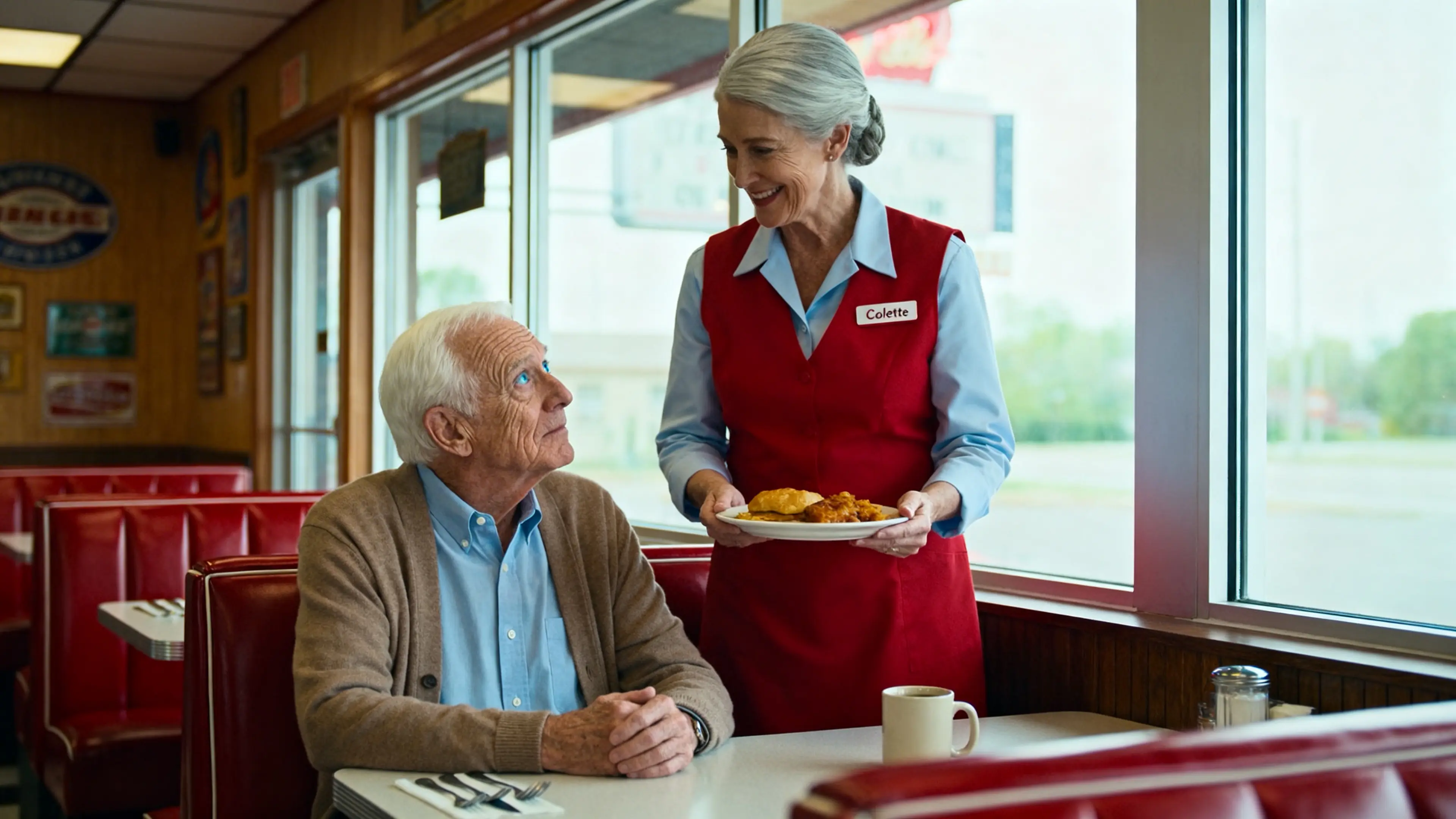
He wore a tailored charcoal suit that probably cost more than I made in two months, leather shoes that gleamed despite the weather, and a watch that caught the light like a small piece of jewelry.
He looked successful, prosperous, every inch the successful businessman he had always wanted to be.
He looked around the diner with barely concealed distaste, taking in the worn vinyl booths, the crackling radio playing oldies, the smell of grease and coffee that permeated everything.
His gaze swept over the other customers, construction workers in dirty clothes, elderly couples counting out exact change, a single mother trying to keep her toddler quiet while she ate.
Then his eyes found me.
I was standing by the coffee machine, my polyester uniform wrinkled from the busy lunch rush, my hair escaping from its ponytail, holding a pot of coffee with hands that suddenly couldn't stop shaking.
For a moment, neither of us moved.
I waited for recognition, for some sign of warmth or regret in his face.
Instead, Carlton smiled.
But it wasn't the warm smile I remembered from his childhood.
It was cold, calculating, amused.
He walked over to where I stood, his expensive shoes clicking against the worn linoleum floor.
The diner had grown quieter, conversations dropping to whispers as people sensed some kind of drama unfolding.
“Well, well,” Carlton said, his voice carrying clearly through the suddenly quiet restaurant. “Look what we have here.”
“Carlton,” I whispered, my voice barely audible. “I didn't expect to see you here.”
“I'll bet you didn't.” His smile widened, but there was no warmth in it. “I was driving by and I thought I saw something familiar through the window. Had to come in and see for myself.”
He looked me up and down deliberately, taking in every detail of my appearance. The cheap uniform, the sensible shoes with their worn soles, the name tag pinned to my chest like a badge of failure.
“You look...” He paused, pretending to search for the right word. “Pitiful.”
The word hit me like a slap.
I felt heat rise in my cheeks. Felt the curious stares of every customer in the restaurant.
But Carlton wasn't done.
“I mean, I knew things were tight for you,” he continued, his voice growing louder, more confident. “But I never imagined they were this bad. A waitress at sixty years old?”
He shook his head in mock sympathy.
“That's just sad, Mom. Really sad.”
“Carlton, please,” I managed to say, my voice shaking. “Can we talk about this somewhere private?”
“Private?” He laughed, a harsh sound that made several customers look up from their meals. “Why would we need privacy? I'm not ashamed of anything. Are you ashamed, Mom? Ashamed of your choices?”
I felt tears prick at my eyes, but forced them back.
I wouldn't cry in front of these people. I wouldn't give Carlton that satisfaction.
“You know why I'm here,” I said quietly. “You know what happened to my money.”
Carlton's expression changed, becoming harder, more cruel.
“What happened to your money? You mean what happened when you finally had to live within your means? When you couldn't rely on Dad's pension forever?”
The lie came so easily to his lips, so smoothly that for a moment I almost doubted my own memory.
But I knew the truth. I knew what he and Rebecca had done.
“I trusted you,” I whispered.
“And I helped you,” he shot back. “I helped you understand reality. This is what happens when you live beyond your means for too long. This is what happens when you can't manage your own finances.”
From the corner of my eye, I saw Lance shift in his seat. He had stopped eating entirely and was watching our conversation with an intensity that made me uncomfortable.
His hands, I noticed, were no longer trembling.
“You look ridiculous,” Carlton continued, his voice growing louder with each word. “A sixty-year-old woman in a polyester uniform serving coffee to strangers. Do you know how embarrassing this is for me? For Rebecca?”
“I'm sorry if my poverty inconveniences you,” I said, finding some strength in my voice.
Carlton laughed again.
“Poverty? Is that what you're calling this? Mom, you made your choices. You chose to be irresponsible with money. You chose to sign those papers without reading them properly. You chose not to plan for your future. This isn't poverty. This is consequences.”
Each word was carefully chosen to wound, to shift blame, to make everything my fault.
I realized with crystal clarity that Carlton felt no guilt about what he had done.
In his mind, he had simply taken what was rightfully his from a foolish old woman who couldn't be trusted to manage it herself.
“I worked my whole life,” I said, my voice growing stronger despite the tears in my eyes. “I sacrificed everything for you and your sister. I put you through college, helped you buy your first house, gave you everything I could give.”
“And what did you expect in return?” Carlton's voice was mocking now. “Some kind of lifetime pension for being a mother? That's not how the world works, Mom. Children don't owe their parents a living.”
The restaurant was completely silent now.
Every customer, every employee was watching this painful family drama unfold.
I felt exposed, humiliated, reduced to nothing more than entertainment for strangers.
But then something happened that I didn't expect.
Lance stood up.
He moved slowly, carefully, like the elderly man he appeared to be.
But there was something different about him as he rose from his chair. His posture was straighter, his movements more deliberate.
The trembling in his hands had stopped completely.
He walked over to where Carlton and I stood, his footsteps deliberate and quiet.
Carlton glanced at him dismissively, probably expecting some doddering old man to shuffle past on his way to the bathroom.
Instead, Lance stopped directly in front of Carlton and looked up at him with eyes that were suddenly sharp as razors.
“Excuse me,” Lance said, his voice carrying an authority that I had never heard before. “I couldn't help but overhear your conversation.”
Carlton looked down at Lance with barely concealed annoyance.
“This is a private family matter, old man. It's none of your business.”
Lance smiled, but it was nothing like the gentle, trembling smiles he had given me over the past weeks.
This smile was cold, calculating, dangerous.
“You know,” Lance said conversationally, “I've been coming to this restaurant for quite some time now. And in all that time, I've been watching people, learning about them, seeing what kind of character they have when they think no one important is paying attention.”
Carlton frowned, clearly confused by this strange turn in the conversation.
“That's... that's nice, I suppose, but this really isn't any of your concern.”
“Your mother,” Lance continued, as if Carlton hadn't spoken, “has shown me more genuine kindness than I've received from anyone in years. She shares her food with me when I can't afford a full meal. She listens to my stories about my late wife. She treats me with dignity and respect, even though she has every reason to be bitter about her own circumstances.”
Carlton's frown deepened.
“Look, I don't know who you think you are—”
“On the other hand,” Lance said, his voice dropping to a near whisper that somehow carried to every corner of the now-silent restaurant, “you just publicly humiliated the woman who gave birth to you. The woman who sacrificed her entire adult life to give you opportunities. You stood here in front of strangers and mocked her for working an honest job to survive.”
Carlton's face was beginning to flush red.
“Now wait just a minute—”
“I wonder,” Lance continued, his eyes never leaving Carlton's face, “what kind of man does such a thing? What kind of character reveals itself in that behavior?”
The temperature in the restaurant seemed to drop ten degrees.
Every customer was leaning forward in their seats, sensing that something significant was happening, though they couldn't quite understand what.
Carlton straightened his shoulders, trying to reassert his authority.
“I don't know who you think you are, but you're completely out of line. This is between me and my mother.”
Lance nodded slowly, as if considering this.
Then he reached into his jacket pocket and pulled out his cell phone.
It was expensive, sleek, the kind of device that cost more than most people made in a month.
“You're absolutely right,” Lance said calmly. “This is between you and your mother. But I think you should know something before you continue.”
He pressed a number on his phone's speed dial, then held it to his ear. When someone answered, his voice became crisp, businesslike, completely different from the trembling uncertainty I was used to hearing.
“Marcus, it's Lance. Yes, I need you to run a background check on someone for me.”
He looked at my son expectantly.
“Carlton Matthews,” my son said automatically, then immediately looked like he regretted giving his name.
“Carlton Matthews,” Lance repeated into the phone. “I want to know everything. Where he works, who he knows, what business connections he has. Everything.”
He paused, listening.
“Yes, immediately. And Marcus, this is priority one.”
He ended the call and slipped the phone back into his pocket.
The entire restaurant was so quiet you could hear the coffee pot gurgling on its burner.
Carlton had gone pale.
“Who... who are you?”
Lance looked at him for a long moment, then smiled that cold, dangerous smile again.
“Someone who believes very strongly in consequences,” he said softly. “Someone who has spent his entire life learning that character matters. And someone who has just discovered what kind of character you really have.”
He turned to me, and suddenly his expression was gentle again, though his eyes remained sharp.
“Colette, my dear,” he said, his voice warm despite everything that had just happened, “would you mind if we finish this conversation tomorrow? I think your son and I might have some things to discuss.”
I nodded numbly, still trying to process what I had just witnessed.
This wasn't the trembling, uncertain old man I had been sharing lunches with.
This was someone else entirely.
As Lance walked past Carlton toward the door, he paused and spoke quietly, but his words carried clearly through the silent restaurant.
“You should have come in that day when you drove by and saw your mother working here,” he said. “You should have shown her the respect she deserved. But you didn't.”
He looked directly at Carlton.
“You made a choice, Carlton. And now you're going to live with the consequences of that choice.”
The bell chimed as Lance left the restaurant, and suddenly everyone was talking at once.
But I barely heard the voices around me.
I was staring at my son's pale, frightened face, wondering who Lance really was and what he meant by consequences.
Carlton looked at me with something like panic in his eyes.
“Mom, who is that man? How do you know him?”
For the first time in months, I felt something that might have been hope stirring in my chest.
“I thought he was just a lonely old man,” I said softly. “But I think I might have been wrong about that.”
I couldn't sleep that night.
I kept replaying the scene at the diner over and over in my mind, trying to understand what had happened.
The Lance I thought I knew, trembling, uncertain, counting quarters for toast, had vanished in an instant, replaced by someone who commanded attention with a single phone call and made my grown son turn pale with fear.
The next morning, I arrived at work early, hoping Lance would come in before his usual time. I needed answers. I needed to understand who this man really was and what he meant when he talked about consequences.
Ruth noticed my distraction immediately.
“You look like you didn't sleep a wink, honey. Everything all right?”
“I'm fine,” I said, though my voice sounded strained even to my own ears. “Just tired.”
But I wasn't fine.
My hands shook as I refilled salt shakers and wiped down tables. Every time the bell over the door chimed, I looked up, expecting to see Lance or Carlton or someone else who might help me make sense of what had happened.
At 11:15, the door opened, and Lance walked in.
He looked exactly like the frail old man I had befriended weeks ago. Slightly stooped shoulders, careful steps, hands that trembled as he hung his worn coat on the hook by his table.
But now I knew it was an act.
And once you know something is performance, you can't unsee it.
He sat at his usual table and waited.
Our eyes met across the restaurant, and he gave me that same gentle smile he had offered every day since we met.
But now I could see the intelligence behind it, the careful assessment that I had mistaken for simple kindness.
I walked over to his table, my heart pounding.
“Your usual?” I asked, my voice barely steady.
“Actually,” Lance said, his voice back to the soft, uncertain tone I was used to, “I think today I'd like something different. Could I have the breakfast special and coffee?”
“Of course.”
The breakfast special cost $12.50, more than five times his usual order.
When I brought his food fifteen minutes later, Lance gestured to the seat across from him.
“Would you mind sitting with me for a moment, my dear? I think we need to talk.”
I glanced around the restaurant. The morning rush was over, and we only had a few customers. Ruth caught my eye and nodded. She could handle things for a few minutes.
I sat down across from Lance, my hands folded tightly in my lap.
“Who are you?” I asked without preamble.
Lance smiled, and this time it was neither the trembling uncertainty I was used to, nor the cold calculation from yesterday.
It was something warmer, more genuine than either.
“My name really is Lance,” he said. “Lance Morrison. And I really am seventy-four years old, and my wife really did die two years ago, and my children really have abandoned me.”
He paused, cutting into his eggs with steady hands.
“But I wasn't entirely honest about what I did for work.”
“What did you do?”
“I built companies,” Lance said simply. “Started with nothing after college and spent fifty years building, buying, and selling businesses. Technology companies, manufacturing, real estate development, restaurants. By the time I retired, I owned or had major stakes in over two hundred companies across the country.”
My mouth fell open.
“Two hundred companies?”
“Give or take.” Lance took a bite of his eggs, watching my reaction carefully. “I was what people call a serial entrepreneur. Some ventures failed spectacularly. Others made me more money than I could spend in ten lifetimes.”
I struggled to process this information.
“But you count quarters for toast. You can barely afford coffee.”
Lance's expression grew sad.
“After Eleanor died, my children made it very clear that they were only interested in their inheritance. They wanted me to update my will immediately to divide everything between them so they could start planning their futures. When I told them I wasn't ready to think about that, that I needed time to grieve, they stopped speaking to me.”
He set down his fork and looked directly at me.
“So I decided to conduct an experiment. I wanted to see what kind of person I really was when I had nothing. And I wanted to see what kind of people others were when they thought I was nobody important.”
The implications of what he was saying began to sink in.
“You've been pretending to be poor?”
“For eight months now,” Lance confirmed. “I've been living in a small apartment across town, carrying just enough cash for basic necessities, wearing my oldest clothes. I wanted to experience life the way most people live it. But more importantly, I wanted to find out who would show kindness to a useless old man who couldn't do anything for them in return.”
“You were testing me.”
“At first,” Lance admitted. “When I started coming here, I was just observing, watching how the staff treated customers who couldn't afford to tip well, seeing which people were genuinely kind versus which ones were performing kindness for an audience.”
He leaned forward slightly.
“And then you started sharing your lunch with me. Not because you thought I could help you. Not because you wanted anything from me. But because you saw someone who was hungry and you had food to share.”
Lance's voice grew thick with emotion.
“Do you have any idea how rare that is, Colette? Do you know how many wealthy, successful people I've known who wouldn't share a sandwich with a stranger, even if they could easily afford it?”
I thought about all the lunches we had shared. All the times I had pushed extra food toward him. All the moments when I had chosen to spend my employee discount on his coffee instead of saving the money for myself.
“You were watching everything,” I said, understanding finally dawning.
“I was. And what I saw was a woman who had been betrayed by her own children, left with nothing, forced to start over at sixty years old, and still had enough compassion to care for someone else who seemed to have even less.”
Lance reached into his jacket and pulled out that expensive phone again. This time, I noticed details I had missed before: the platinum case, the custom leather holder, the way it looked like it had been designed specifically for him.
“Yesterday, after your son left, I made some calls,” he said, scrolling through the device. “I wanted to know exactly what kind of man Carlton Matthews is when he thinks no one important is watching.”
My stomach clenched.
“What did you find?”
“Your son works for Henderson and Associates, a mid-sized consulting firm downtown. He makes good money, around eighty-five thousand a year, but he lives well beyond his means. The house he lives in, your old house, is mortgaged to the hilt. He has significant credit card debt, two car payments, and he's been passed over for promotion twice in the past year.”
Each fact hit me like a small punch to the stomach.
My son, who had seemed so successful, so confident, was struggling financially despite taking everything I had.
“But here's the interesting part,” Lance continued, his voice growing harder. “He's been telling people at work that he's expecting a significant inheritance soon. He's already started spending money he doesn't have based on assets he believes he'll inherit from his wealthy father-in-law.”
“His father-in-law?”
“His wife's father owns a small chain of hardware stores. Moderately successful, but nothing extraordinary. The inheritance Carlton is counting on amounts to maybe two hundred thousand dollars to be split between three children.”
Lance's smile was grim.
“Hardly enough to support the lifestyle he's been promising his wife and children.”
I felt sick.
“He took my money because he needed it.”
“He took your money because he wanted it,” Lance corrected. “There's a difference. He convinced himself that you didn't need it as much as he did. That he was somehow entitled to it because he was your son.”
Lance put his phone away and looked at me intently.
“Colette, what would you say if I told you I could get your money back?”
The question hit me like a bolt of lightning.
“What?”
“What if I could get your money back? Your house, your savings, everything Carlton and Rebecca took from you. What would you say?”
I stared at him, afraid to hope.
“I would say that's impossible. They had legal documents. I signed papers.”
“Papers can be challenged, especially when they were signed by someone who was grieving and not properly advised of their rights, and particularly when the people who benefited from those papers committed what could be construed as elder abuse.”
He leaned forward, his eyes intense.
“But I'm not talking about legal action, Colette. I'm talking about something much more direct.”
“I don't understand.”
“Remember what I told you about owning two hundred companies? Well, one of those companies happens to hold the mortgage on your son's house. Another one owns the consulting firm where Carlton works. A third one provides the financing for his car loans.”
The room seemed to tilt around me.
“You own Henderson and Associates?”
“Controlling interest. Yes. Bought it three years ago when the original owner wanted to retire.”
Lance's smile was sharp now. Predatory.
“Carlton doesn't know it yet, but his job security depends entirely on how generous I'm feeling today.”
I couldn't speak. The implications were staggering.
“Here's what's going to happen,” Lance said, his voice calm and businesslike. “Carlton is going to receive a phone call this afternoon. He's going to be told that his position at Henderson and Associates is being eliminated due to restructuring. He'll also be informed that his mortgage has been called in for immediate payment due to some technical violations in his paperwork.”
“Lance, you can't—”
“I'm not finished,” he said gently. “He'll also discover that his car loans have been transferred to a new company with much stricter payment terms. By the end of this week, your son is going to be facing financial pressures that will make his current debt problems look like pocket change.”
I felt dizzy.
“You're going to destroy him.”
“I'm going to give him a choice,” Lance corrected. “He can return every penny he took from you, with interest, and I'll reverse all of these decisions. His job will be reinstated, his loans will return to their original terms, and his mortgage will be renegotiated. Or he can continue to believe that actions don't have consequences.”
Lance reached across the table and took my trembling hands in his steady ones.
“But more importantly, I'm going to give you a choice, too.”
“What kind of choice?”
“You can go back to your old life. Your house, your savings, your security. Carlton will learn that treating his mother like garbage has a price, and hopefully he'll become a better man because of it.”
I waited for the other option, sensing there was more.
“Or,” Lance said slowly, “you can start a new life with someone who understands what it means to be betrayed by family, who knows what it's like to discover that the people you love most in the world only see you as a source of money.”
The weight of what he was offering hit me all at once. Not just my money back, not just revenge on Carlton, but something I had never dared to hope for.
A second chance at happiness.
“I don't understand why you would do this for me,” I whispered.
Lance squeezed my hands gently.
“Because in eight months of pretending to be poor, in eight months of watching how people treat someone they think is worthless, you're the only person who saw me as human. Not as a source of money, not as someone to be used or ignored, but as a person worthy of kindness and respect.”
He paused, his voice growing soft.
“And because I've been alone for two years, and these past few weeks, sharing lunch with you and listening to your stories and seeing your strength in the face of betrayal, these have been the happiest days I've had since Eleanor died.”
Tears were streaming down my face now, but for the first time in months, they weren't tears of pain or loss. They were tears of possibility, of hope, of the overwhelming realization that sometimes the universe sends exactly what you need in the form you least expect.
“What happens now?” I asked.
Lance smiled, and this time it was purely gentle, purely real.
“Now we finish our breakfast. Then I make a phone call to Henderson and Associates. And then we see whether your son is capable of learning from his mistakes.”
As Lance signaled for Ruth to bring him more coffee, I realized that my life was about to change again.
But this time, I wouldn't be falling.
This time, someone would be there to catch me.
The phone call came at exactly 2:30 in the afternoon while I was serving coffee to a table of construction workers and trying to process everything Lance had told me.
My phone buzzed in my apron pocket, and when I saw Carlton's name on the screen, my heart jumped into my throat. I stepped into the back room to answer it, my hands trembling so badly I almost dropped the phone.
“Mom.” Carlton's voice was tight with panic. “Mom, I need to talk to you. Something's happening.”
“What kind of something?” I asked, though I already knew.
“I just got fired.” The words came out in a rush. “They called me into the office and said my position was being eliminated immediately. No warning, no explanation, just gone. Twenty-four hours to clear out my desk.”
I closed my eyes, feeling a mix of satisfaction and guilt that surprised me with its intensity.
“I'm sorry to hear that, Carlton.”
“Sorry? That's all you have to say?” His voice was rising now, the way it used to when he was a teenager and didn't get his way. “Mom, I have a mortgage, car payments, credit cards. I have kids to support. I can't just lose my job like this.”
“What do you want me to do about it?” I asked quietly.
There was silence on the other end of the line for a moment. When Carlton spoke again, his voice was different, smaller, more desperate.
“I need help, Mom. I know things have been difficult between us lately, but you're family. Family helps each other, right?”
The irony was so thick I could taste it.
Now that Carlton was in trouble, suddenly family mattered. Suddenly, I was important enough to call.
“Like you helped me?” I asked.
“That was different,” Carlton said quickly. “That was about making smart financial decisions for your future. This is an emergency.”
Even now, even when he was begging for my help, he couldn't admit what he had really done. He couldn't say the words, “I'm sorry,” or “I was wrong.” He could only justify and rationalize and make it my fault for not understanding.
“Carlton,” I said softly, “I work at a diner for minimum wage plus tips. I live in a four-hundred-square-foot studio apartment. What exactly do you think I can do to help you?”
“You could... you could ask your boss for more shifts or get a second job. Or maybe that old man you've been talking to. Maybe he knows someone who's hiring.”
I felt anger rise in my chest, hot and sharp.
Even in his desperation, Carlton saw me as nothing more than a resource to be exploited. He didn't want my advice or my comfort or my emotional support. He wanted me to sacrifice even more of myself to solve problems he had created.
“The old man I've been talking to,” I repeated slowly.
“Yeah. You mentioned him before. Lance something. Maybe he has connections.”
I almost laughed.
If Carlton only knew how many connections Lance had, how easily he could solve every financial problem my son faced with a single phone call.
But that wasn't going to happen. Not until Carlton learned some fundamental truths about respect and consequences.
“I'll think about it,” I said.
“Mom, please. I'm really scared here. The mortgage payment is due in two weeks, and without my job—”
“You'll figure something out,” I said, echoing the same dismissive tone he had used with me when he left me with nothing. “You're a smart man, Carlton. I'm sure you'll think of something.”
I hung up before he could respond.
Twenty minutes later, Lance appeared at his usual table.
He moved with his familiar, careful steps, but I could see the difference now. The controlled strength behind the apparent frailty, the sharp intelligence behind the confused elderly act.
When I brought him his coffee, he smiled up at me with genuine warmth.
“How are you feeling, my dear?”
“Confused,” I admitted. “Carlton called. He's lost his job.”
“I heard.” Lance's expression didn't change, but there was satisfaction in his eyes. “And how did that make you feel?”
I thought about it honestly.
“Part of me feels guilty. He has children, responsibilities. But part of me feels like maybe it's time he understood what it's like to have everything taken away from you.”
“Good,” Lance said simply. “That means you're human, but you're not weak. Feeling guilty about someone else's suffering shows you have empathy. But recognizing that consequences are necessary shows you have wisdom.”
Over the next three days, Carlton called six more times.
Each conversation followed the same pattern: panic, desperation, increasingly frantic requests for help that I couldn't possibly provide, and growing anger when I failed to solve his problems for him.
By Friday, his tone had changed completely.
“This is your fault,” he said when I answered his latest call. “That old man, Lance, whatever his name is, he did something. I know he did.”
“What are you talking about?”
“Don't play dumb, Mom. The timing is too perfect. He threatened me on Tuesday, and by Wednesday afternoon my whole life was falling apart.” Carlton's voice was sharp with accusation. “Who is he? What kind of connections does he have?”
“He's a friend,” I said.
“A friend who can get someone fired with a phone call? A friend who can call in mortgages and car loans? What kind of friend has that kind of power?”
I didn't answer, but Carlton continued anyway.
“I did some research, Mom. I started asking questions. Do you know what I found out?”
My heart was pounding, but I kept my voice steady.
“What did you find out?”
“Lance Morrison. Seventy-four years old. Net worth estimated at somewhere between five hundred million and eight hundred million dollars. Owner or major stakeholder in dozens of companies, including the one that just fired me.” Carlton's voice dropped to a whisper. “You've been having lunch with one of the richest men in the state. And somehow you convinced him to destroy my life.”
“I didn't convince him to do anything,” I said truthfully. “Lance makes his own decisions.”
“So you admit it. You admit you knew who he was.”
“I found out the same day you did,” I said. “When he stood up to you in the restaurant. Before that, I thought he was just a lonely old man who needed a friend.”
Carlton was quiet for a long moment. When he spoke again, his voice was different. Not angry, not panicked, but calculating.
“What does he want?” Carlton asked. “Men like that don't destroy people's lives for no reason. What does he want from me?”
I looked across the restaurant where Lance was sitting at his usual table, reading a newspaper and drinking coffee like he didn't have a care in the world.
But I knew he could hear every word of this conversation. Knew he was waiting to see what I would say.
“I think you should ask him yourself,” I said.
“What?”
“He comes to Murphy's Diner every day at 11:30. Table by the window. If you want to know what he wants, come ask him.”
Carlton was silent for almost a full minute.
Finally, he said, “Will you... will you be there when I talk to him?”
For the first time in our conversation, my son sounded like the little boy he used to be. Scared, uncertain, looking to his mother for protection.
It broke my heart and filled me with hope at the same time.
“Do you want me to be there?” I asked gently.
“Yes,” Carlton whispered. “Please.”
Saturday morning, Carlton walked into Murphy's Diner at exactly 11:45.
He looked terrible. Unshaven, wearing a wrinkled shirt and jeans instead of his usual expensive suit, dark circles under his eyes that spoke of sleepless nights.
Lance was already at his table, working on his usual toast and coffee. He looked up when Carlton approached, his expression neutral.
“Mr. Morrison.” Carlton's voice was hoarse. “Could I... could I sit down?”
Lance gestured to the empty chair across from him.
“Of course.”
I was refilling salt shakers at a nearby table, close enough to hear their conversation but trying to look like I wasn't listening.
Carlton sat down heavily, his hands shaking as he folded them on the table.
“I know what you did,” he said without preamble.
“Do you?” Lance's voice was mild, conversational. “What exactly do you think I did?”
“You got me fired. You called in my loans. You're trying to destroy my life because of what happened with my mother.”
Lance took a sip of his coffee.
“Considering... that's an interesting theory. Tell me, Carlton, do you think your life is being destroyed?”
“I lost my job. I'm about to lose my house. My credit is ruined. If that's not destruction, what is?”
“Consequences,” Lance said simply. “There's a difference.”
Carlton's face flushed red.
“Consequences for what? For telling my mother the truth? For helping her understand reality?”
Lance set down his coffee cup with deliberate care.
“Let me tell you what I see when I look at you, Carlton. I see a man who stole everything from his widowed mother and convinced himself it was for her own good. I see someone who publicly humiliated a woman who sacrificed her entire adult life for his benefit. I see a person who feels entitled to wealth he didn't earn and respect he hasn't shown to others.”
Carlton opened his mouth to protest, but Lance held up a hand.
“But more than that,” Lance continued, “I see someone who has never faced real consequences for his actions. Someone who has always been bailed out, always been protected from the results of his choices.”
“What do you want from me?” Carlton asked, his voice barely above a whisper.
Lance leaned forward slightly.
“I want you to understand something that your mother understood when she was your age. That life is not fair. That sometimes you lose everything through no fault of your own. And that the measure of a person is how they treat others when they have nothing left to lose.”
He paused, glancing over at me.
“Your mother lost everything because she trusted you. But instead of becoming bitter or cruel, she chose to share her lunch with a stranger who appeared to have even less than she did. That's character, Carlton. That's the kind of person she is.”
Carlton followed Lance's gaze to where I stood, and for a moment I saw something in his eyes that might have been understanding.
“What happens now?” Carlton asked.
Lance smiled, but it wasn't the cold, calculating expression he had worn in our previous encounter.
It was something warmer, more hopeful.
“Now you have a choice to make,” Lance said. “You can continue believing that the world owes you something, that your mother's sacrifice was meaningless, that respect is something you deserve rather than something you earn.”
He reached into his jacket and pulled out a piece of paper, which he placed on the table between them.
“Or,” Lance continued, “you can sign this document returning every penny you took from your mother, with interest, and spend the next year learning what it means to earn your way back into her life.”
Carlton stared at the paper without touching it.
“And if I sign this?”
“Your job will be restored on Monday morning. Your loans will return to their original terms. You'll have a second chance to be the son your mother deserves.”
Carlton looked up at Lance, then over at me, then back at the paper.
“And if I don't sign it?”
Lance's expression hardened.
“Then you'll discover that I have a very long memory and a very short tolerance for people who abuse those weaker than themselves.”
The restaurant was completely silent except for the soft hum of conversation from other tables and the distant clatter of dishes from the kitchen.
Carlton stared at the document for what felt like forever, his hands trembling almost as badly as Lance's had when I first met him.
Finally, Carlton looked up at me.
“Mom,” he said, his voice breaking. “I'm sorry. I'm so sorry for everything.”
It was the first time he had apologized since this whole nightmare began. The first time he had acknowledged that he had done something wrong. The first time he had called me Mom instead of treating me like a burden he had to manage.
I walked over to the table and sat down beside Lance, facing my son across the small space.
“I know you are,” I said softly. “The question is, what are you going to do about it?”
Carlton picked up the pen Lance had placed beside the document and, with hands that shook with emotion rather than fear, signed his name at the bottom.
For the first time in months, I felt like maybe I had my son back.