The first time the old man came into Rosewood Diner, nobody noticed him except the waitress who was too tired to ignore sadness.
His wheelchair rolled slowly across the black-and-white checkered floor just after the lunch rush had ended. The bells above the glass door gave a weak little jingle, almost swallowed by the hum of the coffee machine and the low crackle of the radio behind the counter.
Outside, rain slid down the windows of Maple Street in thin silver lines. Cars moved through puddles. A delivery truck hissed past the curb. Inside the diner, the smell of bacon grease, coffee, and warm pie hung in the air the way it always did.
Emily Carter had been wiping down table six when she looked up.
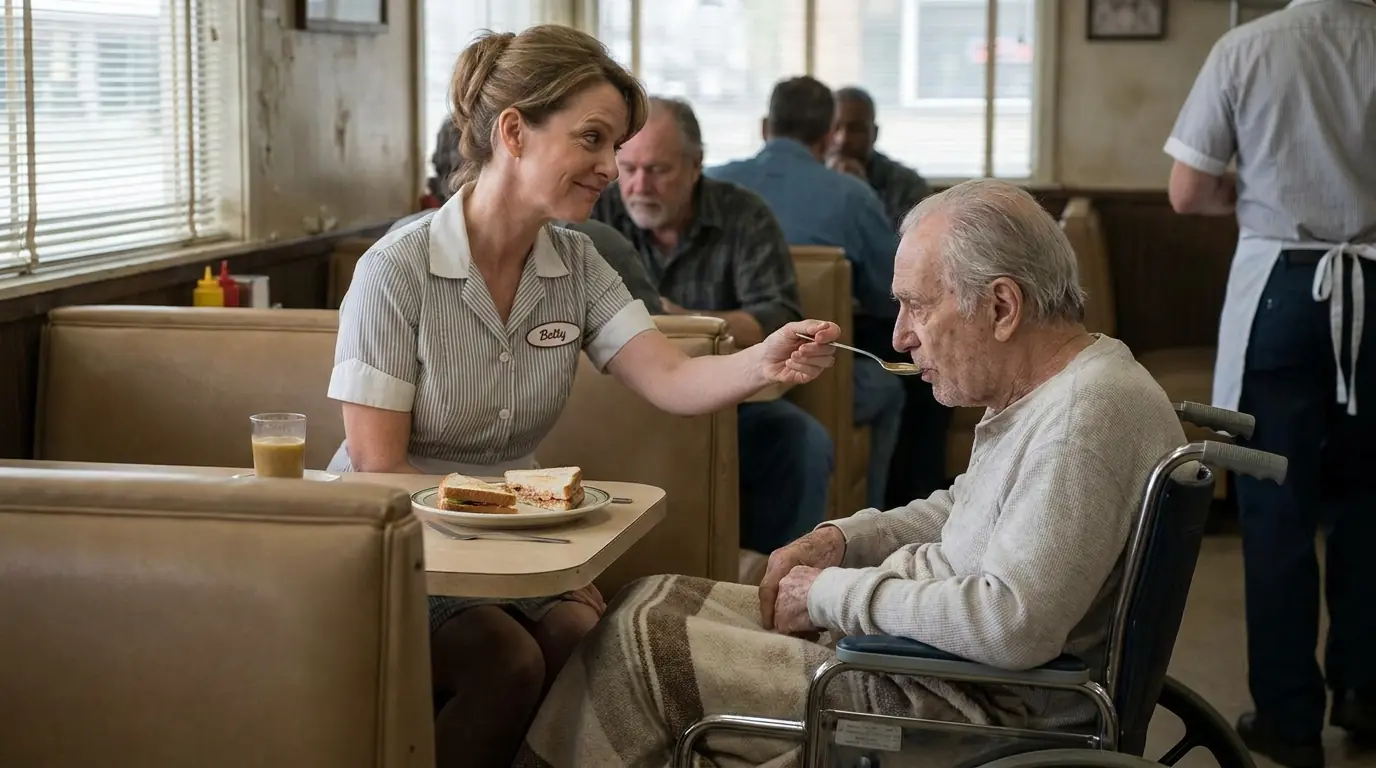
The old man was sitting just inside the door, both hands resting on the wheels of his chair. He wore a brown coat that looked too thin for November, a wool cap pulled low over his forehead, and black gloves with the fingertips worn nearly smooth. His face was pale and deeply lined, not only with age, but with the kind of quiet hunger a person tries to hide.
Emily had seen that look before.
She had seen it in men who came in pretending they only wanted coffee because coffee was all they could afford. She had seen it in mothers who ordered one plate of pancakes and cut it into tiny pieces for three children. She had seen it in her own mirror on mornings when rent was due and tips had been bad.
The old man glanced around the diner as if he were stepping into a memory instead of a restaurant.
Behind the counter, Earl Nash, the owner, was counting bills from the register. Earl was a square-shouldered man with a red face, silver hair, and eyes that could spot a missing nickel from across the room. He looked up only long enough to judge the old man’s coat, his wheelchair, and the emptiness in his hands.
Then he looked back down at the money.
Emily set the rag beside the sugar caddy and walked over.
“Afternoon,” she said gently. “Would you like a table or a booth?”
The old man lifted his eyes. They were a soft gray-blue, cloudy at the edges, but awake. Very awake.
“A table, if you don’t mind,” he said. His voice was low and careful, like someone who had learned not to ask for too much.
“Of course.”
Emily guided him toward the small table by the front window. It was the warmest spot in the diner when the afternoon sun came through, though there was no sun that day. Still, it was away from the draft near the door and close enough to the counter that she could keep an eye on him.
He stopped beside the chair. Emily moved it away without making a fuss.
“There you go,” she said.
“Thank you, miss.”
“Emily,” she said. “My name’s Emily.”
He gave the smallest nod. “Samuel.”
“Nice to meet you, Samuel.”
She handed him a menu, but he didn’t open it right away. His hand trembled slightly as he placed it flat on the plastic cover. His eyes moved across the diner again.
They lingered on the old photographs by the register.
Rosewood Diner, 1978.
Maple Street Flood, 1983.
Evelyn’s First Pie Contest, 1986.
Christmas Breakfast for the Town, 1991.
Most customers never looked at those photographs. To them, they were just decoration. Old smiling faces in faded frames. Old cars. Old signs. A version of town that had disappeared before many of them were born.
But Samuel looked at those photographs like they were alive.
Emily noticed.
“What can I get started for you?” she asked.
Samuel opened the menu slowly. His eyes moved down the prices. Soup, six dollars. Grilled cheese, five fifty. Coffee, two dollars. Meatloaf plate, eleven ninety-five.
His fingers tightened on the edge of the menu.
“Just coffee,” he said.
Emily knew.
She had heard that tone too many times. The tone of someone choosing the cheapest thing before anyone else could know they had no choice.
“Cream and sugar?”
“Black is fine.”
She started to turn away, then stopped.
“Soup’s fresh today,” she said. “Chicken noodle. Good for weather like this.”
Samuel smiled politely, but his eyes lowered.
“Coffee will do.”
Emily carried the coffeepot to the counter. Earl was still counting money.
“Table four wants coffee,” she said.
Earl didn’t look up. “Long as he pays for it.”
Emily’s jaw tightened.
She poured coffee into a mug and looked toward the kitchen window. Benny, the cook, was scraping onions from the grill. A pot of chicken noodle soup simmered behind him, giving off steam that smelled like carrots, celery, and comfort.
Emily had worked at Rosewood Diner for four years. She knew how much food got thrown out at the end of each day. She knew which pie slices were too uneven to sell. She knew which bowls of soup sat under the warmer until closing and then disappeared into the trash.
She also knew Earl watched the register like a hawk.
Still, she took a bowl from the shelf.
She ladled soup into it, added two packets of crackers, and carried it with the coffee to table four.
Samuel looked up in surprise.
“I only ordered coffee,” he said.
“I know,” Emily replied. “Kitchen made an extra bowl by mistake.”
His eyes searched her face.
“I can’t pay for that.”
“You don’t have to. Mistakes happen.”
Samuel stared at the soup for a long moment. The steam curled between them. His lips pressed together, and Emily saw pride fighting hunger.
“I don’t take charity,” he said softly.
Emily placed the coffee beside the bowl.
“Then don’t,” she said. “Take a kitchen mistake.”
For the first time, his smile reached his eyes.
He picked up the spoon.
Emily walked away before he could thank her again, because she had learned that kindness sometimes landed softer when a person did not have to look at it directly.
At the counter, Earl’s voice came low.
“That better not be going on the house.”
Emily grabbed a towel and wiped a spotless section of counter.
“It was soup from the bottom of the pot,” she said. “Would’ve been tossed.”
“Food costs money whether it’s tossed or not.”
Emily turned and met his eyes.
“So does throwing away customers.”
Earl snorted. “He bought one coffee. That’s not a customer, that’s a chair taking up space.”
Emily glanced toward Samuel. He was eating slowly, as if trying to make the bowl last longer than it could.
“He’s a person,” she said.
Earl shut the register drawer harder than necessary.
“Don’t get sentimental on my clock.”
Emily did not answer. She had learned that some people mistook cruelty for business sense.
Samuel stayed for forty minutes.
He ate every spoonful of soup. He drank half the coffee. He warmed his hands around the mug. Before he left, he placed two quarters and five pennies on the table beside the untouched bill Emily had never brought him.
She found the coins after he rolled out into the rain.
Under them was a napkin.
On the napkin, drawn in blue pen, was a tiny sketch of the diner’s front window. The letters on the sign were perfect. ROSEWOOD DINER. Beneath it, in small careful handwriting, he had written:
Thank you for pretending it was a mistake.
Emily folded the napkin and put it in her apron pocket.
She did not know then that it would be the first of many.
Samuel came back the next day.
This time, he arrived just after two, when lunch was over and the diner had settled into its slow afternoon rhythm. Emily was refilling ketchup bottles. Benny was smoking out back. Earl was in his office, arguing with a supplier over the phone.
Samuel rolled in wearing the same brown coat and wool cap.
Emily smiled before she could stop herself.
“Afternoon, Samuel.”
“Afternoon, Emily.”
“Coffee?”
“If it’s not trouble.”
“It’s never trouble.”
She brought him coffee. Then she brought him a small plate with half a turkey sandwich and a few fries.
He looked at it.
“Another mistake?” he asked.
Emily gave him a serious nod. “Terrible kitchen. Very unreliable.”
Samuel’s mouth twitched.
“It happens a lot around here.”
He picked up the sandwich with both hands. His fingers were thin, the knuckles swollen. He ate with quiet dignity, never rushing, never asking for more, never acting as if the food was owed to him.
That made Emily want to feed him even more.
On the third day, she brought oatmeal with brown sugar.
On the fourth, meatloaf from an order a customer had changed.
On the fifth, a bowl of chili and a biscuit she paid for with two dollars from her tip jar.
Every time, Samuel protested at first. Every time, Emily invented another excuse.
“The cook made too much.”
“Someone canceled an order.”
“This biscuit broke in half, so we can’t sell it.”
“The soup looks lonely.”
“Pie slices don’t count after three o’clock.”
Samuel never fully believed her.
But he let her protect his pride.
By the second week, he had become part of the diner’s afternoons.
He always came after the rush. He always sat at table four by the window. He always thanked Emily by name. Sometimes he talked. Sometimes he only watched the street with his hands folded in his lap.
Emily learned small things about him.
He liked coffee black, but he liked apple pie warmed just enough to soften the crust. He hated peas. He had once known how to repair watches. He remembered when Maple Street had two hardware stores, a movie theater, and a barber who sang hymns while trimming hair.
He did not speak about family.
Whenever Emily asked where he lived, he gave answers that sounded true and incomplete.
“Not far.”
“On the east side.”
“Where the buses still remember to stop.”
She never pushed.
Emily had her own private rooms inside her heart. She understood locked doors.
At twenty-eight, she lived in a small apartment above a closed flower shop with a heater that groaned all night. Her mother had died when Emily was nineteen, leaving behind a Bible full of pressed flowers and hospital bills that seemed to multiply in drawers. Her father had left years before that, chasing work down south and never quite finding his way back.
Emily had no husband, no children, no savings worth mentioning.
What she did have was a stubborn belief that a person could still choose goodness even when life had not chosen softness for them.
That belief had cost her before.
It cost her tips when she defended customers Earl wanted rushed out. It cost her sleep when she took extra shifts to cover bills. It cost her peace when people mistook her gentleness for weakness.
But every afternoon, when Samuel’s face eased at the first taste of hot food, Emily felt that belief become a little less foolish.
One Thursday, a group of construction workers came in late for lunch. They were loud, muddy, and impatient. Emily moved quickly between the counter and their booth, filling Cokes, bringing burgers, laughing at jokes she barely heard.
Samuel sat at table four with a bowl of vegetable soup and a piece of cornbread.
One of the men noticed him.
“Look at that,” he muttered to his friend. “Must be nice sitting around all day getting handouts.”
His friend chuckled.
Emily froze with a pitcher of sweet tea in her hand.
Samuel’s spoon stopped halfway to his mouth.
The first man leaned back, louder now. “Hey, old-timer, you got a secret? I’m tired too. Maybe I should roll in here and get fed for free.”
The booth laughed.
Emily set the pitcher down with a sharp thud.
“Gentlemen,” she said, her voice calm but cold, “you want refills or a lesson in manners?”
The laughter died.
The first man blinked. “Excuse me?”
“You heard me.”
Earl stepped out of his office at the sound of tension. “Everything all right?”
Emily did not look away from the booth.
“Just checking whether table nine came in hungry or rude.”
The man’s face reddened. “We’re paying customers.”
“Then eat,” Emily said. “Don’t perform.”
For one dangerous second, nobody moved.
Then Benny, who had appeared at the kitchen window, called out, “Burgers up.”
The moment broke.
The men grumbled, but they stopped.
Samuel lowered his spoon back into the bowl. His hand trembled more than usual.
Emily walked over to him.
“I’m sorry,” she said quietly.
Samuel shook his head. “People talk when they’re afraid they might one day need the mercy they mock.”
Emily looked at him.
“That sounds like something you’ve had a long time to learn.”
“A very long time.”
He finished his soup, but he did not stay as long that day.
When Emily cleared his table, there was another napkin sketch waiting beneath the empty bowl. This one showed a pair of hands placing a bowl of soup in front of a man by a window. Beneath it, Samuel had written:
A meal is never small when it saves someone from being invisible.
Emily kept that napkin too.
By December, Samuel had come every weekday for nearly a month.
Snow began falling on Maple Street in powdery bursts. Christmas garlands appeared on lampposts. The diner windows were painted with white snowflakes by a high school girl Earl paid in pancakes. A little plastic tree stood by the register, leaning slightly to the left.
Emily started saving the best leftovers before Earl could count them.
She became an expert in quiet generosity.
She learned to ring in Samuel’s coffee and cover the food herself. She learned which plates Benny could make from scraps without making it obvious. She learned when Earl was distracted, when he was watching, when he was too busy complaining about bills to notice one extra biscuit leaving the warmer.
Benny knew.
He never said it plainly. He only started making “accidental” extra portions.
“Clumsy hands,” he would say, sliding a small bowl of stew toward Emily.
Mabel, the morning waitress, knew too. She was sixty-three, with dyed red hair and a laugh like gravel in a tin can. She covered for Emily when Earl wandered too close.
“You got a soft spot,” Mabel told Emily one afternoon.
Emily looked toward Samuel, who was carefully buttering toast.
“I guess.”
“Soft spots are where the Lord checks if we’re still human.”
Emily smiled. “You always say things like that?”
“Only when I’m right.”
But secrets in small diners never stayed entirely secret.
Earl began noticing.
He noticed Samuel stayed too long for the amount of money he spent. He noticed Emily clearing plates from table four that were not on the receipts. He noticed Benny’s “mistakes” happening with suspicious regularity.
One icy Friday evening, after Samuel had left and Emily was mopping near the counter, Earl came out of his office holding a stack of receipts.
“Emily.”
She kept mopping. “Yes?”
“Come here.”
His voice had the flat tone of a man who had already decided he was angry.
Emily leaned the mop against the counter and walked over.
Earl placed the receipts down one by one.
“Coffee.”
“Coffee.”
“Coffee.”
“Coffee.”
He tapped each slip with his finger.
“Funny thing. That old man eats more than any coffee customer I’ve ever seen.”
Emily said nothing.
Earl’s eyes narrowed.
“How long have you been giving away my food?”
“I’ve been paying for some of it.”
“Some?”
“Earl, most of it would’ve been thrown out.”
“That is not your decision.”
“It should be somebody’s decision before good food lands in the garbage while a hungry man sits ten feet away.”
Earl’s face darkened.
“You think you’re better than me because you hand out soup?”
“No,” Emily said. “I think the soup is better than both of us if it does what it’s supposed to do.”
Benny coughed from the kitchen, trying badly to hide a laugh.
Earl shot him a look, then turned back to Emily.
“This is a business. Not a church basement.”
“It used to be both,” Mabel said from the coffee station.
Everyone looked at her.
Mabel shrugged. “Before your time, Earl. Evelyn Rosewood used to feed half the town after church. Folks paid when they could. Nobody left hungry.”
Earl’s jaw tightened.
“Evelyn Rosewood is dead. I own this place now.”
Mabel’s face changed, just a little. “You run it. That ain’t always the same thing.”
Earl stepped toward Emily.
“One more free plate to that old man, and it comes out of your paycheck. After that, you’re gone. Understand?”
Emily’s throat tightened.
She needed this job.
Her rent was late. Her car needed new tires. Her electricity bill sat unopened on the kitchen table at home because unopened bills felt less real for a few hours.
But then she looked at table four.
Empty now.
Clean.
Waiting.
“I understand,” she said.
Earl nodded, satisfied.
But understanding was not the same as obeying.
The next Monday, Samuel came in during a snowstorm.
The bells above the door jingled wildly as wind pushed in behind him. Snow clung to his cap and shoulders. His gloves were damp. His face looked grayer than usual.
Emily hurried over.
“Samuel, you shouldn’t be out in this weather.”
He tried to smile. “I have an appointment with bad coffee.”
“You’re shaking.”
“Old bones complain. That’s all.”
She guided him to table four and brought coffee first. His hands wrapped around the mug, but the trembling did not stop.
Emily went into the kitchen.
Benny looked up. “He looks rough.”
“I know.”
“Earl’s watching.”
Emily glanced toward the office. The blinds were partly open.
“Make me a bowl of stew,” she said.
Benny hesitated. “Em.”
“Please.”
Benny looked at her face and stopped arguing.
He filled a bowl with beef stew, potatoes, and carrots. Then he added a warm roll.
Emily took money from her apron pocket. Seven dollars and change. Nearly half her tips from the morning.
She rang the stew into the register under her own employee meal.
Then she carried it to Samuel.
He looked at the bowl, then at her.
“No mistake today?” he asked.
“No,” Emily said. “Today it’s mine.”
Samuel’s eyes softened.
“I told you, I don’t take charity.”
“And I told you, I don’t serve charity. I serve food.”
“That sounds like a distinction made by a stubborn woman.”
“It is.”
He studied her for a long moment.
Then he whispered, “Thank you, Emily.”
She squeezed his shoulder once, lightly, and returned to work.
Earl said nothing.
Not then.
But when Emily picked up her paycheck the following Friday, it was short.
Thirty-two dollars.
There was a note clipped to it.
Unauthorized food deduction.
Emily stood by the office door with the check in her hand, feeling heat rise behind her eyes. Thirty-two dollars meant groceries. It meant gas. It meant deciding which bill could wait without becoming a disaster.
Earl watched her from his desk.
“You were warned,” he said.
Emily folded the check.
“Yes,” she replied. “I was.”
She walked out before he could see her cry.
That afternoon, Samuel noticed.
He noticed because people who have suffered long enough become experts at reading what others try to hide.
“You’re quieter today,” he said.
Emily forced a smile. “Busy morning.”
“There are only two customers in here.”
“Emotionally busy, then.”
Samuel tilted his head.
“Did I cause trouble for you?”
“No.”
“Emily.”
She looked away.
He placed one hand on the table.
“I have lived too many years to be protected by lies.”
She sighed.
“Earl took money from my check.”
Samuel closed his eyes.
“For feeding me.”
“For feeding you.”
“I won’t come back.”
The words came too quickly.
Emily turned to him.
“Don’t say that.”
“I won’t be the reason you lose your job.”
“You are not the reason.”
“He is the owner.”
“He’s the owner of the register,” Emily said. “Not my conscience.”
Samuel looked at her with an expression she could not read.
There was sorrow in it.
And something else.
Something like recognition.
“My wife used to say things like that,” he said.
Emily softened. “You were married?”
“For forty-seven years.”
“What was her name?”
Samuel’s eyes moved to the window.
“Evelyn.”
Emily went still.
The name hung in the air between them.
Evelyn.
The name on the diner photographs. Evelyn Rosewood. The woman who had started the pie contests. The woman Mabel said used to feed half the town. The woman whose smiling picture hung near the register, wearing a blue dress and holding a cherry pie.
Emily looked toward the photo wall, then back at Samuel.
“Evelyn?” she asked.
Samuel seemed to realize what he had said. His face closed gently.
“A common name.”
“Samuel…”
He lifted his coffee.
“Some memories are warmer when left covered.”
Emily did not push, but the question stayed with her all day.
That night, after closing, she stood by the photographs near the register. She had seen them hundreds of times, but now she looked closely.
In the picture from 1986, Evelyn Rosewood stood in front of the diner holding her prize-winning pie. Beside her was a younger man with dark hair, broad shoulders, and a proud smile. His face was partly turned away, but something about the eyes made Emily lean closer.
Gray-blue.
Awake.
She wiped dust from the frame with her sleeve.
The caption read:
Evelyn and Henry Rosewood, First Pie Contest, 1986.
Henry.
Not Samuel.
Emily’s breath caught.
Mabel came up behind her.
“You finally noticed,” she said.
Emily turned. “Mabel, is this him?”
Mabel looked at the photograph. Her expression grew careful.
“I wondered from the first week.”
“You knew?”
“I suspected.”
“Why didn’t you say anything?”
“Because an old man giving a false name usually has a reason. And because grief can make people ghosts before they’re dead.”
Emily stared at the photograph.
“Henry Rosewood owned this diner?”
“Built it,” Mabel said. “For Evelyn. She loved feeding people. He loved her enough to build a place where she could do it every day.”
“What happened?”
Mabel folded her arms.
“Evelyn died about fifteen years ago. Cancer. Henry changed after that. Then there was an accident a few years later. I heard he lost the use of his legs. After that, he disappeared from town life. His daughter handled things for a while. Then the diner got leased out, sold around, papers changed hands. Earl came in acting like he built the walls with his bare hands.”
“Does Earl know?”
Mabel gave a humorless laugh.
“Earl knows what benefits Earl.”
Emily looked back at the man in the photograph.
Henry Rosewood.
Samuel.
The old man at table four who pretended not to need soup.
“Why would he come back here and not say who he is?” Emily whispered.
Mabel’s eyes softened.
“Maybe he wanted to see what was left.”
The next day, Samuel did not come in.
Emily checked the door every time the bells rang.
A mother with two children.
A mail carrier.
Three teenagers.
A salesman.
No Samuel.
At three o’clock, she wiped table four twice.
At four, she poured a cup of coffee and let it sit behind the counter until it went cold.
At five, snow began falling again.
By closing, worry had settled in her chest like a stone.
The following day, he still did not come.
Emily asked Benny if he had seen him near the bus stop. Benny had not. She asked Mabel if she knew where Henry Rosewood lived. Mabel only knew he had once owned a large white house on Cedar Lane, but it had been sold years ago.
On the third day, Emily used her break to roll her old car slowly through the east side of town, searching bus stops, benches, church steps, and the library entrance.
No Samuel.
No Henry.
No brown coat.
She returned to work with cold hands and a fear she could not name.
Earl noticed her distraction.
“Looking for your charity project?” he asked.
Emily ignored him.
He leaned against the counter. “Maybe he found another place to beg.”
Emily turned so sharply that the spoon in her hand clattered to the floor.
“Don’t.”
Earl smirked. “Don’t what?”
“Don’t talk about him like that.”
“Why? He family?”
Emily looked at the photo wall.
“No,” she said quietly. “But this place might be.”
Earl’s face hardened.
“What does that mean?”
Before Emily could answer, the bells above the door rang.
Three strangers walked into the diner.
The first was a woman in her early fifties wearing a dark wool coat, her hair pinned neatly at the back of her head. Her face was pale with worry. The second was a tall man carrying a leather folder under one arm. The third was a young woman, maybe twenty-five, with red eyes and a scarf wrapped tightly around her neck.
They did not look like travelers stopping for lunch.
They looked like people who had been searching.
The woman in the wool coat stepped forward.
“Excuse me,” she said. “We’re looking for someone.”
Earl straightened, putting on his customer smile. “Well, you came to the right place. Sit anywhere you like.”
“We’re not here to eat.”
The young woman pulled something from her purse.
A photograph.
Emily felt the air leave her lungs before she even saw it clearly.
The woman held it up.
It was Samuel.
Not the young man from the wall. Not the smiling husband beside Evelyn. It was Samuel as Emily knew him now, sitting in his wheelchair, wearing the brown coat and wool cap. The photograph looked recent. He was outside somewhere, perhaps near a bus station, unaware that the picture had been taken.
“Have any of you seen this man?” the woman asked.
The diner went silent.
Emily gripped the counter.
Earl glanced at the photograph, then at Emily.
“Maybe,” he said. “Who’s asking?”
The woman swallowed.
“My name is Lydia Rosewood. He’s my father.”
Mabel made a small sound behind the coffee station.
Emily stepped forward.
“Your father?”
Lydia turned to her. “You know him?”
Emily hesitated.
Every instinct in her told her to protect Samuel.
Henry.
Whoever he wanted to be.
“Why are you looking for him?” Emily asked.
The tall man answered.
“He left his assisted living apartment nearly six weeks ago. He wasn’t being held there, but he uses a wheelchair and has heart trouble. His family has been searching everywhere.”
Emily’s chest tightened.
Heart trouble.
Six weeks.
That was almost exactly when he had first come into the diner.
The young woman with the scarf stepped forward, tears shining in her eyes.
“We heard someone had seen him near Maple Street. Please. If he’s been here, we just need to know he’s alive.”
Emily looked at Lydia.
The woman’s face was tired in a way Emily recognized. Not careless. Not cruel. Tired from fear.
“He’s been coming here,” Emily said softly.
Lydia’s hand flew to her mouth.
The young woman began to cry.
“Oh, thank God,” she whispered.
Earl suddenly smiled wider.
“Well,” he said loudly, “we’ve taken good care of him here. Haven’t we, Emily?”
Emily stared at him.
The words felt filthy.
Mabel slowly set the coffeepot down.
Benny appeared at the kitchen window, his face dark.
Lydia looked between them.
“What does that mean?” she asked.
Earl adjusted his collar.
“I mean, he came in a few times. We run a respectable establishment. Of course we treated him properly.”
Emily’s hands curled at her sides.
She thought of the short paycheck.
She thought of the warning.
She thought of Samuel counting coins onto the table.
She thought of Earl calling him a chair taking up space.
Lydia’s eyes fixed on Emily.
“Did my father eat here?”
Emily looked at Earl.
Then she looked back at Lydia.
“Yes,” she said.
Lydia closed her eyes in relief.
“Was he able to pay?”
The question was quiet.
Humiliated.
Tender.
Emily understood then that Lydia was not asking about money. She was asking whether her father had suffered.
Emily answered carefully.
“He paid for his coffee when he could.”
“And food?”
Earl cut in.
“Like I said, we made sure he was handled.”
Emily’s voice turned firm.
“I fed him.”
Everyone looked at her.
Earl’s face reddened.
Emily continued.
“He came in hungry. He didn’t want charity. So I told him the kitchen made mistakes. I brought him soup, sandwiches, stew, pie. Sometimes Benny helped. Sometimes Mabel covered for me. Sometimes I paid out of my tips.”
Lydia stared at her as if Emily had just handed her something breakable.
“You fed him every day?”
“Almost every day.”
The young woman pressed the photograph to her chest and cried harder.
Earl forced a laugh.
“That’s a little dramatic. She violated policy, actually. We had to correct the situation.”
The tall man turned to him.
“What situation?”
Earl faltered. “Food costs. You understand business.”
The man opened his leather folder.
“I understand leases, Mr. Nash.”
Earl’s smile vanished.
The man pulled out a document and placed it on the counter.
“My name is Robert Harlan. I represent the Rosewood Family Trust.”
The diner seemed to shrink around them.
Earl looked at the document.
“What is this?”
“A copy of your operating lease.”
“I don’t need a copy. I know what I signed.”
“Then you may remember section eight.”
Earl said nothing.
Robert adjusted his glasses.
“The tenant operating Rosewood Diner is required to maintain the community meal provision established by Evelyn Rosewood. One hot meal per day must be made available, without public humiliation, to any elderly or disabled resident unable to pay.”
Mabel whispered, “I knew it.”
Emily stared at Robert.
Lydia’s eyes filled again, but this time not only with fear.
“My mother wrote that provision,” Lydia said. “My father insisted it remain after she died.”
Earl’s face turned a strange gray-red.
“That’s old language. Nobody enforces that.”
Robert’s voice stayed calm.
“The trust does.”
“I never saw anybody come in asking for that.”
“Because you removed the sign,” Mabel said.
Everyone turned to her.
She pointed toward the wall near the register, where a faded rectangle marked the wallpaper beside the photo frames.
“There used to be a little plaque right there. Evelyn’s Table. Ask quietly. Eat with dignity.”
Lydia covered her mouth.
Robert looked at Earl.
“Did you remove it?”
Earl’s jaw worked. “The wall was repainted.”
“It hasn’t been repainted in twenty years,” Benny called from the kitchen.
For once, nobody laughed.
Emily felt tears burning behind her eyes.
Evelyn’s Table.
Ask quietly. Eat with dignity.
Samuel had not come to the diner by accident. Henry Rosewood had returned to the place he built for mercy, and mercy had been hidden behind a missing plaque and a locked register.
Lydia turned to Emily.
“Where is he now?”
Emily’s heart sank.
“I don’t know. He hasn’t come in for three days.”
Lydia swayed slightly. The young woman caught her arm.
Robert’s expression tightened.
“We need to keep searching.”
Emily grabbed her coat from the hook behind the counter.
“I’m coming with you.”
Earl snapped, “You are still on shift.”
Emily looked at him.
“No,” she said. “I’m not.”
“You walk out that door, don’t come back.”
The threat hung in the air.
For four years, Emily had feared those words.
She had feared the empty space after losing a job. She had feared bills, hunger, shame, starting over. She had feared proving right every person who said kindness was a luxury for people who could afford it.
But in that moment, fear felt smaller than table four.
Emily untied her apron and placed it on the counter.
“Then I won’t.”
Mabel smiled faintly.
Benny knocked once on the kitchen window in approval.
Earl looked around, realizing too late that the room was not on his side.
Emily walked out with Lydia, Robert, and the young woman into the cold afternoon.
The search lasted four hours.
They checked the bus station first. The clerk remembered Samuel, though she knew him only as “the polite old fellow with the brown hat.” He had spent time there on cold mornings but had not been seen since Tuesday.
They checked the library. A librarian said he sometimes sat near the history shelves and looked through old town newspapers.
They checked two churches, the senior center, the pharmacy, and the small park by the river.
As they searched, Lydia told Emily the story in pieces.
Henry Rosewood had never recovered after Evelyn died. For years, he kept the diner alive because it had been her dream. Then the accident happened on an icy road outside town. He survived, but his legs did not fully recover. He withdrew from friends. He let lawyers handle business. He gave control of the diner lease to managers, then to tenants.
Lydia had tried to help, but grief had made him proud and difficult.
“He thought needing help meant becoming a burden,” Lydia said, wiping her eyes with gloved fingers. “I told him a thousand times he was my father, not a burden. But he hated being watched. Hated being worried over.”
The young woman was Lydia’s daughter, Grace.
“My grandfather used to bring me here when I was little,” Grace said. “He’d sit me at the counter and tell me Grandma Evelyn believed pancakes could fix almost anything.”
Emily smiled sadly. “That sounds like her.”
“You never met her.”
“No,” Emily said. “But I think I’ve been working in the shadow of her kindness.”
By dusk, the sky had turned deep blue. Streetlights flickered on. Snow began falling again, soft and steady.
They were near the old train depot when Emily noticed wheelchair tracks in the thin snow along the sidewalk.
“Wait,” she said.
The others stopped.
The tracks curved behind the depot toward an old brick building with boarded windows. A faded sign above the door read: ROSEWOOD STORAGE AND SUPPLY.
Lydia inhaled sharply.
“My father owned this building.”
The front door was locked, but a side entrance stood partly open.
Emily stepped inside first.
The air smelled of dust, wood, and cold metal. Light from the street spilled through dirty windows. Old diner furniture was stacked along one wall: red vinyl stools, cracked tabletops, boxes of dishes wrapped in yellowed newspaper.
And near the back, beneath a hanging lamp that flickered weakly, sat Samuel.
Henry.
He was in his wheelchair beside a workbench, wrapped in his thin coat. In his lap was a wooden plaque, half-cleaned, its painted letters faded but readable.
EVELYN’S TABLE
ASK QUIETLY
EAT WITH DIGNITY
Lydia made a broken sound.
“Dad.”
The old man turned.
For a moment, he looked not surprised, but deeply tired.
“Lydia,” he said.
She rushed to him and dropped to her knees beside his chair, wrapping her arms around him carefully. Grace knelt too, crying into his shoulder.
Henry closed his eyes.
His gloved hand rose slowly and rested on his daughter’s hair.
“I didn’t mean to frighten you,” he whispered.
“You vanished,” Lydia cried. “Dad, we thought you were dead somewhere.”
“I needed to see it.”
“See what?”
His eyes moved to the plaque.
“What was left of her.”
Emily stood a few feet away, shivering in the doorway.
Henry looked at her.
There was shame in his face now.
And gratitude.
“You found me,” he said.
“You stopped coming,” Emily replied. “I got worried.”
He smiled faintly. “That was not very convenient of me.”
“No,” she said, her voice shaking. “It was not.”
Robert stepped forward. “Mr. Rosewood, we need to get you somewhere warm.”
Henry looked down at the plaque.
“I came here to find this. I thought Earl had thrown it away.”
“He removed it,” Emily said. “But he didn’t destroy it.”
Henry’s fingers brushed the letters.
“Evelyn painted it herself. The day we opened, she told me a diner without mercy was only a room selling food.”
Lydia wiped her face.
“Why didn’t you tell us you were going back there?”
Henry looked at his daughter.
“Because I was ashamed.”
“Of what?”
“Of needing the provision I created.”
No one spoke.
Henry’s voice grew thinner.
“I built that place as a man who could stand behind the counter and pay every bill. I came back as an old man who could not afford a bowl of soup without counting coins. Pride is a foolish coat, Lydia. It keeps out help, not cold.”
Grace squeezed his hand.
“Grandpa.”
He looked at Emily.
“The first day I came in, I wanted to see if Evelyn’s kindness still lived there. I thought maybe the walls would remember. But walls don’t feed people.”
Emily swallowed.
“No. People do.”
Henry’s eyes shone.
“You did.”
They got him out of the storage building and into Robert’s car. Lydia wrapped a thick blanket around him. Grace held his hand all the way to the medical clinic, where a doctor checked him and said he was weak, cold, and stubborn, but stable.
Emily waited in the lobby, still wearing her waitress shoes, still smelling faintly of coffee and fryer oil.
At nearly nine o’clock, Lydia came out.
“He’s asking for you.”
Emily stood.
Henry was sitting up in a clinic bed with a blanket over his legs. Without his wool cap, he looked smaller, his white hair combed back, his face worn by exhaustion.
On the bedside table sat the wooden plaque.
Emily stepped into the room.
“You scared everybody,” she said.
“I am being thoroughly informed of that.”
“Good.”
He nodded toward the chair beside the bed.
“Sit with me a minute.”
Emily sat.
For a while, neither of them spoke.
Then Henry said, “My name is Henry Rosewood.”
“I know.”
“I should have told you.”
“You didn’t owe me your name.”
“I owed you the truth.”
Emily looked at him gently.
“Maybe. But you came in hungry. Truth could wait.”
He smiled, then coughed lightly.
“I watched you fight for me when you thought I had nothing to offer you.”
Emily folded her hands in her lap.
“I didn’t do it because I thought you had something.”
“I know.”
“That’s the point.”
Henry looked toward the plaque.
“When Evelyn died, I believed the best part of my life had ended. Then when I lost the use of my legs, I believed the useful part had ended too. People kept telling me I still mattered, but they said it in bright rooms with clean blankets and careful voices. I didn’t believe them.”
Emily listened.
“I came back to the diner because I wanted to sit where she used to stand. I wanted to feel close to her. But when I saw what Earl had done, I was angry. Then you brought me soup and called it a mistake.”
His voice broke slightly.
“For the first time in years, I felt Evelyn had not completely left the world.”
Emily’s eyes filled.
“She must have been wonderful.”
“She was impossible,” Henry said, smiling through tears. “Bossy. Tender. Always feeding people. She once gave away my lunch to a stranger and told me love digests better than roast beef.”
Emily laughed softly.
“I would have liked her.”
“She would have loved you.”
The words hit Emily harder than she expected.
For years, she had lived without older voices blessing her choices. Without a mother to tell her she had done well. Without a father to say he was proud. Without anyone to look at her tired hands and see more than service.
She wiped her cheek quickly.
Henry noticed but did not embarrass her by mentioning it.
Instead, he reached for an envelope on the bedside table.
“I need to ask you something,” he said.
Emily looked wary. “If it involves more secret soup, I’m listening.”
He chuckled.
“No. It involves the diner.”
The next morning, Rosewood Diner did not open at six.
At six-thirty, regulars gathered outside in confusion, peering through the glass. At seven, Earl Nash arrived in his truck, holding keys and wearing the irritated expression of a man ready to blame someone else.
But the front door would not open.
A notice had been taped to the glass.
TEMPORARILY CLOSED BY ORDER OF THE ROSEWOOD FAMILY TRUST
Earl ripped it down and stormed around to the back.
Robert Harlan was waiting there with two trust representatives and a locksmith.
By eight, Earl was inside shouting.
By nine, he was outside carrying a cardboard box of office belongings.
By ten, half of Maple Street knew.
By noon, Mabel called Emily.
“You better get down here,” she said.
Emily had barely slept. She had spent the night turning Henry’s words over in her mind.
It involves the diner.
She drove to Maple Street with her stomach tied in knots.
When she arrived, the diner was full of movement but closed to customers. Mabel was behind the counter. Benny was in the kitchen, grinning like a man who had just inherited a holiday. Lydia and Grace were cleaning the photo wall. Robert was speaking with a contractor near the door.
And Henry Rosewood sat at table four, wearing a warmer coat, the wooden plaque resting on the table before him.
Emily entered slowly.
The bells jingled.
Everyone turned.
Henry smiled.
“There she is,” Mabel said.
Emily looked around. “What’s happening?”
Henry gestured to the chair across from him.
“Come sit.”
She did.
Her heart pounded.
Henry placed a document on the table.
“The trust has ended Earl’s lease for violation of the community meal provision and several other unpleasant matters Robert says I should not list in polite company.”
Benny called from the kitchen, “List them!”
Mabel swatted the air. “Hush.”
Henry continued.
“The diner will reopen under direct trust management while we restore it.”
Emily nodded slowly. “That’s good.”
“It needs a manager.”
She blinked.
Henry watched her.
“Someone who understands that food is not only a product. Someone who knows the difference between pity and dignity. Someone who has already been running the heart of this place without the title.”
Emily stared at him.
“No.”
Henry smiled. “That is a strange first answer.”
“I mean, no, I can’t. I’m a waitress.”
“Evelyn was a waitress when I met her.”
“That’s different.”
“How?”
Emily opened her mouth, then closed it.
Henry leaned forward slightly.
“Emily, I am not offering you charity.”
She almost laughed through the sudden panic in her chest.
“That sounds familiar.”
“I am offering you work. Serious work. Paid fairly. With help. Mabel already threatened me into keeping her on mornings.”
Mabel lifted her chin. “Somebody has to teach her how to boss people properly.”
“Benny has agreed to stay,” Henry said.
Benny leaned through the kitchen window. “As long as nobody makes me cook kale.”
Grace raised her hand. “We may negotiate vegetables later.”
“Traitor,” Benny said.
Emily looked down at the document.
Her name was printed on the first page.
Emily Carter, General Manager.
Her vision blurred.
“I don’t have a degree,” she whispered.
Henry’s voice softened.
“You have a witness.”
“A what?”
“You have witnessed hunger without looking away. You have witnessed pride without crushing it. You have witnessed cruelty and refused to copy it. A diner can survive many things, Emily. It cannot survive a manager who has never truly seen people.”
Emily pressed her hand to her mouth.
Lydia sat beside her.
“My mother used to say this place needed someone who could feed both the stomach and the spirit. My father believes that’s you. After what you did for him, so do I.”
Emily looked at the plaque.
EVELYN’S TABLE
ASK QUIETLY
EAT WITH DIGNITY
“What about that?” she asked.
Henry’s eyes warmed.
“That goes back on the wall today.”
The restoration took three weeks.
Not a fancy restoration. Not the kind that makes a beloved old place unrecognizable. Henry did not want polished marble or expensive lighting. He wanted the diner cleaned, repaired, and returned to itself.
The cracked red booths were mended. The floor was polished until the black-and-white tiles shone. The old photographs were reframed. The missing plaque was hung beside the register, exactly where the faded rectangle had waited all those years.
Underneath it, Emily added a small handwritten card:
No explanations required.
No shame allowed.
Ask any server.
Henry cried when he saw it.
“I think Evelyn would approve,” he said.
Emily smiled. “Only think?”
He wiped his eyes. “She would correct the handwriting, then approve.”
News spread quickly.
Some people praised the change. Some grumbled that free meals would attract trouble. Some said Earl had been unfairly treated. Most simply came by to peek through the windows and see whether the old Rosewood Diner was really coming back.
On reopening morning, Emily stood behind the counter in a clean blue dress and a white apron. Her name tag no longer said Server.
It said Emily, Manager.
She kept touching it, as if it might disappear.
Mabel noticed.
“You keep rubbing that name tag, you’ll polish your name clean off.”
Emily dropped her hand. “I’m nervous.”
“Good. Means you care.”
Benny rang the bell from the kitchen. “First pancakes of the new empire!”
“It’s a diner, Benny,” Emily called.
“Every empire starts with pancakes.”
At seven o’clock, Henry rolled to the front door.
Lydia stood beside him. Grace held the ribbon. Robert had tried to make a formal speech, but Henry waved him off.
Instead, Henry looked through the glass at the people gathered outside.
Regulars. Neighbors. Former employees. A few elderly residents from the apartment building near the church. Two mothers with children. The bus station clerk. The librarian. Even the construction worker who had mocked Samuel weeks before stood near the back, looking ashamed and holding his hat in both hands.
Henry turned to Emily.
“You open it.”
“Me?”
“Yes.”
She unlocked the door.
The bells jingled louder than she remembered.
People came in slowly at first, then with warmth, filling booths and counter stools. Coffee poured. Bacon sizzled. Plates clattered. The diner woke like a sleeping heart remembering its rhythm.
At table four, Henry sat with a cup of black coffee.
This time, he did not sit alone.
Lydia sat on one side. Grace sat on the other. Mabel brought him oatmeal with brown sugar and toast cut diagonally.
He looked at the plate.
“Was this a mistake?” he asked.
Emily stood beside the table, smiling.
“No,” she said. “Today it’s policy.”
Henry laughed, and the sound changed the room.
Later that morning, the construction worker approached Emily near the counter.
He shifted uncomfortably.
“Ma’am.”
Emily turned. “Yes?”
“I owe that old man an apology.”
Emily looked toward Henry.
“Then give it to him.”
The man swallowed. “Think he’ll hear me out?”
“I think he’s better at that than most.”
The man walked to table four, hat in hand. Emily could not hear every word, but she saw his bowed head. She saw Henry gesture to the empty chair. She saw the man sit.
A few minutes later, Mabel brought them both coffee.
That was how Rosewood Diner began again.
Not with grand speeches.
With coffee.
With apology.
With oatmeal.
With a chair pulled out instead of pushed away.
Weeks passed. Winter deepened. Snow gathered on awnings and melted in gray piles by the curb. The diner grew busy, then busier. People came from neighboring towns after reading about Evelyn’s Table in the local paper.
But Emily made sure the heart of the place did not become a performance.
The free meals were never announced loudly. No bell rang. No one clapped. No photographs were taken for praise. If someone needed food, they could ask quietly, and they received a plate like any other customer.
Sometimes they paid later.
Sometimes they never could.
Either way, they were served with dignity.
Henry came every afternoon.
He still sat at table four. He still drank black coffee. He still drew on napkins with blue pen.
But now, his sketches changed.
He drew Benny flipping pancakes like a circus act.
He drew Mabel pointing a coffeepot like a weapon.
He drew Grace hanging Christmas lights crookedly.
He drew Lydia laughing with her head back.
He drew Emily standing beneath the restored plaque, holding a tray.
Under that one, he wrote:
The walls remembered because someone listened.
Emily framed it and placed it in the office.
Her office.
She still had trouble believing that part.
One evening in late January, after closing, Emily found Henry alone by the photo wall. The diner was quiet. Chairs had been turned upside down on tables. The floor smelled faintly of lemon cleaner. Outside, Maple Street glittered with frost.
Henry was looking at the old photograph from the pie contest.
Evelyn and Henry Rosewood, 1986.
Emily stopped beside him.
“You miss her a lot tonight?” she asked.
“I miss her every night,” he said. “But some nights it feels less like losing her and more like carrying her.”
Emily nodded.
“That sounds better.”
“It is.”
He glanced at her.
“I never asked why you did it.”
“Fed you?”
“Yes.”
Emily leaned against the counter.
“I knew what hunger looked like.”
Henry waited.
“My mom got sick when I was a teenager. Money got thin. People were kind sometimes, but they were often loud about it. They made sure we knew they were helping. My mother hated that. She used to say the worst part of needing help was having to perform gratitude for people who wanted an audience.”
Henry’s face softened.
“So you gave me no audience.”
“I tried.”
“You succeeded.”
Emily looked at the plaque.
“I think I was feeding her too. My mother, I mean. Or the memory of her. Maybe all kindness is like that. We give someone what we wish someone had given us.”
Henry was quiet for a long moment.
Then he said, “That is something Evelyn would have written down.”
Emily smiled.
“Maybe put it on a napkin.”
He pulled one from the dispenser.
“Say it again.”
She laughed. “Right now?”
“Wisdom has poor manners. It arrives when it wants.”
So Emily repeated it, and Henry wrote it down in his careful hand.
A month later, the diner held its first community supper under the restored Evelyn’s Table program.
No tickets. No speeches. Just a long evening of open doors, hot food, and neighbors sitting beside neighbors. Benny made chicken and dumplings. Mabel baked three pies and complained that none of them looked right. Grace organized volunteers. Lydia served coffee. Emily moved through the room, checking tables, calming children, greeting old customers by name.
Henry sat near the window, watching it all.
At one point, Emily noticed he was crying.
She walked over.
“You all right?”
He nodded.
“I spent years thinking Evelyn’s dream died because I stopped protecting it.”
Emily looked around the crowded diner.
“It didn’t die.”
“No,” he whispered. “It was waiting.”
The bells above the door jingled.
A man stepped in hesitantly, cold wind moving around him. He was middle-aged, wearing a work jacket with a broken zipper. His eyes moved to the full tables, then to the plaque on the wall.
Emily saw the moment he almost turned around.
She crossed the room before he could.
“Evening,” she said. “One for dinner?”
He looked embarrassed.
“I don’t have much.”
“That wasn’t my question.”
His eyes lifted.
Emily smiled gently.
“One for dinner?”
After a moment, he nodded.
She led him to a small table near the counter.
Henry watched.
The man sat. Emily brought him chicken and dumplings, coffee, and a slice of pie. She placed the plate in front of him exactly as she would for any paying customer.
No announcement.
No explanation.
No shame.
Henry’s hand trembled as he reached for a napkin.
He began to draw.
By spring, Rosewood Diner had become more than busy.
It had become beloved again.
The town changed around it in small ways. The church pantry began delivering vegetables once a week. The bakery donated day-old bread. A retired teacher started leaving twenty-dollar bills in a coffee can labeled “For Somebody’s Supper.” Customers who had once eaten silently began learning each other’s names.
Even Earl Nash’s shadow faded.
He left town in March, after failing to lease another restaurant nearby. Some people said he moved to Indiana. Others said Kentucky. Emily did not ask. She wished him no harm, but she did not miss him.
One April morning, a letter arrived at the diner addressed to Emily Carter, Manager.
The handwriting was Henry’s.
She found it odd because Henry was sitting at table four when Mabel handed it to her.
Emily held up the envelope.
“You know you’re here, right?”
Henry sipped his coffee. “I am experimenting with mystery.”
Mabel snorted. “He’s been waiting all morning for you to open it.”
Emily narrowed her eyes playfully and opened the envelope.
Inside was a single sheet of paper.
Dear Emily,
Some debts should not be called debts, because that makes kindness sound like accounting.
Still, gratitude needs somewhere to go.
You fed me when I was a hungry old man pretending not to be hungry. You defended me when I was too tired to defend myself. You protected my dignity before you knew my name.
Because of that, you returned more than food to me.
You returned my wife’s dream.
You returned my daughter’s father.
You returned me to myself.
The Rosewood Family Trust has voted to establish a permanent leadership position for Rosewood Diner and Evelyn’s Table. If you accept, you will continue as general manager with full salary, benefits, housing assistance for one year, and a future profit-sharing arrangement.
This is not charity.
This is not reward.
This is recognition.
With deepest respect,
Henry Rosewood
Emily read it once.
Then again.
The room blurred.
Mabel pretended to wipe the counter. Benny pretended to check the grill. Grace stood near the register with both hands over her mouth. Lydia watched quietly, smiling through tears.
Emily looked at Henry.
“You can’t keep doing this,” she whispered.
“Doing what?”
“Changing my life like it’s another kitchen mistake.”
Henry smiled.
“Terrible management. Very unreliable.”
Emily laughed and cried at the same time.
She walked to table four and hugged him carefully.
Henry patted her back.
For the first time since she was nineteen, Emily felt something inside her rest.
Not because life had become easy. It had not. There were still bills, busy days, broken appliances, difficult customers, and nights when loneliness pressed against the apartment windows.
But there was also a place where she belonged.
A place where kindness was not an accident.
A place where dignity was served hot.
On the anniversary of the day Samuel first rolled into the diner, Emily arrived before dawn.
She unlocked the front door, turned on the lights, and stood alone in the quiet.
The diner smelled faintly of coffee grounds and polished wood. The photo wall glowed under soft light. New pictures had joined the old ones now.
Henry at table four with Lydia and Grace.
Mabel holding two pies.
Benny wearing a paper crown on Pancake Day.
The first community supper.
Emily standing by the restored plaque.
At the center was the old photograph of Evelyn and Henry from 1986.
Beside it, Emily had added Samuel’s first napkin sketch: the front window of the diner, drawn in blue pen, with the words:
Thank you for pretending it was a mistake.
She looked at it for a long time.
Then the bells above the door jingled.
Henry rolled in, bundled in a thick navy coat Grace had bought him. He was older than he had been a year ago, more fragile in some ways, but his eyes were brighter.
“You’re early,” Emily said.
“So are you.”
“I run the place.”
“I built the place.”
She smiled. “Fair point.”
He rolled to table four. Emily poured his coffee before he asked.
“Black,” she said.
“You remembered.”
“I’m a professional.”
He looked toward the window, where morning light was beginning to touch Maple Street.
“Do you ever think about that first bowl of soup?” he asked.
Emily sat across from him.
“Sometimes.”
“I do too.”
“It was good soup.”
“It was terrible soup.”
Emily laughed. “It was not.”
“It was too salty.”
“Then why did you eat all of it?”
Henry wrapped both hands around the mug.
“Because it was warm. And because you let me keep my pride.”
Emily’s smile softened.
Outside, the town began waking. A delivery truck rolled by. A woman hurried past with a child in a red coat. Snow clouds gathered over the rooftops, though winter had not fully arrived yet.
Inside, the diner waited.
Soon Benny would start the grill. Mabel would complain about the coffee filters. Grace would bring fresh flowers for the counter. Lydia would stop by with paperwork and stay for pie. Customers would fill the booths. Someone would laugh too loudly. Someone would leave too small a tip. Someone would come in hungry and afraid to ask.
And they would be fed.
Henry reached into his coat pocket and pulled out a small object wrapped in cloth.
“I have something for you,” he said.
Emily raised an eyebrow. “Should I be nervous?”
“Probably.”
He unwrapped it.
Inside was an old brass key.
Emily stared at it.
“This was the first key to the diner,” Henry said. “I gave one to Evelyn the morning we opened. She said keys were not for locking doors, but for deciding when to open them.”
He placed it in Emily’s palm.
“I want you to have it.”
Emily closed her fingers around the key. It was heavier than she expected, warm from his pocket.
“I don’t know what to say.”
Henry looked at the plaque on the wall.
“Say you’ll keep opening the door.”
Emily followed his gaze.
EVELYN’S TABLE
ASK QUIETLY
EAT WITH DIGNITY
She thought of her mother. She thought of Evelyn Rosewood. She thought of the first day Samuel had come in from the rain, pretending coffee was enough. She thought of strangers walking through the door with his photograph, searching for a man she had known only by hunger and kindness.
Then she looked at Henry.
“I will,” she said.
The bells above the door jingled again.
A customer stepped in from the cold.
Emily rose, slipped the brass key into her apron pocket, and smiled.
“Morning,” she called. “Sit anywhere you like.”
And at table four, Henry Rosewood watched the diner fill with light.