Two men are about to kidnap a young woman right now. Corner booth, table four.
Sarah sees it. The iron grip on her wrist. The eyes that stopped begging for help days ago.
The bag that isn't hers. She's just a waitress, 17, helping raise her little sister. Nearest cop is 40 minutes away. She has one shot. One.
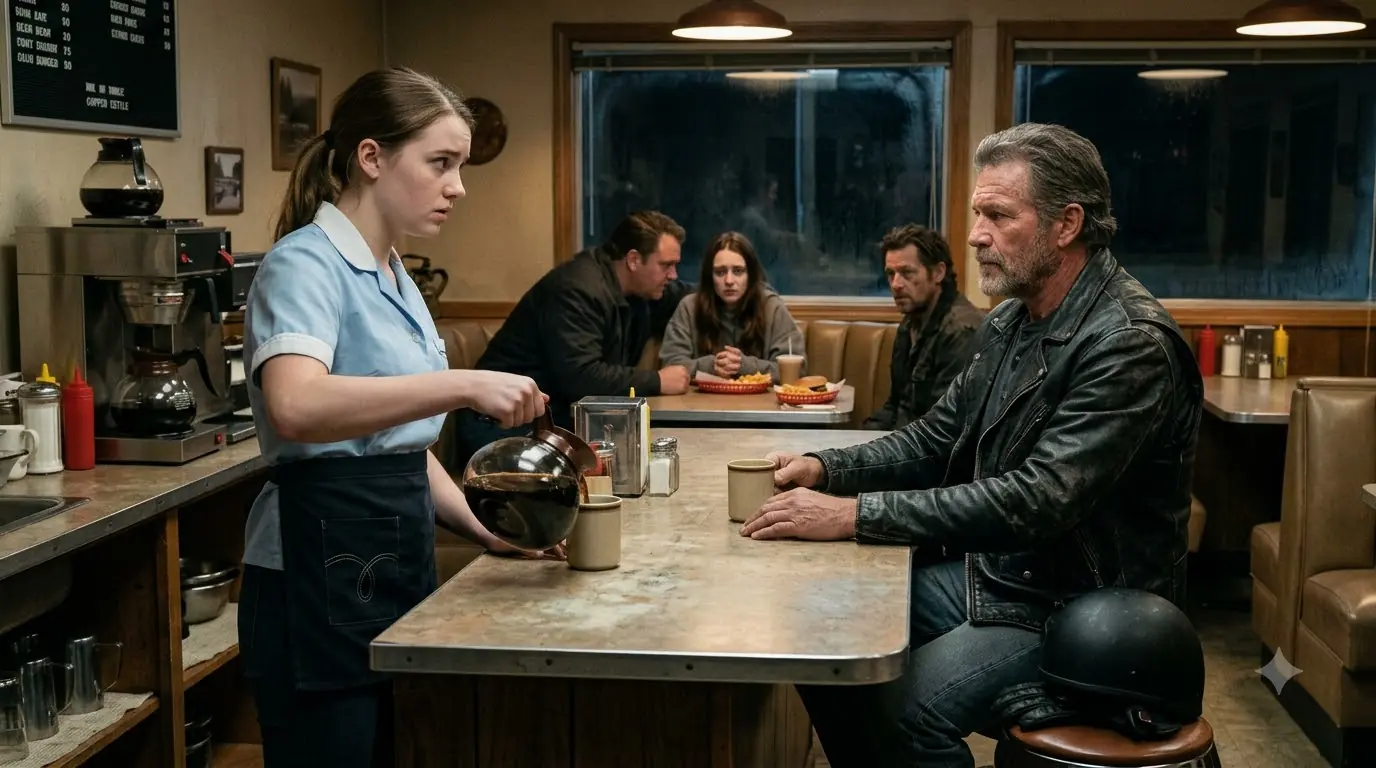
So, she picks up the coffee pot, hands completely steady, walks past that booth, and slides a folded napkin onto the window table without breaking stride. Triangle. Fold. Tuck. 12 minutes later, Ray Ironside Callahan, president of the Hells Angels, walks through that door.
Alone. No sirens. No weapons. Just a look that made those two men go completely silent. Nobody in that diner has forgotten what happened next.
Two men walked into the Copper Kettle at 6:47 on a Friday night. Nobody looked up. That was the thing about rural Montana in October. Strangers came through all the time. Truckers.
Hunters. People passing through on Route 191 who needed coffee and a warm place to sit for 20 minutes before getting back on the road. The Copper Kettle had seen all of them. Nobody looked up anymore. But Sarah looked up.
She always looked up. The two men moved through the door the way people move when they've done something many times before. No hesitation. No glancing around like someone new to a place. The bigger one, broad shoulders, dark jacket, the kind of face that didn't invite conversation, went straight for the corner booth, the one furthest from the counter, furthest from the window, best view of both exits.
Sarah noticed the booth choice before she noticed anything else. She always noticed the booth choice. The second man was smaller, quieter. He came in last and positioned himself on the outside of the seat, closest to the aisle, closest to the door, and between them, a young woman, college age, maybe 19. Dark hair, gray hoodie slightly too large for her frame.
She moved into the booth the way someone moves when they've learned recently that moving slowly and quietly is the safest way to move. Her hands went flat on the table the moment she sat down. Her eyes went straight to the surface in front of her. She didn't look around. She didn't look at the menu.
She looked at the table. Sarah set down the coffee pot she was holding, slowly, quietly. Something cold moved through her chest. The Copper Kettle had been standing on Route 191 for 31 years. It wasn't much.
Nine counter stools, 11 booths, a coffee machine that sounded like it was always about to give up, but never quite did. The sign outside had been missing the letter K for 2 years. The vinyl on booth three had a crack that Sarah had been meaning to report since last spring, but it was warm, the food was honest, and on a Friday night in October with a cold front pushing down from Canada, every soul within 30 miles seemed to find their way here. Sarah had worked this counter for three years. She knew every face, every order, every habit.
She knew who was fighting with their spouse and who had just gotten good news and who needed the coffee more than they needed anything else tonight. Three years had given her something no training manual could teach, the ability to read a room like a language, fast, instinctive, and right now every single word of that language was screaming at her. She gave them four minutes before she walked over, not too fast, not too slow. "Evening, folks. What can I get started for you?"
The big one ordered without opening the menu. "Black coffee, burger, fries." The smaller one said the same. Quick, practiced, the kind of men who made decisions fast and didn't revisit them. Then they both looked at the young woman.
"She'll have the same," the big one said. Sarah kept her pen moving, kept her face completely still. Then she looked at the young woman just for a moment, just long enough. "How do you want that burger?" A pause, one second too long.
"Medium." Her voice was barely above a whisper, not soft, careful. The kind of careful that comes from learning that the wrong answer has a cost. "Medium it is." Sarah smiled, collected the menus, and walked back to the counter.
She put the order through to the kitchen. Then she stood very still and ran the list in her head, the list she had carried for three years, added to it, refined it. Never written it down because some things you don't write down, you just know them the way you know your own name, the way you know the sound of your little sister's voice. Young woman who doesn't order for herself, eyes that stay down even when spoken to directly, clothes that don't fit, not her clothes, hands flat on the table, still, not relaxed still, told to be still, no bag, no phone, nothing that belongs to her. Sarah had been 14 years old when she first learned what those signs meant.
Not from a class, not from a pamphlet, from the inside. Three months in a situation she had never fully described to anyone, not even to Linda next door, not even on the nights when Emma was asleep and the house was quiet and the memories came back anyway. She had gotten out, she had rebuilt, she had made something real. This counter, this town, her little sister's laugh, the coffee machine that never quit, but she had never once forgotten what those eyes looked like and the young woman in the corner booth had those eyes. Sarah picked up the coffee pot and walked to the far end of the counter.
Mary. She kept her voice easy, conversational. "You seen Deputy Harris lately?"
Mary Collins, 62, County Clerk's office, Friday pie without fail, looked up. "Harris? Lord, no, he's on leave. Family thing up in Missoula. What about the night shift?"
Mary shook her head. "Honey, there is no night shift." Two deputies covering the whole county on weekends and one of them's Harris. She took a bite of pie. "Something wrong?"
"Nope." Sarah smiled. "Just making conversation." She walked back to the center of the counter. 40 minutes.
Maybe more on a Friday night with icy roads. That was how long it would take for anyone with a badge to get here. Long enough for two men and a young woman to finish their food, stand up, walk out the door, and disappear onto a highway going north. Long enough for everything to go wrong. Sarah stood behind the counter and breathed.
She thought about her options. She had learned a long time ago to think clearly before she moved. Because the first move mattered more than any move after it. Option one, call 911, 40 minutes, maybe 45. By then, that booth would be empty and those tire tracks would be cold.
Option two, walk over there, say something directly, and watch the big one's hand move to the young woman's arm in a way that said, clearly, without a single word, that she would pay for whatever happened next. Option three. Sarah's eyes moved to the napkin holder. Three years ago, on a Tuesday afternoon that had started just as quietly as this, Ray Callahan had sat down at this counter and ordered black coffee and said nothing for a long time. Sarah had refilled his mug twice before he spoke.
"We lost a girl," he said, quiet, looking at the counter. "Jimmy's daughter, 18 years old. Gone four days before anyone knew what had really happened." He stopped. Set his mug down carefully.
"By the time we understood, it was too late to do it right." Sarah hadn't said a word. "These people are careful," Ray said. "They don't make noise. They move fast. They pick places where nobody's watching."
He looked up at her. "You'd see it before I would. You know what to look for." She had nodded, just once. "You see it, and you can't call anyone, and you can't do it alone, you signal me. Before anything else, you signal me first."