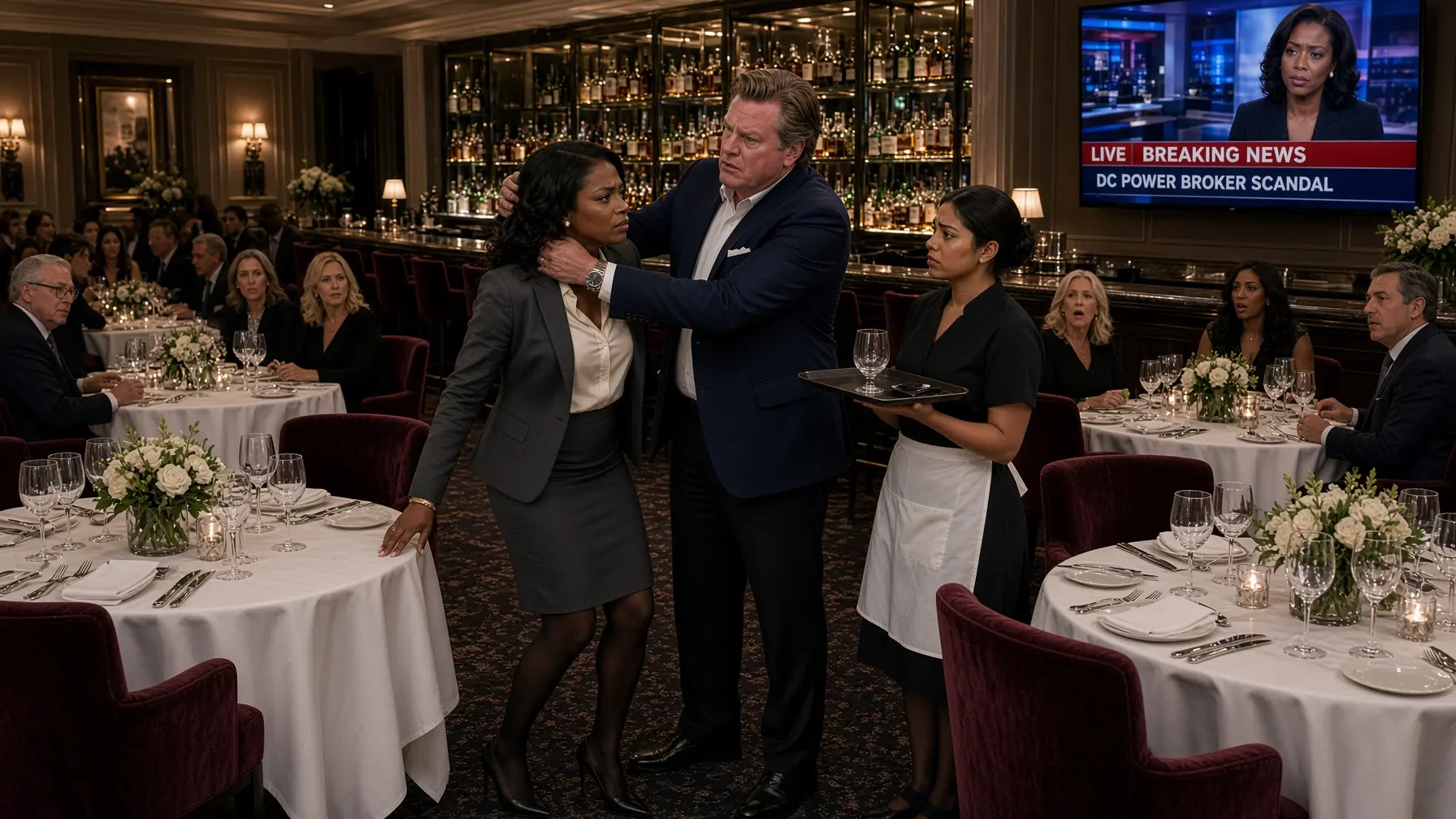
Grant Holloway’s fingers were still tangled in Nia Carter’s hair when the restaurant went quiet.
Not the soft quiet of a refined dining room between courses. Not the polite hush that drifts over white tablecloths and wine glasses when a pianist changes songs. This was a harder silence, the kind that arrives when an entire room realizes it has just crossed into something uglier than an argument.
Nia stood beside his table with one hand braced lightly against the linen edge, her body pulled half a step off balance by the fist at the side of her head. She did not scream. She did not claw at him. She did not flail.
Her jaw was tight. Her eyes were steady. Her anger had gone so cold that it barely looked like anger at all.
Grant, on the other hand, looked energized by the attention.
He had risen from his velvet chair so abruptly that it had scraped backward across the polished floor. One hand remained twisted in Nia’s smooth black curls, the other gestured sharply toward the front entrance.
“Get your filthy broke ass out of here,” he said loudly, making sure every nearby table could hear him. “People like you drag a place like this straight into the gutter.”
A young waitress named Lena froze three feet away, her serving tray pressed against her chest so tightly her knuckles had gone pale. Two older men at the next table stopped cutting into their steaks. A woman in emerald silk lowered her wine glass without taking her eyes off the scene. Someone near the bar had already reached for a phone.
Nia’s voice, when it came, was low and even.
“Take your hand off me.”
Grant gave a short, ugly laugh.
“Lena,” he snapped, without looking away from Nia, “do your job and throw her out before she ruins my appetite.”
Lena’s mouth opened, but before any words came, a burst of sound cut across the room from the large television mounted above the back bar.
The local evening news had returned from commercial.
The female anchor on-screen smiled toward the camera beneath a lower-third graphic and said, “Coming up next, an exclusive live interview with award-winning editor Nia Carter, the woman behind the investigative series that changed the city’s corruption trial.”
Nia’s photograph filled the screen.
A studio portrait. Cream blouse. direct gaze. unmistakable.
The same woman currently standing beside Grant’s table with his hand in her hair.
Lena’s face changed first.
Then the woman in emerald silk gasped.
Then somebody near the bar said, “Oh my God.”
Only then did Grant look up.
His grip loosened.
And for the first time all evening, he understood that the room was no longer watching Nia.
It was watching him.
Three hours earlier, Nia had promised herself the night would be simple.
A quiet dinner. One meal without cameras, board meetings, station lawyers, or congratulatory handshakes from people who suddenly remembered her name now that her face was on billboards and promo spots all over the city.
She had not wanted to go out at all.
By six o’clock she had already been awake for nearly fourteen hours. The day had started at a downtown studio before sunrise and had rolled straight through editorial meetings, a legal review on a pending story, a planning session with producers, and then a pre-interview segment for the station’s seven o’clock broadcast. Her phone had not stopped vibrating once. Texts from colleagues. Texts from old professors. Texts from distant relatives who had not spoken to her in years but had apparently seen her face on the news.
One message had finally worn her down.
It came from her older brother Malcolm.
You’ve spent ten years telling everybody else to show up when it matters. Tonight matters. Eat something that didn’t come from a newsroom vending machine.
He was not wrong.
That evening, Channel Eight was formally announcing her as the network’s new executive editor for special investigations, the youngest person and the first Black woman to hold the role in the station’s history. There would be a short segment before the live interview, a profile piece assembled from old footage and newsroom clips. The station wanted her in studio by seven. That left just enough time for a meal downtown before changing and heading back.
So she agreed to dinner with herself.
No entourage. No colleagues. No ceremony.
Just one hour of calm.
The Hawthorne Room had seemed safe for that.
It sat inside a restored brick building two blocks from the station, elegant without being theatrical. Local judges ate there. Surgeons celebrated promotions there. Men who wore expensive watches and believed they were humble because they preferred bourbon to champagne liked to become regulars there. The food was excellent. The waitstaff was professional. The management valued discretion.
Nia had been there twice before and had never had reason to regret it.
When she arrived that evening, dusk was slipping between the high-rises, turning the city windows bronze. She handed her keys to the valet, adjusted the cuff of her cream blouse beneath the charcoal jacket, and stepped inside.
The hostess greeted her with an apologetic smile.
“Ms. Carter? Your table’s almost ready. About ten minutes, if you don’t mind waiting.”
Nia smiled back. “That’s fine.”
She noticed him before he noticed her.
Grant Holloway sat halfway down the main dining room at a four-top near the center aisle, the kind of table people liked when they wanted to be seen. He was in a navy dinner jacket with a pocket square, too tan for November, too loud for the room despite technically speaking at a normal volume. Mid-forties, moneyed confidence, the expression of a man who believed politeness was something other people performed for him.
He was already making Lena nervous.
Nia noticed the way the waitress stood straighter when she approached his table, the way Grant barely looked at her face when he corrected the wine pour, the way his guests—another man in a dark suit and a woman who looked far younger than either of them—smiled too quickly after each of his jokes.
She had spent enough years reading rooms to identify the center of discomfort.
Grant was it.
Nia chose a small standing table near the bar to wait. She checked her phone, answered two messages, ignored six more, and skimmed through notes for the live interview.
At 6:18, Lena passed with a tray of cocktails. Grant stopped her.
Not with words at first. With fingers.
He snapped them once.
Nia looked up sharply.
Lena pivoted back immediately, a flush rising into her cheeks. Grant said something Nia could not hear. Lena apologized, though for what Nia couldn’t guess. She took away one of the glasses.