Eleanor had no answer.
But they found one.
Over the next two days, Marianne dug into the closed records of St. Agnes Hospital. The hospital had shut down years earlier, but old files still existed in storage. Former employees still lived in the city. Some refused to talk. Some said they did not remember.
One retired nurse finally did.
Her name was Judith Carver.
When Marianne first called, Judith said she knew nothing. But when Marianne mentioned Richard Whitmore, the twins, and possible criminal charges, the old woman began to cry.
She agreed to meet.
Judith arrived at Marianne’s office wearing a gray coat and carrying guilt like a weight on her back. Her hands trembled as she sat down. Eleanor was there. So was Marianne. Nathan waited outside the room with Eli, though the boys heard enough through the door to know something terrible was coming.
Judith told them that Eli had never died.
He had been weaker than Nathan at birth, yes. He needed extra care. But he was alive. Richard had spoken privately with a senior doctor. There had been money. Forms. A private transfer. Everyone involved had been told the baby would be placed quietly with another family.
Judith looked down, ashamed.
“I was young,” she whispered. “I was scared. Mr. Whitmore was powerful. I thought the child would be cared for.”
Eleanor’s voice turned cold.
“My child was barefoot on a sidewalk.”
Judith began to sob.
“I didn’t know. I swear I didn’t know.”
But not knowing did not undo anything.
That evening, Richard Whitmore came to the brownstone.
He did not knock like a man asking permission.
He entered like a man used to owning every room he stepped into.
He wore a long black coat, his silver hair combed back, his expression controlled. But when he saw Eli standing beside Nathan in the living room, something flickered across his face.
Not shock.
Recognition.
And then irritation.
Eleanor saw it.
That tiny moment told her more than any confession could.
“Richard,” she said, standing between him and the boys. “Explain.”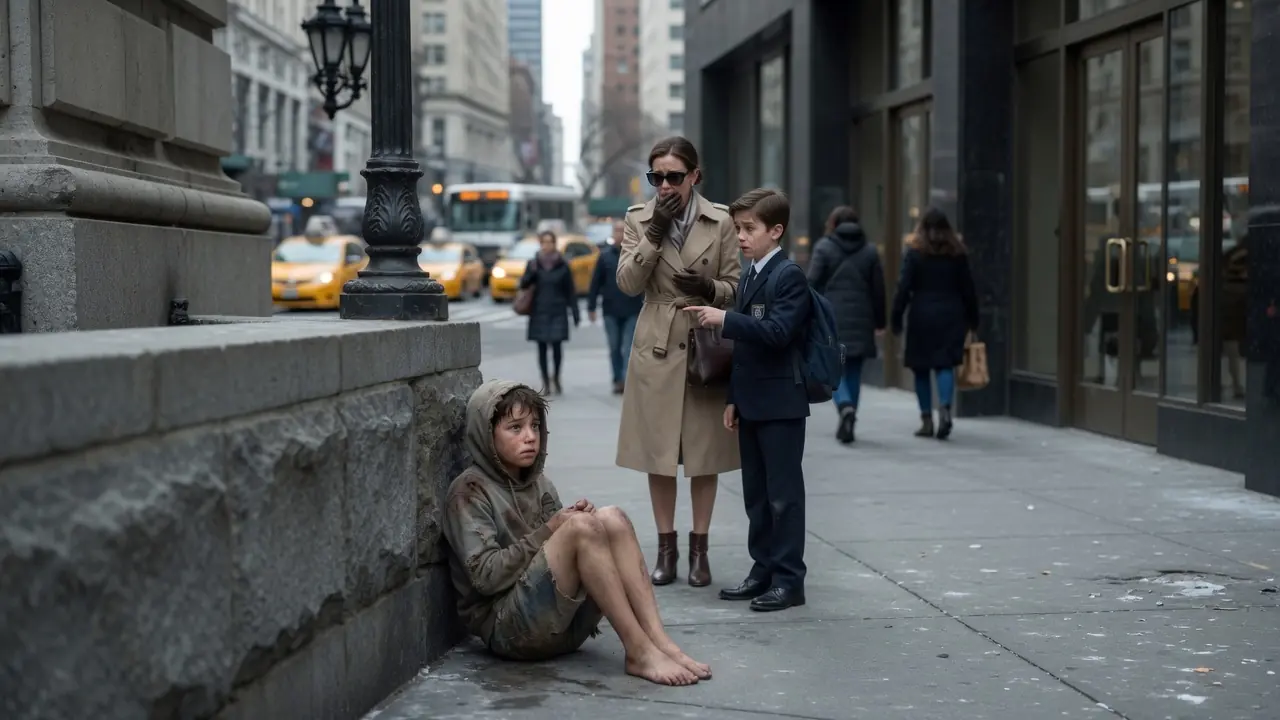
Richard looked at Eli like he was a problem that had returned.
“Who is this child?”
Nathan stepped forward.
“You know who he is.”
Richard’s eyes moved to him.
“Nathan, go upstairs.”
“No.”
The word shocked everyone.
Nathan had never spoken to his father that way before.
Richard’s jaw tightened.
“This is an adult conversation.”
“No,” Nathan said. His voice shook, but he did not step back. “This is about my brother.”
Eli looked at him.
Brother.
The word landed hard.
Eleanor held the DNA report in her hand.
“We have proof,” she said. “We have the locket. We have the DNA results. We have Judith Carver’s statement. I want the truth.”
Richard stared at her for several seconds.
Then he exhaled, almost bored.
“You were in no condition to make decisions at the time.”
Eleanor went still.
“What decisions?”
“The child was weak,” Richard said. “The doctors were uncertain. My family was under public scrutiny. There were inheritance matters. Press attention. You were unstable after delivery.”
Eleanor’s voice dropped.
“So you told me my baby was dead.”
“I protected you.”
“No,” Eleanor said. “You protected yourself.”
Richard’s expression hardened.
“I made the best decision I could.”
Eli stepped out from behind Eleanor.
His face was pale, but his eyes were steady.
“Did you know I was alive?”
Richard looked at him.
For one second, he said nothing.
And that was the answer.
Eli nodded slowly.
“You knew.”
“I did not know what happened after the arrangement,” Richard said.
“But you didn’t look.”
Richard’s mouth tightened.
“There was no reason to reopen an old wound.”
Eli gave a small, bitter laugh.
“Old wound?” he said. “I was the wound.”
The room went silent.
Nathan’s eyes filled with tears, but he did not wipe them away.
Eleanor turned to Marianne, who was standing near the doorway.
“Call them,” she said.
Richard’s face changed then.
“Eleanor, think carefully.”
“I have,” she said. “For twelve years, I thought one of my sons was dead. Tonight, I’m finally thinking clearly.”
The police investigation began that week.
The newspapers eventually got the story, of course. A wealthy financier. A hidden twin. A closed hospital. A mother who had mourned a child who was still alive. Reporters stood outside buildings. Cameras followed Richard. Lawyers issued statements. People who had once smiled at Eleanor at charity dinners suddenly became very quiet.
But inside the Brooklyn brownstone, the story was not about headlines.
It was about breakfast.
It was about Eli learning that he could take a second piece of toast without asking three times.
It was about Eleanor leaving a nightlight in the hallway because Eli did not like total darkness.
It was about Nathan pretending not to notice when Eli slipped extra granola bars into his drawer, then quietly adding more the next day.
Healing did not come like a movie ending.
It came slowly.
Some mornings Eli barely spoke. Some nights he woke up from dreams and sat on the floor with his back against the wall. Sometimes Eleanor reached for him and he pulled away. Sometimes he got angry over small things, because small things were safer to be angry about than twelve stolen years.
Eleanor learned not to take it as rejection.
She learned to stay.
That was what Eli needed most.
Not speeches.
Not gifts.
Not promises wrapped in guilt.
He needed someone who stayed when he was quiet, stayed when he was scared, stayed when he did not know how to be loved.
Nathan learned too.
He learned that sharing a mother was harder than he expected. He loved Eli. He wanted Eli safe. But sometimes, when Eleanor spent hours helping Eli adjust to doctors, school tutors, and counselors, Nathan felt invisible. Then he felt ashamed for feeling invisible.
One night, he finally admitted it.
“I’m glad he’s here,” Nathan told Eleanor. “But sometimes I feel like I lost you a little.”
Eleanor pulled him into her arms.
“You didn’t lose me,” she said. “I’m sorry I made you feel that way.”
Nathan held on tighter than he meant to.
Eli saw them from the hallway.
He almost turned away.
Instead, Nathan looked up and said, “Come here.”