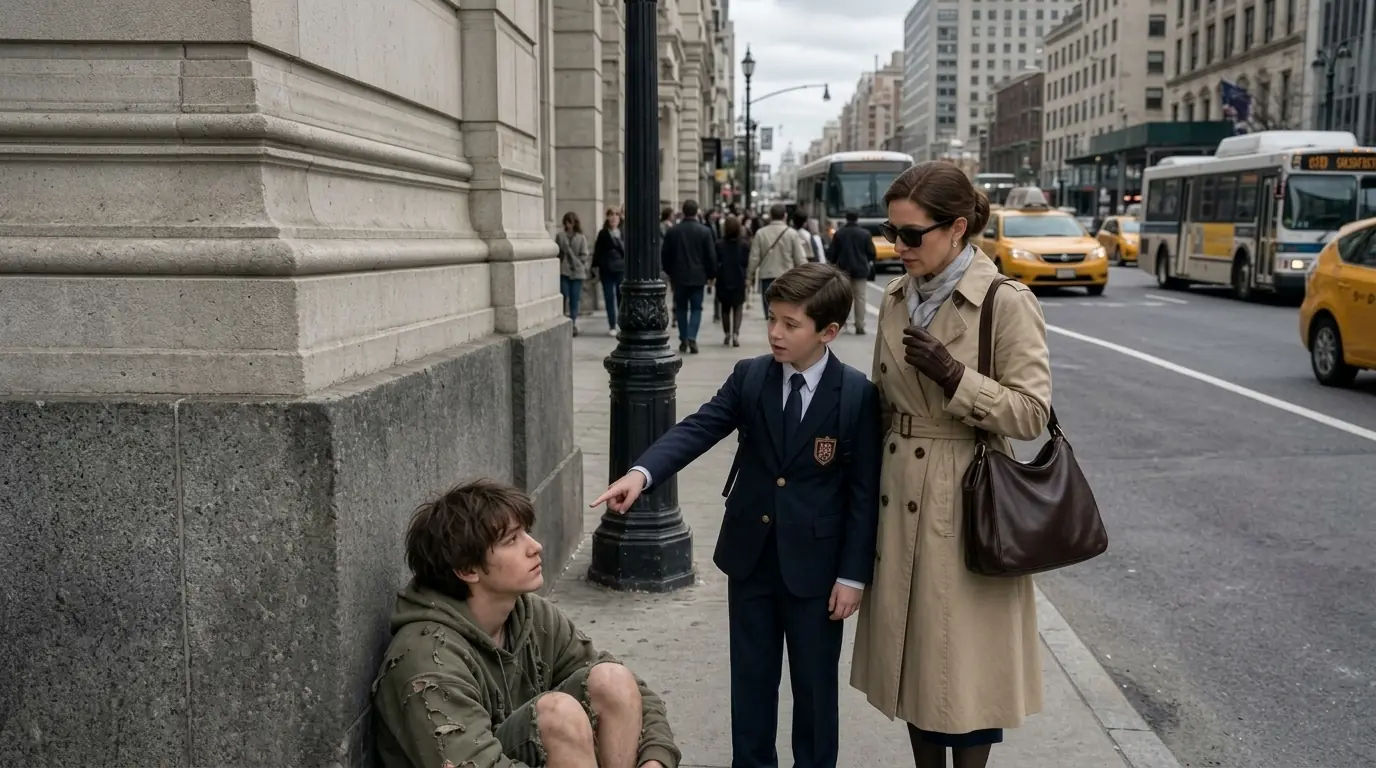
Traffic kept moving along Lexington Avenue as if nothing unusual had happened. Yellow cabs pushed through the intersection, delivery trucks blocked half the curb, and office workers hurried beneath a pale December sky with coffee cups warming their hands. Yet forty-six-year-old Victoria Langley had stopped so suddenly in the middle of the sidewalk that her thirteen-year-old son, Owen, nearly walked into her. Ten feet ahead of them stood a barefoot boy holding an old silver locket in one red, trembling hand.
He looked close to Owen’s age, although hunger had narrowed his face enough to make him appear younger. An oversized army-green jacket hung from his shoulders, his jeans were torn near one knee, and both feet were wrapped loosely in scraps of cloth darkened by winter slush. His brown hair needed cutting, his lips were cracked, and his eyes carried the exhausted caution of a child who had learned to evaluate strangers before speaking. Victoria might have assumed he wanted money if he had not been staring directly at her as though he already knew who she was.
“Mrs. Langley?” he asked. Owen turned toward his mother because almost nobody outside school events and charity dinners called her that on the street. Victoria did not answer, and the boy swallowed before taking one careful step closer. “I think this belongs to you,” he said as he opened the locket.
Inside was a faded photograph small enough to fit beneath his thumb. A young woman lay exhausted in a hospital bed, her hair damp against her forehead, while two newborn babies rested against her chest beneath matching striped blankets. Even after thirteen years, Victoria recognized the hospital gown, the silver bracelet on her wrist, and the tiny scar above her eyebrow that no camera had ever managed to hide. The woman in the photograph was her.
Owen looked from the picture to his mother and then back to the stranger. Something about the boy’s face made his expression change before he understood why. The eyes were nearly identical to his own, as were the slight bend in the left eyebrow and the dimple that appeared only when the boy tightened his mouth. Owen whispered, “Mom?”
Victoria could not answer because the sidewalk had disappeared around her. She was back beneath white hospital lights at St. Catherine’s Medical Center thirteen years earlier, barely conscious after an emergency delivery while doctors moved around her with urgent voices. Her husband, Charles, had stood beside the bed holding her hand and crying in a controlled, silent way she had never seen before. He had told her one of their twin sons had died.
She remembered asking to see the baby. Charles said the doctors thought it would be cruel in her condition and that he had already taken care of everything. Victoria had been weak from blood loss, sedated after surgery, and terrified that the surviving child might die too. When a nurse finally placed Owen in her arms, love and grief arrived at the same time and became impossible to separate.
For thirteen birthdays, Victoria had purchased one small white rose in memory of the child she believed she had lost. Charles disliked the ritual and told her repeatedly that grief should eventually become private enough not to affect the living. She stopped putting the flower at the dinner table after Owen turned six, but she never stopped buying it. She kept each dried stem inside a cedar box in her dressing room.
Now the dead child was standing barefoot in front of her. Victoria pressed one hand over her mouth while the boy watched with growing fear. He seemed ready to run at the first sign she did not recognize the picture. “Where did you get that?” she finally whispered.
The boy closed the locket halfway. “The woman who raised me had it.” His voice was soft but flat, as though he had rehearsed the sentence too many times. “She said if I ever found you, I should ask why you gave me away.”
Victoria’s knees weakened. Owen grabbed her arm before she stumbled into a woman pushing a stroller. “She told you I gave you away?” Victoria asked.
The boy nodded. “Her name was Rosa Alvarez. She wasn’t my real mom, but she was the only mom I knew.” He looked toward the sidewalk rather than at Victoria. “Before she died, she said somebody brought me to her when I was a baby and told her my family didn’t want me.”
Victoria stared at him. “I never gave you away.” The words came too quickly, almost harshly, and the boy flinched. She lowered her voice immediately.
“I didn’t know you were alive,” she said. “I swear to you, I was told one of my babies died.” The boy looked back at the locket, and a muscle tightened near his jaw. “Then somebody lied.”
Owen stepped closer to him. “What’s your name?” he asked. The boy hesitated for several seconds.
“Caleb.” Victoria repeated it under her breath, and hearing the name made something inside her break because she had never been permitted to name the son she lost. Charles had insisted that creating a name for a baby who lived only minutes would make her grief harder. For years she had privately called him Baby B because that was what one hospital bracelet had said.
Caleb was watching her cry now with visible discomfort. He had probably imagined anger, rejection, disbelief, or maybe an embrace. He did not seem prepared for a woman in an expensive cream coat to stand on a Manhattan sidewalk looking as though she had suddenly lost the ability to breathe. “I can go,” he said.
“No.” Victoria reached toward him and stopped before touching him. “Please don’t.”
Caleb’s shoulders tightened. Owen noticed the reaction and took a step backward to give him room. Victoria noticed that too.
“How did you find us?” she asked. Caleb slipped the locket into his palm and looked across the avenue toward Wellington Preparatory School, the private academy Owen attended three blocks away. “There was another paper with the necklace.”
Rosa had kept an old photocopy of a hospital identification sheet containing the surname Langley and the words St. Catherine’s. After Rosa died six months earlier, Caleb spent weeks searching public library computers for the hospital name and wealthy families named Langley connected to Manhattan. Eventually he found photographs from a charity event featuring Victoria, Charles, and Owen. Seeing Owen had frightened him because the resemblance made the impossible story suddenly believable.
“I saw him outside school three days ago,” Caleb said, looking at Owen. “I followed him because I wanted to see where he went.” Owen remembered a thin boy near the deli across from school, but he had barely registered him. The realization turned his stomach.
“You were there every day?” Owen asked. Caleb nodded. “I wanted to talk to you, but you had friends around.”
Owen looked down at his polished shoes. That morning he had complained because one lace felt tighter than the other. Caleb had been standing outside without any shoes at all. “Where have you been sleeping?” Owen asked.
Caleb shrugged. “Different places.” Victoria’s face tightened.
Rosa had lived with him in Queens until cancer took her. Her landlord allowed Caleb to remain in the apartment for several weeks before discovering no adult guardian existed. Caleb panicked when social services became involved because Rosa had spent years warning him that authorities might separate him permanently from anything connected to his past. He ran.
For several months he moved among shelters, train stations, church basements, and occasionally apartments belonging to adults who knew Rosa. Some were kind. Others wanted money or work he could not reasonably provide. One man stole the silver locket and made Caleb unload boxes behind a restaurant for two days before returning it.
Victoria had to look away. She thought of Owen’s bedroom overlooking Central Park, his winter boots lined beneath the bench, and the argument they had the previous week about whether he needed a new gaming system. None of that was Owen’s fault. The contrast still made her feel physically ill.
“Come with us,” she said. Caleb immediately stepped backward. “No.”
Victoria stopped. “All right.”
Owen looked confused. “Mom, it’s freezing.” Victoria nodded.
Then she looked directly at Caleb. “You do not have to come to our apartment, and you do not have to meet anybody you don’t want to meet.” She carefully removed her gloves and held them out.
“Can we at least get somewhere warm while we figure out what you want?” Caleb stared at the gloves. “Where?”
“There’s a café around the corner.” He considered it. “Public?”
“Yes.” Caleb nodded once.
The café was crowded enough to make him feel safer. He chose a table against the wall with a clear view of both entrances, and Victoria resisted the urge to ask why. Some questions were already answered by the way he sat.
She ordered tomato soup, grilled cheese, hot chocolate, and apple pie. Caleb said he was not hungry until the food arrived. Then he stared at the plate long enough that Owen quietly looked away to give him privacy.
Caleb ate slowly for the first few minutes. He broke the sandwich into small pieces and chewed carefully, as if someone had taught him that hunger looked shameful when visible. Halfway through the soup, control gave way and he began eating faster.
Victoria felt tears rising again. “You don’t have to slow down for us.” Caleb stopped moving.
“Rosa said people treat you different when you eat like you haven’t seen food before.” Victoria swallowed. “Rosa sounds like she spent a lot of time trying to protect you.”
Caleb’s expression softened for the first time. “She did.” He explained that Rosa had been a nursing assistant when she was younger but developed chronic back problems and later cleaned offices at night.
She never had much money. Sometimes rent came late, sometimes the electricity was shut off for a day or two, and Caleb learned early which grocery stores marked bread down in the evening. Still, Rosa attended parent meetings, made birthday pancakes, and once spent three months saving for a secondhand bicycle he later had stolen.
“She wasn’t perfect,” Caleb said. “She yelled a lot when she was scared.” Victoria nodded. “Parents do that sometimes.”
Caleb studied her. “Did you?” The question surprised her. “Yes.”
Owen immediately said, “Definitely.” Caleb almost smiled.
It disappeared quickly, but Victoria saw it. She wanted to reach across the table and take his hand. She did not.
Instead she asked whether Rosa ever mentioned who brought him to her. Caleb said she described a woman from a private adoption organization who arrived with paperwork stating the biological parents had requested confidential placement. Rosa had originally planned to foster only temporarily, but the organization disappeared before a legal adoption was completed.
That created years of uncertainty. Rosa eventually obtained guardianship through family court using the documents she possessed, but she never believed the story about Caleb’s parents abandoning him. The photograph bothered her.
“What mother who didn’t want a baby keeps holding both of them for a picture?” Rosa once asked. That question stayed with Caleb.
Before dying, she gave him the locket and made him promise he would look for the woman in the photograph if he ever felt ready. “She said maybe the truth would hurt,” Caleb said. “But at least it would be mine.”
Victoria closed her eyes. She already loved Rosa Alvarez for that sentence.
Owen pushed his untouched pie toward Caleb. Caleb immediately asked, “Why?” Owen shrugged awkwardly. “Because you finished yours.”
“You feel sorry for me.” Owen looked embarrassed. “Probably.”
Caleb’s face hardened. Owen continued before he could respond.
“But I also don’t know what I’m supposed to do right now.” He looked at Caleb directly. “I might have a twin brother who’s been living outside, and this morning my biggest problem was a history test.”
Caleb watched him. Owen pushed the plate halfway between them. “So maybe we split it and both stop acting normal.”
Caleb looked down. Then he moved the plate into the middle. They each took a fork.
Victoria watched them share the pie and felt hope arrive in a form so fragile she almost feared naming it. She stepped outside before the emotion became too much and called the one person she trusted to help without alerting Charles. Her attorney, Rebecca Doyle, answered on the second ring.
“Victoria?” she said. “Is everything all right?” Victoria looked through the café window.
Owen was saying something to Caleb that made Caleb’s eyebrows lift. Two boys with the same face sat on opposite sides of a small table, one wearing a Wellington blazer and the other an oversized secondhand jacket. “Rebecca, I need you tonight.”
Her attorney’s tone changed instantly. “What happened?” Victoria took a breath.
“I found my son.” There was silence.
Then Rebecca said, “Owen is with you.” Victoria closed her eyes.
“Not Owen.” Another silence, longer this time.
“Victoria, tell me exactly what that means.” She did.
Rebecca told her not to confront Charles, not to return to the Fifth Avenue apartment, and not to discuss the situation electronically except through a secure line she would arrange. She would organize an emergency DNA test, locate hospital records, and contact a child-welfare attorney because Caleb’s current legal status needed immediate attention. For the first time that afternoon, Victoria felt someone else carrying part of the weight.
She returned to the table. “We’re not going home.” Owen looked up.