“Who are you, and what are you doing on my land?”
Garrett Whitlock asked the question before his horse had fully stopped moving. The morning was still young, but the mountains had already turned hard with winter, the kind of cold that made leather stiff and breath rise white from a man’s mouth. Snow lay thin across the high ridges, not deep enough to bury the sage, but enough to turn the whole country pale and watchful.
Garrett had ridden out from Stone Creek Ranch before sunrise, as he did every December after the first real freeze. Men in town called him rich, and they were right, but they mistook wealth for ease. Garrett owned more cattle than some counties could count, more timber than most men could dream of, and more miles of fence than any hired crew could check in a week.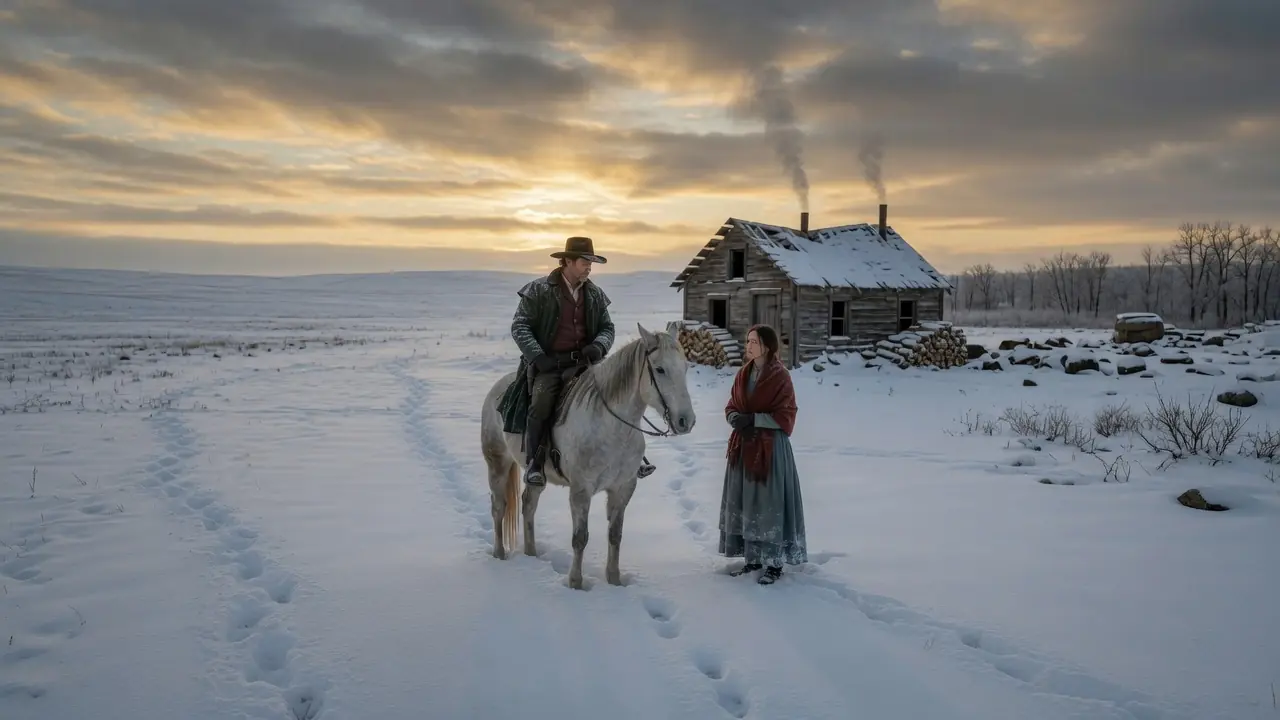
But land did not stay loyal just because a man’s name was written on a deed. Water lines froze, fences broke, drifters crossed where they had no right to cross, and winter had a way of finding every weakness a rancher ignored. Garrett believed in seeing things with his own eyes, so each year he rode the far northern reaches of his property, where the pines grew thick and the valley dropped into a hidden cut of rock and snow.
That was where he saw the smoke.
It rose from the chimney of an old trapper’s cabin he had not thought about in years. The place sat low in a narrow hollow beneath the ridge, half-hidden by juniper, pine, and a wall of wind-carved stone. The roof had sagged the last time Garrett passed through, the porch leaning sideways, the shutters hanging like broken wings.
No one had lived there in twenty years. At least, no one was supposed to.
Garrett pulled his black gelding to a halt and narrowed his eyes. The smoke was thin but steady, not the ragged smoke of a careless fire or a passing camp. Someone had banked it right, fed it right, and trusted it to hold through the night.
He rode closer without hurry. Garrett Whitlock did not rush when he was angry, and he was not angry yet. A trespasser could be a thief, a fool, a child, a fugitive, or someone with nowhere else to go, and he had learned long ago not to spend judgment before collecting facts.
The closer he came, the more the cabin told him. Fresh-cut wood was stacked beneath the eaves. The door had been rehung with new leather hinges. A cracked window was patched with oiled cloth stretched tight enough to keep out the worst of the wind.
Somebody had not merely stumbled into shelter. Somebody had worked.
Garrett dismounted, boots sinking into the crusted snow. His horse flicked an ear, breathing warm clouds into the blue-white cold. Garrett rested one hand near the rifle in his saddle boot, not reaching for it, only reminding himself that soft questions sometimes needed hard backup.
He crossed the small clearing and stepped onto what remained of the porch. Before he could knock, the door opened.
A woman stood inside with a lantern in one hand and a folded blanket over her arm. She looked no more surprised to see him than if she had been expecting the mail. Her dress was plain, her sleeves rolled, her dark hair tied back without vanity, and her eyes met his with a calm that did not ask permission to exist.
Garrett had seen fear before. He had seen lies, panic, defiance, and the quick little smiles people used when they wanted something. This woman showed none of those things.
“Morning,” she said. “You must be Mr. Whitlock.”
Garrett studied her. “You know my name.”
“Hard not to. Your cattle wear it. Your fences wear it. Half the wagons in Bellweather Pass carry something that came from your ranch.”
“That does not answer my question.”
“No,” she said. “It does not.”
He waited. Most people filled silence because they were afraid of what it might expose. She did not.
Garrett tipped his chin toward the cabin. “This place sits on Stone Creek land.”
“I know.”
“And you are living in it.”
“For now.”
That answer was too simple to be a lie. Garrett stepped nearer, his shadow falling across the threshold. “Name.”
“Elena Marlow.”
She said it clearly, with no hesitation and no apology. Garrett let the name settle in his mind, searching for any memory of it from town ledgers, market gossip, court notices, or debt lists. Nothing came.
“You alone here?”
“Yes.”
“How long?”
“Long enough to know the roof leaks from the west side and the chimney draws better after noon.”
That almost made him smile. Almost. “That is not an answer either.”
“Three weeks,” Elena said. “Give or take two days.”
The wind moved through the pines behind him, carrying loose snow off the branches in a pale whisper. Garrett looked past her into the cabin. He saw a clean hearth, stacked kindling, a table made from two boards, a kettle hanging over low coals, and strips of cloth stuffed between the logs where the cold would have found its way in.
It was poor shelter, but not pitiful. That distinction mattered.
“You invite yourself into abandoned buildings often?” he asked.
“Only when they look less dangerous than the road behind me.”
Garrett heard the line beneath the line. A road behind her. Trouble behind her. A reason she was not eager to name.
He removed his gloves slowly. “Are you wanted by the law?”
“No.”
“Are you running from a husband?”
“Family?”
She looked toward the hearth. Not away from him exactly, but away from the question. “Not anymore.”
That was grief, but she wore it like an old coat, not a fresh wound. Garrett understood that better than he wanted to. His own mother had died when he was twelve, and his father had turned grief into work so completely that Garrett had inherited both the ranch and the habit.
Elena stepped back from the doorway. “Since you rode this far, you may as well come in where the wind won’t bite your face off.”
Most trespassers begged. Some cried. A few lied before a man even asked the right question. Elena Marlow offered shelter in a cabin she had no legal right to occupy, and did it with the steady manner of a woman who believed dignity did not require ownership papers.
Garrett stepped inside.
The cabin was warmer than he expected. Not comfortable, not by any decent standard, but alive. A blanket had been nailed over the worst gap in the north wall, and a stack of stones held up one corner of the table. Dried roots and wild herbs hung from the rafters in careful bundles.
A tin cup sat on the hearthstone. A sewing needle rested beside a folded shirt. Nothing was wasted. Nothing was decorative unless usefulness had already been satisfied.
“You patched the roof,” Garrett said.
“As much as one woman can patch with bad tools and stubbornness.”
“You cut that wood yourself.”
“It refused to cut itself.”
This time Garrett did smile, though it faded quickly. He walked the room slowly, not touching anything. The place smelled of smoke, pine sap, damp wool, and survival.
“You understand I could have you removed.”
“I do.”
“You understand I could ride back to Bellweather Pass and return with the sheriff.”
“I do.”
“But you do not look worried.”
Elena met his eyes. “Worry does not change much. Work does.”
Garrett stopped near the table. That answer stayed with him. He had built an empire on a similar belief, though he had never said it so plainly.
“What brought you to my land, Miss Marlow?”
For the first time, her steadiness shifted. Not enough to break, just enough to prove it cost her something. She took the kettle from the hook, poured hot water into the tin cup, and set it near him without asking whether he wanted it.
“I needed a place where no one would look first.”
“Who is no one?”
“Men who win because the law gets tired before they do.”
Garrett looked at her more sharply. “That sounds like a dangerous kind of trouble.”
“It is.”
“You bringing it here?”
“I hope not.”
“Hope is not a fence, Miss Marlow. It does not keep anything out.”
“No,” she said. “But sometimes it keeps a person standing until they can build one.”
There was no pleading in her voice. That made it harder, not easier. Garrett could turn away from manipulation, fear, or theatrics, but plain truth had a weight of its own.
He took the cup and let the heat warm his fingers. “How long did you intend to stay?”
“Until spring if I could. Less if I had to.”
“And after that?”
“I have not had the luxury of after that.”
Garrett looked around the cabin again. Spring was months away. A hard winter could kill a person in a place like this, especially a person alone, especially if a roof gave way or sickness came through the door. He could send her off, wash his hands clean, and remain fully within his rights.
But rights and decency had never been the same thing.
“I will think on it,” he said.
Elena nodded once. “Fair enough.”
Garrett set the cup down. “Do not mistake thinking for permission.”
“I won’t.”
“And do not leave this hollow without telling me where you mean to go. If trouble follows you, I will not have it sneaking through my fences blind.”
“I understand.”
He stepped back outside. The cold struck him hard, but it felt simpler than the cabin, simpler than the woman inside it. Garrett mounted his horse and looked once more at the thin smoke rising into the morning sky.
Elena Marlow had not begged him to save her. That was the thing he thought about as he rode away. She had simply stood in the ruin she had repaired and waited for him to decide what kind of man he meant to be.
Garrett Whitlock did not sleep well that night.
It was not worry exactly. Worry was for men who lacked plans. Garrett lay awake because plans required facts, and Elena Marlow was a fact he could not yet place.
By dawn he was at his desk, where the ledgers were stacked in neat columns and the oil lamp burned low. Outside, the ranch yard stirred with the first sounds of morning: horses stamping in stalls, men calling to one another, iron hinges groaning in the cold. Garrett pulled a clean sheet from his ledger book and began to write.
He wrote the way he handled land contracts: precise, spare, without sentiment. Elena Marlow would be permitted to occupy the north hollow cabin through the end of winter. In exchange, she would perform work useful to Stone Creek Ranch: marking damaged fences, reporting spring washouts, checking distant water points, keeping a fire in the old line shelter when storms threatened.
It was not charity. Garrett did not trust charity. Charity put one person above another and called it kindness.
Work made the ground level.
He rode back to the cabin after breakfast, the folded agreement tucked inside his coat. Elena was outside when he arrived, hauling a split log from the wood pile. Snow dusted her shoulders, and a scarf covered her hair, but she moved with that same clean efficiency he had noticed the day before.
“You came back,” she said.
“I said I would think on it.”
“And did you?”
“I did.”
She set the log down and waited. Garrett dismounted, tied his horse to a low branch, and took the paper from his coat.
“This is an agreement. If you sign it, you may stay here until the spring thaw. You will not be trespassing. You will be working under my authority.”
Elena looked at the paper but did not reach for it yet. “Doing what?”
“Checking fence lines north of the creek. Reporting damage. Marking places where water freezes over or gullies deepen. Keeping note of any strangers crossing the back ridge. It is work I need done and work you appear capable of doing.”
Her eyes moved from his face to the paper. “And the cabin?”
“You may use it as shelter through winter.”
“And wages?”
Garrett had expected that question, but not so directly. He respected it. “Food stores every two weeks. Basic supplies as needed. Ten dollars monthly.”
“That is more than fair.”
“It is accurate for the work.”
“May I read it?”
He handed it over. She took the paper with both hands and read every line carefully. Snow continued to fall in light grains, settling on the brim of Garrett’s hat and the shoulders of his coat.
Elena read it once. Then she read it again.
“You wrote that either party may end the agreement with seven days’ notice,” she said.
“I did.”
“Make it three days for me.”
Garrett lifted his brow. “Why?”
“Because if the trouble I spoke of finds me before spring, I may need to leave faster than seven.”
There it was again, the thing behind her eyes. Not fear exactly, but calculation shaped by experience.
Garrett took the paper back, pulled a pencil from his coat, and braced the agreement against his saddle. “Three days, then.”
He changed the line, then handed it back. Elena read the correction and gave one slow nod.
“You are a careful man, Mr. Whitlock.”
“Careless men lose ranches.”
“And careful women survive winter.”
He looked at her. “That they do.”
She signed her name at the bottom. Elena Ruth Marlow. Her handwriting was fine and steady, each letter shaped with quiet confidence.
Garrett signed beneath it. His name took up more room than hers, bold and practiced, but for some reason he noticed how natural the two signatures looked on the same page. Not equal in size, perhaps, but equal in intention.
“That settles it,” he said. “You work for Stone Creek now.”
Elena handed him the contract. “Then I suppose I should start.”
“East fence line. Follow the creek until it bends under the granite shelf. Mark anything broken. Do not cross beyond the old burned pine. That land drops steep after the snow.”
“I know the shelf.”
“You have been that far?”
“Not foolish enough to live somewhere without learning the exits.”
Again, Garrett found himself approving before he had time to stop. “Good.”
Elena pulled on her gloves and reached for a small notebook on the porch rail. The book had been stitched together from scraps of paper and twine, but the pages were filled with neat marks and observations. She had already been doing the work before he named it.
He watched her walk toward the creek, her boots making sure tracks in the snow. She did not look back to see if he was watching. That, more than anything, told Garrett the agreement would hold.
Elena Marlow was not looking for rescue. She was looking for room to stand.
Two weeks passed, and Stone Creek Ranch ran smoother for having her in the north hollow.
Garrett did not say that aloud. He did not need to. Her reports came every Friday afternoon, written in the same careful hand as her signature, with damaged rails marked by distance and direction, frozen springs noted by depth, and weather changes recorded better than some hired riders could manage.
She found three broken fence posts before cattle slipped through them. She marked a washout near the ridge that would have swallowed a wagon come thaw. She noticed strange tracks near the old miner’s road and described them with enough detail for Garrett to know it had been two men, not one, riding light, not hauling.
Capability was hard to ignore when it kept proving itself useful.
By the time Founders Day came to Bellweather Pass, Garrett had stopped thinking of Elena as a problem and started thinking of her as an answer to several. He rode into town under a low gray sky, the main street strung with faded bunting and pine garlands. The town looked half frozen and half determined, which was how mountain towns survived in the first place.
Children ran between wagons with red noses and mittened hands. Women sold pies from covered tables near the church steps. A brass band near the saloon fought bravely against the cold, playing tunes that sounded better in spirit than in execution.
Garrett hated social obligations, but wealth came with them. A man who owned the largest ranch in three counties could not simply disappear when the town gathered. He funded the school roof, supplied beef for winter relief, and kept enough people employed that even those who disliked him still nodded respectfully when he passed.
“Whitlock!” called Silas Boone from the feed store porch. “Settle something. If a creek jumps its bed after flood season, does the boundary move with it?”
Garrett did not slow. “Not unless the deed says waterline instead of marked survey.”
Silas cursed under his breath. “That is what I told him.”
“Then tell him louder.”
Garrett moved on before anyone could recruit him into a full argument. Founders Day always loosened tongues and sharpened old grudges. Boundary lines, grazing rights, unpaid bills, courtship scandals, missing tools, borrowed horses, every grievance in town seemed to put on its boots and come walking.
He had nearly reached the blacksmith’s tent when he heard a name he had not heard in years.
“Pritchard’s back,” someone said.
Garrett stopped.
The voices came from behind a canvas stall stacked with sacks of flour. Two men stood close together, speaking low, but not low enough.
“I saw him with my own eyes,” one man said. “Elam Pritchard, same long coat, same yellow teeth. Claims he is only passing through, but he was at the recorder’s office asking after widow parcels.”
“Widow parcels?” the other man muttered. “That snake never changes.”
“Blue Mesa woman lost her land last winter after he filed some forfeiture paper. Swore she never signed it. Sheriff said the document had a seal, and that was the end of it.”
Garrett’s jaw tightened.
“He forges clean,” the first man said. “That is the trouble. Takes land from people who cannot afford to challenge him, then sells it twice before anyone catches breath.”
Elam Pritchard.
The name was filth wrapped in polish. Garrett remembered him now: a land agent with a lawyer’s vocabulary and a thief’s soul. He had passed through the territory years ago, buying disputed parcels for pennies, leaning on widows, debtors, and illiterate farmers until their names disappeared from land they had bled to hold.
Garrett had never had business with him. Pritchard avoided men with money, influence, and lawyers of their own.
He preyed on people standing alone.
Garrett moved past the flour stall before the men noticed him. The mayor had started his speech near the church, waving one gloved hand and speaking about endurance, legacy, and the proud spirit of Bellweather Pass. People clapped at the proper places.
Garrett heard none of it.
His mind had already ridden north to the cabin. Elena’s words returned with unwanted clarity. Men who win because the law gets tired before they do.
He stayed through the speech because leaving too abruptly would start questions. He shook hands, bought two jars of preserves he did not need, and agreed to supply the school with extra coal through February. But each conversation passed through him without taking hold.
Elam Pritchard was back in the region. A forged forfeiture near Blue Mesa matched Elena’s silence too closely to be coincidence. And if Garrett had learned anything from land, it was that trouble left tracks long before most men bothered to look down.
The next morning, Garrett rode to the north hollow.
Elena was kneeling beside the cabin wall when he arrived, packing mud and straw into a crack where wind had been cutting through. She looked up at the sound of hoofbeats but did not stand immediately. Snow clung to her skirt, and a dark smudge of soot marked one cheek.
“You ride early,” she said.
“This is not a work inspection.”
That made her stand.
Garrett dismounted and looped the reins over a branch. For a moment, he considered how much to say. Then he decided the truth was cleaner.
“I heard a name in town yesterday. Elam Pritchard.”
Elena’s hand went still at her side. The change was small, but Garrett saw it. A woman like her had trained herself not to flinch, but names had a way of striking places armor did not cover.
“You know him,” Garrett said.
“I know what he does.”
“To land?”
“To people first. Land after.”
Garrett stepped closer but kept enough distance not to crowd her. “Was he the trouble behind you?”
Elena looked toward the ridge, where the clouds dragged low over the pines. “Yes.”
The word came out quiet, but there was no weakness in it.
Garrett waited.
“My husband, Nathan, left me forty acres near Blue Mesa,” she said. “Good soil by mountain standards. A little creek, a stand of pine, enough room for a cow, a garden, maybe one day a proper house.”
Her voice stayed even. That made the story worse somehow. “Nathan died of fever, and by the time I buried him, Pritchard had already heard there was a widow with land and no brothers nearby.”
“What did he claim?”
“Debt first. Then disputed boundary. Then an old lien I had never seen. He brought papers and told me signing would settle things clean. I refused.”
Garrett nodded once. “So he forged what he needed.”
“One morning I woke to men pulling down my fence. They had a deed saying I had forfeited the parcel to satisfy debt. My signature was on it. A judge’s clerk stamped it. The sheriff told me his hands were tied.”
“Did you fight?”
“With what?” Elena turned back to him now, and the calm in her eyes had sharpened. “Money? Lawyers? Witnesses who suddenly remembered errands when I asked for help? Pritchard did not steal from me because he was clever. He stole from me because he knew no one would spend more to defend me than he could spend to ruin me.”
Garrett felt anger move through him slowly, heavy as winter water beneath ice. He trusted anger only after it had cooled enough to become useful.
“Do you have anything from the land?” he asked. “Any deed copy, tax note, receipt, letter?”
Elena went inside without answering and returned with a small tin box. She opened it and removed folded papers wrapped in cloth. Her hands did not shake, but she handled them like they were the last living pieces of something lost.
“My husband’s original deed,” she said. “Our tax receipt from the year before he died. A letter from the county office confirming the parcel was free of debt.”
Garrett took them carefully. “Why did you not show me these before?”
“Because papers did not save me the first time.”
“No,” he said. “But the right man carrying them might.”
Elena studied him. “And you are that man?”
“I can be.”
“Why?”
The question did not surprise him. It was the only one worth asking.
Garrett looked past her at the patched roof, the woodpile, the smoke, the careful life she had built from abandonment. “Because you work under my name now. Because a forged deed left unchallenged is rot in the whole county record. Because men like Pritchard grow bold when decent people call their crimes none of their business.”
He handed the papers back. “And because you should not have had to run to survive what was already yours.”
For the first time since he had met her, Elena’s expression changed enough to show what lived underneath it. Not tears. Not softness. Something more dangerous.
Hope.
“What do you need from me?” she asked.
“Dates. Names. Every man who came to your fence. Every clerk who looked at those papers. Every word Pritchard said if you remember it.”
“I remember all of it.”
“I thought you might.”
They sat at the rough table while the fire burned low, and Elena told him the story from the beginning. Garrett wrote it down in his notebook, every detail, every name, every date. He did not interrupt unless precision required it.
By the time he left, the sky had gone iron gray. Snow began again, soft but steady. Garrett tucked Elena’s copied facts into his coat and rode toward town with the expression of a man who had found a cracked beam in a bridge and meant to replace the whole span before anyone else crossed it.
He went first to the county recorder, Abel Voss, a cautious man with ink on his fingers and fear of disorder in his bones.
The recorder’s office smelled of dust, paper, coal smoke, and old authority. Ledgers lined the walls in heavy volumes, each one recording the fate of farms, ranches, widow parcels, mining claims, and the bones of men’s futures. Abel looked up when Garrett entered and straightened so fast his chair scraped the floor.
“Mr. Whitlock. What brings you in?”
“Blue Mesa transfers. Winter before last. Name of Elena Ruth Marlow.”
Abel’s face changed by half an inch, but that was enough. “Marlow. Yes. I believe there was a forfeiture.”
“I want the ledger.”
“Those records are not—”
Garrett removed one glove and set it on the counter. He did not raise his voice. “I want the ledger.”
Abel swallowed. “Of course.”
He brought out the volume, heavy and leather-bound. Garrett turned the pages until he found the entry. There it was, recorded in black ink and official language, reducing a woman’s life to a transaction.
Forfeiture of parcel to Elam Pritchard Holdings for satisfaction of prior debt.
A signature followed.
Garrett stared at it for a long time. He had Elena’s true signature in his coat on the work agreement. The two did not match. Not slightly, not imperfectly, not in the way a frightened person’s hand might change under pressure.
They were different hands entirely.
“Who witnessed this?” Garrett asked.
Abel leaned closer. “Clerk’s mark says Jonas Pike.”
“Where is Pike now?”
“Gone west. Or drunk in a ditch. Hard to say.”
“And Pritchard filed it himself?”
“Yes.”
“Were debts verified?”
Abel’s mouth tightened. “There was a note attached.”
“Show me.”
The note, when found, was thin and convenient. It claimed Nathan Marlow had owed money for livestock feed, tools, and supplies. No merchant signature. No account seal. No itemized ledger.
Garrett looked at Abel. “You accepted this?”
“I did not handle the original filing.”
“But your office recorded it.”
“The sheriff had reviewed the papers.”
“Lazy men always point at the next lazy man.”
Abel flushed. “Mr. Whitlock—”
Garrett closed the ledger. “Make a certified copy of this transfer, the attached note, and every document tied to the parcel. I want them today.”
“That will take time.”
“You have until noon.”
From the recorder’s office, Garrett went to the sheriff. Sheriff Tom Rusk was a broad man with tired eyes and a talent for surviving between stronger men’s disputes. He was not corrupt exactly. He was worse in some ways.
He preferred peace over justice when justice made noise.
“You remember Elena Marlow?” Garrett asked.
The sheriff shifted behind his desk. “Widow up near Blue Mesa?”
“That is the one.”
“She lost a parcel. Hard thing.”
“She had it stolen.”
Rusk sighed. “Garrett, papers were stamped. I cannot go undoing county business because a woman later regrets signing.”
“She did not sign.”
“You got proof?”
“I will.”
The sheriff rubbed his jaw. “Pritchard is slippery. Always has been. You stir that water, you better be ready for what comes up.”
“I am.”
“I figured you might be.”
By late afternoon, Garrett found Elam Pritchard in a rented room above the livery, where the smell of horses rose through the floorboards and mixed with cigar smoke. Pritchard opened the door wearing a waistcoat too fine for the town and a smile too thin for friendship.
“Garrett Whitlock,” he said. “What an honor. I did not realize Stone Creek had business with me.”
“It does now.”
Pritchard’s smile stayed, but his eyes sharpened. “Come in, then.”
Garrett remained in the hallway. “You filed a forged forfeiture on Elena Marlow’s Blue Mesa parcel.”
“That is a serious accusation.”
“It is a serious crime.”
Pritchard gave a soft laugh. “Widows often misunderstand legal matters. Emotional strain, grief, debts they were not aware of—”
Garrett stepped forward. Pritchard stopped talking.
“I have her true signature. I have the county copy. I have the false debt note with no merchant seal. By tomorrow, I will have statements from every man who pulled down her fence.”
Pritchard’s smile faded. “Men talk differently when money changes hands.”
“Yes,” Garrett said. “And they talk very differently when offered a chance to avoid prison.”
Pritchard’s jaw tightened.
Garrett took the certified copies from his coat and held them up. “Here is what happens next. You will sign a sworn statement acknowledging fraudulent filing. You will surrender any claim to the Blue Mesa parcel. You will pay the fees to correct the record. Then you will leave this county.”
“And if I refuse?”
Garrett’s face did not change. “Then I will spend more money destroying you than you have ever stolen in your life.”
Pritchard tried to laugh, but the sound came dry. “You cannot frighten me with money.”
“No. Money does not frighten men like you. Exposure does. Judges frighten you. Bankers withdrawing favor frighten you. Men whose widowed sisters and aging fathers might have been your next targets frighten you.”
Garrett leaned closer. “You survived because you took from people standing alone. Elena Marlow is no longer standing alone.”
For a moment, neither man moved. Downstairs, a horse kicked at a stall door. Somewhere outside, a wagon rolled through snow-packed mud.
Pritchard looked away first.
“I will need time.”
“You have two hours.”
“Whitlock—”
“Two hours.”
Garrett left him there with the papers in his hand and fear finally moving behind his eyes.
By sundown, Elam Pritchard had signed the sworn statement. By the following morning, the county record was corrected under pressure from Garrett, Abel Voss, Sheriff Rusk, and two frightened men who admitted they had been paid to tear down Elena’s fence. By the end of the week, Pritchard was gone from Bellweather Pass with half his luggage and none of his confidence.
Garrett did not ride to Elena immediately.
That would have been drama, and Garrett had no taste for drama. He spent three days securing the corrected deed, paying the court fees himself, arranging a fresh survey of the Blue Mesa parcel, and ordering materials from the lumber yard before the news reached her in pieces through anyone else’s mouth.
When he finally rode to the north hollow, he did not come alone. Behind him rolled a freight wagon loaded with lumber, shingles, nails, windows, stovepipe, tools, and two barrels of supplies. The team horses moved slow through the snow, their harness bells ringing softly in the cold.
Elena stepped outside before he reached the cabin. She wore her brown coat and work gloves, and her hair was tucked beneath a wool scarf. Her gaze moved from Garrett to the wagon, then back again.
“That looks like more than fence repair.”
“It is.”
He climbed down from the wagon and pulled a leather folder from beneath the seat. “Your Blue Mesa parcel is yours again. Legally. Fully. The corrected deed is registered, and Pritchard’s claim is void.”
Elena did not reach for the folder right away. She looked at it as if it might disappear if she moved too quickly.
“Say that again,” she said.
Garrett softened his voice without meaning to. “Your land is yours again.”
She took the folder. Her hands were steady, but her breathing changed. She opened it and read the first page, then the second, then pressed her thumb over the seal as if testing whether law could be felt through paper.
“He signed?” she asked.
“He signed.”
“And the county accepted it?”
“The county had encouragement.”
That drew the faintest laugh from her, small and stunned. Then she looked toward the wagon. “And all that?”
“Your old cabin at Blue Mesa was torn down. Fence too. The land needs rebuilding.”
Elena closed the folder slowly. “You brought enough lumber for more than a fence.”
“I know.”
“Garrett.”
It was the first time she had used his given name. He noticed. He wished he had not noticed quite so much.
“I am not asking you to take charity,” he said. “I am offering work, wages, and materials under a proper arrangement.”
Her expression grew guarded again. “What kind of arrangement?”
“You remain a land consultant for Stone Creek Ranch through the year if you choose. You continue surveying remote lines, water sources, winter damage, and boundary concerns. Your reports have already saved me more than your wages twice over.”
He gestured toward the wagon. “In addition, I will front the cost of rebuilding a cabin on your Blue Mesa parcel. You may repay it over time through wages, timber rights, or not until you are able. Terms written fair, no interest.”
“No interest is not business.”
“It is my business. I may conduct it as I please.”
“Elena studied him, trying, he could tell, to find the hidden hook. She had been cheated by papers before. Trusting clean ones would not come easy.”
“Why?” she asked.
Garrett looked toward the old trapper’s cabin, the patched window, the careful woodpile, the proof of every morning she had refused to fold. “Because a woman who can turn a ruin into shelter can turn rightful land into a home. Because I have more timber than I can cut in a season. Because Pritchard took more than property from you, and I do not like thieves keeping what they steal.”
He paused. “And because you have earned every bit of help by standing straighter than most people who had far less reason to.”
For a long moment, she said nothing. Snow began to fall lightly, dusting the shoulders of her coat. Garrett let the silence remain.
At last, Elena nodded once. “I will read the terms.”
“I expected nothing less.”
He handed her a second document. She read it with the same careful attention she gave all things that mattered. When she finished, her eyes rose to his.
“You left a clause allowing me to refuse the rebuilding after spring survey.”
“I did.”
“And one allowing me to purchase the materials outright if I come into money.”
“Yes.”
“And one stating that neither your assistance nor your wages give you claim to my Blue Mesa land.”
Garrett held her gaze. “That land is yours. I do not steal with better handwriting.”
Something in her face changed then. Not a smile exactly, but the beginning of one. The kind that had been locked away so long it needed time to remember itself.
“All right,” she said. “I accept.”
Garrett extended his hand. Elena took it, firm and warm through the gloves.
The handshake lasted only a moment, but it settled something between them. Not debt. Not obligation. Something sturdier and stranger.
Respect, maybe.
The new cabin went up on a south-facing rise above the Blue Mesa creek, where morning light touched the windows early and the ground drained clean after thaw. Garrett sent three carpenters, two ranch hands, and a mason who complained more than he breathed but laid stone like scripture. Elena worked beside them every day.
She refused to stand aside and watch men build her life for her. She hauled boards, measured beams, mixed mortar, and corrected one carpenter twice when he set a frame unevenly. The carpenter did not like it until he checked and found she was right.
Garrett came every few days, officially to inspect progress. That was what he told himself. He checked the foundation, the roof pitch, the chimney draft, and the placement of the stove.
But he also noticed the way Elena’s shoulders changed as the cabin took shape. At first, she moved like a woman afraid to believe walls could remain standing. Then, slowly, she began to move like someone planning where to put things.
A table by the east window. Shelves along the north wall. A garden patch beyond the creek come spring.
Life returning by measurements.
One afternoon, near the end of January, Garrett found her standing in the unfinished doorway while the carpenters worked inside. The frame around her was bare wood, the floor still dusted with saw shavings, the roof not yet shingled on the back side. Yet she looked at the place like it was already warm.
“You approve?” he asked.
She did not turn. “I am trying to.”
“Trying?”
“When you lose a place once, getting it back feels less simple than people imagine. The land is mine again. The papers say so. The cabin is rising right in front of me.”
Her voice dropped. “But some part of me still waits for a man to ride up with another document and say I misunderstood my own life.”
Garrett stood beside her. “If that man comes, he will find me waiting.”
Elena looked at him then. “You cannot stand between me and every hard thing.”
“No. But I can stand between you and the kind that cheats.”
For the first time, she smiled fully. It was not grand. It did not transform the day or make music swell in the cold. But it was real, and Garrett felt it land somewhere he had not meant to leave open.
“Thank you,” she said.
“You worked for it.”
“Not all of it.”
“No,” Garrett admitted. “Not all of it.”
The honesty sat between them, clean and unembarrassed.
By March, the cabin was finished.
It was modest by Garrett’s standards and handsome by anyone else’s. Stone foundation, tight walls, a proper chimney, two south-facing windows, a small porch, and enough room for a bed, a table, shelves, and a stove that did not smoke when the wind turned. Elena walked through it slowly the first time the fire was lit, touching the doorframe, the wall, the smooth surface of the table Garrett’s carpenter had built from leftover pine.
Outside, snowmelt ran silver through the creek. The garden soil was still too hard to break, but spring had begun whispering under winter’s breath.
Garrett stood on the porch with his hat in his hands. “Your contract runs through the end of the month. I brought the renewal if you want it.”
Elena came to the doorway. “A year at a time?”
“A year at a time.”
“My choice?”
“Always.”
She leaned one shoulder against the frame. “And if I stay?”
“You keep wages. You keep your land. You keep the work. I may ask for more detailed mapping come summer. The north ranges need better records, and you are better at observing land than half the men I pay.”
“That almost sounded like praise.”
“It was praise.”
“Then you are improving.”
Garrett huffed a quiet laugh. The sound surprised him. It had been a long time since laughter came without first being pulled.
Elena looked past him toward the meadow. “I will renew.”
He nodded, trying not to show how pleased he was. “Good.”
“But I want one change.”
“Of course you do.”
Her smile deepened. “I want to be paid partly in cash and partly in ownership of the survey maps I draw. Copies for you, originals for me.”
Garrett considered it. “Planning a business?”
“Planning choices.”
He looked at her then, really looked. The woman he had found in the ruined cabin was still there, steady and guarded and sharp-eyed. But now there was something else standing with her.
Possibility.
“Agreed,” he said.
He wrote the change on the porch rail, using the same pencil he had used the first winter morning in the snow. Elena signed first this time. Garrett signed beneath her.
When he finished, neither of them moved away.
“You know,” Elena said, voice quiet, “I thought that day you first rode up, you had come to take the last thing I had.”
“What last thing?”
“The place where I could be left alone.”
Garrett folded the contract carefully. “And now?”
She looked back into the cabin, where the fire burned steady and warm. “Now I think maybe you gave me something better than being left alone.”
“What is that?”
“A place where I do not have to be alone unless I choose it.”
The words stayed with him.
Garrett was not a man who spoke quickly when a thing mattered. He looked out across the creek, the meadow, the pines, and the land that had once been stolen because no one had stood close enough to object.
Then he looked at Elena.
“You belong here,” he said.
She held his gaze. “I am beginning to believe that.”
Down in the valley, the first geese of spring crossed the sky in a dark, shifting line. Their calls drifted over the meadow, wild and distant, carrying the promise of thaw. Snow slid from the cabin roof in a soft rush and broke apart beside the porch.
Garrett had ridden out months ago to remove a trespasser from his land. Instead, he had found a woman who understood work, silence, endurance, and the stubborn dignity of rebuilding what had been stolen. One decision had brought him to her door.
Another had kept her from being driven out.
Years later, folks in Bellweather Pass would tell the story in simpler words. They would say a wealthy rancher found a lonely woman in the snowy mountains and changed her life forever. They would say he gave her land back, built her a cabin, and turned her from a ghost into a woman with a name people spoke with respect.
But Garrett knew the truth was quieter than that.
He did not change her life by saving her. Elena Marlow had already been saving herself long before he arrived. He only did the one thing too many people had failed to do.
He believed her.
And sometimes, in a hard country full of cold mornings and stolen chances, believing someone was the first nail in the house they built after ruin.