The deep thump of the Ducati’s engine rolled across the park just as Ranger Aaron Bell lifted his radio. The red motorcycle eased beside the curb, and its rider killed the ignition before swinging one boot onto the pavement. She was a woman in her late thirties, athletic, sun-browned, and dressed in a black armored riding jacket over faded jeans, with dark hair braided tightly beneath her helmet. She removed one glove, lifted her visor, and stared toward the strange little scene by the bench: eight-year-old Max kneeling beside a destroyed motocross helmet, a sharply dressed woman holding a white Poodle against one leg, and a ranger apparently preparing to remove the crying child instead of asking why pieces of polycarbonate were scattered around a pair of expensive shoes. The rider’s expression changed immediately. “Max?” she called. The boy looked up and relief broke across his face. “Lena!”
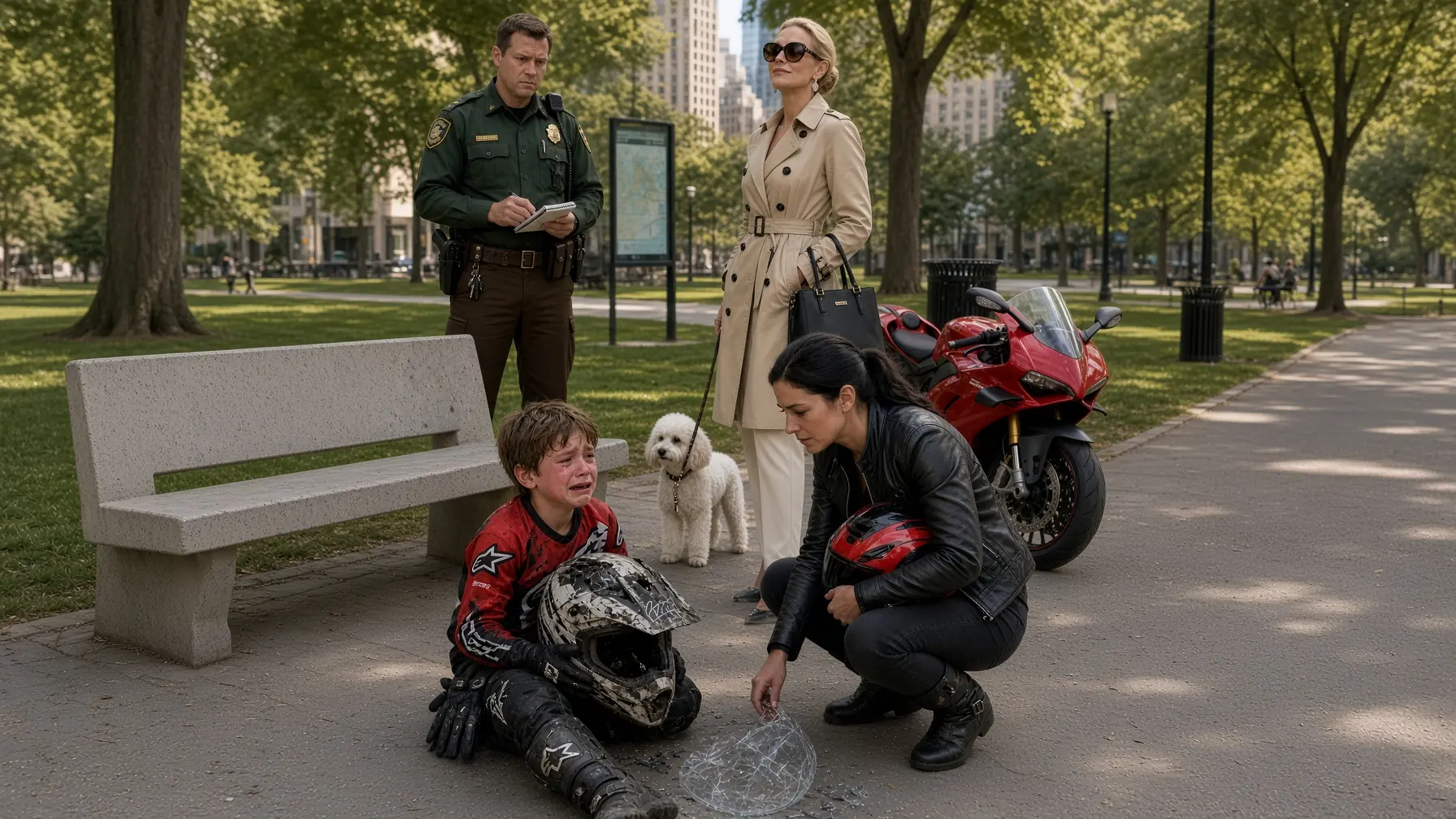
The woman in the beige trench coat turned toward the biker with irritation rather than concern. “Do you know this child?” she asked. Lena Torres did not answer her at first. She crossed the walkway, crouched beside Max, and put one hand lightly on his shoulder. “Are you cut?” Max shook his head, struggling to breathe evenly. Lena checked his hands anyway because he had been gathering broken visor pieces with bare fingers. Then she looked at the helmet on the pavement. The left side shell carried a long white scrape where it had struck concrete. The clear visor was shattered inward around a concentrated puncture near its center. One hinge was twisted backward. Across the crown, still visible despite the damage, was a silver signature: TRAVIS KELLER #17. Lena’s jaw tightened. “Who touched this helmet?”
Max pointed immediately. “She threw it. Then she stepped on the visor.” The wealthy woman let out a theatrical laugh. “That is absolutely false. The boy tried to throw that filthy thing at my dog, and I kicked it away before it struck her.” Ranger Bell lowered his radio slightly. “Ma’am says the helmet was thrown toward the dog.” Lena finally looked at him. “Did you see that happen?” Bell hesitated. “No. I arrived afterward.” Lena nodded. “Then you have two conflicting statements, not a fact.” The woman’s mouth tightened. “Excuse me?” Lena ignored her and returned to the helmet, carefully lifting it by the chin bar. She had been around damaged riding gear long enough to know that impacts told stories, even when people did not. A helmet thrown horizontally at a small dog and kicked away should not have a nearly vertical puncture through the top curvature of its visor while the shell showed a separate sideways impact several feet away.
Lena turned the helmet beneath the sunlight. The visor had not simply cracked from hitting pavement. Around one break was a narrow crescent-shaped pressure mark, smaller than the toe of a boot and concentrated enough that the plastic had folded downward before shattering. She touched none of the sharp edges with bare fingers. Instead she pulled a clean microfiber cloth from her riding jacket and placed the largest fragment on it. A tiny black scuff marked the center. Beside it was something else—an almost transparent sliver trapped in the fracture line. Lena leaned closer, then slowly lifted her eyes from the broken visor to the woman’s feet. The beige pumps were elegant, narrow, and high enough that each heel ended in a hard little point. One heel cap looked slightly chipped. A clear shard of plastic glittered against the bottom edge.
The woman noticed Lena staring. Her foot moved backward instinctively. “What exactly are you looking at?” she demanded. Lena stood. “Your shoe.” The woman gave a dismissive smile. “Yes, they’re Jimmy Choos. Congratulations.” Lena did not smile back. “I don’t care what they cost.” She pointed at the right heel without touching it. “There’s clear plastic embedded in the heel cap.” The woman glanced down. “So?” Lena lifted the cloth holding the visor fragment. “And this visor has a puncture roughly the width of that heel.” Ranger Bell moved closer. His expression changed as he looked from the shoe to the shattered shield. The woman quickly shifted her weight and said, “I already told you. I kicked it away. Obviously my shoe could have touched it.”
Max rose to his feet, wiping tears from his cheeks. “You didn’t kick it away. You picked it up and threw it, then stepped on it after it landed.” The woman snapped, “Stop lying.” Lena moved half a step between them. “Don’t speak to him like that.” The woman’s eyes narrowed. “Who are you supposed to be, his mother?” Lena answered, “No.” She paused. “I’m the person who gave him that helmet.” Max looked at the broken signature again. His lower lip trembled. The helmet had been more than equipment. Lena ran a small youth riding program on weekends, and Travis Keller, a retired national motocross champion who had trained with her years earlier, had signed it for Max after watching him complete his first full beginner course without giving up. Max had carried it home like a trophy and cleaned the visor after every practice. He was not allowed to ride without a different certified helmet once this one became damaged, but he still treasured it because of what the signature represented.
The woman folded her arms. “Then perhaps you should have taught him not to leave expensive toys on public benches.” Lena looked at her. “A child setting his helmet on a bench does not give you permission to destroy it.” The woman laughed coldly. “Destroy? Please. It fell.” Max immediately said, “You threw it.” She turned toward Bell. “This is becoming ridiculous. Are you going to let them harass me?” Bell did not answer as quickly this time. He was looking at the debris pattern. The main helmet shell lay nearly nine feet from the bench. Several visor fragments were clustered near the center of the walkway, not beside the bench. The dog remained tucked safely against the woman’s left leg, and there was no sign that a heavy helmet had struck or even frightened it enough to pull away. Bell crouched and looked at the pavement. “Where were you standing when he supposedly threw it?”
The woman pointed vaguely toward the bench. “There.” Bell followed her finger. “And where was the dog?” She gestured toward her side. “With me.” Bell looked at the distance between the bench and the cracked shell. “The helmet traveled this direction?” “Yes.” “Toward the dog?” “Exactly.” Lena studied the path. If Max had thrown it toward the dog from beside the bench, the helmet should have traveled toward the woman’s current position near the hedge. Instead the scrape direction on the shell suggested it struck the pavement from the opposite angle, roughly where someone standing at the bench would have thrown it sideways. That was not proof by itself, but it did not fit the woman’s story cleanly. Bell noticed the same problem. “And then you kicked it away from the dog?” he asked. “Yes.” “Which way?”
The woman pointed toward the center of the path. Bell looked again. The shell already lay there. Lena said nothing. She did not need to. The woman’s explanation was beginning to require the helmet to travel in two contradictory directions. “Maybe I don’t remember every inch,” she snapped. “I was protecting my animal.” Max looked toward Bella, the tiny Poodle. “She wasn’t even near my helmet.” The woman gave him a look so sharp that Lena stepped closer again. “Enough.” Bell straightened. “Ma’am, I need your name.” Her face hardened. “For what?” “For the incident report.” “I was the victim.” Bell answered calmly, “At this point I have a damaged item, conflicting accounts, and possible intentional property destruction. I need everyone identified.”
Her name was Victoria Langford. She said it with the expectation that recognition should follow. It did. Bell had seen the Langford name on plaques around the city—arts donations, hospital fundraising, a renovated public fountain downtown. Victoria’s husband ran a commercial property firm. She chaired at least one philanthropic board. None of that answered what happened to Max’s helmet. Bell wrote her information down anyway and asked Max for his guardian’s number. Max’s father, David, was at a nearby hardware store and answered on the second ring. When Bell explained there had been an incident but Max was physically fine, David said he would be there in ten minutes. Max looked mortified. “Dad’s going to be mad.” Lena crouched beside him. “At you?” He nodded. “I wasn’t supposed to take this helmet out unless I was riding.” Lena looked at the crushed visor. “That is a problem you and your dad can discuss. It does not make what happened here your fault.”
Victoria heard the sentence. “There. Even she admits the child broke rules.” Lena turned. “Breaking a rule with your father is not consent for a stranger to smash your property.” Victoria rolled her eyes. “You people are determined to make this dramatic.” Lena’s expression sharpened. “What people?” Victoria hesitated. “Bikers. The whole performance. The leather, the motorcycle, the attitude.” Lena looked down at her armored jacket, then toward Max’s dirt-bike boots. “Interesting recovery.” Bell glanced up from his notebook. Victoria realized he had heard it too and changed subjects. “I want that child removed. He endangered my dog.” Bell replied, “I’m not removing anyone until I understand what happened.”
That was the first thing anyone in authority had said that made Max’s shoulders relax.
Lena asked Bell whether the park had cameras. He looked toward the entrance. “City camera on the east gate, but I don’t know whether it covers this bench.” Victoria immediately scoffed. “There is no need to turn this into an investigation. It’s a child’s used helmet.” Max flinched. Lena looked at her. “How much do you think it cost?” Victoria shrugged. “A hundred dollars?” Lena almost smiled. “Closer to four hundred when it was new.” Victoria’s eyebrows lifted, but she recovered. “Then his parents should have taught him to take care of it.” Lena nodded toward the broken visor. “They did. That’s why it lasted two years.”
A middle-aged man carrying two coffees approached cautiously from the path. “Excuse me,” he said. Everyone turned. “I didn’t see the first part, but I saw the woman step on something.” Victoria stared at him. “You absolutely did not.” The man looked uncomfortable but continued. “I was coming from the kiosk. I heard the first crack, looked over, and saw her foot come down on the helmet.” Bell asked his name. “Peter Walsh.” “Did you see the boy throw it?” “No. I only looked after the first sound.” Victoria immediately seized on that. “Exactly. You didn’t see what the child did before I defended my dog.” Peter shook his head. “I’m not saying I did. I’m saying the second step didn’t look defensive. The helmet was already on the ground.”
That distinction mattered.
Lena walked to the bench and examined the concrete. Near the edge was a faint black streak about six inches long. The helmet’s rubberized chin vent had a matching abrasion. “Bell,” she called. The ranger came over. Lena pointed but did not touch. “If the helmet started on the bench and was thrown sideways, it may have scraped here first.” Victoria groaned. “Are you a detective now?” Lena answered, “No. I repair riding gear.” That was only partly true. She owned Torres Moto Works, a motorcycle repair and training shop, and had spent twelve years inspecting helmets after crashes because parents repeatedly brought damaged gear to her asking whether it was still safe. She knew enough to recognize obvious impact patterns and, more importantly, enough to know where her expertise stopped. “I’m not saying this proves who threw it. I’m saying the physical damage should be photographed before anyone cleans anything.”
Bell agreed.
Victoria did not.
“This is absurd. You’re treating my shoes like murder evidence.”
“No,” Bell said. “I’m treating a possible property-damage complaint like a property-damage complaint.”
The shift in his language was unmistakable. Victoria heard it too. “Five minutes ago you were listening to me.” Bell looked at her. “Five minutes ago I had less information.” She stared as though he had said something offensive. “So now I’m a liar because some biker showed up?” Bell shook his head. “I did not say that.” “You didn’t have to.” Lena almost laughed at the familiarity of the phrase. It was exactly the kind of reasoning Victoria had used against Max—if people stopped immediately agreeing with her, they must have taken someone else’s side.
David arrived faster than expected in an old silver pickup with bags of potting soil still in the bed. He parked badly, jumped out, and crossed the grass before the ranger could wave him toward the path. He was thirty-five, exhausted-looking, and still wearing work jeans despite it being Saturday. Max ran to him. David crouched, checked his son’s face and hands, then looked toward the destroyed helmet. His expression fell. “Oh, buddy.” Max started crying again. “Dad, I didn’t do it. I swear.” David put both hands on his shoulders. “I know. Slow down. Tell me from the beginning.”
Victoria interrupted. “Your son tried to throw that object at my dog.” David looked at her for the first time. “Were you speaking to me?” She lifted her chin. “I am the person he attacked.” David looked down at Bella, who was calmly sniffing a patch of grass. Then toward Bell. “Did anyone see him attack the dog?” Bell answered, “We’re still establishing the sequence.” David nodded. He did not argue. He asked Max to tell the story once, without exaggerating anything he could not remember. Max explained tying his boot, Victoria telling him to remove “trash” from the bench, her grabbing the helmet, throwing it, then stepping on the visor. David listened without interrupting.
When Max finished, David looked toward Lena. “You believe him?” Lena answered carefully. “I believe parts of the damage fit his account better than hers, and there’s an independent witness who saw the second impact. That is not the same as me witnessing the first throw.” David nodded. “Thank you.” Victoria laughed. “How noble. A little courtroom now.” David did not react. He walked toward the helmet but stopped before touching it. “Can that ever be ridden again?” Lena shook her head. “Absolutely not. Any hard impact retires it. The shell may have hidden damage even where it looks intact.” Max stared at the silver signature. “Can we fix the visor?” Lena’s face softened. “We can replace a visor. But we won’t use this helmet for riding again.”
“I ruined his favorite thing,” Victoria said sarcastically. “Call the newspapers.”
Max turned toward her. “Why are you being mean?”
That question landed harder than any accusation.
Victoria’s face hardened. “Because children need to learn consequences when they behave badly.” David took a step forward, then stopped himself. “My son is eight.” She answered, “Old enough to lie.” David’s jaw tightened. “And you are old enough to know better than to call a child a liar before the facts are checked.” Bell moved slightly between them, not because David had threatened anyone, but because the emotional temperature had risen.
Then a teenage girl jogged toward them from the picnic area holding a phone. “Ranger?” she called. Bell turned. “My mom said I should show you this.” She introduced herself as Hannah Ruiz. She and two friends had been recording a short dance video near the fountain about thirty yards away. Max and Victoria were not centered in the frame, but the bench appeared in the background for several seconds before Hannah stopped recording. “I didn’t notice until my friend said there was yelling,” Hannah explained. “We checked the video.”
Victoria went still.
Bell asked Hannah not to play it publicly yet and instead moved with her a few feet away so he could view the original. Lena remained beside Max and David. Victoria tried to follow. Bell raised one hand. “Please stay there.” “I have a right to know what she’s showing you.” “You will be told what is relevant.” Victoria folded her arms.
Bell watched the clip once.
Then again.
His expression changed.
He asked Hannah, “Can you scrub back about three seconds?”
She did.
Bell looked toward Victoria.
“Ma’am.”
“What?”
“I need you to stay where you are.”
Her confidence finally cracked.
“What is on that phone?”
Bell asked Hannah to preserve the original file and not edit or upload it before her mother could provide a copy through the city’s normal process. Then he returned.
“The video captures part of the incident.”
Victoria’s face drained slightly.
“What part?”
Bell looked at his notes.
“It shows you walking to the bench. It shows Max kneeling near his shoe. It shows you lift the helmet from the bench.”
Max stared.
David closed his eyes briefly.
Bell continued. “It then shows you throwing it toward the walkway.”
Victoria’s lips parted.
“That video is too far away to show context.”
Bell nodded. “It does not record clear audio.”
“There. Exactly.”
“It also does not show Max touching the helmet before you pick it up.”
Silence.
Victoria tried another explanation. “He had already threatened the dog.”
Bell asked, “How?”
“He was waving the helmet.”
“The video shows it resting on the bench as you approach.”
“He could have done something before filming started.”
“That is possible.”
Victoria seized on it. “Then you cannot say I lied.”
Bell’s voice stayed calm. “The statement you gave me was that Max threw the helmet at your dog and you kicked it away. The video shows you taking the helmet from the bench yourself and throwing it.”
Nobody spoke.
Victoria looked toward Hannah’s phone.
Then toward Max.
Then at Lena.
Her story changed again.
“Fine. I moved it because it was filthy and blocking a public bench. The child became aggressive, so I got it away from us.”
Lena’s eyes narrowed. “And the heel through the visor?”
Victoria looked down at her shoes.
“That was an accident.”
Peter Walsh spoke from behind Bell. “It didn’t look accidental.”
Victoria snapped, “Nobody asked you.”
Bell closed his notebook.
“Ms. Langford, do not address witnesses that way.”
She stared at him. “Are you seriously going to make this a criminal matter over a helmet?”
Bell answered, “I am going to document what happened. The city attorney and police can determine anything beyond park enforcement if necessary.” He was a ranger, not a prosecutor, and he knew the limits of his role. He could issue a park exclusion for disorderly behavior and refer property-damage allegations to local police, but he was not going to invent charges because a video made Victoria look bad.
Max looked toward Hannah. “Can I see it?”
David glanced at Bell.
The ranger nodded as long as Hannah was comfortable.
She brought the phone over.
The footage was only eleven useful seconds.
There was Max kneeling at the bench.
There was Victoria approaching.
There was her hand reaching.
There was the helmet leaving the bench and striking the walkway.