How does an entire town stay quiet while a young woman is tied to a saloon post?
That was the question nobody in Dodge City wanted to answer that night.
They could argue about cattle prices, poker hands, land claims, whiskey, guns, and weather until sunrise. They could call themselves decent men while sitting under lamplight with cards in their hands and dust on their boots. But when Clara Bell stood bound to the center post of the Black Lantern Saloon, wrists raw from rope and dress torn from being dragged through the street, those same men suddenly found their glasses very interesting.
Nobody stepped forward.
Not one rancher.
Not one merchant.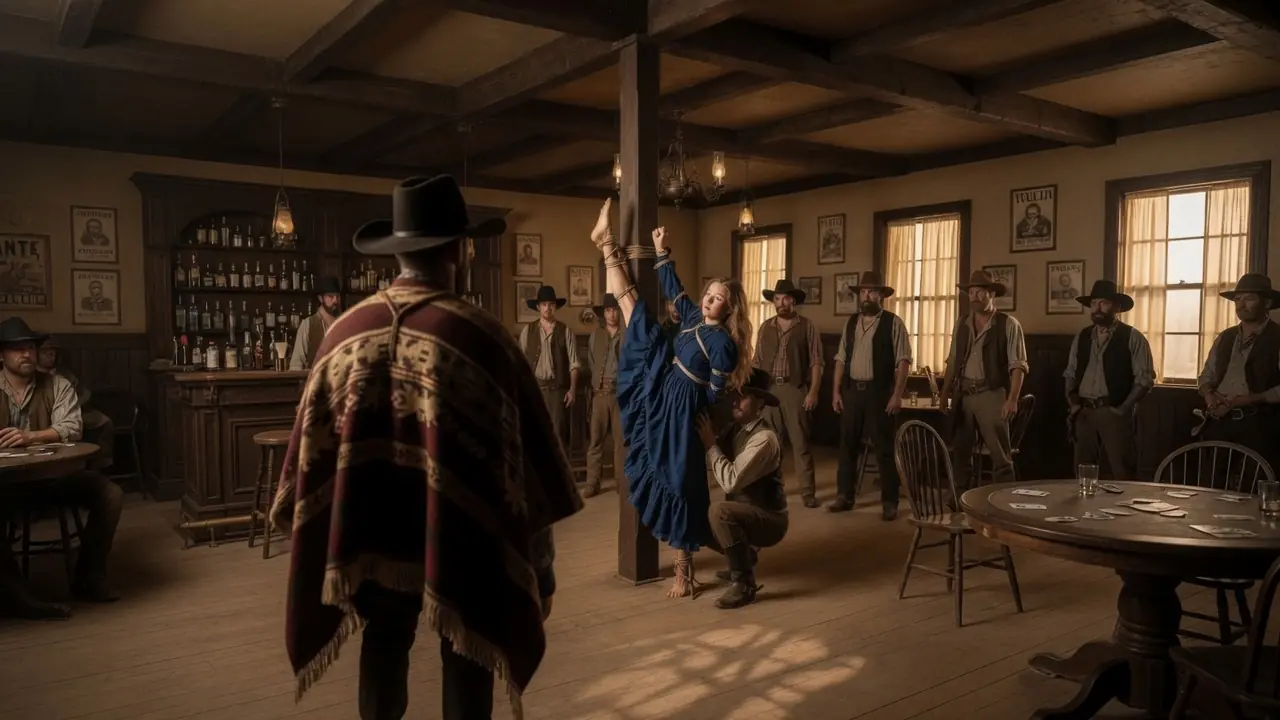
Not one deputy.
Not one man who had watched her grow up carrying laundry baskets behind her mother on Front Street, or seen her bring medicine to sick miners in winter, or heard her sing in the church choir when she was still young enough to believe the town protected its own.
Clara was twenty-two years old.
She had dark hair coming loose from its pins, a split lip, and dust across the side of her face where someone had shoved her down before tying her up. Her blue dress was plain, the hem muddy, the sleeve ripped at the shoulder. She looked frightened because only a fool would not be frightened in a room like that.
But she did not look broken.
That was what made the men around her uncomfortable.
Her chin still lifted.
Her eyes still moved from face to face.
She was looking at them like she meant to remember every man who stayed silent.
Elias Vard stood near the bar with a clean vest, polished boots, and a smile that never reached his eyes. He owned three cattle yards, two warehouses, half the debts in Dodge City, and enough fear to make honest men misplace their courage when he walked into a room.
He did not hold a gun.
He did not need to.
Six men stood around Clara, and every one of them had been paid to make sure she never spoke before the circuit judge arrived in the morning.
Wade Brannon stood closest to her, a former deputy with quick hands and no conscience anyone could find. Silas Trent leaned against the piano, hat low, watching the room like he was already deciding who would die first if things turned ugly. Milo Fitch held a shotgun across his chest. Cole Granger guarded the door. Avery Pike cracked his knuckles because men like Avery liked the sound of coming violence.
And near the wall stood Owen Bell, Clara’s cousin.
He was not with them exactly.
But he was not against them either.
His eyes stayed on the floorboards, and sometimes that kind of cowardice hurts worse than open cruelty.
Elias tapped one finger on the paper lying on the table.
“Sign it, Clara,” he said, voice smooth as oiled leather. “You sign that statement, admit you stole those documents, admit you lied about the ledger, and this ends before it gets worse.”
Clara looked at the paper.
Then she looked at him.
“You mean before it gets worse for you.”
A few men shifted at that.
Elias’s smile thinned.
“You always did have your mother’s mouth.”
“And my father’s memory.”
The room went still for half a breath.
Elias did not like that.
Nobody in Dodge City said Clara’s father’s name anymore if they could help it. Matthew Bell had been a land clerk twenty years earlier, back when Dodge City was younger and less careful about hiding its sins. Officially, Matthew Bell had died running from a robbery charge.
Unofficially, people knew better.
But knowing better and saying better were two different kinds of courage.
Clara had found his old ledger hidden beneath a loose board in the back room of her mother’s house after the old woman passed. Names. Dates. Land transfers. False debts. Forced signatures. Payments made to men who burned barns, threatened widows, and drove families off claims that Elias Vard later bought for almost nothing.
That ledger could ruin half the powerful men in town.
So now Clara was tied to a saloon post while grown men pretended not to see her wrists bleeding.
Elias leaned closer.
“The judge comes tomorrow. You know what happens if you speak.”
“Yes,” Clara said. “People finally hear the truth.”
“No,” Elias said softly. “You disappear before breakfast.”
The piano player lowered his eyes.
The bartender wiped the same glass until his hand shook.
Then the saloon doors opened.
Slow.
Not kicked.
Not thrown wide.
Just pushed open by a dusty hand, as if the man outside had all the time in the world.
A stranger stepped inside.
He wore a weathered black coat, a gray hat pulled low, and trail dust from his boots to his shoulders. He was not old, but not young either. Forty maybe. His face was rough from sun and distance, the kind of face that had forgotten the comfort of staying anywhere too long.
Nobody knew him.
Or if they did, nobody said so.
He stood just inside the doorway and let his eyes adjust to the lamplight.
He saw Clara.
He saw the rope.
He saw the six hired killers.
He saw Elias Vard smiling like a man who believed the room belonged to him.
Then the stranger said, “This ends tonight.”
The words were quiet.
That made them worse.
A loud man can be dismissed as drunk or foolish. A quiet man who says something like that has already decided what he is willing to do about it.
Nobody laughed.
Not even Avery Pike.
Elias turned slowly.
“You lost, friend?”
The stranger took one step forward.
“No.”
“Then you misunderstood what you walked into.”
“I understood enough.”
His eyes moved to Clara’s wrists, then to the torn sleeve, then to the men around her. He looked at each one carefully, as if he were storing their faces somewhere permanent.
Clara stared at him.
Something flickered across her face.
Not recognition exactly.
Something close to it.
“You have his eyes,” she whispered.
The stranger looked at her then.
For the first time, his face changed.
Only a little.
But Elias saw it.
“Whose eyes?” Elias asked.
Clara swallowed.
“Matthew Bell’s.”
The stranger did not answer.
But the room felt the name hit him.
Elias stepped away from the bar, all smoothness gone from his voice.
“You know this girl?”
The stranger looked at Clara.
“No.”
“Then walk out.”
“No.”
Wade Brannon laughed under his breath and moved his thumb near his holster.
“Wrong answer.”
The stranger did not look at him.
That was the first insult.
Wade’s jaw tightened.
Clara kept her eyes on the stranger like she was trying to place him through pain and dust and disbelief.
“My father had a brother,” she said.
The stranger’s face went still.
Elias’s eyes sharpened.
Clara’s voice was dry, but it carried.
“He left town after Matthew died. Folks said he had a son.”
For the first time, the stranger spoke to her directly.
“What was his name?”
“Thomas Bell.”
The stranger’s jaw worked once.
Then he said, “Thomas Bell was my father.”
The saloon seemed to grow smaller around them.
Elias stared at him.
The stranger removed his hat slowly.
“My name is Caleb Rane,” he said. “My mother changed it after we left Kansas. But before that, I was Caleb Bell.”
Clara’s breath caught.
For a moment, she looked less like a girl tied to a post and more like someone who had just found the last living piece of a story she thought had ended before she was born.
“My father said Matthew was no thief,” Caleb said.
“He wasn’t,” Clara whispered.
Elias slammed his palm against the table.
“That is enough.”
The sound snapped the room back into danger.
He pointed at Caleb.
“You came into the wrong saloon with the wrong old story.”
“No,” Caleb said. “Looks like I came to the right one.”
Elias looked at Wade.
“Get him out.”
Wade stepped forward.
Slow.
Confident.
The kind of man who had dragged more than one body through a doorway and never lost sleep over it.
“You heard him.”
Caleb did not move.
Wade came closer.
Still nothing.
For a second, it looked like Wade might grab him by the coat.
Then he stopped.
Something in Caleb’s stance made him think twice.
That pause mattered.
Men like Wade did not pause often.
Silas Trent smiled faintly from near the piano.
“You always this stubborn, stranger?”
Caleb glanced at him.
“Only when cowards tie up women.”
The smile vanished.
Elias’s face hardened.
“This girl stole private property.”
Clara laughed once, bitter and tired.
“Private property? You mean the ledger my father died protecting?”
“You mean the book of lies your mother filled your head with.”
“My mother spent twenty years afraid to speak your name above a whisper.”
“Because she had sense.”
“No,” Clara said. “Because she had a daughter to keep alive.”
A murmur moved through the room.
Small.
But real.
Elias heard it.
That was when he made his second mistake.
He turned toward the crowd.
“You all know what this is. A desperate girl trying to make money from old accusations. Her family lost everything because her father was a thief, and now she wants revenge.”
Caleb looked around the saloon.
Men looked down.
Some because they believed Elias.
More because they did not.
Clara lifted her bound hands as much as the rope allowed.
“If I am lying,” she said, “untie me and let me speak before the judge tomorrow.”
Nobody answered.
That silence convicted the room more than any speech could.
Caleb stepped closer to the post.
Wade moved to block him.
“Touch that rope and you die.”
Caleb looked at him at last.
“You first.”
The room tightened.
Hands drifted toward guns.
The shotgun barrel lifted an inch.
Then a new voice spoke from the doorway.
“Not yet.”
Everyone turned.
Marshal Henry Cross stood just inside the saloon doors, his face pale under the brim of his hat. He was not wearing his badge on his chest. It sat in his hand instead, gripped tight enough that the metal edge cut into his palm.
Elias looked surprised.
Then angry.
“Marshal, this is being handled.”
“No,” Cross said. “It is being hidden.”
That made every man in the room go quiet.
Caleb looked at the marshal.
“You have it?”
Cross hesitated.
Then he reached beneath his coat and pulled out a worn leather ledger.
Clara closed her eyes.
Elias took one step forward.
“Henry.”
The marshal looked at him.
For the first time in years, he did not look away.
“You should have left that girl alone.”
The story had begun three days earlier, though Caleb had not known he was walking toward it then.
He had ridden into Dodge City with no plan to stay. He needed feed, coffee, cartridges, and maybe a room if the price was not robbery. He had spent most of his adult life moving between towns because staying meant answering questions, and questions always circled back to a family name his mother had buried on purpose.
Bell.
His father never used it after they left.
Not in public.
Not on papers.
Not even when drunk.
He became Thomas Rane, a quiet blacksmith in a town three counties east, and he raised his son to keep his head low and his past lower.
But sometimes at night, when the forge was dark and the wind sat against the walls, Thomas spoke of a brother named Matthew.
A good man.
A careful man.
A man who wrote things down because he believed paper could outlive fear.
Then one morning, Thomas said nothing at all.
His heart gave out before Caleb turned nineteen.
His mother died four years later.
After that, Caleb stopped belonging anywhere.
He became a hired hand, a guard, sometimes a tracker, sometimes a gunman when towns were short on law and long on trouble. He never took pride in it. But he was good at surviving, and survival has a way of turning into a profession if a man does it long enough.
He had not come to Dodge City for family.
He had come for supplies.
But on his first afternoon there, he heard Clara’s name in the feed store.
A young woman causing trouble.
A girl with forged papers.
A Bell girl who did not know when to stay quiet.
The name stopped him.
Bell.
He asked one question too many.
By sunset, Milo Fitch was following him.
By nightfall, Clara was tied to a post.
Now the ledger sat in Marshal Cross’s hands, and the whole saloon understood that the night had stopped being a warning.
It had become a reckoning.
Elias spoke carefully.
“Henry, think about what you are doing.”
“I have been thinking for twenty years.”
“Then think one minute longer.”
“No,” Cross said. “That is how men like you survive.”
He placed the ledger on the table.
The sound was small.
But it cut through the room like a hammer striking iron.
Caleb stepped forward and opened it.
The pages were yellow, edges cracked, handwriting small and exact. Matthew Bell had not written like a frightened man. He had written like a clerk who believed names mattered because someday someone might need them.
Caleb turned the pages.
Widow Ada Pierce.
Forced sale after false debt.
Ranch burned two nights later.
Payment made to Wade Brannon.
Wade’s face went flat.
Caleb read the next.
James Lorne.
Claim transferred after forged signature.
Witness paid by Elias Vard.
A man near the bar whispered, “Lorne never signed. I remember that.”
The room shifted.
Caleb kept reading.
Sarah and Peter Mills.
Driven from north pasture claim.
Threat delivered by Silas Trent and Milo Fitch.
Silas no longer smiled.
Then Caleb found the name.
Matthew Bell.
Clerk.
Collected copies of Vard transfer records.
Intended to testify before Judge Harlan.
Killed before hearing.
Official report: fled arrest and fired on deputy.
Signed by Deputy Wade Brannon and Marshal Henry Cross.
The saloon was silent.
Caleb looked at the marshal.
Cross’s face had gone gray.
“That report was false,” Cross said.
Wade turned on him.
“Shut your mouth.”
Cross looked at him.
“I have been doing that for twenty years.”
Clara’s eyes filled, but she did not cry.
Not yet.
“My father did not run?”
“No,” Cross said.
“He did not shoot first?”
“No.”
Her voice broke.
“You let them call him a thief.”
Cross swallowed.
“Yes.”
That single word was uglier than any excuse would have been.
Elias moved suddenly.
Not toward the ledger.
Toward Clara.
“Enough.”
Avery Pike stepped in fast, reaching for Caleb.
Caleb took the first blow across the shoulder and let it push him sideways. Then he came back hard, one fist driving into Avery’s ribs, the other catching his jaw. Avery crashed into a table and went down with cards and whiskey spilling over him.
The room broke open.
Chairs scraped.
Someone shouted.
The shotgun came up.
Marshal Cross drew first and aimed at Milo Fitch.
“Lower it.”
Milo hesitated.
His eyes moved to Elias.
Then to the ledger.
Then to the men around him who suddenly did not look as eager to die.
He lowered the shotgun a little.
Not enough.
But doubt had entered the room.
Doubt is the first crack in bought loyalty.
Wade Brannon grabbed Clara by the hair and yanked her back against the post, putting his gun near her ribs.
Caleb froze.
Every man in the saloon froze with him.
Clara gasped, but her eyes stayed open.
Wade’s voice was low.
“You take one more step, and she drops.”
Elias smiled again, though now it looked more like desperation than confidence.
“There,” he said. “Now we can be sensible.”
Caleb did not move.
He watched Wade’s hand.
The gun.
Clara’s breathing.
The rope.
And Owen Bell standing near the wall, shaking like a man watching his own soul come loose.
Clara turned her head as much as she could.
“Owen.”
Her cousin flinched.
“You knew,” she said.
He closed his eyes.
“You knew what was in the ledger.”
“I didn’t know all of it.”
“But you knew enough.”
His face folded with shame.
“I owed Elias money.”
Clara’s mouth trembled.
“My mother fed you after your father died.”
“I know.”
“She took you in for a winter.”
“I know.”
“And you helped them drag me here.”
Owen looked at the rope.
Then at Wade.
Then at Elias.
Something in him finally broke in the right direction.
His hand moved toward his boot.
Wade saw it too late.
Owen pulled a small knife and cut the rope around Clara’s wrists.
She dropped forward.
Caleb moved.
The gun went off, but the shot hit the post where Clara’s shoulder had been a heartbeat before. Caleb slammed into Wade, driving him back into the table. Cross fired once into the ceiling.
“Next man who draws dies standing,” the marshal shouted.
This time, they believed him.
Silas Trent backed away from the piano.
Milo Fitch lowered the shotgun completely.
Cole Granger moved from the door.
Men who had been paid in fear started remembering that dead men do not spend money.
Elias looked around and saw his power leaving one face at a time.
That was when men like him became most dangerous.
“You think this changes anything?” he hissed.
Caleb stood between Clara and the room.
“It already has.”
Elias reached for his gun.
Fast.
Too fast for a man who had spent years letting others do the killing.
Caleb drew and fired once.
The shot cracked through the saloon.
Elias stumbled back into the bar, knocking over a bottle of rye. For one stunned second, he looked almost offended that consequence had found him personally.
Then he fell.
Nobody cheered.
That was not the kind of room where decent people cheered.
The quiet after the shot was heavier than the shot itself.
Clara sat on the floor, wrists bleeding, breath shaking, eyes fixed on the ledger.
Caleb knelt beside her.
“You hurt bad?”
She looked at him.
“My pride hurts worst.”
He almost smiled.
“That heals crooked.”
“So do most things.”
Marshal Cross stepped to the table and picked up the ledger with both hands.
Then he looked at the men in the room.
“Tomorrow morning, Judge Avery hears every name in this book. Anyone who leaves town tonight will be treated like a man running from what he knows.”
Wade Brannon, blood at his mouth, laughed bitterly from the floor.
“You are not even wearing your badge.”
Cross looked at the badge still clenched in his left hand.
“No,” he said. “But I finally remember what it was for.”
By morning, Dodge City had changed.
Not completely.
Towns do not become honest overnight.
But the lie cracked open.
The circuit judge arrived at nine and found the Black Lantern Saloon closed, Elias Vard dead, Wade Brannon in custody, three hired guns missing, and half the town standing outside the marshal’s office pretending they had always been ready to tell the truth.
Clara testified with bandaged wrists.
Marshal Cross confessed to the false report that had destroyed Matthew Bell’s name.
Owen Bell told what he knew and cried through most of it, which did not make him innocent but did make him useful.
The ledger was read into record.
Name by name.
Theft by theft.
Signature by signature.
Families who had left Dodge City in shame would later receive letters telling them the shame had never belonged to them.
And Matthew Bell, land clerk, father, husband, and murdered witness, was cleared before sundown.
Caleb went to Boot Hill that evening.
Clara walked with him.
Neither of them spoke much.
They found Matthew Bell’s marker leaning near the edge of the hill, weathered and meanly carved. Someone had cut THIEF into the bottom years ago. Wind had worn it down, but not enough.
Clara knelt first.
She touched the wood.
“My mother came here every year until she got too sick,” she said. “She used to scrape at that word with a kitchen knife.”
Caleb crouched beside her and took out his own knife.
“Then we finish it.”
Together, they cut the word away.
Not cleanly.
Not perfectly.
But enough.
Later, the town replaced the marker.
MATTHEW BELL
A MAN WHO KEPT THE TRUTH
Clara stood in front of it for a long time.
Caleb stood beside her.
Not touching.
Just there.
After a while, she said, “Are you leaving?”
“I usually do.”
“That is not what I asked.”
He looked toward Dodge City below them, dusty, loud, guilty, alive.
“I do not know yet.”
Clara nodded.
“That is honest enough for tonight.”
Caleb did leave eventually.
Men like him do not change all at once because a town suddenly knows their name. But he came back before winter. Then again in spring. Then often enough that Dodge City stopped calling him stranger and started calling him Caleb Bell, whether he liked it or not.
Clara kept the ledger.
Not in hiding.
In the courthouse.
Behind glass.
Not because paper could fix what had been broken, but because forgetting was how men like Elias Vard grew powerful in the first place.
People told the story for years.
Some made it about the gunfight.
Some made it about the nameless gunslinger.
Some made it about Elias Vard falling in the saloon he thought he owned.
But Clara told it differently.
She said the real story was not that one man walked in with a gun.
The real story was that an entire town watched a young woman be tied to a post, and for one terrible hour, no one remembered how to be brave.
Then one man spoke.
Then another.
Then a coward cut a rope.
Then a marshal told the truth twenty years late.
That was how the night changed.
Not all at once.
One choice at a time.
Because evil does not need every man in town to be wicked.
It only needs most of them to stay quiet.
And sometimes the difference between a town that rots and a town that lives is one voice saying, “This ends tonight,” and meaning it enough for the others to finally stand.