Every September morning, before the sun cleared the Blue Ridge, trucks rolled out of Mercer Orchards carrying pears that would never appear beneath supermarket lights.
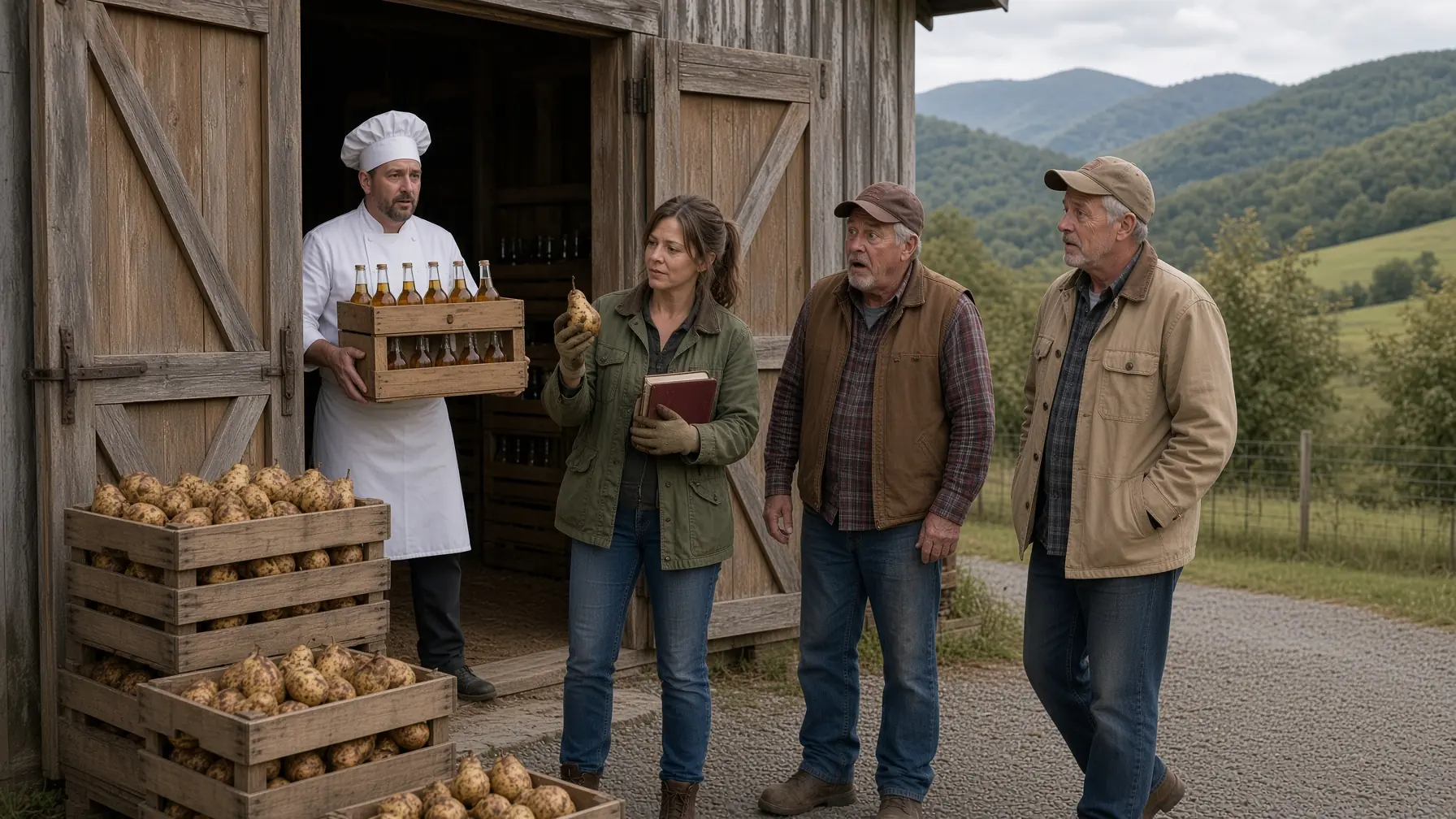
Some were bruised where harvest bins had pressed too hard against one another. Others wore russet scars, bird pecks, wind rub, sunburn, or shallow hail marks. A few had grown crooked enough to offend the sizing machines even though the flesh beneath their skin was perfectly sound. The best fruit went into clean cardboard cartons stamped with the Mercer name and headed toward grocery distributors. The imperfect fruit went somewhere else.
Some became livestock feed.
Some went into commercial compost.
And, during heavy harvest weeks, some deteriorated faster than anyone could find a use for them.
David Mercer hated that last category.
He had managed the family’s commercial orchard for thirty-one years and understood exactly how much labor existed inside a pear nobody bought. Somebody had pruned that tree in February, sprayed it in spring, thinned fruit in June, checked irrigation through July, watched for disease in August, then paid a crew to pick it in September. By the time a pear reached the packing line, money had already been spent on it whether a grocery buyer liked the skin or not.
Still, agriculture did not pay farmers for effort.
It paid for what markets accepted.
Then, one autumn, a woman named Hannah Carter began waiting beside an old packing shed at the end of a gravel driveway with a burgundy notebook under one arm.
She wanted the rejected pears.
At first David assumed she meant a few boxes.
“Take whatever your pigs can eat,” he told her.
“I don’t have pigs.”
“Deer?”
“No.”
“Then how many do you want?”
Hannah looked toward a half-ton bin filled with fruit that had missed fresh-market grade.
“All of those.”
David laughed.
Not cruelly.
He simply thought she did not understand what she was asking.
“That’s close to nine hundred pounds.”
“I know.”
“And I’ve got four more bins coming off the line this afternoon.”
“How much?”
“For the fruit?”
“Yes.”
David studied her.
Most people who wanted seconds expected them free.
Hannah did not.
“You’re saving me sorting and disposal.”
“So what’s fair?”
He thought.
“Five cents a pound if you take only sound culls and haul them yourself.”
Hannah opened the burgundy notebook.
“Five cents.”
“You writing that down?”
“Yes.”
“Why?”
“So next week neither of us remembers it differently.”
That answer made David look at her again.
Hannah Carter was thirty-five years old and had spent most of the previous eighteen months discovering how quickly a life could become smaller.
Her husband, Nathan, had died after a short illness that began as back pain and ended with a cancer diagnosis neither of them had expected. He was thirty-eight. Their daughter Lucy was nine. The family owned fifteen acres outside a small Virginia town where the foothills began lifting toward the Blue Ridge, though “farm” was a generous word for what remained. Nathan had grown vegetables on three acres, kept a few laying hens, and repaired equipment for neighbors. Hannah handled bookkeeping for two local businesses and sold baked goods at holiday markets when she had time.
Then Nathan got sick.
The vegetable ground went mostly fallow.
Medical travel consumed savings.
Repairs were postponed.
The roof over the old packing shed leaked through two places.
After Nathan died, Hannah found herself with a modest mortgage, several medical bills still being sorted through insurance, one child to raise, fifteen acres that produced almost no income, and enough money in the checking account to make every unexpected expense feel personal.
People offered advice.
Most meant well.
Sell five acres.
Rent the house.
Move closer to Charlottesville.
Take a full-time bookkeeping position.
Let somebody else maintain the property.
Hannah listened to everyone.
Then she did something that looked, from the outside, like refusing to listen at all.
She stayed.
Not because the land had been in Nathan’s family for seven generations. It had not. They had bought it twelve years earlier because they could afford it and because Nathan wanted enough ground to grow food without having a neighbor’s porch twenty feet from their bedroom.
Hannah stayed because the mortgage was manageable if she could create income from the property.
The problem was figuring out what fifteen acres could realistically support.
She could not compete with large produce farms.
She did not have enough pasture for a serious cattle operation.
Fruit trees would take years to establish.
She considered cut flowers, mushrooms, herbs, laying hens, nursery plants, and even renting the packing shed to a cabinetmaker.
Nothing fit cleanly.
Then she remembered something her mother used to say while trimming vegetables in the kitchen.
Ugly doesn’t mean bad. Bad means bad.
Her mother had grown up poor enough that waste carried moral weight. Bruised peaches became preserves. Overripe tomatoes became sauce. Chicken bones became stock. Bread ends became crumbs.
Hannah had inherited that habit.
What she lacked was a product.
The idea came during a September afternoon when she stopped at Mercer Orchards to buy apples for Lucy’s school fundraiser.
She saw a loader carrying a bin of rejected pears toward the compost area.
“What’s wrong with those?”
David, who happened to be walking past, glanced toward the bin.
“Depends which one.”
“They look fine.”
“Some are.”
“Then why aren’t you selling them?”
“Because grocery stores don’t buy ‘some are fine.’ They buy grade, size, appearance, packing specification.”
Hannah walked closer.
One pear had a dark bruise along its shoulder.
Another was misshapen but firm.
A third carried hail marks that looked like freckles.
“How much do you reject?”
“Varies by year.”
“Ten percent?”
“Sometimes.”
“More?”
“In a rough cosmetic year, much more.”
“What happens to it?”
“Juice processor takes some when pricing works. Livestock takes some. Compost takes plenty.”
“And the rest?”
David shrugged.
“Becomes next year’s dirt.”
Hannah picked up one sound but scarred pear.
She turned it in her hand.
“How much sugar is in one of these?”
David frowned.
“In a pear?”
“Yes.”
“Depends on variety and maturity.”
“What do people ferment pears into?”
“Perry.”
She knew cider.
She had never heard the word.
“Pear cider?”
“Basically.”
“And after that?”
David stared at her.
Then smiled.
“Now I know the look.”
“What look?”
“The one people get right before they make their own life difficult.”
That evening Hannah searched the library, then the internet, then university extension publications.
Fermentation was not a magic trick.
Fruit contained fermentable sugars.
Yeast converted those sugars largely into alcohol and carbon dioxide.
Acetic acid bacteria could then oxidize ethanol into acetic acid when given oxygen and appropriate conditions.
Pear vinegar existed.
Good pear vinegar existed.
Some of it was expensive.
Hannah looked toward the packing shed through her kitchen window.
The roof leaked.
The floor was concrete.
There was running water on one wall because Nathan had once washed produce there.
The building was ugly.
But it could be cleaned.
The following morning she drove back to Mercer Orchards.
That was how the first rejected pears arrived.
Not free.
Not by the tractor-trailer.
One bin.
Then another.
Hannah quickly learned why commercial processors did not simply accept every damaged fruit item indiscriminately.
Cosmetic seconds were useful.
Rot was not.
Mold was not.
Fruit with animal contamination was not.
Pears fermenting spontaneously inside split skins before they reached her were not something she wanted in controlled batches.
She began sorting aggressively.
Sound misshapen fruit went into one pile.
Bruised fruit that could be trimmed immediately went into another.
Anything moldy, deeply rotten, contaminated, or suspicious went to compost.
David noticed.
“You throw more out than I expected.”
“I’m making food.”
“Good answer.”
By October, the old packing shed smelled like pears.
Lucy called it “the fruit room.”
Carl Bennett called it “the county deer buffet.”
Carl was sixty-three and operated a small apple orchard on the adjoining property. He was not mean, but humor arrived in his mouth faster than tact.
One afternoon he slowed his pickup beside Hannah’s driveway.
“You opening a wildlife sanctuary?”
Hannah was carrying two crates.
“No.”
“Because every whitetail within ten miles knows your address.”
“I’m experimenting.”
“That is what people say before the fire department comes.”
She smiled.
“Want a pear?”
“Is it one of the good bad ones or the bad bad ones?”
“Good bad.”
He took it.
The fruit was scarred but sweet.
Carl bit into it.
“Nothing wrong with that.”
“Exactly.”
“Still not sure why you need eight hundred of them.”
“Neither am I yet.”
He laughed and drove on.
Hannah’s early experiments were terrible.
She began too casually.
Fruit was washed, crushed, pressed through a small basket press Nathan had once used for apples, then transferred into food-grade containers. Her first batches relied on whatever yeast happened to arrive naturally with the fruit and environment because old books made spontaneous fermentation sound romantic.
Reality was less poetic.
Batch one fermented.
Batch two developed an unpleasant surface growth.
Batch three smelled like nail-polish remover and overripe fruit.
Batch four became sour but harsh.
Batch five barely fermented at all.
Hannah wrote everything down.
Oct. 14 — Bartlett-heavy batch. 14.1° Brix. Temperature 68°F.
Oct. 18 — activity strong. smell clean.
Oct. 22 — surface film developing. uncertain. isolate.
Oct. 24 — discard. do not pretend uncertainty is quality.
She had purchased an inexpensive refractometer to measure soluble solids before fermentation. She monitored temperature with two thermometers because she did not trust one. She learned that Brix readings after fermentation began no longer translated simply into sugar because alcohol altered refractometer readings.
She learned because she made mistakes.
One evening Lucy found her sitting on an overturned bucket staring at three gallons of vinegar that smelled wrong.
“Is it ruined?”
“Yes.”
“Can you fix it?”
“No.”
“What happens?”
“Compost.”
Lucy looked disappointed.
“You worked on that forever.”
“Six weeks.”