The men of Dry Creek did not summon Sarah Dawson to save her family.
They called her there to decide which of her children would belong to whom.
The distinction became clear the moment Sarah walked through the town hall doors and saw seven names written in separate columns across Mayor Walter Hayes’s papers. Jack. Ben. Emma. Ella. Jacob. Grace. Lily. Beside each name was the surname of another family, as though her children were sacks of flour being distributed before winter.
Sarah stopped breathing.
Six weeks earlier, Daniel Dawson had still been alive.
He had been standing beside their barn repairing a hinge with his sleeves rolled above his elbows, joking that the whole building leaned because it was tired of Dakota wind. Daniel had always joked when things were difficult. He had joked when crops failed, when their mare threw a shoe twenty miles from town, and even when the roof leaked over their bed and Sarah woke with rainwater dripping onto her forehead.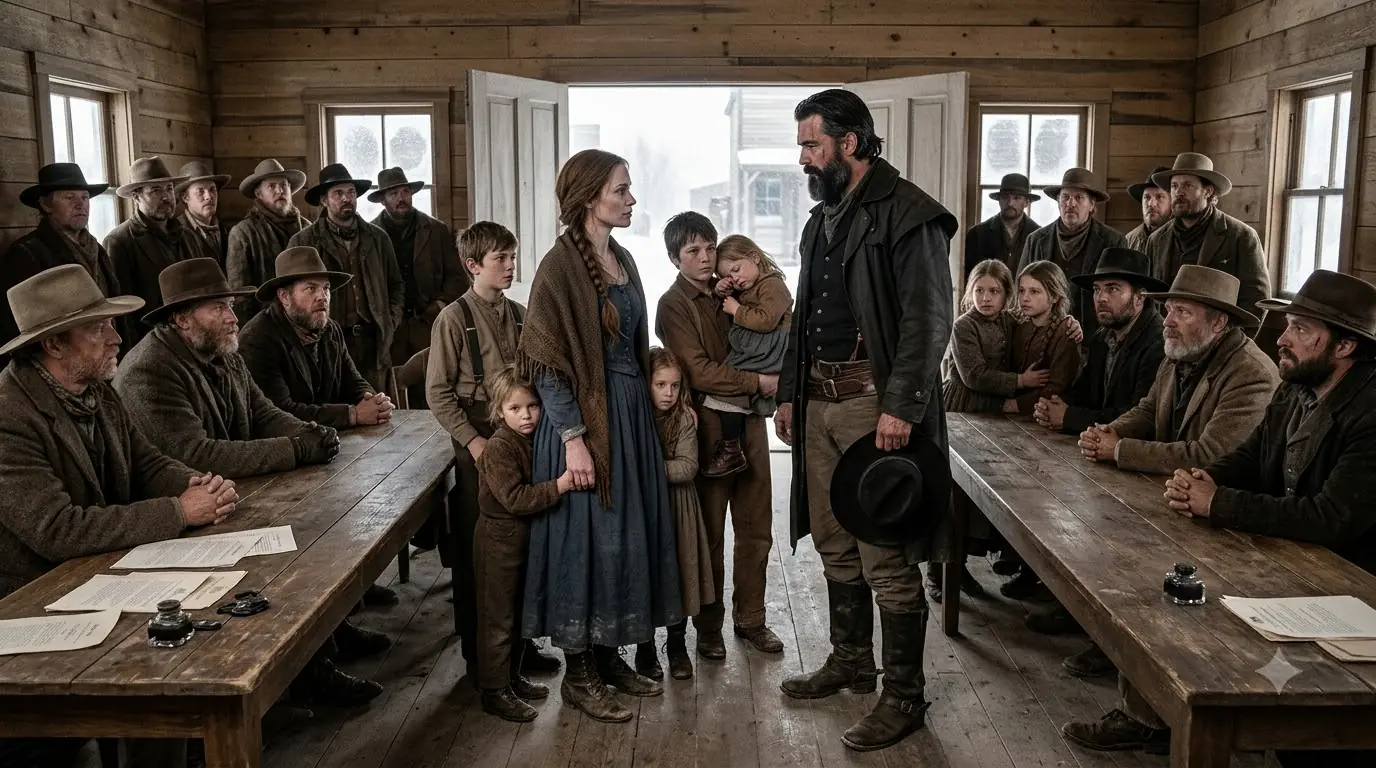
Then he started coughing.
At first, Daniel dismissed it.
By Tuesday evening he had a fever.
By Wednesday he could barely stand.
On Thursday, Sarah sent Jack riding into Dry Creek for the doctor, but the doctor was already at a ranch twenty miles north helping with a difficult birth.
Daniel died before sunrise Friday.
Sarah sat beside him with his hand between hers while seven frightened children waited in the hallway.
He had tried to apologize.
That was the part she hated remembering most.
Daniel Dawson had spent fifteen years helping everyone within riding distance, yet with his last breaths he apologized to Sarah because he was leaving her with debt.
“Sixty dollars,” he whispered.
“Daniel, stop.”
“Pierce has the note.”
“I don’t care about the note.”
“Roof needs patching.”
“Stop.”
“Sarah.”
She leaned close.
His voice was barely there.
“Keep them together.”
Her throat closed.
“I will.”
“Promise.”
“I promise.”
Daniel died before she could say anything else.
Three days later, Sarah buried him on the hill behind their cabin.
The ground was already hardening.
Jack dug until his hands blistered.
Ben helped.
Sarah used Daniel’s shovel.
None of the neighbors Daniel had spent years helping came.
One wagon passed along the distant road.
It never turned toward their property.
Sarah remembered each shovel of frozen dirt hitting the coffin.
She also remembered one of Daniel’s favorite sayings.
“I’d rather break my back than beg another man for a rope.”
She had hated that stubborn pride when he was alive.
After his death, she understood it.
Now she stood inside Dry Creek town hall surrounded by men who had accepted Daniel’s labor a hundred times but suddenly found themselves unable to remember him beyond the amount of food his children might consume.
Sarah removed her brown shawl slowly.
Seven children clustered around her.
Jack, thirteen, stood at her right shoulder. He was already almost as tall as she was, with Daniel’s dark hair and the dangerous silence of a boy trying to become a man before his time. Since his father’s death, Jack had stopped crying where anyone could see him.
Ben, twelve, stood beside him holding Lily.
Little Lily had cried herself asleep on the wagon ride into town. Her cheek rested against Ben’s shoulder, one tiny hand still gripping his collar.
The twins, Emma and Ella, both ten, held hands.
They had done that almost constantly since Daniel died.
Jacob, seven, pressed against Sarah’s skirt.
Grace, six, stood behind him, staring at the floor.
Sarah looked toward Mayor Walter Hayes.
He was sixty-three and had known Daniel for more than a decade.
“Why are my children’s names on those papers?”
Walter swallowed.
“Mrs. Dawson.”
“Answer me.”
Harold Pierce shifted at the long table.
He owned the largest ranch near town and also held Daniel’s sixty-dollar debt note.
“There’s less than two months until the worst weather.”
Sarah looked at him.
“So?”
Harold folded his hands.
“There isn’t enough food.”
“For whom?”
“For everybody.”
Sarah looked around the room.
Twenty-three families were represented.
Some men looked ashamed.
Others looked irritated.
Several refused to meet her eyes.
Walter cleared his throat.
“Sarah, nobody wants your children to suffer.”
Her heart began pounding.
“What exactly have you decided?”
Walter glanced at the paper.
“We thought it might be best if the children stayed with families who could provide for them until spring.”
Sarah stared.
“Together?”
Silence.
“Walter.”
“No.”
The word struck harder than she expected.
Jack stepped closer to her.
Sarah looked at the columns again.
Jack beside the Pierce family.
Ben beside the Harris ranch.
Emma and Ella separated between two households.
Jacob with the miller.
Grace with the schoolmistress.
Lily with Mayor Hayes and his wife.
Sarah felt cold despite the stove burning near the wall.
“You separated the twins.”
Walter looked uncomfortable.
“The Andrews family can only take one child.”
“They have never spent a night apart in their lives.”
“Sarah.”
“And Lily?”
Walter hesitated.
“My wife and I thought we could care for her.”
Sarah looked at sleeping Lily.
Then at Walter.
“You mean take her.”
“No.”
“That is exactly what you mean.”
Harold Pierce leaned forward.
“We are trying to solve a practical problem.”
Sarah turned toward him.
“My children are not a practical problem.”
“Your children need food.”
“I know.”
“Your roof leaks.”
“I know.”
“You owe me sixty dollars.”
“I know exactly what I owe you.”
Harold’s voice hardened.
“Then you know you cannot feed seven children through January.”
Sarah’s face burned.
Because he was right.
There were two sacks of flour at home.
Half a barrel of potatoes.
Dried beans.
Salt pork enough for perhaps three weeks if she rationed it severely.
One milk cow.
Five chickens.
A small quantity of oats.
Sarah had calculated everything.
She had calculated it at night when the children slept.
She had calculated it while pretending not to hear Jack whispering with Ben about eating less so Lily and Grace could have more.
She knew exactly how impossible the winter looked.
But impossible was not the same as surrender.
“Give me one week.”
Harold sighed.
“To do what?”
“Find work.”
“There’s no work.”
“Then I’ll make some.”
“Sarah.”
“I can sew. I can cook. I can clean. Jack and Ben can help with stock.”
Jack immediately nodded.
Sarah continued.
“I can sell the cow.”
“You need the milk.”
“Then I’ll sell something else.”
“What?”
She stopped.
Harold spread his hands.
“That is what we’re saying.”
Sarah looked around the room.
“Daniel repaired your barn.”
Harold’s jaw tightened.
“What?”
“Two summers ago. Lightning split the north beam. Daniel worked there three days.”
“This has nothing to do with that.”
Sarah turned toward another rancher.
“Mr. Lawson. Daniel pulled your wagon from the river mud.”
The man looked down.
“And you, Walter. Who rebuilt your chimney after the storm?”
Walter stared at the table.
Sarah’s voice cracked.
“He worked for half this town and barely charged most of you.”
Nobody answered.
“When he died, Jack and I dug his grave.”
Her son lowered his face.
Sarah continued quietly.
“Not one of you came.”
The silence became painful.
Harold shifted.
“This is not about Daniel.”
“It is about what people owe one another.”
“We cannot feed every struggling family.”
“I did not ask you to.”
Sarah’s eyes burned.
“I asked for one week.”
Before Walter could answer, the front doors opened violently.
Wind swept snow across the floor.
Every head turned.
A man stood in the doorway.
For a moment, nobody moved.
Cole Blackwood removed one black glove.
He filled the doorway in a long dark duster dusted with snow. At forty-one, he was taller than nearly every man in Dry Creek, with broad shoulders hardened by years of mountain ranch work. A thick black beard covered most of his jaw, streaked lightly with gray, while a pale scar ran from his left temple down toward the beard line.
People called him Blackwood more often than Cole.
Some called him the mountain wolf when he was not close enough to hear.
He owned Blackwood Ridge, a large ranch nearly eighteen miles north of town where the hills climbed toward pine country. The ranch produced cattle, horses, timber, and enough hay that Cole rarely depended on town merchants.
He also lived alone.
Mostly.
He employed four permanent ranch hands, two seasonal workers, and an elderly housekeeper named Martha Bell.
But no family.
Not anymore.
Cole closed the doors behind him.
Harold Pierce frowned.
“This is private town business.”
Cole looked toward Sarah.
Seven children surrounded her.
His expression barely moved.
“I heard.”
Walter stood.
“Cole.”
“I heard enough from the porch.”
Harold pushed his chair back.
“Then you know we’re trying to arrange suitable placements.”
Cole looked at the papers.
Then at the children.
Jack stared back defiantly.
Ben tightened his arms around Lily.
Emma and Ella moved closer together.
Cole’s gaze stopped on the sleeping little girl.
Then he looked toward Sarah.
Her face held no request.
No expectation.
Only exhaustion.
Cole turned toward Walter.
“You’re splitting them?”
“For the winter.”
“Across seven homes?”
“Five.”
Cole stared at him.
Walter shifted.
“It’s temporary.”
Cole looked at the twins.
“Those two know that?”
Emma squeezed Ella’s hand harder.
Nobody answered.