The snow began before Eleanor Whitmore reached the last mountain pass.
At first it came gently, little white flecks touching the wagon canvas and melting almost instantly. By midafternoon, the wind had strengthened enough to drive those flakes sideways across the trail, erasing the tracks behind them nearly as quickly as the horses made them. Eleanor sat beneath a wool blanket with both hands locked around the handle of the only trunk she had left in the world and wondered, not for the first time, whether she had made the most foolish decision of her twenty-eight years.
Three thousand miles behind her was Baltimore.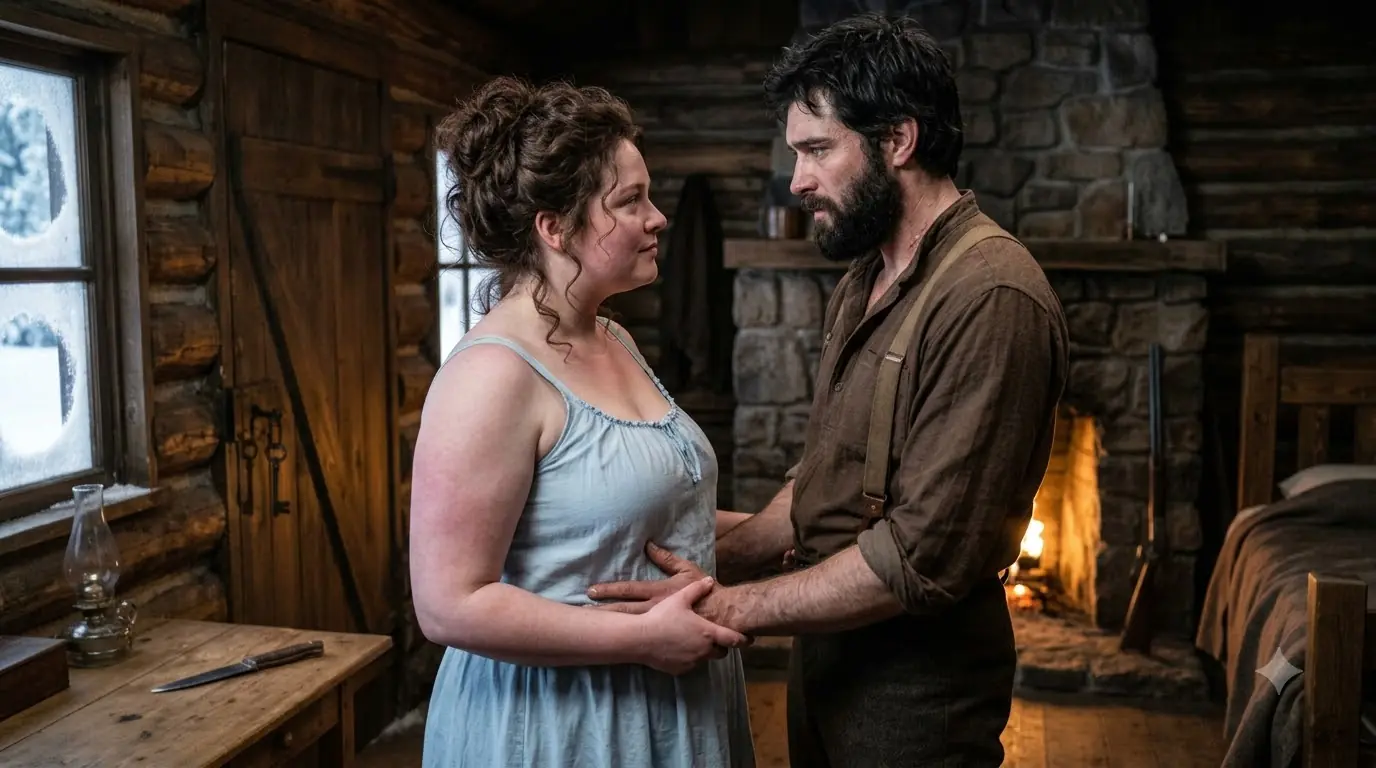
There were people there who knew her name, though few who would have opened their doors if she arrived with nowhere to sleep. There had once been a townhouse with narrow windows, walnut furniture, silver serving spoons, and a husband who wore expensive coats while secretly owing more money than Eleanor had believed possible. Now Henry Whitmore was dead, most of the furniture had been sold, the townhouse belonged to creditors, and Eleanor’s old acquaintances had gradually stopped inviting her to tea once they understood she could no longer return favors.
Ahead of her was a man she had never met.
Caleb Mercer.
Thirty-two years old.
Trapper.
Landowner.
Colorado Territory.
No children.
No living close family.
According to the letters he had sent through a matrimonial service, he owned one hundred sixty acres of mountain land, a sound cabin, two horses, several traps, enough stored meat to survive winter, and no particular talent for conversation.
His first letter had been so unromantic Eleanor almost laughed.
Mrs. Whitmore,
I am not looking for a delicate woman. Winters here are difficult. I hunt and trap for long stretches and require someone who does not panic when weather closes the trail. I do not drink excessively, gamble, or keep company in town beyond business. I own my property outright. If we agree, I will cover your remaining documented debts and transportation.
Caleb Mercer
Eleanor had stared at those sentences for a long time.
Not one compliment.
Not one promise of romance.
Nothing about beauty, affection, companionship, or destiny.
And somehow that blunt practicality felt safer than every polished man who had ever told her what she wanted to hear.
She had written back.
Mr. Mercer,
I can cook, preserve meat, sew adequately, keep accounts well, tend a kitchen garden, manage poultry, and tolerate silence better than most people. I have lived through poverty disguised as respectability, so mountain weather does not particularly frighten me. I do not require romance. I require honesty.
Eleanor Whitmore
His reply came seventeen days later.
Then perhaps we understand one another.
Three months after that, Eleanor sat in a wagon climbing into the Colorado mountains while a stranger named Tom Avery drove the horses and repeatedly glanced toward the sky.
“We need to move faster,” he said.
Eleanor looked ahead.
Nothing but pine forest.
“How much farther?”
“Maybe eight miles.”
“Maybe?”
“Road changes after storms.”
“That is not comforting.”
Tom laughed.
“You’re really marrying Mercer?”
“Yes.”
“Never met him?”
“No.”
Tom whistled.
Eleanor tightened the blanket around her shoulders.
“You have an opinion.”
“Everybody has an opinion about Caleb.”
“That was not an invitation.”
Tom grinned.
“Fair enough.”
Another mile passed before Eleanor asked anyway.
“What do people say?”
Tom considered.
“That he’s big.”
“I gathered that from the tailor measurements.”
“He sent you measurements?”
“For a winter coat.”
Tom laughed.
“That sounds like him.”
“What else?”
“He traps alone farther north than most men are willing to go with partners.”
“Useful.”
“He once carried a man with a broken leg eleven miles through snow.”
“Admirable.”
“He broke another man’s jaw in Red Creek.”
Eleanor looked over.
“Less admirable.”
“Depends who tells it.”
“Why?”
“Man had been beating a stable girl.”
Eleanor became quiet.
Tom continued.
“He doesn’t talk much.”
“I know.”
“Doesn’t go to church much.”
“That is between him and God.”
“Has a scar.”
“So do half the men west of Kansas.”
Tom glanced at her.
“You really aren’t nervous?”
Eleanor looked down at her gloved hands.
“I did not say that.”
The truth was that she was terrified.
Not because Caleb might be rough.
Roughness she understood.
Henry had taught her that cruelty did not always look rough at first.
Henry Whitmore had been charming when they met.
He courted Eleanor beneath garden lanterns. Sent books instead of flowers because she once mentioned roses died too quickly. Asked permission before their first kiss.
Then they married.
The cruelty came slowly.
A hand gripping her wrist too tightly.
A sentence spoken through clenched teeth.
Silence that lasted entire evenings when she failed to anticipate what he wanted.
Eventually there were apologies after every ugly moment.
Flowers.
Promises.
Then repetition.
When Henry died, Eleanor mourned him.
That confused her.
A person could miss someone who had frightened them.
Grief was not a moral judgment.
Now she was going to marry another stranger.
The absurdity of it might have been funny if the alternative were not poverty.
Tom suddenly pulled the reins.
“There.”
Eleanor looked up.
At first she saw only trees.
Then smoke.
A thin gray column rising beyond a ridge.
They rounded the bend and a cabin appeared.
Larger than Eleanor expected.
Two rooms at least, built from dark pine logs with a stone chimney and a low attached shed. A fenced pen sat to one side. Split firewood was stacked nearly six feet high beneath an overhang. Two horses stood inside a lean-to, protected from the growing storm.
A man waited beside the cabin.
Eleanor knew immediately it was Caleb.
He was enormous.
Tom had not exaggerated.
At least six feet four, broad enough through the shoulders that the dark wool coat across his body seemed constructed more like horse tack than clothing. Dark hair showed beneath a fur-lined hat. His beard covered a hard jaw, and when the wagon drew closer Eleanor saw the pale scar beginning near one side of his neck and disappearing beneath his collar.
Caleb stepped forward.
The first thing he looked at was the horse team.
The second was the sky.
Then Eleanor.
His gray eyes stopped.
For several seconds nobody spoke.
Eleanor felt every insecurity she thought she had buried return at once.
She was not a small woman.
Never had been.
Full breasts.
Soft stomach.
Heavy hips.
Thick thighs.
In Baltimore, women discussed how certain dress patterns could “forgive” generous figures.
Eleanor hated that word.
Forgive.
As though fabric were doing charity.
Caleb looked at her body only once.
Not with disgust.
Not even with surprise.
His gaze returned to her face.
“Mrs. Whitmore?”
“Yes.”
“I’m Caleb.”
“I assumed.”
Something almost amused moved through his eyes.
Then he stepped toward the wagon.
Tom climbed down.
“Storm’s getting ugly.”
Caleb nodded.
“You should stay.”
Tom shook his head.
“My sister’s place is four miles back.”
“You won’t make Red Creek.”
“Wasn’t planning to.”
Caleb looked toward Eleanor.
“Cold?”
“A little.”
He reached for her trunk.
Eleanor grabbed the opposite handle instinctively.
“I can carry it.”
“I know.”
She hesitated.
That answer surprised her.
Caleb continued.
“It’s heavy.”
“That does not mean I cannot carry it.”
“No.”
“Then?”
He looked at the deep snow already forming beneath the wagon.
“You’re wearing city boots.”
Eleanor looked down.
He was right.
She released the trunk.
Caleb lifted it easily.
Too easily.
The weight had required two porters in Denver.
Eleanor followed him toward the cabin.
Tom called:
“Mercer!”
Caleb turned.
“You two doing the ceremony today?”
Eleanor froze.
Caleb looked toward her.
“I arranged Reverend Foster.”
“Where?”
“Red Creek.”
Eleanor stared at the worsening snow.
“That is impossible tonight.”
“Yes.”
Tom grinned.
“Looks like you’ll have to wait.”
Then he climbed onto the wagon.
Eleanor’s stomach dropped.
Wait.
Alone in a cabin with a stranger.
Caleb noticed her face.
“I can take the shed.”
She stared.
“In this weather?”
“I’ve slept in worse.”
“I’m not throwing you out of your own house.”
“Then I’ll sleep beside the stove.”
Eleanor studied him.
“Before we’re married?”
His expression became unexpectedly embarrassed.
“Yes.”
Tom laughed so loudly Caleb gave him a look that made him stop.
The wagon departed.
Eleanor stood beneath the cabin roof listening to the wind.
Caleb opened the door.
“Come inside.”
The cabin smelled of smoke, pine, leather, dried herbs, and something simmering.
Eleanor entered.
Warmth touched her face.
A stone hearth filled one wall. A heavy table stood near the center. Shelves held jars, flour, beans, salt, coffee, dried apples, and tin cookware. A single large bed occupied the far side, partly hidden by a canvas divider someone had installed recently.
Eleanor looked at the divider.
Caleb noticed.
“I put that up yesterday.”
“For me?”
“Yes.”
“Why?”
He seemed confused.
“For privacy.”
Something tightened in her throat.
“Thank you.”
He nodded.
That evening they ate elk stew.
Caleb spoke little.
At first, Eleanor feared his silence.
Henry always became quiet before anger.
Caleb’s quietness felt similar enough to wake old instincts.
She watched his hands.
Huge hands.
Scarred knuckles.
One finger slightly crooked from an old break.