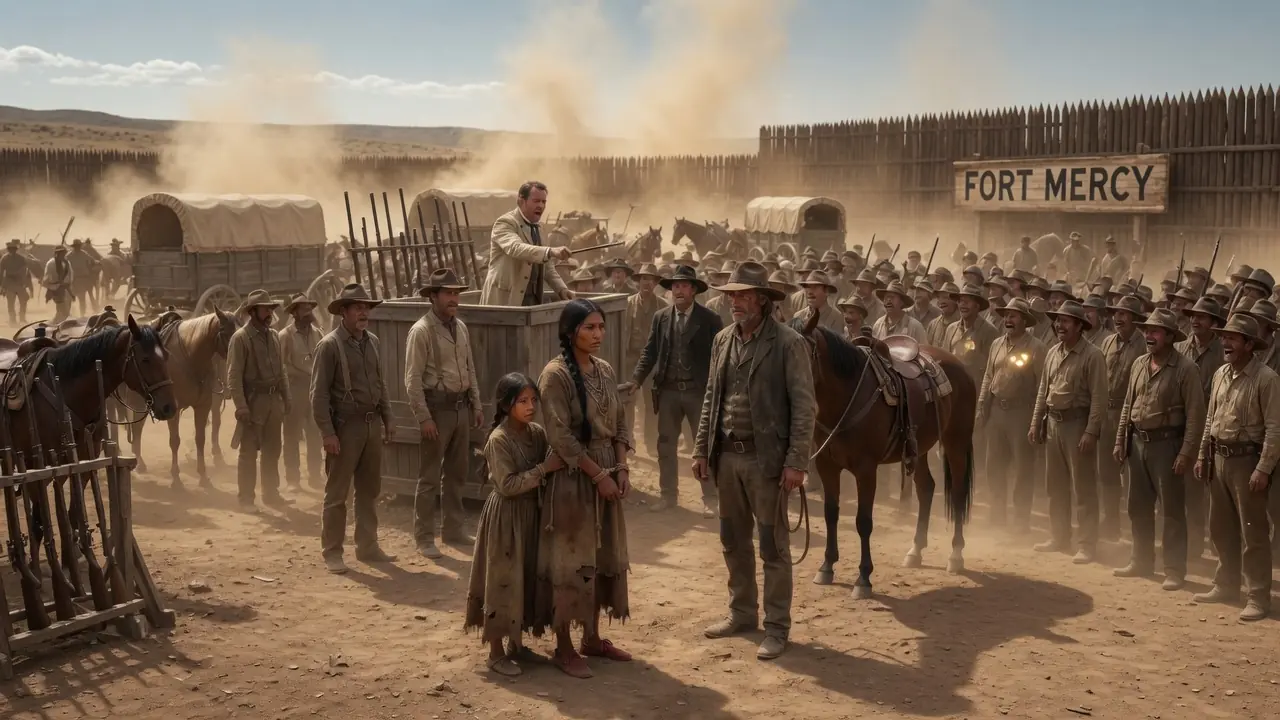
The dust outside Fort Mercy rose so thick that it turned the afternoon sun the color of old blood.
I remember that because I remember everything about that day.
The heat.
The smell of horse sweat and gun oil.
The laughter of men who had forgotten how to be ashamed.
And the two sisters standing on a wooden platform with their wrists tied, their backs straight, and their eyes refusing to bow.
My name is Caleb Ward.
I was thirty-nine years old when I rode into Fort Mercy on a sorrel horse with a lame left hind leg and a heart so tired I did not care much whether I rode back out.
That was in 1883, near the edge of Arizona Territory, where the land opened wide and cruel beneath a hard blue sky. Men came there for silver, cattle, land, revenge, and sometimes because they had nowhere else decent to go.
I had come for salt, coffee, ammunition, and horseshoe nails.
Nothing more.
I owned a small ranch north of Red Knife Mesa, a lonely spread of dry grass, red rock, and stubborn cattle. I lived there with one old Mexican cook named Teresa, three hired hands, and the ghosts of people I had failed to save.
Once, I had been a soldier.
I do not say that proudly.
I had worn the uniform. Followed orders. Rode where I was told. Believed what I was told, at least for a while. Then I saw too much. Burned homes. Empty cradles. Children walking behind soldiers with eyes too old for their faces.
By the time I left the cavalry, I no longer knew how to look at myself without seeing the men I had helped become.
My wife, Sarah, used to say a man could repent with his hands if his mouth had no words for it. She believed work could save a soul if the soul was willing to be honest.
Sarah died of fever four years before that day at Fort Mercy.
After that, I stopped believing much of anything.
I bought cattle. Fixed fences. Paid my men fair. Gave water to travelers. Rode alone when the nights got too long.
That was the life I had left.
Then I heard the auction bell.
It rang from the far side of the fort, sharp and ugly, cutting through the clamor of wagons and horses. At first, I thought it was a livestock sale. Fort Mercy often held them when traders came through from the south.
I almost ignored it.
Then I heard a man laugh and say, “That one still has fight in her.”
Something in my stomach went cold.
I tied my horse outside the general store and walked toward the sound.
A crowd had gathered near the old freight yard. Miners, teamsters, drifters, ranchers, soldiers off duty, and men whose eyes told me they had come for reasons no decent man would name aloud.
On the platform stood an auctioneer in a cream-colored coat.
Jonas Pell.
I knew his name. Everyone did. He bought stolen horses, sold whiskey to starving men, and could make any evil sound like commerce if the price suited him.
Behind him stood six captives.
Four men.
Two women.
The women were young.
Sisters, I knew at once.
The elder stood slightly forward, shielding the younger with her body as much as the rope allowed. She might have been twenty-four or twenty-five. Tall, straight-backed, with black hair braided down her shoulder and a face carved by pride rather than fear. Her eyes were dark and steady.
The younger sister stood behind her, perhaps eighteen, perhaps nineteen. She was smaller, but no less proud. Her chin trembled once, but she lifted it again before anyone could enjoy seeing it.
Apache, I thought.
Maybe Chiricahua, though I would not have sworn to it. I had known enough Apache people in war and truce to know better than to pretend all bands were the same.
Jonas Pell pointed toward them with his cane.
“Now, gentlemen, here is a rare pair. Sisters, taken near the border country. Strong hands. Young enough to train. The older one looks wild, but wild stock can be made useful with firm handling.”
Laughter rippled through the crowd.
My hands curled into fists.
The older sister did not flinch.
She looked at Jonas Pell as if she were memorizing his face for the afterlife.
“The younger one,” Pell went on, “would suit kitchen work, laundry, maybe more delicate service if properly managed.”
A man near me chuckled.
I turned my head and looked at him.
The laugh died in his throat.
“Bidding starts at seventy-five dollars for the pair.”
Hands went up.
A mining boss bid ninety.
A rancher bid one hundred.
A man with broken teeth bid one hundred and twenty.
The younger sister closed her eyes for one second.
The older one whispered something to her in Apache, too soft for the crowd to hear but sharp enough to carry strength.
The girl opened her eyes again.
I had seen courage in many forms.
Men charging under gunfire.
Mothers burying sons.
Children crossing deserts barefoot.
But there was something in those sisters that made my chest ache.
They stood there with nothing left but dignity.
And even that, men were bidding to take.
“One hundred and fifty,” someone called.
“Two hundred,” said another.
Jonas Pell smiled wider.
Then Harlan Stokes stepped forward.
My blood turned colder.
Stokes owned a mine east of Mercy Gulch. Men went to work for him when they were desperate. Some came back broken. Some did not come back at all. Stories about what happened to women on his property were told in low voices, and never when his gunmen were near.
“Three hundred for the pair,” Stokes said.
The crowd quieted.
Jonas Pell’s eyes shone.
“Three hundred from Mr. Stokes.”
The older sister looked across the crowd then.
Her gaze found mine.
I do not know why.
Maybe because I had stopped breathing.
Maybe because guilt has a scent and she recognized it.
Her eyes held mine.
There was no begging in them.
Only a question sharp enough to cut.
Are you another man who watches?
I had watched before.
Too many times.
That was the truth I carried like a stone in my chest.
Jonas Pell lifted his gavel.
“Three hundred going once.”
I heard Sarah’s voice, though she had been dead four years.
A man can repent with his hands.
“Four hundred,” I said.
Every head turned.
Jonas Pell blinked, then smiled.
“Well now. Caleb Ward joins us. Four hundred dollars.”
Harlan Stokes looked at me slowly.
“You should keep walking, Ward.”
“I have done enough walking.”
Stokes’s eyes narrowed.
“Four hundred and fifty.”
“Five hundred.”
The crowd murmured.
That was good money. Hard money. Winter money.
Stokes spat into the dust.
“Six hundred.”
I looked at the sisters.
The younger one was staring at me now. The older one still looked guarded, but something had shifted in her face.
Not hope.
Not yet.
Hope was too dangerous.
“Eight hundred,” I said.
The crowd erupted.
Jonas Pell almost dropped his gavel from delight.
Stokes turned red.
“You fool.”
“Likely.”
“Those women are not worth eight hundred dollars.”
I looked at him.
“That is the difference between us. You still think this is about worth.”
He said nothing.
Jonas Pell lifted the gavel.
“Eight hundred dollars going once. Going twice.”
The older sister did not look away from me.
The gavel struck wood.
“Sold to Caleb Ward.”
The word sold made bile rise in my throat.
I had saved them from Stokes.
But I had still bought them.
There are some sins a man commits even while trying to stop worse ones. The only thing to do afterward is not pretend clean hands.
I paid Jonas Pell with money meant for winter feed and two new mares.
He counted every bill with pleasure.
“Fine purchase, Ward,” he said. “Though I did not figure you for the type.”
“I am not.”
He laughed.
“They all say that at first.”
I stepped close enough that his smile faltered.
“You will hand me the papers. Then you will forget their faces.”
His eyes hardened.
“Careful, Ward. Law is law.”
“No,” I said. “Law is what men write down. Justice is something else.”
He gave me the papers.
A deputy cut the sisters from the line but left their wrists tied.
I took out my knife.
The younger one tensed.
The older one stepped in front of her.
“I am not going to hurt you,” I said in Apache.
Both women froze.
The older sister’s eyes sharpened.
“You speak our words?” she asked.
“Some.”
“Why?”
“I was a soldier.”
Her face closed like a door.
“Then you have hurt our people.”
“Yes.”
The honesty settled between us.
I cut the rope from her wrists first, then the younger’s.
“My name is Caleb Ward,” I said. “I have a ranch north of Red Knife Mesa. I am taking you there because it is safer than here. Once there, you are not bound. You are not property. You may leave when you choose.”
The younger sister stared at her freed hands.
The older one rubbed the raw marks at her wrists.
“What do you want from us?” she asked.
“Nothing.”
“No white man pays eight hundred dollars for nothing.”
The words landed hard because she was right to say them.
“I paid because if I did not, he would have.”
I glanced toward Harlan Stokes.
The older sister followed my gaze.
Understanding moved across her face.
Not gratitude.
Not trust.
Only knowledge of the danger avoided.
“What are your names?” I asked.
She hesitated.
Then said, “I am Iska.”
The younger one whispered, “Naya.”
I repeated the names carefully.
Iska watched my mouth form them.
“You say them wrong,” she said.
“I expect I do many things wrong.”
For the first time, Naya almost smiled.
Almost.
I led them to my wagon.
The crowd made remarks as we passed. Some ugly. Some curious. Some meant to shame me. I let them fall.
Sheriff Abel Knox stepped into my path near the street.
He was a heavy man with pale eyes and a badge he wore like permission.
“Ward.”
“Sheriff.”
“You know what you are taking responsibility for?”
“I know who I am taking home.”
His mouth twisted.
“Apache women are trouble.”
“So are white men. Yet the territory keeps making more of them.”
Someone nearby laughed before realizing it was not safe.
Knox’s eyes hardened.
“If they run, if they steal, if they put a knife in somebody, it comes back on you.”
“If someone harms them,” I said, “it comes back through me.”
The sheriff studied me.
Then stepped aside.
We rode out of Fort Mercy with the sun dropping behind the red hills and the dust settling behind us like a curtain closing on a shameful stage.
For the first hour, no one spoke.
Iska and Naya sat in the wagon bed wrapped in blankets I had given them, though Iska kept one hand near the small knife I had handed back to her.
She had looked startled when I returned it.
“Keep it,” I said.
Her eyes searched mine.
“For what?”
“For whatever you think you may need it for.”
Now she held it beneath the blanket, not hidden well enough to fool me.
I was glad.
A woman who has been tied should have something sharp within reach.
At dusk, we stopped near a dry wash to rest the horses. I built a small fire and set coffee to boil. Teresa had packed beans and corn cakes for my trip. I divided them between us.
Naya ate slowly, as if expecting the food to be taken away.
Iska did not eat until Naya had finished.
I noticed.
She noticed me noticing.
“You watch too much,” she said.
“I am trying to understand.”
“Men like you understand only after blood.”
There was no anger in the words.
Only fact.
That made them worse.
“You may be right.”
She looked surprised by the answer.
The fire cracked between us.
After a while, Naya spoke in careful English.
“You have wife?”
“No.”
“She dead?”
“Yes.”
“I am sorry.”
I looked at her.
She meant it.
After everything done to her, she could still offer sorrow to a stranger.
“Thank you,” I said.
Iska looked into the fire.
“Do not mistake my sister’s soft heart for weakness.”
“I did not.”
“You will.”
“No,” I said. “I have seen enough weakness to know it rarely looks like kindness.”
Iska’s eyes lifted to mine.
For a moment, the firelight caught in them.
Then she looked away.
Red Knife Ranch lay in a shallow valley beneath walls of rust-colored stone. The land was stubborn, but it gave enough if a man learned when to ask and when to leave it alone. Cottonwoods followed the creek. The house was low and square, built from timber and stone, with a porch Sarah had wanted because she loved sitting outside after supper.
I had not sat there much after she died.
Teresa came out before the wagon stopped.
She was fifty-something, strong as rawhide, and had been running my house longer than I had been willing to admit it needed running.
She saw the sisters.
Then she saw my face.
“What have you brought home, Caleb?”
“Guests.”
Her brows lifted.
“Guests with rope marks?”
I climbed down.
“Guests who need food, clean clothes, and rooms with doors that lock from the inside.”
That softened her face.
She crossed herself.
“Madre de Dios.”
I helped Naya down first. Iska refused my hand and climbed down on her own.
Teresa noticed that too.
“Come inside,” Teresa said gently. “Both of you. There is stew.”
Naya looked at Iska.
Iska looked at me.
“You said doors lock from inside?”
“Yes.”
“No one comes in?”
“No one.”
“Even you?”
“Especially me.”
She studied me for a long moment.
Then she nodded once.
Inside, Teresa gave them warm water, clean cloths, and two dresses that had belonged to Sarah’s sister, who had stayed with us one summer years before. The dresses were plain but soft. Naya touched the sleeve of one as if fabric could be a miracle.
Iska did not touch hers until Teresa left the room.
That night, I sat alone on the porch while the house settled behind me.
Voices moved upstairs.
Teresa’s low Spanish.
Naya’s soft replies.
Iska’s sharper tone.
I understood only pieces.
Enough to know they were frightened.
Enough to know I was the reason.
That was a hard thing to sit with.
I had brought them out of Fort Mercy, but I had not brought peace. A man cannot hand peace to someone like a cup of coffee. Peace has to be believed before it can be held.
The next morning, Iska was in the yard before sunrise.
She wore the brown dress Teresa had given her, but she moved as though it were temporary. Her braid hung over one shoulder. Her eyes followed every sound: the horses shifting, the chickens scratching, the bunkhouse door creaking, one of the hands coughing as he came outside.
She was mapping danger.
I recognized it because I had done the same after the war.
“You sleep?” I asked.
“No.”
“Bed too soft?”
“Walls too close.”
I nodded.
She looked at me as if she had expected mockery and disliked finding none.
Naya emerged later with Teresa, carrying a basket of laundry. She kept close to the older woman but smiled when one of the cats wound around her skirt.
By breakfast, my hired hands knew enough not to ask stupid questions.
Or so I hoped.
There were three of them then. Old Ben Cutter, who had ridden with me five years and trusted silence more than speech. Miguel Ortega, Teresa’s nephew, twenty-two, quick with horses and quicker with laughter. And Wade Sloane, a broad-shouldered hand I had hired two months earlier because winter work did not wait for perfect judgment.
Ben nodded to the sisters respectfully.
Miguel touched his hat.
Wade stared.
Too long.
I saw Iska see it.
“Wade,” I said.
He looked at me.
“They are guests in this house.”
His mouth twitched.
“Sure, boss.”
The way he said it told me trouble had only postponed itself.
Over the next week, the ranch formed a new rhythm.
Naya stayed mostly with Teresa, helping in the kitchen, learning English words for tools, foods, and small comforts. She had a quiet grace that made people speak gently around her without being asked. She laughed for the first time on the fourth day when Miguel dropped an entire sack of flour and emerged from the cloud looking like a ghost.
Iska did not laugh.
But she watched.
Always watched.
She spent time near the horses, not touching at first. Just standing by the corral, letting them become used to her presence. On the sixth morning, a young mare no one could saddle without a fight came close to the fence and lowered her head toward Iska’s hand.
Ben saw it from the barn.
“Well,” he muttered. “That mare hates everybody.”
“Maybe she has taste,” Iska said.
Ben blinked.
Then laughed.
From then on, he liked her.
I tried to keep distance.
It seemed proper.
Necessary.
She had not come to my ranch by choice, not truly. I would not turn rescue into another kind of claim.
But distance became difficult when someone changed the shape of your home.
Naya’s songs began to fill the kitchen. Teresa started humming with her. Miguel lingered near the door pretending to need more coffee. Ben carved small wooden animals and left them on the table for Naya without comment.
And Iska moved through the yard like a flame held carefully in both hands.
Sharp.
Bright.
Dangerous to approach carelessly.
One afternoon, I found her in the stable with the young mare.
The mare had been mean since I bought her. Kicked two men. Broke one rail. Nearly took a bite from Wade’s shoulder.
Iska stood inside the stall with her.
No rope.
No whip.
No fear.
My heart nearly stopped.
“Iska,” I said quietly.
She did not turn.
“If you shout, she will startle.”
“I was not planning to shout.”
“You are thinking about it.”
“I am thinking about several things.”
The mare snorted.
Iska lifted one hand, palm low.
The mare lowered her head.
Slowly, impossibly, Iska touched the animal’s neck.
“She is not mean,” Iska said.
“She has made a strong argument otherwise.”
“She is afraid. Men hurt her and called her wild because she remembered.”
The words were about the horse.
Not only the horse.
I leaned against the stall door.
“You know horses?”
“My father did. He taught me before soldiers came.”
Her hand moved gently over the mare’s neck.
“What was his name?”
She went still.
For a moment, I thought she would not answer.
Then she said, “Talon.”
I repeated it carefully.
“Talon.”
She looked at me.
“Better that time.”
“I can learn.”
She studied me for a breath too long.
“Yes,” she said. “Maybe.”
The first real trouble came from town.
Sheriff Knox arrived with two riders three days later. I saw them from the barn and met them in the yard before they reached the house.
Knox did not dismount.
“Ward.”
“Sheriff.”
“Word is you have those Apache women loose on your ranch.”
“They are free to move.”
“That so?”
“It is.”
“Had a complaint. Woman fitting the older one’s description stole chickens from the Mercer place.”
“The Mercer place is nine miles south.”
“Apache move quick.”
I stared at him.
Behind me, the house door opened.
Iska stepped onto the porch.
Naya appeared behind her.
Knox’s eyes moved over them.
“Come here, girl.”
Iska did not move.
I stepped into his line of sight.
“You will address her by name.”
His smile was ugly.
“I do not know her name.”
“Then you have no business speaking to her.”
Knox’s riders shifted in their saddles.
The sheriff leaned forward.
“You test me, Ward?”
“No. I am informing you.”
“There are folks in this territory who do not like what you are doing.”
“I have noticed.”
“You taking up with Apache women will not make you friends.”
“I did not buy them to win friends.”
The word buy struck me like a slap from my own mouth.
Iska heard it.
I saw the flicker in her eyes.
Knox laughed.
“At least you admit what they are.”
“No,” I said. “I admit what I did. There is a difference.”
The sheriff’s smile faded.
“You keep them under control.”
“They are not animals.”
“They are Apache.”
“So were some of the bravest people I ever faced.”
The yard went quiet.
Knox studied me, uncertain whether to push.
Then he spat into the dust.
“Trouble comes, Ward, do not come crying to the law.”
“I have never found much comfort crying to men like you.”
He rode off.
When I turned, Iska was watching me.
“You said you bought us.”
“I did.”
Her face closed.
“I told you I would not lie.”
“No,” she said. “You do not lie. That makes some things worse.”
She went inside.
For two days, she avoided me.
I deserved it.
On the third night, I found her by the creek.
Moonlight silvered the water. Cottonwood leaves whispered in the wind. She sat on a fallen log with her knees drawn up, looking toward the red cliffs.
I stopped several yards away.
“I should not have said it that way.”
“You said truth.”
“I said part of it.”
She did not turn.
I stepped closer, slowly.
“I paid money in Fort Mercy. That is true. I cannot make that clean by saying my intention was different. It was still wrong that money could be exchanged for your lives.”
Her shoulders tightened.
“I know what it is to belong to someone on paper,” she said. “Men speak papers and laws. We bleed.”
The words struck deep.
“Yes.”
“My mother died because soldiers said we had to move. My father died because he would not. My aunt disappeared after men took her from a camp. All had papers. Orders. Claims. Reasons.”
She turned to look at me.
“You say you are different. Maybe you are. But difference does not erase memory.”
“No,” I said. “It does not.”
“What do you want from me, Caleb Ward?”
The question came without softness.
I answered the only way I could.
“I want you to know that if you leave tomorrow, I will give you a horse, food, money, and directions. If you stay, you stay because you choose to. Not because I paid. Not because you owe me. Not because this ranch has walls.”
She searched my face in the moonlight.
“And if I never trust you?”
“Then I keep my word anyway.”
For the first time, something in her expression shifted.
Not open.
But less closed.
“That is a hard thing,” she said.
“Yes.”
“Good.”
Then she looked back at the creek.
I sat several feet away, not beside her.
For a long time, we listened to the water.
The next morning, Wade Sloane was gone.
So was one rifle, two horses, and the small tin box where Teresa kept emergency money.
Miguel found the tracks heading south.
Ben cursed.
I saddled up immediately.
Iska came from the stable leading the mean mare, now saddled and calm.
“You are not coming,” I said.
“Yes.”
“No.”
“Wade saw me with the mare. He hated that she would not obey him and came to my hand. He will sell the horses before sunset if he reaches Mercy Gulch.”
“This is not your fight.”
“He stole from this house.”
I looked at her.
She looked back.
Not pleading.
Deciding.
I thought of what I had told her by the creek.
If you stay, you stay because you choose to.
“All right,” I said.
We rode hard.
Iska tracked better than any scout I had ever known. She saw broken grass, mud marks, bent brush, a thread of saddle blanket caught on mesquite. By noon, we found Wade near an abandoned line shack, trying to change saddles.
He reached for his gun.
Iska already had her rifle aimed.
“Do not,” she said.
Wade froze.
I dismounted.
“You stole from me,” I said.
Wade glared.
“You chose them over your own kind.”
“My kind does not steal from my house.”
“She your woman now?” he sneered.
Before I could answer, Iska spoke.
“I am my own woman.”
Wade laughed.
“You think he sees you that way?”
I saw the words hit her.
Then I saw her lift her chin.
“Yes,” she said. “Because if he forgets, I will remind him.”
Despite the situation, I nearly smiled.
We brought Wade back to Fort Mercy and handed him to Sheriff Knox, who looked disappointed that he could not blame Iska.
On the ride home, the sun dropped low and red over the mesa.
Iska rode beside me.
“You let me come,” she said.
“You chose to.”
“You could have stopped me.”
“I could have tried.”
She looked at me then, and this time there was warmth in her eyes.
“Smart man.”
“Occasionally.”
Trust did not arrive all at once after that.
It came in pieces.
Naya began sitting beside me on the porch after supper, asking about Sarah, about my ranch, about the stars. She told me stories from her childhood, sometimes in English, sometimes in Apache when the English words hurt too much to find.
Teresa taught her to make tortillas.
Naya taught Teresa a song for grinding corn.
Miguel fell half in love with Naya and became useless whenever she smiled. Naya noticed and teased him gently until he blushed so hard Ben nearly choked laughing.
Iska took over much of the horse work.
Not officially.
Nothing with Iska was official until she decided it was.
But soon every difficult horse found its way to her hands. Men from neighboring ranches began hearing of it. A few came to watch. Some came to mock.
They stopped mocking when a stallion from the Mercer place, a black devil of a horse that had thrown three men, stood still under Iska’s touch while she murmured to him in Apache.
“Witchcraft,” one man muttered.
“No,” Ben said from the fence. “Skill. Harder for fools to understand.”
I loved him for that.
The ranch changed.
Not easily.
Not without danger.
But truly.
Where there had been silence, there were voices. Where Sarah’s empty chair had once accused me, Naya now sat sewing beside Teresa. Where the stable had been only work, Iska made it a place of patience and command.
And me?
I began waking with purpose again.
That frightened me.
A man can become used to grief. He can wear it so long that warmth feels like betrayal when it returns.
One evening, I stood at Sarah’s grave on the hill above the house. The sun was low, the stone warm beneath my hand.
“I do not know what I am doing,” I said aloud.
The wind moved through the grass.
“I thought saving them might settle something. Instead, it has opened everything.”
I closed my eyes.
“I miss you.”
That truth was still true.
Then, softer, I said, “But I think I am alive again.”
When I opened my eyes, Iska stood at the bottom of the hill.
She did not come closer.
She waited.
When I walked down, she said, “Your wife?”
“Yes.”
“You loved her.”
“Yes.”
“Still?”
“Yes.”
She nodded.
“Good.”
The answer surprised me.
“Good?”
“If you stopped loving her because she died, I would not trust your love for anyone living.”
I had no words for that.
Iska looked toward the grave.
“She is part of you.”
“Yes.”
“I do not want to erase ghosts.”
“No one could erase Sarah.”
“Then maybe there is room.”
The words were quiet.
Dangerous.
I looked at her.
Her face held fear and courage together.
“Room for what?” I asked.
She looked away first.
“Do not make me say everything first, Caleb Ward.”
I almost laughed.
Instead, I took one step closer.
Not too close.
“I think there is room for love to return,” I said. “Not the same love. Not replacing. But real.”
Her breath caught.
“And who would this love be for?”
“You know.”
“I want to hear.”
Fair.
She had earned every honest word.
“You, Iska.”
The wind moved between us.
“I love you,” I said. “I do not know when it began. Maybe when you looked at me from that platform like you were daring me to remember I still had a soul. Maybe when you calmed that mare. Maybe when you told Wade you belonged to yourself. But I love you.”
Her eyes shone in the fading light.
“I am not easy.”
“No.”
“I am angry.”
“Yes.”
“I do not forget.”
“I know.”
“I may never be soft in the way men want women soft.”
“I do not want soft. I want true.”
She stepped closer then.
“Then hear truth. I love you too. It angers me. It frightens me. But it is there.”
I reached for her hand slowly enough for her to refuse.
She did not.
Her fingers closed around mine.
For the first time in years, I felt no ghost standing between me and tomorrow.
The final test came in summer.
Harlan Stokes did not forget being outbid.
Men like him never forget losing what they believe they are owed.
He came at dusk with six riders. I was in the stable with Iska when Ben shouted from the yard.
“Riders!”
We came out fast.
Stokes sat at the head of them, grinning beneath his black hat.
“Evening, Ward.”
“You are trespassing.”
“I came for a business conversation.”
“I have none with you.”
His eyes moved to Iska.
“There she is. The expensive one.”
I felt Iska stiffen beside me.
My hand went to my rifle.
Stokes smiled wider.
“You wasted good money. I would have made her useful.”
Iska stepped forward before I could stop her.
“I am useful,” she said. “Just not to men like you.”
One of his riders laughed.
Stokes’s face hardened.
“Careful, girl.”
Caleb raised rifle? Wait keep first person. I raised my rifle.
“You speak to her with respect or you leave bleeding.”
Stokes drew slowly.
The yard became still.
Then the sound of another rifle cocking came from the porch.
Naya stood there.
Her hands trembled, but the rifle was aimed at Stokes.
Teresa stood beside her with a shotgun.
Miguel came from the bunkhouse.
Ben from the barn.
Even the old black stallion screamed from the corral as if the whole ranch had decided together that this ground would not be taken.
Stokes looked around.
He had expected a lonely man with two frightened women.
He had found a family.
“You cannot protect them forever,” he said.
“No,” Iska replied. “But I can protect myself today.”
She raised her rifle.
Stokes saw her eyes and finally understood he was not looking at prey.
He spat into the dust.
“This territory is changing in ugly ways.”
“Yes,” I said. “It is becoming harder for ugly men.”
His riders shifted uneasily.
One by one, they turned.
Stokes followed.
We watched until they disappeared beyond the ridge.
Only then did Naya lower the rifle and begin shaking.
Iska crossed to her and wrapped both arms around her.
“You were brave,” she whispered.
“I was terrified,” Naya said.
“Those are often the same thing.”
That night, no one slept early.
We sat outside under the stars, all of us. Teresa made coffee. Miguel built a fire. Ben carved a little wooden horse and handed it to Naya without looking at her, which made her cry quietly into her cup.
Iska sat beside me.
Not touching at first.
Then her hand found mine in the dark.
No one mentioned it.
Everyone saw.
In September, Kavan, an Apache elder and distant kin to the sisters through their mother’s line, came to Red Knife Ranch.
He arrived with three riders and no weapons visible. Iska and Naya ran to him before his horse had fully stopped.
There were tears.
Fast Apache words.
Hands on faces.
Grief and joy tangled together.
I stood back.
This was not mine to enter.
After a long time, Kavan approached me.
“You are Caleb Ward.”
“Yes.”
“You bought my kin.”
“I did.”
His eyes were dark and deep-set, his face lined by sun and sorrow.
“You freed them?”
“Yes.”
“You love Iska?”
I looked at her.
She did not look away.
“Yes.”
Kavan studied me.
“You were cavalry.”
“Yes.”
“You rode against our people.”
“Yes.”
“You regret?”
The word was simple.
The answer was not.
“Every day.”
He was silent for a long while.
Then he said, “Regret is a heavy blanket. It keeps a man warm enough to survive, but too heavy to walk far.”
I swallowed.
“I am trying to walk.”
He nodded once.
“Then walk well.”
Iska came to stand beside me.
Kavan looked at her.
“You choose this man?”
“I do.”
“He does not own you?”
Her chin lifted.
“No one owns me.”
A faint smile touched the old man’s mouth.
“Good.”
Then he looked back at me.
“If you hurt her, I will come.”
“I would expect nothing less.”
He nodded.
“Then you have my blessing, Caleb Ward. Not because you deserve it for what you did one day in Fort Mercy. One act does not make a life. But what you build after may.”
Those words stayed with me.
One act does not make a life.
What you build after may.
Iska and I married at the end of October, one year after the auction.
We did not marry in Fort Mercy.
I would not have given that town the honor.
We married under the cottonwoods by the creek, with red cliffs rising behind us and the sky wide above. Kavan spoke words in Apache. Teresa said a prayer in Spanish. Ben, who claimed he had something in his eye from the dust, stood beside me as witness.
Naya braided Iska’s hair that morning.
She wove in small white flowers that grew near the creek after rain. Iska wore a dress Teresa had sewn, simple and pale, with a sash of deep red cloth from her mother’s people.
She came toward me not like a woman being given away.
Like a woman arriving.
That mattered.
When she stood before me, she took my hands.
“These hands once carried weapons against my people,” she said softly, for me alone.
“Yes.”
“Now they build fences, hold reins, mend what they can.”
“Yes.”
“They are not clean hands.”
“No.”
“But they are honest hands.”
My throat tightened.
“I hope so.”
She looked into my eyes.
“Then I will take them.”
I could not speak for a moment.
When the vows were done, Naya threw her arms around both of us.
“I have a brother now,” she said fiercely.
“You had one before the vows,” I told her.
She cried harder.
The ranch grew after that.
Not in wealth, at first.
In purpose.
Word spread slowly that Red Knife Ranch took in people who had nowhere safe to go. Not only Apache. A Mexican widow with two boys. A half-starved boy from a failed mining camp. A former soldier who woke screaming and knew too much about shame. A Navajo woman searching for her cousin. A freed Black horseman from Texas who could ride anything with four legs and patience.
We did not ask people to become the same.
We asked them to work, respect one another, and leave cruelty at the gate.
Some neighbors hated us.
Some respected us.
Some came around when they needed help during a hard winter and found Iska organizing food stores better than any quartermaster I had served under.
Naya started a small school in the old tack room. She taught children letters in English and Apache words for sky, water, horse, home. Teresa taught them Spanish when she was in the mood. Ben taught them how to whittle and then complained that no one respected the dignity of wood.
There was laughter in the house.
Real laughter.
The kind I had thought buried with Sarah.
One morning in spring, I stood on the porch watching Iska work with a young colt in the corral. The animal circled her, nervous but curious. She stood still, one hand extended, patient as sunrise.
Naya came to stand beside me.
“She is happy,” she said.
“Yes.”
“So are you.”
I looked at her.
She smiled.
“You look surprised.”
“I suppose I am.”
“You should stop being surprised by good things. It insults them.”
I laughed.
Iska looked over from the corral.
“What is funny?”
“Naya is correcting me.”
“Good,” Iska said. “Someone must.”
Years passed.
Fort Mercy changed slowly, as all hard places do when enough stubborn people refuse to let them remain the same. Jonas Pell died in prison. Sheriff Knox lost his badge after taking bribes from the wrong man. Harlan Stokes was killed in a mining dispute far from any woman he could harm.
Red Knife Ranch remained.
Bigger.
Louder.
Stranger.
Better.
Some called it a refuge.
Some called it foolishness.
We called it home.
On the anniversary of the day I first saw Iska and Naya, I rode with my wife to the ridge above the ranch. Below us, smoke rose from the cookhouse. Children chased one another near the creek. Horses moved in the pasture. Naya stood outside the schoolroom scolding Miguel’s youngest boy for putting a frog in the chalk box.
Iska sat beside me on her horse, her hair braided over one shoulder, streaked now with a little silver.
“Do you still think of that platform?” I asked.
“Yes.”
“I am sorry.”
She looked at me.
“I know.”
“If I could have found another way—”
“You found the way that was there.”
“That does not make it right.”
“No,” she said. “But what came after matters.”
I thought of Kavan’s words.
One act does not make a life.
What you build after may.
Iska reached over and took my hand.
“You did not save me once, Caleb Ward,” she said. “You gave me ground to stand on until I could save myself again.”
That was more grace than I deserved.
But love, I had learned, is often exactly that.
Grace undeserved but not wasted.
When people ask how Red Knife Ranch became what it became, some say it began with an auction. Some say it began with eight hundred dollars. Some say it began with guilt, or mercy, or a widower trying to make peace with his past.
They are all partly wrong.
It began when two sisters stood on a platform before men who wanted to strip them of dignity, and still they did not bow.
It began when one of them looked at me as if asking whether I would remain a coward forever.
It began when I finally answered no.
But the life we built did not come from that moment alone.
It came from every morning after.
Every fence mended.
Every meal shared.
Every child taught.
Every horse calmed.
Every time Iska chose to stay, not because she had nowhere else to go, but because this place had become hers.
And every time I remembered that taking someone home is not the same as giving them one.
A home is not a roof.
It is respect.
It is choice.
It is the right to stand without being owned.
It is the people who learn your wounds and do not use them against you.
That is what Iska taught me.
That is what Naya brought into my house.
That is what Red Knife Ranch became.
And if I had to ride into Fort Mercy again, if I had to stand in that dust before those cruel men and spend every dollar I had to change the road those sisters were on, I would do it.
Not because it made me good.
But because it gave me the chance to spend the rest of my life becoming better.