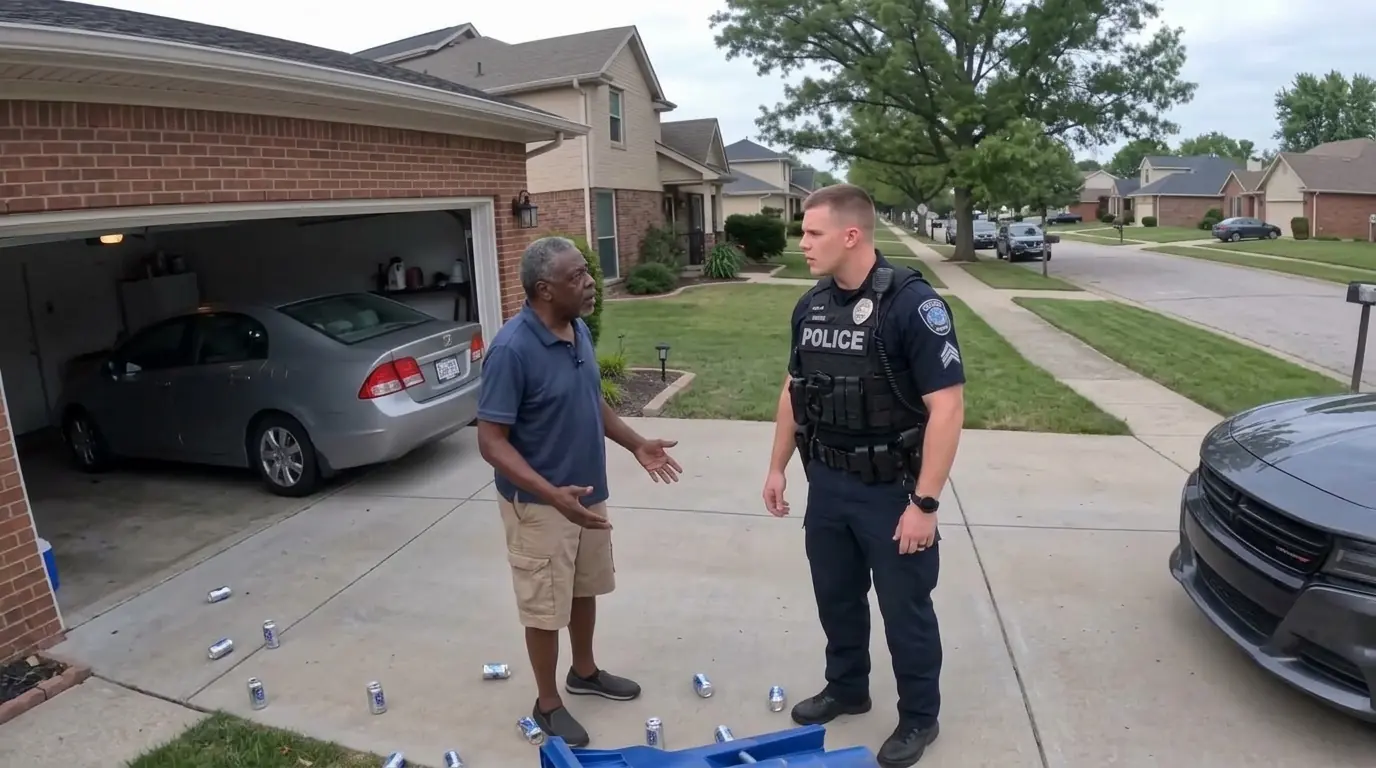
“Put the bin down and get on the ground.”
Leonard Hayes stopped halfway down his own driveway with both hands wrapped around the handles of a blue recycling cart. Flattened cardboard boxes stuck out of the top beside aluminum cans and an empty detergent bottle, while the quiet Saturday morning continued around him as though nothing unusual had happened. A police cruiser sat crooked at the curb, and the young officer beside it already had one hand near his holster.
Leonard looked behind himself at the red-brick house where he had lived for thirteen years. The garage door was open, his sedan was parked inside, and a pair of gardening gloves lay beside the walkway where he had dropped them twenty minutes earlier. “Officer, I live here,” he said calmly. “You need to slow this down before you make a decision you can’t take back.”
Officer Brandon Cole did not slow down.
At twenty-eight, Cole had spent just under four years in uniform and only six weeks assigned to the North Hills precinct. He had transferred from a busier district after several supervisors described him as proactive, decisive, and willing to take control quickly. What none of those words explained was how badly he handled uncertainty.
“Drop it,” Cole repeated. “Hands where I can see them.”
Leonard did not argue about the recycling bin. He lowered it slowly until its wheels touched the driveway, then raised both hands to shoulder level. His movements were deliberate because he understood something Cole clearly did not: once fear entered an armed encounter, facts could become irrelevant very quickly.
“I am standing still,” Leonard said. “I am unarmed, I am on my property, and I am complying with every safety-related instruction you’ve given me.” Cole stepped farther onto the driveway and ordered him onto the ground. Leonard looked at the clean concrete beneath his loafers and refused.
That refusal changed Cole’s face.
“I said prone out.”
“There is no lawful reason for me to lie face down in my driveway.”
“You’re being detained.”
“For what?”
Cole’s jaw tightened. “We had a burglary call nearby.”
Leonard waited.
“That does not answer my question.”
Cole stepped closer.
The original dispatch call had come from three blocks away. A homeowner reported seeing a white male in his twenties wearing a gray sweatshirt and blue jeans looking into a rear window while holding what might have been a pry bar. Cole had read only the first line of the dispatch summary before spotting Leonard walking from the side of his garage.
Leonard was sixty-three. Black. Wearing a faded forest-green polo and tan shorts.
He was holding recycling.
None of those differences interrupted the story Cole had already created.
“You fit what we’re looking for,” Cole said.
Leonard studied him.
“What exactly do I fit?”
Cole stared.
“The suspicious activity.”
“That is not a description.”
“You came from the side of a house.”
“My house.”
“You expect me to take your word for that?”
Leonard breathed slowly.
“No. I expect you to investigate before escalating.”
That sentence seemed to irritate Cole more than it should have.
Inside the house, Leonard’s wife, Evelyn, was making omelets while a public-radio program played from a speaker near the kitchen sink. She believed her husband was trimming hedges and taking the recycling toward the curb. She had no idea a police officer was pointing a Taser toward his chest.
Leonard preferred it that way for the moment.
He had spent more than forty years around courtrooms, police departments, prosecutors, defense attorneys, city councils, and disciplinary hearings. He understood exactly how quickly an encounter could become worse when frightened family members appeared. If Evelyn came running outside, Cole might interpret her fear as interference.
So Leonard kept his voice controlled.
“Officer, what is your name?”
“Don’t worry about my name.”
“I asked because I want to address you properly.”
Cole glanced down.
“Officer Cole.”
“Officer Cole, what specific crime do you reasonably suspect me of committing?”
“Burglary.”
“Based on what fact?”
Cole’s eyes hardened.
“Your behavior.”
“I was rolling my recycling bin down my driveway.”
“You’re refusing commands.”
Leonard shook his head slightly.
“You cannot manufacture suspicion from my reaction to being stopped and then use that reaction to justify the stop.”
Cole frowned.
“You a lawyer?”
Leonard almost smiled.
“That doesn’t matter.”
“It matters if you think you can talk circles around me.”
“I’m not trying to talk around anything. I’m asking you to identify the reason you detained me.”
Cole removed his Taser fully now.
A small red dot appeared on Leonard’s shirt.
The change in the encounter was almost absurd.
One minute earlier, Leonard had been considering whether the hydrangeas near the fence needed more water. Now he was calculating the likelihood that a nervous officer might mistake movement for aggression and discharge a weapon in his driveway.
“Turn around,” Cole ordered.
Leonard remained facing him.
“If I turn without knowing what you want next, you may decide that movement is noncompliance.”
“Stop playing games.”
“I’m trying to keep both of us safe.”
Cole laughed.
“You think I need you keeping me safe?”
Leonard looked directly at him.
“Yes.”
That answer infuriated him.
Cole holstered the Taser and moved closer.
“I need ID.”
“My wallet is inside.”
“Convenient.”
“My driver’s license lists this address.”
“Then go get it.”
Leonard raised one eyebrow.
“You just told me not to approach the house.”
Cole paused.
For a second, logic had nowhere to go.
Then pride filled the gap.
“Don’t get smart.”
“I am offering to prove residency.”
“You could go inside and grab a weapon.”
“You could accompany me to the doorway.”
“No.”
“You could run the registered vehicles in the garage.”
“No.”
“You could ask the neighbor filming us.”
Cole turned.
Across the street, seventy-two-year-old Patricia Lewis had stepped onto her front porch holding her phone horizontally. Patricia was a retired high-school principal who had known Leonard and Evelyn since they moved onto Briarwood Avenue. Her expression looked less frightened than offended.
“Leonard,” she called. “Are you all right?”
“I’m fine, Pat.”
Cole pointed at her.
“Go back inside.”
Patricia lowered the phone just enough to look over it.
“I’m standing on my own porch.”
“This is an active police investigation.”
“And I am documenting you bothering my neighbor while he puts out recycling.”
Cole’s face reddened.
“Ma’am, do not interfere.”
“I’m not interfering.”
She lifted the phone again.
“I’m recording.”
Leonard almost wished she had gone inside.
Not because he did not appreciate the witness.
Because he could see Cole becoming more desperate now that someone else could evaluate him.
Authority performed for an audience often behaved differently from authority exercised quietly.
Cole turned back to Leonard.
“Last chance. ID or you’re going in cuffs.”
Leonard kept his hands visible.
“I have told you where the ID is.”
“Then you’re refusing.”
“I’m not refusing.”
“You are.”
“No, Officer Cole. You are refusing every reasonable way to verify the very thing you claim to be investigating.”
Cole stepped into Leonard’s personal space.
“Enough.”
Leonard did not move.
“Turn around.”
“For what charge?”
“Obstruction.”
“Asserting constitutional rights is not obstruction.”
“Disorderly conduct.”
“Standing quietly in my driveway is not disorderly conduct.”
“You’re interfering with an investigation.”
“I am the person you are investigating.”
Cole’s nostrils flared.
Leonard saw the shift before the officer acted.
He had seen it hundreds of times in recorded footage.
The moment when an officer stopped asking what was lawful and started asking what would restore control.
Cole grabbed Leonard’s left wrist.
Patricia shouted from across the street.
“Officer!”
Leonard did not pull away.
He spoke loudly enough for her phone.
“I am not resisting.”
Cole twisted his arm behind him.
Pain shot across Leonard’s shoulder.
He clenched his teeth.
“I am allowing Officer Cole to control my arm.”
“Stop talking.”
“I am making no aggressive movement.”
“Stop resisting.”
“I am not resisting.”
The phrase had become automatic inside police encounters for a reason.
Cole pushed Leonard toward the hood of the cruiser.
Leonard’s chest touched warm metal.
The recycling bin remained upright twenty feet away.
A cereal box slowly slid from the top and landed on the driveway.
Cole pulled out handcuffs.
“You are under arrest for obstruction and disorderly conduct.”
Leonard stared at the windshield.
“That will not survive review.”
“You can explain it to the judge.”
“I intend to explain it to several people.”
The first cuff closed.
Then the second.
Leonard flexed his fingers.
“Check the spacing.”
Cole stared.
“What?”
“You’ve cinched the left cuff too tightly.”
“Get in the car.”
“Department general order requires a fit check and double lock.”
Cole looked at him.