The clippers didn’t stop, even after the extensions came off, even after Ariel Daniels’s scalp, patchy, vulnerable, marked by alopecia, was fully exposed. The buzzing just kept going.
Evelyn Roar stood behind her, hand steady on the clippers. Not a nurse, not a doctor, a senior administrative officer who’d decided this was discipline.
“Hold still,” Roar said, cold, clinical.
Ariel’s knuckles went white, gripping the chair. Twenty years old, fine arts sophomore. She’d hidden her condition for two years with extensions and scarves. Now it was being stripped away in a campus health office under fluorescent lights.
Three classmates stood frozen in the hallway outside. One held up a phone. The flash blinked.
Ariel didn’t cry. She stared straight into the mirror, face blank. But inside, one question burned.
How does someone do this to another human being and believe they’re right?
The video would be online in two hours. The reckoning would take three days.
Six months earlier, Ariel had chosen this university for one reason. Its art program didn’t care who you were, only what you could create.
She lived in a shared apartment 15 minutes off campus with two roommates who worked nights. Rent was $340 a month, just under half her financial aid stipend. The other half went to art supplies, extensions, and the special shampoo her dermatologist prescribed.
Alopecia areata. Autoimmune. Unpredictable patches of hair loss that came and went without warning. She’d had it since she was 12. Most people never knew. The extensions weren’t vanity. They were armor.
Ariel worked weekends at a campus coffee shop. $12 an hour. Tips averaged another $30 on good days. She didn’t complain, didn’t ask for accommodations beyond what was already documented with disability services. She showed up early to her studio classes, stayed late, and kept her head down. Literally.
Her professors praised her work, charcoal portraits with an unsettling intimacy, like she could see through people. But she rarely spoke in critiques, didn’t go to gallery openings, didn’t network. Art was her language. Everything else felt like noise.
Evelyn Roar noticed her anyway.
Roar had been with the university for 12 years, climbing from student conduct coordinator to senior administrator, overseeing academic professionalism standards, a vague title that gave her access to almost everything. She attended studio reviews, sat in on discipline hearings, made notes.
She didn’t like Ariel. Not because Ariel broke rules, but because she existed in a way that felt like quiet defiance. The girl who wore scarves and extensions in a fine arts program that celebrated raw authenticity. The student who submitted flawless work but never performed vulnerability on demand.
Roar saw it as deception. A lack of humility.
When the university announced new professionalism guidelines for studio labs, stricter dress codes, hygiene standards, equipment protocols, Roar volunteered to enforce them personally.
She walked through studios with a clipboard, citing students for untied hair, inappropriate clothing, and unsanitary practices.
Most students adjusted, tied their hair back, wore closed-toe shoes. Ariel kept wearing her scarf.
“It’s for a medical condition,” she’d explained once, calmly, when Roar stopped her outside the printmaking lab. “It’s documented with disability services.”
Roar’s smile didn’t reach her eyes.
“Rules are rules, Miss Daniels. We don’t make exceptions for aesthetics.”
That was three weeks before the clippers.
Ariel had three rules she lived by.
One, never make her condition anyone else’s problem. She managed it quietly. Medications, appointments, the careful routine of attaching extensions every morning. If people stared, she didn’t correct them. If they assumed it was fashion, she let them.
Two, earn everything. No shortcuts. No special treatment beyond what was legally documented. She’d seen how pity worked. It gave people power over you. The moment you accepted help, you didn’t earn. You owed them something.
Three, don’t pull anyone else into your fights until there’s no other option, especially not family.
Her mother had taught her that one, though not with words. With years of watching what happened when you mixed personal relationships with institutional power. The weight it put on everyone. The assumptions people made. The way it changed how they saw you, not as someone who’d earned their place, but as someone who’d been handed it.
So Ariel had been careful.
When she’d applied to universities, she’d used her father’s last name on applications, Daniels, not her mother’s surname. When financial aid forms asked about parental occupations, she’d written government service. Technically true. Sufficiently vague.
She’d gotten in on her portfolio, on her grades, on nothing else. And she intended to graduate the same way.
Late at night, alone in her room after her roommates left for their shifts, Ariel sometimes stood in front of the mirror and practiced what she’d say if someone ever asked her why she worked so hard to handle everything herself. She never found the right words. But she understood the feeling, that dignity wasn’t something given by institutions or authorities. It was something you built in private, in small choices no one else witnessed.
Every time you solved your own problem, every time you didn’t ask for mercy you hadn’t earned, every time you looked at an unfair situation and decided you’d handle it properly, legally, and alone until you absolutely couldn’t anymore.
Only then would she make the call. Only when every other door had closed. Only when the cost of staying silent outweighed the cost of asking for help.
She wasn’t there yet.
Even after Roar’s harassment had escalated from pointed comments to confiscating her sketchbook during a critique, even after being pulled aside three times in two weeks for dress code violations no one else was cited for. Not yet.
The spring semester portfolio review was in 11 days.
For fine arts majors, it was everything. Faculty evaluated your year’s work, decided if you advanced, determined scholarship renewals, and selected candidates for the summer residency program in Vermont. Full funding, studio space, mentorship from visiting artists. It was the kind of opportunity that could define a career.
Ariel had been working toward it for 18 months.
Her portfolio was nearly complete. Twenty-three pieces documenting a visual thesis on visibility and concealment, self-portraits where faces dissolved into shadow, hands reaching through layers of translucent fabric, eyes watching from behind architectural barriers.
She’d meant it as commentary on privacy in public spaces. Now it felt uncomfortably autobiographical.
The problem was simple. She needed her work, all of it, including the sketchbook Roar had confiscated two days ago, citing inappropriate content after Ariel had drawn a figure study during an open session. The sketchbook contained her process notes, preliminary sketches, and the conceptual framework she’d need to present to the review committee. Without it, her portfolio was incomplete, unexplained, dead in the water.
She’d filed a formal request for its return through the student conduct office.
Roar had responded with a 10-page report alleging that Ariel had consistently demonstrated unprofessional behavior, disregard for community standards, and a pattern of deception regarding personal appearance.
The report requested a disciplinary hearing, scheduled for eight days from now, three days before the portfolio review.
Ariel could fight the accusations, produce her medical documentation, explain the extensions, the scarves, the condition she’d managed privately for eight years, prove that every decision she’d made was legal, documented, and protected under disability accommodations.
But doing it publicly, in a hearing where faculty and administrators would attend, meant revealing everything she’d worked to keep private. It meant becoming the girl with alopecia instead of the artist with the haunting portraits. It meant watching people’s faces change when they realized what was under the scarf. It meant attention.
And if she escalated beyond the university’s internal process, filed complaints with outside agencies, involved legal representation, or, God forbid, made that phone call, it would become something else entirely, something that couldn’t be undone.
The residency committee would see a student embroiled in controversy, not an artist they wanted to invest in.
She had 11 days to get her sketchbook back, clear her name, and prove her work stood on its own merit without breaking any of her rules, without asking for help she hadn’t earned.
The clock was running.
The phone call came at 11:47 p.m. on a Tuesday.
Ariel was in her room photographing her portfolio pieces for digital backup. Her phone buzzed on the desk. No caller ID, just a number with an area code she recognized but hadn’t seen in months.
She stared at the screen through four rings.
Let it go to voicemail.
Three minutes later, a text arrived from the same number.
Call when you can. Not urgent.
It was the kind of message that meant the opposite. If it wasn’t urgent, there wouldn’t be a message at all.
Ariel deleted it without responding.
In the drawer of her desk, under a stack of printmaking supplies, there was a business card she’d been given two years ago. Plain white, embossed text, a phone number with a DC area code. She’d never used it, never intended to. It existed as a last resort, the kind of thing you kept in a drawer and hoped you’d never need.
She’d checked on it twice since the sketchbook was confiscated, just to make sure it was still there. She hadn’t taken it out, hadn’t turned it over in her hands, or rehearsed what she’d say if she ever dialed the number.
But knowing it existed created a strange pressure in her chest, like standing at the edge of a cliff you had no intention of jumping from, but couldn’t stop looking at.
The next morning, she found an email in her spam folder. No subject line, sent from an unfamiliar address three days ago. It had been automatically filtered.
Checking in. Hope things are going well. Let me know if you need anything.
Generic. The kind of email someone sends when they’re monitoring from a distance, but don’t want to intrude.
Ariel marked it as read and left it in spam. She didn’t reply, didn’t archive it, didn’t delete it.
That afternoon, walking across campus to her studio, she passed two security officers having a conversation near the admin building. One of them glanced at her a fraction of a second longer than normal before returning to his conversation.
Probably nothing. Probably coincidence.
But Ariel’s mind logged it anyway. Filed it next to the missed call, the email, the business card she wasn’t supposed to need.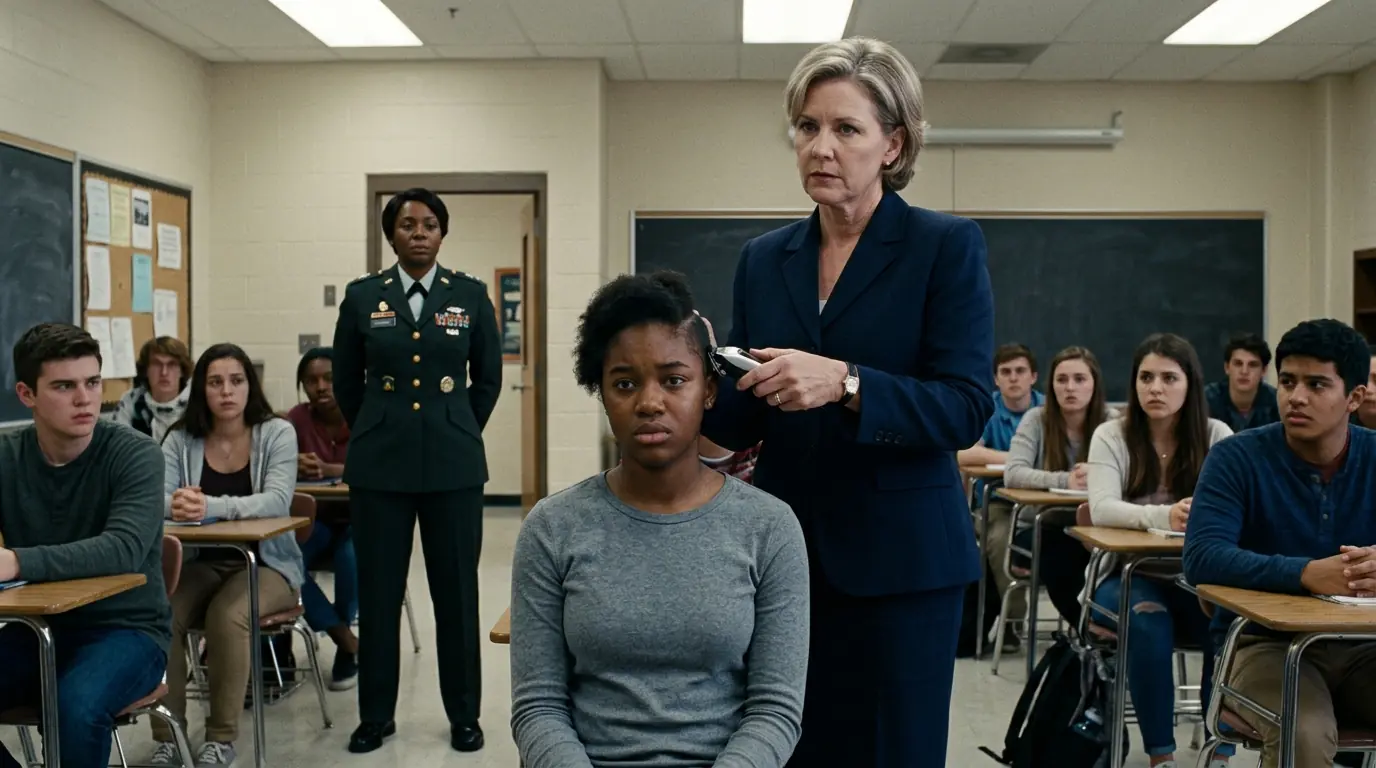
She kept walking.
Ten days until the portfolio review. Seven days until the disciplinary hearing.
She could still handle this herself. She had to.
The meeting happened in Roar’s office on a Thursday afternoon.
“I’m willing to make this very simple for you,” Roar said, leaning back in her chair. Professional. Reasonable. “Withdraw your request for the sketchbook. Apologize for the disruption you’ve caused. Agree to follow all professionalism standards going forward without accommodation exceptions.”
Ariel sat perfectly still.
“My accommodations are legally documented.”
“Accommodations for a medical condition, not for personal expression that violates community standards.”
Roar slid a single sheet of paper across the desk.
“Sign this. The disciplinary hearing gets cancelled. You get your sketchbook back tomorrow. The portfolio review proceeds normally.”
Ariel read the document.
It was a behavioral contract, agreeing that her choices regarding personal appearance had created disruption, acknowledging that accommodations do not exempt students from professional conduct expectations, consenting to immediate corrective action if future violations occur.
It was carefully worded, vague enough to be enforceable for anything, specific enough to go in her permanent record.
“And if I don’t sign?”
Roar’s expression didn’t change.
“Then we proceed with the hearing. I present my documentation of your pattern of behavior. The committee makes their decision whether that affects your portfolio review.”
She paused.
“Well, these things have a way of coming up in faculty discussions.”
There it was. Not a threat, just a statement of fact delivered with perfect deniability.
Ariel could sign, get her work back, compete for the residency on merit, prove that her art stood alone, walk away with her dignity intact and her principles uncompromised, except for the small detail of agreeing that she’d done something wrong when she hadn’t.
Or she could fight, risk everything she’d built, potentially lose the residency before the committee even saw her work, become the student who made things difficult instead of the artist who earned her place.
She thought about the business card in her drawer.
One phone call could end this, but it would also end everything else.
“I need to think about it,” Ariel said.
Roar smiled.
“You have until tomorrow at noon.”
Ariel didn’t sleep that night.
She sat at her desk with the unsigned behavioral contract in front of her. Her phone lay face down next to it. The drawer with the business card stayed closed.
Three options. All of them had costs.
Sign the contract. Lie about who she was and what she’d done. Get her work back and compete for the residency under a cloud of manufactured guilt. Live with the fact that her permanent record would say she’d been the problem, that her medical condition had been reframed as unprofessional behavior, that she’d agreed to it.
Fight through the university’s process. Refuse to sign, present her documentation at the hearing, trust that facts would matter more than Roar’s narrative. Risk the timing, three days before the portfolio review, with faculty who’d just watched her defend herself against conduct violations. Risk being seen as difficult, litigious, the student who made everything about conflict instead of art.
Or make the call, the one she’d been avoiding for two years. The conversation that would change everything, not just this situation, but how everyone saw her moving forward. She wouldn’t be Ariel Daniels, the artist who earned her place. She’d be Ariel Daniels, the girl who had connections, the student who got special treatment, the one who called in favors when things got hard.
It didn’t matter that it wasn’t a favor, that it was legitimate, that she had every right to ask for help. Perception didn’t care about rights.
And once you made that call, you couldn’t unmake it. Every success afterward would be questioned. Every achievement would carry an asterisk. People would wonder forever whether you’d really earned it or whether someone had made a phone call on your behalf.
She’d spent two years building a reputation that belonged to her alone.
One phone call would burn it down.
But so would signing that contract.
And fighting alone might cost her the residency anyway.
Ariel picked up her phone, put it down, picked it up again.
The business card stayed in the drawer.
At 4:17 a.m., she made her decision.
She wouldn’t sign, wouldn’t call.
She’d fight, but smart, with evidence, with documentation, with every piece of paperwork and recorded conversation she could gather. If she was going to lose, she’d lose on her terms, not theirs.
Ariel started building her case at 6:00 a.m.
First, documentation. She logged into the disability services portal and downloaded every piece of paperwork related to her condition. Medical diagnosis from three different doctors. Accommodation approval letters dating back to her freshman year. Email confirmations that the university had received and processed everything.
She created a folder, labeled it, timestamped it.
Second, timeline. She opened a blank document and began reconstructing every interaction with Roar over the past four months. Dates, locations, witnesses present, what was said, what was implied. She cross-referenced her calendar, her class schedule, even her coffee shop work shifts to verify timing.
October 12th, first comment about inappropriate studio attire. November 3rd, stopped outside printmaking lab, questioned about scarf. November 18th, sketchbook confiscated during critique. December 2nd, 10-page conduct report filed.
Every incident. Every witness. Every detail she could remember.
Third, witnesses. She made a list of students who’d been present during Roar’s confrontations. Three classmates in the printmaking lab. Two in the critique where her sketchbook was taken. The studio monitor who’d watched Roar go through her work without permission. She didn’t contact them yet, but she had names.
Fourth, evidence of pattern. She filed a Freedom of Information request with the university for all conduct reports Roar had filed in the past two years. Public record. Legal. They had 10 business days to respond.
Fifth, her own insurance. She forwarded copies of everything, medical records, accommodation letters, the timeline, the unsigned behavioral contract, to her personal email. Then to a cloud storage account Roar couldn’t access. Then to a thumb drive she put in her backpack.
If something happened to the originals, she had backups.
If the university tried to alter records, she could prove it.
At 11:30 a.m., she walked into Roar’s office and declined to sign the contract.
“I’ll see you at the hearing,” Ariel said. Calm. Clear.
Roar’s smile vanished.
“You’re making a mistake.”
“Maybe,” Ariel said. “But it’ll be mine.”
The retaliation started within two hours.
Ariel’s student ID badge stopped working at the main studio building. When she tried to swipe in for her afternoon class, the reader flashed red.
Error. Access denied.
She walked to the security office, waited 20 minutes, was told there was a system flag on her account pending resolution of administrative matters.
“When will it be resolved?”
The officer shrugged.
“You’ll have to contact student conduct.”
She couldn’t access her studio, couldn’t retrieve her work, couldn’t prepare for the portfolio review, now eight days away.
By evening, three of her professors had received emails, forwarded to her by one sympathetic TA, suggesting that Ariel might not be academically present for end-of-semester evaluations due to ongoing conduct issues. The emails were vague, professional, poison wrapped in bureaucratic language.
Two of the professors teaching her capstone seminar replied to the thread accidentally, including Ariel, with concerns about whether her portfolio should still be considered for the residency, given the circumstances.
No one had asked her side. No one had reviewed her documentation. She’d been flagged, categorized, removed from normal process, and there were still seven days until the hearing where she could defend herself.
The university had essentially placed her in administrative limbo. Present, but not participating. Enrolled, but not accessing. Accused, but not yet judged.
She sat in her apartment that night staring at her phone.
One call could fix this. One call could end it.
She picked up the phone, put it down, opened her laptop instead, and began documenting the new retaliation, screenshots of the badge errors, forwarded emails, photos of the locked studio door.
She was losing, but she was losing with evidence.
The email arrived Friday morning, sent to her entire fine arts cohort, 43 students.
Subject line: Community Standards Reminder.
Ariel’s name wasn’t mentioned. It didn’t need to be.
Recent incidents have reminded us of the importance of professionalism in shared creative spaces. Students who cannot meet basic standards of conduct and hygiene put the entire community at risk. While we value artistic expression, we cannot compromise the safety and comfort of others for individual preferences that violate clearly stated policies. Accommodations are available for legitimate medical needs through proper channels. However, claims of medical necessity do not excuse behavior that disrupts the learning environment or misrepresents personal choices as protected conditions.
It was signed by Evelyn Roar and two department chairs.
Ariel read it three times.
Misrepresents personal choices as protected conditions.
They were calling her a liar publicly to everyone she’d spent two years building professional relationships with.
Her phone started buzzing. Texts from classmates.
Is this about you?
What’s going on?
Did you really fake a medical condition?
No one asked if the accusations were true. They asked if she’d done it. Past tense. Assumed guilt.
By noon, someone had posted the email to the university’s anonymous gossip forum. The comments section filled within an hour.
Always knew something was off about her.
Using disability services for fashion choices is disgusting.
She’s probably lying to get special treatment for the residency.
A few people defended her. Maybe five out of 70 comments. They were downvoted into invisibility.
Ariel sat in the coffee shop during her shift making lattes with shaking hands. A regular customer, someone who’d chatted with her dozens of times, walked in, saw her, and left without ordering.
She understood the calculation Roar had made.
Ariel had no platform, no public presence, no credibility beyond her work, which she couldn’t access. She was a 20-year-old art student with a medical condition most people didn’t understand and documentation no one had seen. Roar was a senior administrator with 12 years of institutional authority.
Who would people believe?
Who would they want to believe?
The hearing was in six days, the portfolio review in nine, and now everyone she’d have to face in both settings had already been told she was a fraud.
Ariel finished her shift, went home, sat in her room.
The business card was still in the drawer.
She didn’t take it out, but for the first time, she let herself imagine what would happen if she did.
Monday morning, Ariel received a certified letter.
The disciplinary hearing had been moved up from six days away to three due to scheduling conflicts and the need for timely resolution before end-of-semester evaluations.
New date: Thursday at 2 p.m. One day before the portfolio review.
The letter included an updated list of allegations.
What had been a conduct issue was now expanded to include fraudulent use of disability accommodations, misrepresentation of medical documentation, disruption of academic environment, failure to comply with administrative directives, creating hostile conditions for staff.
Each allegation referenced university codes, section numbers, policy language.
It looked official, procedural, legal.
It was also nearly impossible to defend against in three days.
The letter noted that Ariel could bring a faculty adviser to the hearing. It listed three approved advisers, none from the art department, all from disciplines she’d never taken classes in, all people who’d have no context for her work, her reputation, or what was actually at stake.
She was being processed through a system designed to look fair while guaranteeing a specific outcome.
That afternoon, she tried to file a formal complaint about the accelerated timeline. The student ombudsman’s office told her they couldn’t intervene in active conduct proceedings. She asked to speak with the Title IX coordinator about disability discrimination. Was told that her case didn’t meet the threshold criteria for Title IX review. She requested an appeal of the badge access suspension. Denied pending hearing resolution. She asked for a postponement of the hearing until after the portfolio review. Denied due to administrative necessity.
Every door she tried led to the same answer.
This is the process.
These are the rules.
We’re following procedure.
The procedure just happened to coincide with destroying her academic future.
Wednesday afternoon, one day before the hearing, Ariel received her response to the Freedom of Information request.
Twenty-three conduct reports filed by Evelyn Roar over the past two years. Nineteen involved female students. Sixteen involved students with documented disabilities or accommodations. Twelve used identical language about misrepresentation and disruption.
Only three had resulted in formal hearings. All three students had withdrawn from the university before completion.
Ariel stared at the data.
She wasn’t the first. She was just the most recent.
And Roar had refined the process to near perfection. Use the system’s own procedures as the weapon. Hide behind policy language. Move fast enough that students couldn’t mount effective defenses.
It was legal, documented, procedurally correct.
And it had worked 22 times before.
Tomorrow, Ariel would be number 23.
Unless.
She looked at her phone.
Ariel reached out to the witnesses, the students who’d been there, who’d seen what happened.
She started with Maya, a classmate from the printmaking lab who’d been standing three feet away when Roar confiscated the sketchbook. They met at a coffee shop off campus. Maya ordered tea she didn’t drink.
“I saw what happened,” Maya said quietly. “It was wrong. Everyone knew it was wrong.”
“Will you say that at the hearing?”
Maya’s hands tightened around her cup.
“Ariel, I’m applying for the teaching assistant position next semester. Roar sits on the selection committee.”
“So that’s a no.”
“I’m sorry.”
Maya looked genuinely pained.
“I have loans. I need that stipend. If I go against her—”
“I understand.”
And she did. That was the worst part.
She tried Cameron next. He’d been in the critique when Roar had made the first public comment about Ariel’s appearance. He’d even defended her at the time, said the scarf didn’t affect anyone’s ability to work.
He agreed to meet. Showed up 15 minutes late.
“Look, I asked around,” he said. “People are saying you might be faking the medical stuff, that you filed complaints against Roar because she called you out.”
“That’s not what happened.”
“I know. I believe you.” He paused. “But my grad school applications are out. I need recommendation letters from this department. If faculty think I’m involved in some kind of controversy—”
He didn’t finish the sentence. Didn’t need to.
Ariel contacted seven other potential witnesses over two days. One never responded. Two declined outright. Three said they didn’t remember enough details to be helpful. One said yes, then texted two hours later, I’m sorry. I can’t risk it.
By Wednesday evening, Ariel had zero witnesses willing to appear at the hearing.
She had documentation, evidence, a pattern of abuse spanning two years and 23 students, but no one willing to stand next to her and say it out loud.
Because Roar didn’t just have institutional power. She had the thing more valuable, the power to affect futures, to write recommendations or withhold them, to remember faces when opportunities came up, to make life easier or infinitely harder.
And everyone knew it.
Ariel sat alone in her apartment, surrounded by printed timelines and evidence folders and data no one would hear because she had no voice amplified enough to make them listen.
She’d done everything right, built her case properly, followed procedure, and she was going to lose anyway, not because she was wrong, but because she was alone.
Thursday morning. Hearing at 2:00 p.m.
Ariel woke at 5:00 a.m. and couldn’t fall back asleep.
She showered, made coffee she didn’t drink, laid out the documentation she’d spent two weeks assembling.
Medical records, 47 pages.
Accommodation letters, 12 pages.
Timeline of incidents, eight pages.
FOIA response showing pattern, 23 cases.
Email evidence, 31 printed exchanges.
All of it organized, tabbed, ready to present.
She’d prepared a statement, practiced it 17 times, kept it factual, unemotional, let the evidence speak.
At 11:00 a.m., she received an email.
The hearing panel had been finalized. Three members. Dr. Richard Kovak, associate dean of student affairs, who’d co-signed the community standards email. Professor Linda Chen, ethics committee chair, who’d served on conduct boards with Roar for six years. James Whitmore, campus security director, who reported to the same VP as Roar.
No one from the art department. No one outside Roar’s professional network. No one who would see this as anything other than an administrative matter requiring administrative solidarity.
The game had been rigged from the start.
Ariel sat at her desk staring at the stack of documentation.
Two weeks of work. Evidence of systematic abuse. Proof that she’d done nothing wrong.
It wouldn’t matter.
She’d walk into that hearing room at 2 p.m., present her case to three people who’d already decided. They’d nod, take notes, thank her for her time, then rule against her using language that sounded reasonable and measured and final.
By tomorrow, she’d be academically flagged. The residency would go to someone else. Her professors would distance themselves.
And in six months, she’d be another name on a list of students who couldn’t adapt to professional standards.
Twenty-two students before her had reached this exact point.
Twenty-two had lost.
The 23rd would lose too, unless she changed the rules.
Ariel opened her desk drawer.
Took out the business card.
Plain white. Embossed text. A DC area code.
She’d told herself she wouldn’t do this, that she’d handle it alone, that asking for help meant losing something more important than a residency or a hearing or even her academic career.
But there was nothing left to lose now.
She picked up her phone and made the call.
The call connected after two rings.
“Ariel.”
Not a question. A statement. The voice was calm, professional, unsurprised.
“I was wondering when you’d reach out.”
“I need advice.” Her voice was steadier than she’d expected. “Legal advice about a disciplinary hearing.”
“Tell me what’s happening.”
She did. Concisely. Factually. The way she’d practiced for the hearing. Medical condition, documented accommodations, escalating harassment, confiscated work, accelerated timeline, stacked panel, 22 previous cases following the same pattern.
Silence on the other end.
Then, “Send me everything you have. Documentation, emails, the FOIA response, all of it.”
“The hearing is in three hours.”
“I know. Send it now.”
Ariel forwarded the files, heard typing on the other end.
“This is systematic,” the voice said after two minutes. “Disability discrimination with a documented pattern. Possible Title IX violations, retaliation, and if they’ve been deleting security footage or communication records, which I’d bet they have, that’s destruction of evidence.”
“The university says it doesn’t meet Title IX threshold.”
“The university is wrong or lying.” More typing. “You said the hearing is at 2 p.m.?”
“Yes.”
“Don’t go.”
Ariel blinked.
“What?”
“Don’t attend. You’ve already lost that hearing. The panel is compromised. The timeline is designed to prevent adequate defense. And anything you say will be used to justify a predetermined outcome.”
A pause.
“This needs to be elevated outside their internal process.”
“To where?”
“Office for Civil Rights. Department of Education. They handle disability discrimination in federally funded institutions. Once a formal complaint is filed, the university is legally obligated to preserve all evidence and suspend punitive action pending investigation.”
“How long does that take?”
“Filing? I can have it done in 90 minutes. Investigation, months. But the moment it’s filed, they can’t touch you.”
It sounded too simple, too clean.
“And the portfolio review tomorrow?”
“They can’t disqualify you based on conduct proceedings that are under federal investigation. If they try, it becomes retaliation, which makes everything worse for them.”
Ariel’s hands were shaking.
“Who do I need to talk to? What forms?”
“You don’t. I’ll handle the filing. You just need to stay available by phone and keep documenting everything.”
She should ask questions, clarify process, understand next steps.
Instead, she asked, “Why are you helping me?”
A long pause.
“Because someone should have helped the other 22. Send me the files. I’ll call you back in an hour.”
The line went dead.
At 2:07 p.m., Ariel received an email.
Your absence from today’s scheduled disciplinary hearing has been noted. Per university policy, failure to appear constitutes acceptance of all allegations. A decision will be issued within 24 hours.
She stared at the screen.
She’d followed the advice, didn’t attend, waited for the federal complaint to provide protection, but the university had moved faster.
At 2:34 p.m., a second email arrived, this one from the registrar’s office.
Pending resolution of conduct matters, you have been placed on interim academic suspension. Access to campus facilities, including studios and libraries, has been revoked. Your enrollment status for next semester is under review.
Academic suspension.
The words felt unreal.
She called the number from the business card. Voicemail. Left a message. Called again 10 minutes later. Voicemail again.
At 3:15 p.m., she received a text from her printmaking professor.
I’m sorry. I was told you’re no longer eligible for portfolio review consideration. I fought for you. It didn’t matter.
The residency was gone.
At 4:00 p.m., the formal hearing decision posted to her student portal.
After review of available evidence and consideration of the respondent’s failure to participate in proceedings, the committee finds Ariel Daniels responsible for fraudulent use of disability services, disruption of academic environment, and failure to comply with administrative directives.
Sanctions: academic suspension through summer term, permanent conduct notation on transcript, forfeiture of current semester academic credit pending grade appeals.
Forfeiture of credit. An entire semester erased.
Her phone buzzed, the number from DC.
“I’m filing the complaint now, but they already ruled,” Ariel said. Her voice sounded hollow. “Suspension. Loss of credit. It’s done.”
Silence, then, “That’s retaliation. They moved before the complaint could provide protection. It makes the case stronger.”
“But I still lost in the short term.”
Yes. Short term. Like that mattered. Like the residency would wait. Like the semester she’d just lost could be recovered. Like her reputation among faculty and classmates wasn’t already destroyed.
She’d done everything right, built evidence, followed procedure, asked for help at the exact moment she was supposed to, and she’d still been crushed by a system that valued its own authority over truth.
Ariel sat in her apartment surrounded by documentation that hadn’t mattered, evidence no one had reviewed, proof of innocence that had been procedurally irrelevant.
She’d lost her studio access, her semester credits, the residency, her academic standing, everything she’d spent two years building.
Gone in four hours.
The next call came at 6:47 p.m. Not from the DC number, from one she hadn’t seen in eight months.
Her mother’s personal cell.
Ariel almost didn’t answer. She picked up on the fourth ring.
“Hi, Mom.”
“I heard.”
Lieutenant Colonel Naomi Daniels’s voice was steady, controlled, the voice she used for briefings, not bedtime stories.
“Your attorney contacted me an hour ago, asked if I was aware of the situation.”
“I didn’t want to bother you.”
“Bother me?” Not a question. A statement of disbelief. “Ariel, you’ve been fighting this alone for two weeks.”
“I handled it, or tried to.”
“I know you did. I’ve seen the documentation you compiled. It’s thorough, professional, exactly what you were supposed to do.”
A pause.
“And they buried you anyway.”
Ariel’s throat tightened. She’d held it together through the emails, the suspension notice, the loss of everything she’d worked for. But her mother’s voice, calm, factual, acknowledging that Ariel had done it right and lost anyway, cracked something.
“I didn’t want to be that person,” Ariel said quietly. “The one who calls their parent the moment things get hard. Who uses connections instead of earning things. I wanted to do this myself.”
“You did do it yourself. You documented everything. Built a legal case. Followed procedure. You did exactly what any attorney would advise.”
Her mother’s voice softened slightly.
“But there’s a difference between asking for help because you’re lazy and asking for help because the system is rigged.”
“It feels the same from the inside.”
“I know.”
Silence.
“When I was a lieutenant, I watched a fellow officer get railroaded by a commander who didn’t like that she’d reported safety violations. She had evidence, witnesses, everything. She still lost until someone with rank equivalent to the commander stepped in and forced an actual investigation.”
“What happened?”
“The commander was reassigned. The officer got her career back, but it took someone outside the chain of command to make the system look at its own corruption.”
A pause.
“Some fights can’t be won alone, Ariel. Not because you’re not strong enough, but because the other side controls the referee.”
Ariel closed her eyes.
“What happens now?”
“Now?” Her mother’s voice shifted. Became something harder. “Now I make some calls. Not as your mother, as someone who knows how these systems actually work. And we see what happens when they realize you were never as alone as they thought.”
Friday morning, 9:47 a.m.
The university president’s office received a phone call requesting an urgent meeting. The caller identified herself as Lieutenant Colonel Naomi Daniels, United States Army, currently assigned to the Pentagon’s Office of Diversity, Equity, and Inclusion Oversight Division.
She was not calling as a parent.
She was calling as a federal officer whose job involved monitoring discrimination complaints at institutions receiving Department of Defense education benefits and federal funding.
The meeting was scheduled for 2:00 p.m. that same day.
By 11:00 a.m., three things happened simultaneously.
First, the Office for Civil Rights received a formal complaint alleging systematic disability discrimination with documentation of 23 similar cases over two years. The complaint named specific administrators and requested immediate investigation.
Second, the university’s legal counsel received notification that security footage from campus facilities, footage the IT department had been instructed to delete, had been preserved through a federal records hold. An IT employee had quietly backed up the files before the deletion order and submitted them with the OCR complaint.
Third, seven students who’d previously been too afraid to speak received calls from a military legal assistance attorney offering pro bono representation.
By noon, four of them had agreed to provide sworn statements.
At 2:00 p.m., Lieutenant Colonel Daniels arrived on campus, not in civilian clothes, in full dress uniform.
She didn’t go to the president’s office.
She went to the administration building where Evelyn Roar worked. Walked through the front door, signed in at the security desk, took the elevator to the third floor.
Roar was in her office when Naomi knocked.
“Can I help you?” Roar stood, confused. Civilian administrators didn’t usually receive visits from military officers.
“Evelyn Roar?”
“Yes.”
Naomi placed a folder on the desk.
“I’m Lieutenant Colonel Naomi Daniels. I’m here regarding the disciplinary case of Ariel Daniels, which was concluded yesterday.”
Roar’s expression flickered, confusion becoming calculation.
“I’m sorry, but student conduct matters are confidential. I can’t discuss—”
“You can because, as of 9:52 this morning, your case is under federal investigation for disability discrimination under Section 504 of the Rehabilitation Act and Title II of the ADA. That removes your confidentiality protections.”
Roar sat down slowly.
“I followed university procedure. Everything was by the book.”
“Your book, which you wrote.”
Naomi opened the folder.
“Twenty-three conduct cases filed by you over two years. Nineteen targeting female students. Sixteen involving students with documented disabilities. Identical language across multiple cases. Accelerated timelines. Stacked panels. Deletion of evidence.”
“I don’t know what you’re talking about.”
“The IT department preserved the security footage you ordered deleted, including video from the campus health office on the day you personally oversaw the removal of my daughter’s hair extensions and then, without medical authorization or legal justification, shaved portions of her head.”
The color drained from Roar’s face.
“That wasn’t— She violated hygiene standards.”
“She had documented alopecia and approved accommodations. You knew that. You’re listed on the distribution for accommodation notices from disability services. You received confirmation of her condition in October.”
Naomi pulled out another document.
“This is a medical authorization form. It’s required before any campus health personnel can perform procedures involving a student’s body. Do you have one for Ariel Daniels?”
Silence.
“You claimed you had administrative approval. The campus nurse states in her written testimony that you told her the procedure was cleared by the dean’s office. Was it?”
“I had verbal approval.”
“From whom? Because the dean’s office has no record of authorizing medical procedures on students. Neither does the provost. Neither does campus health administration.”
Naomi’s voice was level, clinical.
“You lied to medical staff to gain access to a student’s body. You performed an invasive procedure on a person with a documented medical condition. You then filed conduct charges against that student when she refused to sign a document admitting fault.”
Roar’s hands were shaking.
“This is— You can’t just walk in here and accuse—”
“I’m not accusing. I’m stating findings from a federal investigation that’s already underway. OCR received the complaint three hours ago. They’ve already issued a records preservation order to your university. Every email you’ve sent, every report you’ve filed, every security log, it’s all evidence now.”
Naomi stood.
“You have two options. You can cooperate with the investigation and provide your documentation voluntarily, or you can wait for subpoenas. Either way, the truth comes out.”
She walked to the door, then paused.
“My daughter spent two weeks building a case against you. She documented everything, followed every proper channel, did exactly what the system tells people to do, and you crushed her anyway because you thought she was alone.”
Naomi looked back at Roar.
“She wasn’t.”
By 4:00 p.m., Evelyn Roar had been placed on administrative leave.
By 5:00 p.m., the university had issued a statement announcing an internal review of conduct procedures.
By 6:00 p.m., Ariel’s academic suspension had been reversed pending investigation findings.
The clippers had stopped buzzing.
Now came the reckoning.
The investigation took four months.
The Office for Civil Rights found systematic violations spanning three years. Evelyn Roar was terminated. Two administrators who’d enabled the pattern were reassigned. The university implemented mandatory training on disability accommodations and revised its conduct procedures to include external oversight.
Ariel’s academic record was cleared. Her semester credits restored. The conduct notation removed as if it had never existed.
But some things couldn’t be restored so easily.
The residency had gone to another student. That opportunity was gone.
Several professors who had distanced themselves during the suspension now reached out with apologies and recommendations, gestures that felt hollow after their silence.
Ariel didn’t return to the fine arts program. Not because she couldn’t, because she didn’t want to spend two more years in spaces where people had watched her suffer and done nothing.
She transferred to a different university. Started over. Lost a year, but gained something else, clarity about which voices mattered and which institutions deserved her work.
The sketchbook, the one Roar had confiscated, was eventually returned. Water-damaged, several pages torn, but recoverable.
Ariel used it anyway. Incorporated the damage into a new series of work about institutional violence and the paper trails left behind.
The pieces were raw, uncomfortable, honest in ways her earlier work hadn’t been.
She launched an anonymous exhibition online.
Each piece represented one of the students who’d been targeted by Roar’s systematic abuse. She used testimony from the four who’d agreed to speak, redacted names, let the patterns speak for themselves.
The exhibition went viral, not because it was pretty, because it was true.
Six more students came forward with stories, then 12, then 19.
The pattern was bigger than anyone had realized.
Ariel’s mother attended the exhibition opening when it eventually showed in a physical gallery. She didn’t speak, didn’t draw attention, just stood in the back and watched people engage with her daughter’s work.
Afterward, they had coffee.
“You did this yourself,” Naomi said. “The documentation, the case, the art. All I did was make sure people who should have been listening actually heard what you’d already proven.”
Ariel stirred her coffee.
“I spent two years afraid that asking for help would mean I hadn’t earned anything, that people would see me differently.”
“And now?”
“Now I know the difference between asking someone to fight for you and asking someone to witness the fight you’ve already had.”
She looked at her mother.
“You didn’t rescue me. You activated systems that should have worked in the first place.”
Naomi smiled. Quiet. Proud.
“Exactly.”
Three years later, Ariel graduated with a degree in fine arts and a thesis exhibition about the architecture of institutional silence. She didn’t hide her alopecia anymore, wore her scarves when she wanted to, didn’t when she didn’t.
The university that had suspended her invited her back to speak at a conference on disability rights in higher education.
She declined.
Some institutions don’t deserve your return. They deserve your absence as testimony.
But she sent them something else. A single framed piece from the 23 series, a portrait of a young woman with patchy hair loss surrounded by policy documents and legal codes, holding a pair of clippers.
The plaque read, “This is what happens when systems protect power instead of people.”
When you build evidence carefully enough, quietly enough, thoroughly enough, justice doesn’t need to be loud.
It just needs to be undeniable.