The evening air was getting cold, and Maya pulled her thin jacket tighter around her shoulders. She had been walking for hours, her stomach growling so loudly that she was sure people passing by could hear it. It had been two days since her last proper meal, and the hunger was no longer just uncomfortable. It was painful.
She was 17 years old, but life on the streets had made her look both older and younger at the same time. Older because of the tiredness in her eyes, younger because she was so thin now. Her sneakers had holes in them, and she could feel the cold pavement through the worn-out soles with every step she took.
Maya found herself in a part of the city she usually avoided. This was where rich people came to eat and shop. The buildings here were clean and beautiful, with fancy lights and big glass windows. She didn’t belong here, and she knew it. People who walked past her would look away quickly, as if being homeless was something they might catch if they looked too long.
But tonight, Maya wasn’t thinking about how she didn’t belong. She was thinking about food. Real food. Hot food. The kind of food that would stop her stomach from hurting and give her enough energy to find a safe place to sleep for the night.
That’s when she saw it.
A restaurant called Giovani’s. It wasn’t the biggest or the fanciest place on the street, but something about it drew her attention. Maybe it was the warm yellow light that spilled out onto the sidewalk. Maybe it was the smell of fresh bread that made her feel dizzy with hunger. Or maybe it was what she saw through the large front window.
There, in the corner of the dining room, sat a beautiful grand piano. It was black and shiny, catching the light from the chandeliers above.
Maya stopped walking and just stared at it. She hadn’t seen a piano like that in three years. Three long years since everything in her life had fallen apart.
She stood there on the sidewalk, people walking around her, and she felt something she hadn’t felt in a very long time. Not quite hope, but something close to it.
An idea was forming in her mind. A crazy idea. The kind of idea that homeless kids don’t usually have because they’ve learned that taking risks usually makes things worse, not better.
But Maya was so hungry.
And that piano was just sitting there, probably not being used at all.
She could play. She used to be really good, actually, before the accident, before everything changed. Before she ended up on the streets with nothing but the clothes on her back and memories she tried hard not to think about.
She took a deep breath and looked down at herself.
Her jeans were dirty and had a rip in one knee. Her jacket was stained and too thin for the weather. Her hair was tangled because she hadn’t had access to a proper shower in weeks. She probably smelled bad, too, though she had stopped noticing her own smell after the first month on the streets.
What was she thinking? They would never let someone like her into a place like this. The hostess would probably call security before Maya even finished asking her question.
But what if they did let her in? What if she could convince them somehow?
The worst they could do was say no, or maybe throw her out. She was used to that.
Maya watched through the window for a few more minutes. The restaurant was busy, but not packed. Well-dressed people sat at white-clothed tables eating pasta and drinking wine. They looked so comfortable, so safe.
A waiter walked past the piano carrying a tray of food. He didn’t even glance at it. Nobody was playing it. It was just sitting there, silent and unused.
What a waste, Maya thought.
That beautiful instrument just sitting there like a piece of furniture when it could be making music.
Her mother had always said that music was meant to be shared, that keeping an instrument silent was like keeping a bird in a cage.
Her mother had taught her to play when she was just five years old. By the time Maya was 14, teachers at her music academy were saying she had a real gift. They said she could go professional if she kept working hard. They said she had a future.
But that was before.
Before the drunk driver. Before the funeral. Before the foster homes. Before aging out of the system with nowhere to go and no one who cared.
Before all of this.
Maya shook her head, trying to clear away the memories. Thinking about “before” only made things harder. She needed to focus on now, on tonight, on the fact that she needed food and there was a piano in that restaurant.
She looked at her reflection in the window. She looked awful, but she couldn’t do anything about that now.
She either walked through that door and tried, or she walked away and spent another hungry night looking for a safe place to sleep.
For a moment, she almost walked away.
It was easier not to try than to try and fail. At least if she didn’t try, she could avoid the shame of being rejected again.
But that piano kept calling to her.
She could almost feel the keys under her fingers. She could almost hear the music.
And she was so, so hungry.
Maya straightened her shoulders and walked toward the door.
Her hand shook as she reached for the handle. It was heavy, probably brass or something expensive like that. For a second, she thought it might be locked, that the universe was giving her a sign to turn around.
But the door opened smoothly, and a wave of warm air washed over her.
The warmth felt so good after hours in the cold that Maya almost cried.
Inside, the restaurant smelled like heaven. Garlic and tomatoes and fresh bread and herbs she couldn’t name. Her stomach growled even louder, and she pressed her hand against it, embarrassed.
A young woman in a black dress stood behind a hostess stand. She had perfect makeup and shiny hair pulled back in a neat bun. When she looked up and saw Maya, her professional smile faltered for just a second.
Maya saw the surprise in her eyes, the quick assessment, the moment of decision.
“I know I don’t look like I belong here,” Maya said quickly. Her voice came out softer than she intended. She cleared her throat and tried again. “But I saw your piano, the one in the corner. I can play. I’m actually pretty good. I was wondering if maybe I could play something for you. Just one song. And in exchange, maybe I could have something to eat. Anything, even just bread. I’m not picky.”
The words tumbled out fast. She hated how she sounded, weak, begging. But she was begging.
The hostess stared at her, unsure what to do.
“Wait here,” she said finally. “I need to get the manager.”
And so Maya waited, standing in the entrance of Giovani’s restaurant while well-dressed people stared at her and whispered. She focused on the piano in the corner and tried not to run away.
Minutes passed.
Then the hostess returned with a man in his 50s, salt-and-pepper hair, kind eyes.
“I’m Antonio,” he said. “Lisa tells me you want to play my piano for a meal.”
“Yes, sir,” Maya said. “I can really play. I’m not trying to scam you. I’m just… really hungry.”
Antonio studied her.
“That piano belonged to my mother,” he said quietly. “She passed away two years ago. No one has played it since.”
Maya swallowed. “I’m sorry.”
“You really know how to play?” he asked.
“I do. I trained at Riverside Music Academy.”
He paused, thinking.
Relief flooded through her.
“Thank you.”
Maya walked to the piano, sat down, and placed her hands on the keys.
She closed her eyes.
Chopin’s Nocturne in E-flat major.
Her mother’s piece.
Her fingers pressed the first note.
And everything changed.
The restaurant disappeared.
The hunger, the fear, the shame—gone.
There was only the music.
Her hands moved, slowly at first, then with growing confidence. Muscle memory returned. Emotion poured through every note.
People stopped eating.
Stopped talking.
Watched.
Listened.
Some cried.
Antonio stood frozen, tears in his eyes.
When the final note faded, silence filled the room.
Then—
Applause.
Loud. Real. Overwhelming.
Antonio pulled her into a hug. “Brava,” he whispered. “My mother would have loved you.”
That night, Maya didn’t just eat.
She was seen.
She was heard.
She was remembered.
And for the first time in three years—
She was no longer invisible.
The first thing Maya noticed when she started playing was the silence. Not the silence of an empty room, but the heavy, expectant silence of people holding their breath. She could feel it even with her eyes closed, the way the whole restaurant seemed to lean in and listen.
Her fingers moved across the keys with a confidence that surprised her. Three years without practice should have made her rusty, should have made her stumble and forget. But the music was still there, locked somewhere deep in her memory, in her muscles, in her bones. It was like her hands remembered, even when her mind wasn’t sure.
The nocturne started soft and gentle, almost like a lullaby. Her mother used to say this piece sounded like moonlight on water. Maya had never really understood what that meant until now, when she was playing it in this moment of desperation and hope. Now she could hear it, the shimmer, the quiet beauty, the sadness underneath something peaceful.
As she played, memories came flooding back. Not just of her mother playing this piece, but of everything. Of Saturday morning lessons with Mrs. Chin, her piano teacher, who always smelled like lavender. Of recitals where she wore fancy dresses and felt nervous and proud at the same time. Of her father filming her performances on his phone, always saying, “That’s my girl.”
Of the academy, where she had been one of the youngest students, where older kids had been jealous of her talent, where teachers had pulled her aside to tell her she was special, that she had something rare, where she had dreamed of stages and concert halls and a life filled with music.
All of that was gone now.
The academy, the dreams, the future she had imagined. The drunk driver who hit her parents’ car had killed more than just two people that night. He had killed everything Maya was supposed to become.
But not this.
He hadn’t killed this, her ability to play, to make music, to create something beautiful out of nothing but her hands and a piano. That was still hers. Nobody could take that away, no matter how much they took everything else.
The music grew more complex as it moved into the second part. Her right hand danced over the higher keys, while her left kept the steady, rolling rhythm underneath. There was a part here that had always been tricky, a run of notes that required her fingers to move fast and precise.
She had practiced it hundreds of times as a kid.
Please let me remember this, she thought. Please don’t let me mess up now.
But her fingers knew.
They hit every note exactly right, flowing over the keys like water, just like her mother always said.
The difficult part passed, and Maya felt a small victory bloom in her chest. She opened her eyes for just a moment, glancing at the room.
What she saw made her hands almost stop moving.
Everyone was watching her.
Not just glancing over while they ate. Really watching.
A woman in a red dress at a table near the window had tears running down her face. A young waiter stood frozen by the kitchen door, a tray of food balanced in his hands, completely still. An older man in an expensive suit sat with his fork halfway to his mouth, forgotten, his eyes fixed on her.
And Antonio, the manager who had given her this chance, stood behind the bar with his hand over his mouth. Even from across the room, Maya could see the shine of tears in his eyes.
She closed her eyes again quickly. She couldn’t think about them watching, couldn’t think about what they were feeling or why. If she started thinking about the audience, she would get nervous. She would make mistakes.
She needed to stay in the music. Stay in that place where nothing existed except the piano and the notes and the story she was telling with her hands.
The nocturne moved through its middle section, building to a kind of emotional peak before falling back again. This was the part her mother had loved most. She used to say it sounded like someone remembering something beautiful but sad, something that was gone but not forgotten.
Maya understood that now in a way she never had as a child.
She was living it.
Playing this piece was remembering. Remembering who she used to be, who her parents were, what her life looked like before it all fell apart.
Beautiful but sad. Gone, but not forgotten.
Her fingers pressed the keys with more force now. Not quite loud, but stronger, more insistent. The music demanded it. This wasn’t background noise. This was emotion made into sound. This was pain and beauty twisted together until you couldn’t tell where one ended and the other began.
Somewhere behind her, she heard a small sound, someone sniffling, trying not to cry too loudly. Then another person, and another. The restaurant was filling with the sound of people trying to hold back tears while she played.
Maya’s own vision blurred.
She was crying too, she realized. Tears were running down her face and dripping onto her dirty jacket.
But her hands kept moving.
The music didn’t stop. It couldn’t stop. Not now, not when she was so close to the end.
Every mistake she had made in the past three years seemed to press down on her shoulders. Every night she had slept in a doorway. Every time someone had looked through her like she didn’t exist. Every meal she had skipped. Every moment she had felt completely and utterly alone in the world.
But also every sunrise she had survived to see. Every small kindness from strangers who didn’t have to care. Every time she had found the strength to keep going when it would have been easier to give up. Every moment that proved she was still here, still fighting, still Maya underneath all the dirt and hunger and fear.
All of it went into the music.
The piano was absorbing her pain and transforming it into something people could hear and understand.
She wasn’t just playing notes anymore. She was telling her story without words. She was saying everything she had never been able to say to anyone.
I’m still here.
I’m still human.
I still matter, even though I have nothing.
The nocturne began its descent toward the ending. The music got softer again, gentler, like it was tucking itself into sleep. The notes came slower. The urgency faded into something peaceful and accepting.
This was the part that always made her mother smile, that little half-smile she got when something touched her heart.
Maya played these final phrases with a tenderness that surprised even her. Her hands were tired now. Her arms ached. Her fingers were starting to cramp from lack of food and months without playing.
But she was so close.
Just a little more.
Just a few more measures.
The last section was the hardest to play because it was the simplest. Just a few soft notes, repeated with small variations, getting quieter and quieter until they faded away completely. It required control, delicacy, the ability to touch the keys so lightly that they barely made sound.
Maya’s mother used to say the ending of this piece was like watching someone you love walk away. You can still see them, but they’re getting farther and farther, and soon they’ll be gone. But there’s a kind of peace in it, too, an acceptance. A goodbye that isn’t angry, just sad.
Her fingers felt the keys one last time.
The final note hung in the air, sweet and lonely and perfect.
Then silence.
Real silence this time. Not the waiting kind. The kind that comes after something important has happened and no one knows quite what to say.
Maya sat with her hands still on the keys, eyes closed, tears still wet on her face.
She had done it.
She had actually done it.
She had played the whole piece without stopping, without making any major mistakes. She had proven she could really play.
But more than that, she had remembered.
For the first time in three years, she had felt like herself. Not the version of herself that was homeless and hungry and scared, the real version, the Maya who was talented and passionate and full of music.
Slowly, she opened her eyes and lifted her hands from the piano. They were shaking now that the adrenaline was wearing off.
She didn’t want to turn around. Didn’t want to see if people were staring at her or judging her, feeling sorry for her.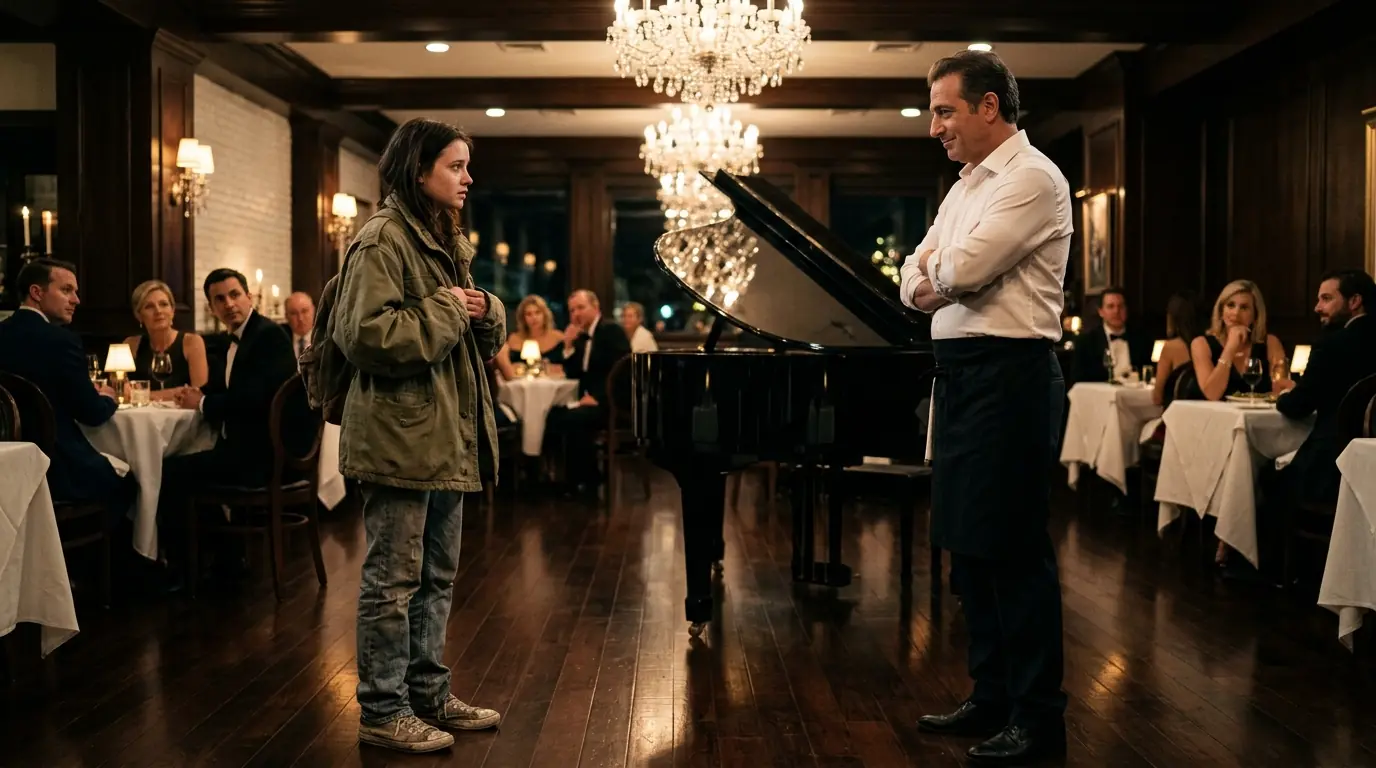
But she had to face them eventually.
This wasn’t her piano. This wasn’t her restaurant. She was just a homeless girl who had asked to play for food.
Maya took a deep breath, wiped her face with her dirty sleeve, and turned around to see what would happen next.
For a moment that seemed to stretch forever, nobody moved.
The restaurant was completely still.
Maya sat on the piano bench, her heart pounding, looking at a room full of frozen faces. She wiped at her wet cheeks again and waited for someone to do something, say something, anything.
Then Antonio started clapping.
It wasn’t polite applause. It wasn’t the kind of clapping you do at the end of a school play because you’re supposed to. It was real. His hands came together hard and loud, echoing through the silent restaurant. His face was still wet with tears, and he didn’t bother wiping them away.
Within seconds, other people joined in.
The woman in the red dress stood up, still crying, clapping so hard her hands must have hurt. The businessman in the expensive suit got to his feet, applauding with a look on his face like he had just witnessed something impossible.
The young couple near the window, the elderly woman dining alone, the group of friends celebrating a birthday, all of them rising, all of them clapping.
Soon, every single person in the restaurant was standing.
The sound was overwhelming, like thunder, filling the room and bouncing off the walls.
The kitchen staff came rushing out, the chef still in his white hat, all of them applauding. Even the hostess who had first looked at Maya with such uncertainty was clapping with tears in her eyes.
Maya didn’t know what to do.
She had never experienced anything like this.
At her recitals as a kid, people clapped politely and said nice things. But this was different. This felt like more than appreciation. It felt like recognition, like these strangers were seeing her, really seeing her, maybe for the first time in three years.
She stood up shakily, her legs weak from sitting and from the emotion of it all. She didn’t know if she should bow or wave or just run out the door because this was all too much. She wasn’t used to being the center of attention anymore. She was used to being invisible.
Antonio was crossing the restaurant now, moving quickly past tables, his face transformed with emotion.
Before Maya could say anything or prepare herself, he pulled her into a tight hug.
He smelled like garlic and wine and something else, maybe cologne or aftershave. It was overwhelming in a different way. She couldn’t remember the last time someone had hugged her.
“Brava,” he said into her hair, his voice thick with emotion. “Brava, brava. My mother would have loved that. She would have loved you.”
Maya felt something crack open inside her chest.
She started crying again. Really crying this time, sobbing into this stranger’s shoulder while the whole restaurant watched and applauded. She couldn’t help it. The kindness was too much. The relief was too much. Everything was too much.
Antonio held her until she got control of herself. Then he pulled back and looked at her with such warmth that it almost started her crying all over again.
“You are not eating by the door,” he said firmly. “You are not eating in the kitchen. You are sitting at the best table in this restaurant, and you are ordering whatever you want. Anything. Everything. Do you understand?”
Maya could only nod. She didn’t trust her voice.
The applause was finally dying down as people returned to their seats, though many were still wiping their eyes and talking in excited voices.
Antonio led Maya to a table by the window, the kind of table that probably required a reservation weeks in advance. The hostess rushed over with a clean white napkin and placed it in Maya’s lap with a gentle smile.
A waiter appeared with a glass of water, then another one with bread. Warm bread, fresh from the oven, with butter.
Maya’s hands shook as she reached for it. She wanted to eat slowly, to have dignity. But the moment that bread touched her lips, she couldn’t help herself.
She ate like she hadn’t eaten in days.
Because she hadn’t.
Antonio sat down across from her, not seeming to notice or care how desperately she was eating. He pushed the bread basket closer to her.
“More,” he said simply. “Eat. Then we’ll talk about real food.”
“Real food?” The words made Maya want to cry again. When was the last time she had eaten real food? Not scraps from dumpsters or day-old donuts from the shelter. Real, proper food made by a chef in a kitchen.
She finished three pieces of bread before she could slow down enough to sip the water. It was cold and clean and perfect. She couldn’t remember water ever tasting this good.
“What’s your name?” Antonio asked gently.
“Maya,” she managed to say around a mouthful of bread.
“Maya,” he repeated, like he was testing how it sounded. “That’s a beautiful name. I’m Antonio, but I suppose you already know that.”
She nodded, swallowing. “Thank you for letting me play… for this.” She gestured at the bread, the water, the chair she was sitting in.
“No,” Antonio said, shaking his head. “Thank you. You just gave everyone in this restaurant something they didn’t know they needed. You gave me something I didn’t know I needed. That piano has been silent for two years. I couldn’t bear to let anyone touch it. But hearing you play…” His voice got rough. “It was like my mother was here again. Like she was saying, ‘It’s okay to let go a little… to let the music live again.’”
A waiter approached the table with a menu, but Antonio waved it away. “She doesn’t need a menu. Maya, do you like pasta?”
“I like everything,” Maya said honestly.
Antonio laughed, a warm, genuine sound. “Then we start with the soup, the minestrone. Then the fettuccine Alfredo, the lasagna, the chicken marsala. We’ll bring you a little of everything until you say stop.”
“That’s too much,” Maya protested weakly, even though her stomach was screaming.
“Yes, yes, all of it. It’s not too much. Nothing is too much after what you just did. You made grown men cry, child. You made my chef cry, and he’s from Sicily. He doesn’t cry at anything.”
The food started arriving.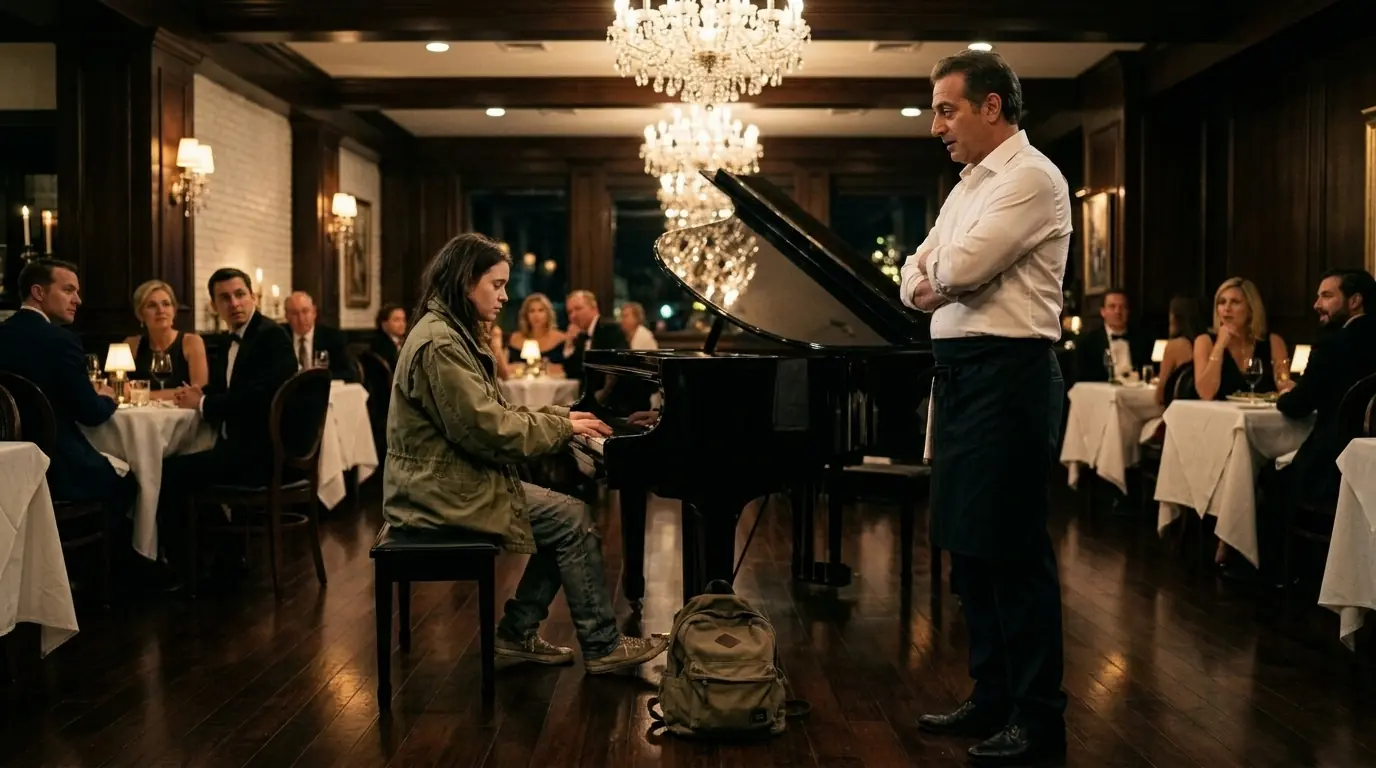
First, a bowl of soup that steamed and smelled like heaven. Maya had to force herself to eat it slowly, to taste it properly. It had vegetables and beans and pasta, and it was the most delicious thing she had ever put in her mouth.
As she ate, something strange started happening.
People kept coming over to the table, not all at once, but one at a time, approaching carefully like they didn’t want to disturb her but couldn’t help themselves.
The first was the woman in the red dress. She was older, maybe sixty, with kind eyes that were still a little red from crying.
“I’m sorry to interrupt your dinner,” she said softly. “I just wanted to tell you something. My daughter used to play piano. She passed away five years ago. Cancer. She was only twenty-eight. And tonight, listening to you play… it was like I could hear her again. Like she was here with me.”
Maya swallowed. “I’m so sorry about your daughter.”
The woman smiled sadly. “She would have loved your playing. She would have wanted to be your friend. I think you have something special.”
She reached into her purse and pulled out some folded bills. “Please take this. I know you need it.”
“I can’t,” Maya said automatically.
“You can,” the woman insisted, pressing the money into Maya’s hand. “Buy yourself a warm coat. It’s getting cold out there.”
Before Maya could argue, the woman was already walking back to her table.
Maya looked down.
Two hundred dollars.
She had never held that much money in her life.
Then the young couple approached.
“That was incredible,” the young man said. “We’re musicians too. Or… trying to be. I play guitar in a band. We’ve been thinking about giving up. It’s hard, you know? But watching you play… it reminded us why we started.”
His girlfriend nodded. “You were so brave to walk in here and ask for a chance. That took courage.”
They left a business card. “If you ever want to jam or need anything, reach out.”
More people came.
A teenager who said she wouldn’t quit piano now.
A businessman who admitted he missed playing.
An elderly man who said Maya had brought back memories of his late wife.
Each one left something.
Money. Cards. A scarf. A gift card.
It kept piling up beside her plate.
Antonio watched it all with a quiet smile.
“You see?” he said finally. “Art does that. Real art. It breaks people open. Makes them feel things they forgot they could feel. You didn’t just play piano tonight, Maya. You reminded all of us what it means to be human.”
Maya stayed for over two hours.
She ate more than she thought possible. She listened as Antonio talked about his mother, about how she used to play that very piano, how music and food were meant to go together.
When the restaurant began to empty, Maya looked at the pile of money.
Four hundred sixty dollars.
“What am I supposed to do with all this?” she asked.
“Whatever you need,” Antonio said. “That’s the point.”
“I feel like I’m taking charity.”
“It’s not charity,” he said firmly. “You earned it.”
Maya folded the money carefully and put it in her pocket.
For the first time in a long time, she had options.
But that also meant a choice.
“I should probably go,” she said quietly.
Antonio looked at her. “Where will you go?”
“There’s a shelter… sometimes they have beds.”
“And if they don’t?”
Maya shrugged. “I’ll figure something out.”
Antonio was silent for a moment.
Then he said, “You’re not sleeping on the street tonight.”
Maya blinked. “What?”
“You stay here. Upstairs. Just for tonight. Shower, bed, breakfast. Then tomorrow you decide what you want to do.”
“I can’t,” she said quickly. “I don’t know you.”
“You know I fed you. You know I trusted you with my mother’s piano. That counts for something.”
Maya hesitated.
She should say no.
But she was so tired.
“So… just tonight,” she said.
“Just tonight,” Antonio agreed, though the look in his eyes said otherwise.
Upstairs, the apartment was small but warm.
Clean.
Safe.
“Bathroom is there,” Antonio said. “Clean towels. Take your time.”
Maya stepped into the shower and stood under the hot water.
And for the first time in longer than she could remember—
she cried without trying to hide it.
The next morning, she woke up confused.
Soft bed. Quiet room. No sirens.
Then she remembered.
She was safe.
Antonio brought her breakfast.
Eggs, toast, bacon, juice.
“I have a proposition,” he said.
Maya froze.
Here it was. The catch.
But Antonio raised his hands. “Not what you think.”
He explained.
People had seen her play. Videos were spreading. Reservations were coming in.
“They want to hear you,” he said. “So—Friday and Saturday nights, you play. I pay you. You eat here. And… you can stay upstairs.”
Maya stared at him.
“Why?”
“Because you deserve a chance.”
“And the catch?”
“One condition. You go back to school.”
Maya looked down.
School.
A future.
Things she had stopped believing in.
“I don’t know,” she whispered.
“Then don’t decide today,” Antonio said. “Just try.”
Maya took a deep breath.
Every instinct told her to run.
But she was tired of running.
“Okay,” she said softly. “I’ll try.”
And just like that—
everything began to change.
Maya’s phone buzzed.
A number she didn’t recognize.
She hesitated for a second, then opened the message.
“Hi Maya, this is Jennifer from tonight’s concert. I’m a social worker at the youth center downtown. We have a lot of kids from tough situations… kids like you used to be. I was wondering if you’d ever consider coming to play for them, maybe talk to them a little. They need someone to show them that things can change.”
Maya read the message twice.
Kids like you used to be.
The words stayed with her.
For a moment, she didn’t answer.
She just sat there, staring at the screen, her fingers hovering over the keyboard.
She thought about those kids.
Sleeping in shelters.
Skipping meals.
Feeling invisible.
Just like she had.
She could still remember exactly what that felt like.
The cold.
The hunger.
The way people looked through you instead of at you.
And suddenly, she realized something.
She wasn’t just playing for herself anymore.
She wasn’t just surviving anymore.
She had something now.
Something valuable.
Something she could give.
Maya typed slowly.
“I’d love to.”
Three days later, she stood in a small room at the youth center.
It wasn’t anything like the concert hall.
No chandeliers.
No polished floors.
Just folding chairs, worn walls, and about twenty teenagers sitting in front of her.
Some looked bored.
Some looked tired.
Some looked like they didn’t believe anything good could ever happen to them.
Maya recognized that look.
She had worn it herself.
A staff member introduced her briefly, but Maya barely listened.
Her heart was beating fast.
This felt different from performing.
Harder, somehow.
Because this wasn’t about impressing anyone.
This was about being honest.
She sat at the old upright piano in the corner.
It was out of tune.
Keys slightly worn.
Nothing like the Steinway at Giovani’s.
But she didn’t mind.
She placed her hands on the keys.
Then stopped.
Turned to the kids.
“Six months ago,” she said quietly, “I was sleeping outside.”
That got their attention.
A few heads lifted.
A few eyes focused.
“I hadn’t eaten properly in days. I didn’t think anything was ever going to change.”
She paused.
“I walked into a restaurant and asked if I could play piano for food.”
A boy in the back scoffed slightly.
“Yeah, right.”
Maya smiled a little.
“I know how it sounds. I didn’t believe it would work either.”
She turned back to the piano.
“But I tried anyway.”
She began to play.
Not perfectly.
The piano wasn’t perfect.
But the music was still there.
Still real.
Still hers.
The room grew quiet.
The same kind of quiet as that first night.
The kind where people stop pretending not to care.
When she finished, no one clapped at first.
They just looked at her.
Trying to understand.
Trying to process.
Then one girl in the front spoke.
“How?”
Maya blinked. “How what?”
“How did you… not give up?”
The question hit her harder than any applause ever had.
Maya thought for a moment.
“I almost did,” she admitted.
“A lot of times.”
She looked around the room.
“At night, when it was cold. When I was hungry. When nobody saw me.”
She took a breath.
“But there was one thing I still had.”
She gestured to the piano.
“This.”
“They could take everything else. But they couldn’t take this from me.”
The girl nodded slowly.
Another kid spoke.
“What if you don’t have something like that?”
Maya didn’t answer right away.
Then she said softly,
“Then you find it.”
“Or you build it.”
“Or you borrow someone else’s belief in you until you can believe in yourself.”
The room stayed quiet.
But it was a different quiet now.
Not empty.
Not hopeless.
Something had shifted.
Afterward, a few kids came up to her.
Not all.
But enough.
A boy who said he used to draw but stopped.
A girl who loved singing but was too scared to try again.
Maya listened to each of them.
Because now she understood—
sometimes people don’t need solutions.
They just need proof.
Proof that it’s possible.
That night, back at Giovani’s, Maya sat at the piano again.
The restaurant was full.
The lights warm.
The air alive with conversation.
She started playing.
And as the music filled the room—
she realized something new.
Her story wasn’t just about survival anymore.
It was about impact.
Every note she played carried more than just sound now.
It carried meaning.
Connection.
Possibility.
Antonio watched her from across the room, a quiet smile on his face.
He didn’t say anything.
He didn’t need to.
Because he could see it.
The girl who walked in starving—
had become someone who could feed others.
Not with food.
But with hope.
And Maya—
for the first time—
understood exactly what her music was meant to do.
Weeks passed, and Maya’s life continued to grow in ways she had never imagined.
Her schedule was full now.
Classes during the day. Practice in the afternoons. Performances on weekends. And, once a week, visits to the youth center.
At first, she thought she was helping them.
But slowly, she realized something deeper.
They were helping her, too.
Every time she walked into that room, she was reminded of who she used to be. Not in a painful way, but in a grounding way. It kept her honest. It kept her humble.
It kept her real.
One afternoon, after a session, the same girl who had asked “how” approached her again.
“My name’s Tasha,” she said quietly.
“Maya,” she replied with a small smile.
“I know,” Tasha said. “Everyone knows.”
Maya laughed softly. “Fair enough.”
Tasha hesitated, then held out a folded piece of paper.
“I wrote something,” she said. “It’s not good or anything, but… you said to try.”
Maya took the paper carefully.
It was a song.
Simple.
Rough.
But honest.
Maya looked up. “This is good.”
Tasha shrugged. “It’s just words.”
“No,” Maya said gently. “It’s yours. That makes it important.”
Tasha didn’t say anything, but her shoulders straightened just a little.
Maya recognized that feeling.
The first spark.
The beginning of belief.
That night, Maya couldn’t stop thinking about it.
About Tasha.
About all of them.
Kids who had something inside them but didn’t know how to protect it yet.
Didn’t know how to grow it.
The next morning, she went downstairs early.
Antonio was already there, prepping in the kitchen.
“You’re up early,” he said.
“I have an idea,” Maya replied.
Antonio smiled immediately. “I like those words.”
“I want to start something,” she said. “Not just playing for them… teaching them. Music, writing, whatever they have. A space where they can create.”
Antonio didn’t even hesitate.
“Done.”
Maya blinked. “You didn’t even hear the details.”
“I don’t need to,” he said. “If it’s your idea, it’s worth doing.”
Within a week, things started moving.
Antonio cleared out a small storage room next to the restaurant.
Linda offered to volunteer one day a week.
The staff helped clean, paint, bring in chairs, a second-hand keyboard, notebooks.
It wasn’t fancy.
But it was theirs.
Maya stood in the doorway the first day they opened it.
Six kids showed up.
Then eight.
Then twelve.
Tasha sat in the front.
Watching.
Listening.
Trying.
Maya didn’t teach like a traditional teacher.
She didn’t stand at the front and lecture.
She sat with them.
Showed them.
Let them try.
Let them mess up.
“Music isn’t about being perfect,” she told them. “It’s about being honest.”
Weeks turned into months.
The room filled more and more.
Drawings on the walls.
Lyrics on paper.
Laughter.
Mistakes.
Progress.
One evening, during a session, Maya heard something.
A melody.
Soft.
Uncertain.
She turned.
Tasha.
Playing.
Not perfectly.
But playing.
Maya didn’t interrupt.
She just listened.
When Tasha finished, she looked up nervously.
“That was nothing,” she said quickly.
Maya shook her head.
“That was everything.”
Something shifted in Tasha’s eyes.
The same shift Maya had felt months ago.
The moment when doubt loosens its grip.
And belief steps in.
That night, Maya sat at the piano in the restaurant again.
The room was full.
The lights warm.
The same as always.
But everything felt different.
She wasn’t just playing anymore.
She was building something.
A ripple.
A chain.
A future that extended beyond herself.
She started to play.
And as the music flowed—
she thought about the girl she used to be.
Cold.
Hungry.
Invisible.
And the person she had become.
Not because life suddenly became easy.
But because someone had given her a chance.
Because someone had chosen kindness.
Because she had chosen to try.
Antonio caught her eye from across the room.
He nodded once.
Proud.
Quiet.
Certain.
Maya smiled slightly.
Then turned back to the keys.
And played—
not just for the room.
Not just for herself.
But for every person who still believed they had nothing.
Because now she knew the truth.
Sometimes—
all it takes—
is one door.
One chance.
One moment.
To change everything.