The cardboard box in Maya Bennett's arms weighed almost nothing. A ceramic mug her daughter had painted for her the previous Christmas, a phone charger with a frayed cord she had been meaning to replace, and a single manila folder containing the printouts she had never gotten around to shredding. She walked through the polished lobby of Whitfield Sterling Capital with her chin level and her steps unhurried. While behind her, on the 12th floor she had just been escorted out of, a small, satisfied laugh carried across the open workstations. The kind of laughter that belongs to people who believe they have finished a difficult task cleanly, without leaving fingerprints.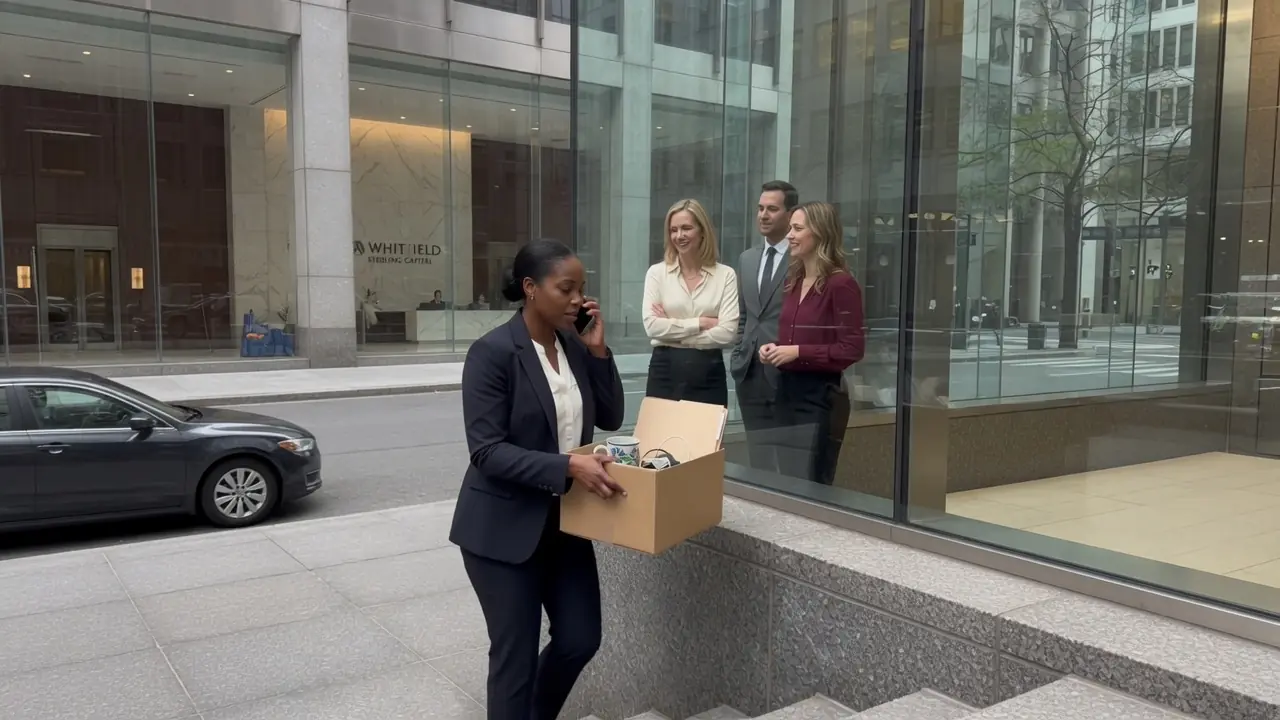
Rebecca Callahan stood near the reception desk with her arms folded, watching Maya's retreat through the tall glass wall that separated the elevator bank from the street. She wore the quiet expression of a woman who had solved a problem that had been irritating her for weeks. Maya stepped out onto the sidewalk, and the cold March air met her at the top of the granite steps. She set the box down on the low stone railing, reached into the inside pocket of her coat, and took out her phone. She made one call.
Her voice, when the line connected, was even and almost conversational. "Fire every one of them." Within the hour, the building she had just walked out of would begin to unravel from the inside. And by nightfall, 23 years of quiet corruption on the 12th floor would be sitting in bound folders on a conference table 22 floors above, waiting to be read by the only person who had never signed her real name to a single company document. Maya Bennett had been back on American soil for less than a month when she walked into the Manhattan headquarters of Whitfield Sterling Capital, carrying nothing but a leather tote and a resume printed under the name Maya Bennett, which was not the name she had built her career under, but it was the name on her birth certificate, and that was enough.
She had spent the previous 11 years in Johannesburg, and Lagos, and Dubai, running restructuring operations for a private equity firm that specialized in the kind of unglamorous, granular work that never made the front page of the financial press. She had built factories back from bankruptcy. She had rewritten supply chains from scratch. She had learned the particular discipline of listening to a room before she spoke in it. And when the call came from her uncle, the founder and chairman of Whitfield Sterling, saying that the time had come to talk about succession, Maya did not ask for the office next to his.
She asked for a desk on the 12th floor and a standard employee badge with no special privileges. Her uncle, Cornelius Whitfield, had built the firm from a small municipal bond desk in Harlem in the early 1980s into one of the largest black-owned investment houses in the country. He was 74 now, and he had been preparing for the transition for close to 3 years, though most of the company did not know it was already underway. He had one condition for the person who would take his seat, and it was the same condition he had imposed on himself as a young man building the firm from a folding table in a rented office. You had to understand the company from the inside out, from the ground floor upward, and not the reverse.
Maya agreed without hesitation. It matched everything she had learned in the field. So, Maya arrived on a Monday morning in a plain navy blazer, dark slacks, and low-heeled shoes that had walked her through three continents and shown no sign of quitting. She introduced herself to the human resources coordinator as a new operations analyst on temporary assignment, part of the firm's rotational program for lateral hires. The coordinator, a distracted young man named Trevor, handed her a badge, pointed her toward the elevator bank, and returned to a stack of onboarding forms without a second glance.
Nobody in that lobby recognized the last name. Nobody in the elevator paused to study her face. That was exactly what Maya had asked for, and exactly what she needed. On the 12th floor, she stepped off the elevator and into the small, ordinary silence of a place that did not yet know she was watching. The 12th floor of Whitfield Sterling Capital housed the compliance and internal reporting division.
A mid-level operations hub where trade documentation, vendor reconciliation, and quarterly disclosure filings all passed through on their way to the executive suite. It was not the trading floor where the young analysts in expensive shirts shouted into headsets, and it was not the research level where the analysts drafted the memos that moved millions of dollars. It was the connective tissue of the firm, the floor where discipline either held or unraveled. Maya had chosen it deliberately. If something was wrong with the culture of Whitfield Sterling, it would show up in compliance before it showed up anywhere else in the building.
Compliance was where the rot always announced itself first if you knew how to read the signs. Her direct supervisor was Rebecca Callahan, a woman somewhere in her late 40s who carried herself with the practiced authority of someone who had held her position long enough to know exactly how much effort was required to keep it, and not one ounce more. She wore expensive silk blouses and a wristwatch that cost more than most of her subordinates made in a month, and she smiled the way people smile in photographs, with the corners of her mouth engaged and the rest of her face uninvolved. On Maya's first morning, Rebecca looked her over once, the sweep of her eyes lasting no longer than 3 seconds, and told her without particular interest that she would be handling data reconciliation for the upcoming quarterly disclosure report. She handed Maya a stack of documents that were already 4 days overdue and walked away before Maya could ask a single clarifying question.
Maya sat down at her assigned desk near the window, opened the stack, and got to work. The data was, predictably, a disaster. Inconsistent formatting across three separate reporting systems, missing source tags on nearly 40% of the entries, duplicate line items scattered through the vendor logs, and at least two entries that appeared to have been manually altered after the original entry date. It was not difficult work for someone who knew what they were looking at. It was simply the kind of work that most people found tedious enough to postpone until it became someone else's problem.
Colton was quieter but sharper. He watched the floor the way a card player watches a table, and he spoke only when speaking would improve his position. Together, the three of them ran the 12th floor with an efficiency that had nothing to do with the quality of their work and everything to do with the management of appearances. By the end of her first week, Maya had completed three assignments that had originally been distributed among four other analysts. She had not announced this.
She had simply placed the finished reports in the shared drive with clean formatting, correct source tagging, and version notes, and she had moved on to the next stack. Two days later, in the small kitchen off the main corridor, she overheard Colton Reeves telling Rebecca that the consolidated vendor reconciliation, the one Maya had spent 14 hours restructuring from scratch, had been formally commended by the deputy chief compliance officer on the 34th floor. Colton took the credit without a flicker of hesitation, without even the small pause that a person with any residual conscience might have allowed themselves. Rebecca nodded approvingly, and within the hour, forwarded the commendation up the chain with Colton copied and Maya's name absent from the entire thread. Maya read the email at her desk, closed her laptop, and went downstairs to get a cup of coffee from the corner deli.
She was not surprised. She was paying attention. And she was, in that moment, 13 days into a project that had already begun to reveal itself far more quickly than she had expected it would. Over the following two weeks, a pattern established itself on the 12th floor with very little variation, and Maya observed it with the same detached attention she had once used to map the failure points of a collapsing textile mill in the outskirts of Durban. Any work she completed that produced a favorable result was quietly claimed by someone else, usually Colton or Ashley, occasionally Rebecca herself.
Any process that went sideways, a delayed vendor response, a misrouted disclosure filing, a miscommunication between the compliance desk and the trading floor, arrived at Maya's chair with her name already attached to it, regardless of whether she had been within a hundred feet of the original decision. The floor had a well-rehearsed choreography for this. Errors needed a name attached to them before they reached Rebecca's inbox, and the name attached was almost always the one belonging to the person with the least institutional standing to push back. Maya was that person, and she had chosen for the moment to remain that person. There were incidents that landed harder than others.
On a Wednesday afternoon in her second week, a compliance analyst named Danielle Prescott, a black woman in her early 30s who had been with the firm for seven years, misfiled a routine amendment to a client disclosure form. The error was cosmetic, a wrong date on the header, easily corrected within five minutes. Rebecca chose to address it in the middle of the open floor, standing over Danielle's desk with her arms folded, her voice pitched to carry across the entire quadrant. She used phrases like fundamental lapse in professional judgment, and this level of carelessness is exactly what puts the firm at risk, and she said them slowly enough that every person on the floor could feel the weight of each syllable. Danielle sat very still in her chair, her face composed, her hands flat on the desk, and she said only yes, she understood, she would correct it immediately.
After Rebecca walked away, Danielle stared at her monitor for a long motionless moment. Her jaw held in a particular kind of stillness that Maya recognized instantly. It was the stillness of a black woman in a professional space who had learned over years that any visible reaction, tears, frustration, the smallest audible sigh, would be cataloged and used against her at the next performance review. Maya watched that moment from her desk and filed it away alongside everything else she had been collecting. What struck her was not the correction itself, but the practiced discipline of Danielle's stillness.
That kind of composure was not natural. It was engineered by repeated exposure. It was the calm of someone who had been taught, incident by incident, that her survival in that building depended on making herself unreadable. The cruelty on the 12th floor operated on a second, quieter frequency as well. Lunch plans were made just loudly enough for Maya to hear, then finalized in configurations that made clear she was not invited.
Questions were directed at her in team meetings that were designed not to gather information, but to expose gaps, phrased in the deceptively neutral tone of a colleague seeking clarification, delivered publicly enough that any stumble became a data point in a running case. Deliverables landed on her desk at 4:50 in the afternoon with vague scope and firm morning deadlines. Ashley had a particular habit of leaning over Maya's cubicle wall to ask, in a bright and friendly voice, whether Maya had ever worked in a corporate environment before, as if the years abroad had somehow disqualified her from understanding the fundamental grammar of an American office. None of it, taken individually, rose to the level of anything a black woman could file a formal complaint about without being told she was being oversensitive. That was the sophistication of it.
Each incident was designed to be individually deniable and collectively devastating. Maya ran 4 miles most mornings before the sun came up along the East River path and she used those runs to think without the noise of the office around her. She had entered this arrangement expecting to find the ordinary friction of corporate life. What she was finding instead was a fully managed ecosystem. The behavior on the 12th floor was not casual or unstructured.
It was institutional. It had a hierarchy, an internal logic, and a shared understanding among its participants about what was permitted and what was protected. And Maya, watching from inside it, was beginning to understand that whatever she eventually did about it would need to be as structured and as deliberate as the thing itself. Her uncle's company had been built on a different principle entirely. Cornelius Whitfield had said more than once at family dinners and at the two industry conferences where Maya had watched him speak that the real value of a firm was never on the balance sheet.
It was in whether the people inside the building trusted each other enough to tell the truth when the truth was inconvenient. Maya had understood that as a principle for most of her adult life. She was only now, on the 12th floor of the building her uncle had built, beginning to see clearly what it looked like when the opposite was true. A firm could carry excellent quarterly returns, a spotless regulatory record on paper, and a reputation for diversity that made it a favorite of financial journalists while quietly rotting on a middle floor, one silenced analyst at a time. In her third week, Rebecca assigned Maya to lead the documentation for a sensitive internal audit of the firm's vendor onboarding protocols.
It was substantially more responsibility than anything Maya had been given before, and she took it seriously in the way she took every assignment seriously, which is to say, she treated it with the full weight of her actual unspoken expertise. She built the tracking framework from scratch in a single afternoon, coordinated with three separate departments over the course of two days, and had the initial architecture ready 36 hours ahead of schedule. She shared editing access with Rebecca and Colton, so the broader team could begin building on the framework while she completed the final validation sections. It was a reasonable, professional, and entirely defensible decision. Maya would come to understand later exactly how carefully that decision had been engineered against her.
On a Thursday morning that would later be marked in the internal legal records as the operative date, Maya arrived on the 12th floor at 7:40 and found Rebecca's glass-walled office already occupied. The blinds, which were almost never drawn, were pulled tight. Ashley Vance and Colton Reeves were seated across from Rebecca. Sandra Merryweather, the head of human resources for the entire firm, was also present, seated at the short end of the table with a slim leather folder open in front of her. Maya had barely set her tote down at her desk when Sandra stepped out into the open floor, walked directly to her, and asked her, in a voice pitched carefully for the immediate vicinity, whether she could come into Rebecca's office for a brief conversation.
Sandra's expression was the practiced neutrality of a person delivering a document she had not drafted. Rebecca stood to the side of the office with her arms folded, her weight shifted onto one hip. Colton was seated in the corner chair with the particular stillness of a person who already knew how the scene would end. Ashley sat closer to Rebecca, and she was, Maya noticed, watching Maya's face rather than looking at the folder on the table. Sandra explained the situation with the careful precision of someone reading from a script that had been reviewed by counsel.
"A significant volume of restricted client data," she said, "had been accessed and extracted from the vendor audit system over the previous 48 hours. The activity had originated from the access credentials Maya had used to build the tracking framework." "There was," Sandra continued, "a clear audit trail." The firm's position was that a serious breach of client confidentiality had occurred, that the evidence was unambiguous, and that given the nature of the incident, the firm could not in good conscience continue Maya's employment.
The termination, she said, would be effective immediately. Maya listened without interrupting. When Sandra finished, Maya asked, evenly, whether she could see the audit trail. Sandra glanced at Rebecca. Rebecca said that the documentation had been placed with the legal department pending further internal review and was not available for release at this time.
Maya asked whether there was a formal process for contesting the termination. Sandra said that given the sensitivity of the alleged conduct, the decision was immediate and final, and that a separation agreement would be forwarded to her personal email within 24 hours. Sandra slid a single-page acknowledgement across the table. Maya read it in full. She signed it.
She asked for a copy. Sandra provided one. Maya thanked her, thanked no one else, picked up her tote, and walked back to her desk with the folded page held lightly at her side. The 12th floor had gone very quiet. People were watching without appearing to watch, their eyes flickering up from their screens and then back down again in the specific rhythm of an office pretending not to witness a public execution.
Maya opened the small drawer beneath her desk, took out the ceramic mug her daughter had painted, the frayed phone charger, and the manila folder she had never gotten around to shredding. She placed them one by one into the cardboard box that Sandra had left beside her chair. She did not linger. She did not look toward Rebecca's office. She did not scan the floor for allies or witnesses.
She lifted the box, walked to the elevator, pressed the button for the lobby, and stepped in without looking back. Danielle Prescott was standing near the printer when Maya walked past. Their eyes met for perhaps 2 seconds. Danielle did not speak. She did not need to.
Something passed between them in that instant, a small, silent acknowledgement of what had just happened and what it meant. And then Maya was in the elevator and the doors were closing and the 12th floor was gone from view. In the lobby, Maya crossed the polished marble floor at her ordinary pace. She did not hurry. She did not slow.
Rebecca Callahan had come down in a separate elevator and was standing near the reception desk with her arms folded, watching Maya's departure through the tall glass wall that faced the street. Her expression carried the small, private satisfaction of a woman who had solved a problem she had been irritated by for several weeks. Maya did not look at her. She stepped through the revolving door, onto the granite steps, and into the cold March air. She set the cardboard box down on the low stone railing that ran along the edge of the steps.
She took her phone out of the inside pocket of her coat. She scrolled to a contact saved under a single letter, C, and she pressed call. The line connected on the second ring. Maya's voice, when she spoke, was level, unhurried, and entirely without inflection. She said three sentences.
The first was an instruction to convene the board and general counsel within the hour. The second was a request to place the full digital record of the 12th floor, every email, every access log, every performance review, every internal chat message, every calendar invite, going back at least 5 years, under immediate legal hold before any of it could be selectively purged. The third sentence was the one that would move through the corridors of the building before the afternoon was out. Fire every one of them. She ended the call, picked up her box, and walked toward the parking garage on the corner.
The call had lasted 4 minutes and 11 seconds. Behind her, through the glass wall of the lobby, Rebecca Callahan was still standing near the reception desk, still wearing the small, private smile of a woman who believed she had won. Maya sat in the driver's seat of her car in the parking garage for a long moment with the engine off and the cardboard box on the passenger seat. Her uncle Cornelius had picked up on the second ring, which told her that he had already been alerted by someone inside the building, most likely his personal assistant, who had been quietly monitoring the internal communications for exactly this kind of contingency. The instruction to place the 12th floor under legal hold had gone out before Maya had even finished the sentence.
The board was already being contacted. The general counsel was already on his way to the 34th floor. She was not angry. She would say later, to the small handful of people she trusted with the fuller version of the story, that she had not felt anger at any point that morning, and this always surprised the people who heard it. Anger required surprise, and Maya had not been surprised by anything Rebecca Callahan or Colton Reeves or Sandra Merryweather had done that morning.
She had been watching the machinery being assembled around her for 3 weeks. What she felt, sitting in the garage with the box on the passenger seat, was closer to a specific kind of clarity. The clarity that comes when a problem you have been carefully studying finally reveals its complete shape, and you understand, without any remaining ambiguity, exactly what it will require of you. She drove to her apartment on the Upper West Side, changed out of the navy blazer into a charcoal suit her tailor in Johannesburg had made for her 3 years earlier, pinned her hair back into a low twist, and was back at the building 48 minutes later. This time, she did not enter through the revolving door in the lobby.
She drove into the private executive parking level beneath the building, used the access code her uncle had programmed for her on her first day back in New York, and took the private executive elevator directly to the 34th floor, where the boardroom, the chairman's office, and the executive conference suite occupied the entire eastern face of the tower. The view from that floor looked south across the harbor toward the Statue of Liberty in the middle distance. Maya had always thought that view was part of the problem with how firms like this were structured. The people at the top spent too much of their day looking outward at the horizon, and not nearly enough of it looking down at what was actually happening beneath their feet. Cornelius Whitfield was already in the boardroom when she stepped off the elevator.
He was standing at the head of the long walnut table, not seated, because Cornelius did not sit down in a meeting when he was angry. And he was, at that moment, more angry than Maya had seen him in the 11 years she had been away from the country. He was dressed, as always, in a dark charcoal three-piece suit with a burgundy pocket square. His silver hair cropped close to the scalp. His posture carrying the deliberate uprightness of a man who had learned to hold himself that way in the 1970s as one of the first black analysts on a Wall Street trading floor, and had never allowed himself to soften it since.
He looked at Maya when she walked in, and something in his face shifted, not quite relief, but the closest expression to it that his features would permit in a professional setting. Martin Ashford, the general counsel of Whitfield Sterling for the past 18 years, was already seated with two members of his team on his right. Three board members had dialed in remotely and appeared on the wall-mounted screen at the far end of the room. Their faces arranged in the small tiled grid that had become the standard architecture of executive crisis meetings since the pandemic. Sandra Merryweather, the head of human resources who had delivered Maya's termination notice less than 2 hours earlier, had also been summoned.
She sat at the far end of the table with the careful composure of a woman who understood that her position in this room had changed dramatically since the morning, and who was now trying to calculate, in real time, whether she was here as a witness or as a subject. Cornelius did not open the meeting with pleasantries. He confirmed for the room that the legal hold was in place, that the firm's information technology security team had already been pulled in to run a parallel audit of the access logs, and that no one on the 12th floor had been informed of any change in circumstance. The 12th floor, as of that moment, still believed it had successfully executed the termination of a mid-level analyst named Maya Bennett. Rebecca Callahan was, according to the internal monitoring, currently at her desk reviewing candidate resumes for Maya's replacement.
Maya remained standing at the side of the table. When her uncle nodded for her to begin, she walked through the previous 3 weeks without notes and without emotion, the way she had once walked a board of Nigerian investors through the operational failures of a shipping consortium in Lagos. She described the pattern of work misappropriation, the deliberate assignment of blame, the fabricated data breach, the specific incident involving Danielle Prescott at the printer, the pattern of 4:50 p.m. deliverables, and the email chain in which Colton Reeves had taken formal credit for 14 hours of her work. Sandra Merryweather listened to all of it without changing her expression, but Maya saw the woman's hand tighten slightly on the leather folder in front of her. She had been handed a termination document that morning and instructed to deliver it without being permitted to examine the underlying evidence.
That much was obvious now, and Sandra knew it. Martin's team had already begun pulling the access logs during the drive over. Within the first 20 minutes of examination, the trail had become clear. The data extraction that had been flagged as originating from Maya's credentials had been initiated during a window in which Maya was demonstrably not at her desk. The building's key card records placed her in the second-floor cafeteria for the entire 40-minute period during which the restricted client files had been accessed.
The originating workstation did not match any machine Maya had ever logged into during her 3 weeks at the firm. The IP address, when the technology team traced it, resolved directly to a desktop terminal registered to Colton Reeves. Someone had obtained Maya's credentials, likely through a shared drive access she had granted Rebecca and Colton for the vendor audit framework, and had used those credentials from Colton's own machine to extract client data that had then been screenshotted and forwarded to Sandra Merryweather's inbox as evidence of Maya's alleged misconduct. It was not a sophisticated operation. It was the kind of scheme that only worked because the people executing it had operated for years inside a system that had never been seriously audited.
They had grown comfortable. Comfort, Maya had learned during her time restructuring failing firms overseas, was almost always the last thing a corrupt system produced before it collapsed. Martin set the preliminary findings on the table and told the room in the flat and unhurried tone that lawyers used when they were entirely confident that the framing was unambiguous. His team would need another 6 to 8 hours to compile the full picture, but what they already had was sufficient to act. Cornelius looked at Maya and asked her quietly how she wanted to proceed.
Maya said she wanted to proceed with an all-hands meeting that afternoon, and she wanted the evidence presented publicly without any announcement of her identity or her relationship to the firm beforehand. Cornelius nodded. Sandra was instructed to prepare the company-wide meeting notice and to say nothing beyond what the notice contained. The notice went out through the internal communication system at 1:15 in the afternoon. All staff, all floors, mandatory attendance in the main atrium at 4:00.
The founding chairman had an announcement regarding the firm's future leadership. The message contained nothing further. In the 2 and 1/2 hours between the notice and the meeting, the building hummed with the specific electrical frequency of a workforce that suspected something significant was about to happen and had no idea what it was. On the 12th floor, Rebecca Callahan held court near the window bank on the western wall, speaking in the low, confident register of a woman who considered herself adjacent to important information. She mentioned twice that transitions of this kind were usually opportunities for people who had demonstrated real value to the organization.
Ashley Vance laughed at something Rebecca said. Colton Reeves stood a few feet away, refreshing his email with a small, private smile. None of them connected the meeting to the termination they had executed that morning. None of them noticed that Sandra Merryweather had not returned to the 12th floor after her morning meeting. None of them registered that the internal servers had, at 11:45 that morning, quietly locked down every document in the 12th floor's shared drive under a legal preservation order.
The atrium on the ground floor of Whitfield Sterling Capital had been designed by the same architect who had designed the firm's original Harlem office in 1984, and it was designed for exactly this kind of gathering. High ceilings, a raised platform at the northern end, tall vertical banners of the firm's history along the walls, and enough open floor to hold the entire company standing. By 3:50 in the afternoon, the room was full. Maya stood in a side corridor off the platform with Martin Ashford watching the crowd through a narrow gap in the folding partition. She could see Rebecca near the center of the atrium positioned with the easy confidence of a woman who expected to hear good news.
Colton stood to her left. Ashley was a few feet back, her arms folded loosely, her eyes on the empty platform. Cornelius Whitfield walked onto the platform at exactly 4:00 with the unhurried authority of a man who had been doing this kind of thing for over 40 years. The room settled immediately. He spoke without a microphone for the first sentence, and then someone in the audio booth adjusted the sound system, and his voice filled the atrium with the particular resonance that comes from a man who had learned to speak in Baptist churches long before he had ever spoken in a boardroom.
He thanked the firm for its work over the decades. He spoke briefly about his mother, who had cleaned office buildings in Midtown Manhattan in the 1960s, and about the folding table in Harlem where he had opened the first Whitfield Sterling account with $2,000 of his own savings and a borrowed telephone. He said that building this firm had been the defining project of his life, and that handing it to the correct person was the most consequential decision he had left to make. He said he had spent a long time thinking about what kind of leader the next chapter of Whitfield Sterling would require, and that he had concluded, after considerable reflection, that the person he needed was someone who understood the firm not from the executive suite, but from the middle floors, where the actual character of any institution was ultimately determined.
He said the next chairperson of Whitfield Sterling Capital had been working inside this building for the past 3 weeks. He asked his niece to come forward. Maya walked onto the platform. She wore the charcoal suit from Johannesburg and she carried nothing. She stopped beside her uncle and looked out across the atrium and the silence that fell over the room was absolute.
It was the specific silence of several hundred people processing an event that did not fit any of the categories they had prepared for. Rebecca Callahan's face, viewed from the distance of the platform, moved through a rapid sequence of expressions. First, a small, uncomprehending pause. Then recognition. Then a visible calculation as she attempted to reconstruct the previous 3 weeks in a new light.
Then at the end, an expression that Maya would later describe to her sister as the particular slackness that comes over a person's features when they finally understand that the ground they had been standing on for a very long time is no longer beneath them. Colton Reeves went pale beside her. Ashley Vance took a small step backward as if physical distance from Rebecca might, in the moment, translate into legal distance. Danielle Prescott, standing near the eastern wall of the atrium, had covered her mouth with one hand and was very deliberately not looking at Rebecca. Sandra Merryweather stood near the platform steps, her hands folded in front of her, her posture carefully neutral.
Maya did not deliver a prepared speech. She introduced herself. Her name, Maya Bennett Whitfield, spoken in full for the first time inside the building. Her career in Johannesburg and Lagos and Dubai, briefly. Her uncle's request that she spend her first weeks at the firm as an ordinary employee so that she could see the company as its employees saw it.
She said the decision to enter the firm anonymously had been the most instructive 3 weeks of her professional career. She said she had learned a great deal about the culture of the 12th floor in particular and that some of what she had learned would require immediate action. She thanked her uncle, stepped to the side of the platform, and asked Martin Ashford to take the floor. Martin was precise and unhurried, the way he had been in the boardroom 2 hours earlier. He explained that in connection with a personnel matter that had occurred earlier that morning, the legal department had initiated a review of records associated with the 12th floor compliance division.
He said the review had already surfaced evidence of a fabricated data breach used to justify the termination of an employee without cause and that further examination of the digital records was revealing a broader pattern of misconduct that the firm intended to address without delay. He said the review would be completed within 24 hours and that all personnel identified in the preliminary findings had been placed on immediate administrative suspension pending the full outcome. He named no one from the platform. The individual notifications, he said, would be delivered privately over the course of the afternoon. The atrium did not erupt.
It went very still in the way that a large room goes still when the thing being said is significant enough that people stop performing their reactions and simply absorb it. A few employees near the back of the room began, quietly, to look at Rebecca Callahan. Rebecca did not look back at them. She was staring at the platform, at Maya, and her mouth was slightly open in a way that no photograph of her had ever captured. Maya remained on the platform for a few moments after the meeting ended, watching the atrium empty in slow, uneven currents.
Rebecca did not linger. She turned toward the west exit and walked out with her chin held at an angle that suggested she was making a conscious effort not to appear as though she were fleeing, which is always the appearance a person creates when they are, in fact, fleeing. Colton followed a few paces behind her. Ashley took a different exit entirely. Danielle Prescott remained near the eastern wall for a long moment after most of the crowd had dispersed, her hand still resting near her collarbone.
And when she finally turned to leave, she looked once toward the platform. Maya met her eyes and very slightly nodded. Danielle nodded back, and then she was gone into the corridor with the rest of the compliance division. One of Martin's junior associates handed Maya a preliminary summary of the records already reviewed. She read it standing at the edge of the platform while the atrium finished emptying around her.
The document was 14 pages. She read all of it. What the record showed was worse than what she had personally observed on the floor. The manipulation of performance evaluations went back nearly six years. There were documented instances of Rebecca approving unfavorable reviews for analysts who had raised informal concerns about the team's working environment.
And at least four of those analysts had subsequently left the firm. Two of the four had been black women. One had accepted a small confidential settlement that had never been escalated to Cornelius or to Martin's office. The credit reallocation was systematic. Project attribution had been rerouted through the team's internal reporting structure in ways that were deliberate and consistent.
Colton Reeves appeared as the falsely credited party in more than 38 instances over the past four years. Ashley Vance in 21. Rebecca Callahan sat above all of it, either as the direct beneficiary or as the approving authority. Her fingerprints were not always on the surface, but they were in the load-bearing structure. Maya handed the summary back to the associate and asked how long the complete audit would take.
The answer was 14 to 16 hours for full documentation. Maya said she would be at her desk on the 34th floor at 6:00 the following morning. She was there at 5:55. Martin arrived at 6:10 with the completed audit in a bound folder and a secure drive backup. They worked through the findings together for nearly 3 hours.
The final picture was more organized than Maya had expected and considerably more damaging than the preliminary summary had suggested. Sandra Merryweather's name appeared in three of the four departed employee complaint files as the assigned human resources contact, a detail that Maya noted without comment and set aside for a separate conversation later that week. By 9:00 that morning, the decisions were made. The formal terminations would cover Rebecca Callahan, Colton Reeves, Ashley Vance, and four additional members of the compliance division whose participation was specifically documented in the audit. Each termination notice would identify the precise conduct that had led to the decision rather than the vague separation language that firms typically used to protect themselves from wrongful dismissal claims.
The four analysts who had left the firm under manufactured negative reviews would be contacted directly by Martin's office within the week, and the firm would make each of them whole through a formal restoration process that would include back pay, reinstated equity, and where they wished, a documented amendment to their internal personnel record. The black analyst who had accepted the small confidential settlement would be contacted first and personally by Maya. That conversation would not be handled through counsel. Sandra Merryweather would remain in her position under a formal internal review whose outcome would determine her future at the firm. It was a harder line to draw than the others and Maya drew it after considerable thought.
Sandra's role in the suppression of complaints was documented but ambiguous. Whether she had actively participated in the pattern or simply failed to escalate what she had seen was a distinction the audit could describe but not conclusively resolve. Acting on incomplete evidence in either direction, Maya decided, would set the wrong precedent for how decisions were made under her leadership. Precedents were how institutions taught themselves what was permitted and Maya intended to be very careful about what her first precedent said. At 9:30, Maya rode the elevator down to the 12th floor for the first time since her termination the previous morning.
She had not announced the visit. She stepped off the elevator and stood for a moment in the open area near the entrance to the floor, looking at the space, the rows of workstations, the glass-walled offices along the far wall, the window bank where Rebecca had held court less than 24 hours earlier. The desks belonging to Rebecca, Colton, and Ashley were empty and would remain so. The rest of the floor was at partial capacity. People had arrived but they were not working.
They were waiting. Maya walked to the center of the floor and asked quietly whether everyone could gather. It took less than a minute. The remaining members of the compliance division arranged themselves in a loose semicircle, some standing, some pulling their chairs closer, all of them watching her with the careful attention of people who had learned over years that facial expressions in that room were not free of consequence. Maya did not stand behind a desk or a podium.
She stood in the open space of the floor. She told them she wanted to be direct about what had happened and what would happen next. She told them the audit was complete, the terminations were final, and she was not there to explain herself or seek their approval. She was there because the people in this room had worked inside a specific environment for years, and some of them had been harmed by it. And she believed they deserved to hear from her directly rather than through a company-wide memorandum.
She said the evaluation system that had governed the floor was suspended immediately. Every performance record from the past 6 years would be reviewed by an independent human resources team before any of it was referenced for any purpose. A new reporting channel would be operational within the week. One that would not route through any manager and would go directly to the general counsel and to her office. She asked whether anyone had questions.
Danielle Prescott raised her hand. She asked whether the review would affect decisions that had already been made, promotions denied, roles filled by other people, opportunities that had passed. Maya said, "Yes, that was specifically what the review was designed to identify and where possible to correct." Danielle nodded and lowered her hand. She did not say anything else.
But something in the set of her shoulders shifted, a small release of attention she had been carrying so long she had probably forgotten she was carrying it. A young analyst named Marcus asked, quietly, whether people who had stayed silent would face any consequence. Maya answered him directly. The review, she said, was focused on documented participation, not on silence. Silence in that environment had not been a neutral choice.
It had been a survival choice, and she was not interested in punishing people for calculating what it would cost them to speak in a system that had given them no safe way to do so. What she was interested in was making certain that calculation never had to be made again inside this building. A few people around the room exhaled in a way that was not quite audible. Maya spent the rest of that morning moving through the firm floor by floor, holding the same conversation. Some floors were more guarded than others.
Some people asked questions. Most listened. She did not ask anyone to trust her. She told them what she was doing and let the work speak for itself in the weeks that followed. The cardboard box that Maya had carried out of the front entrance was still in the back seat of her car.
She had not thought to bring it up. Late one evening, after the building had emptied and the only light left on the 34th floor was the one above her desk, she went down to the garage and brought it up. She set the ceramic mug her daughter had painted on the window sill overlooking the harbor. A leader is not remembered for the moment they reveal their power. They are remembered for what they choose to do with it, who they protect, who they restore, and what kind of place they leave behind for the people who will still be there long after the names on the termination notices have faded from memory.