The printed screenshot was already on Morris Langford's desk when I walked in, and I recognized the image before I sat down. A hotel lobby camera, the angle slightly overhead, the timestamp 3:18:341 in the bottom corner. Me, a woman in a burgundy dress I was trying not to let fall sideways, the elevator doors closing behind us.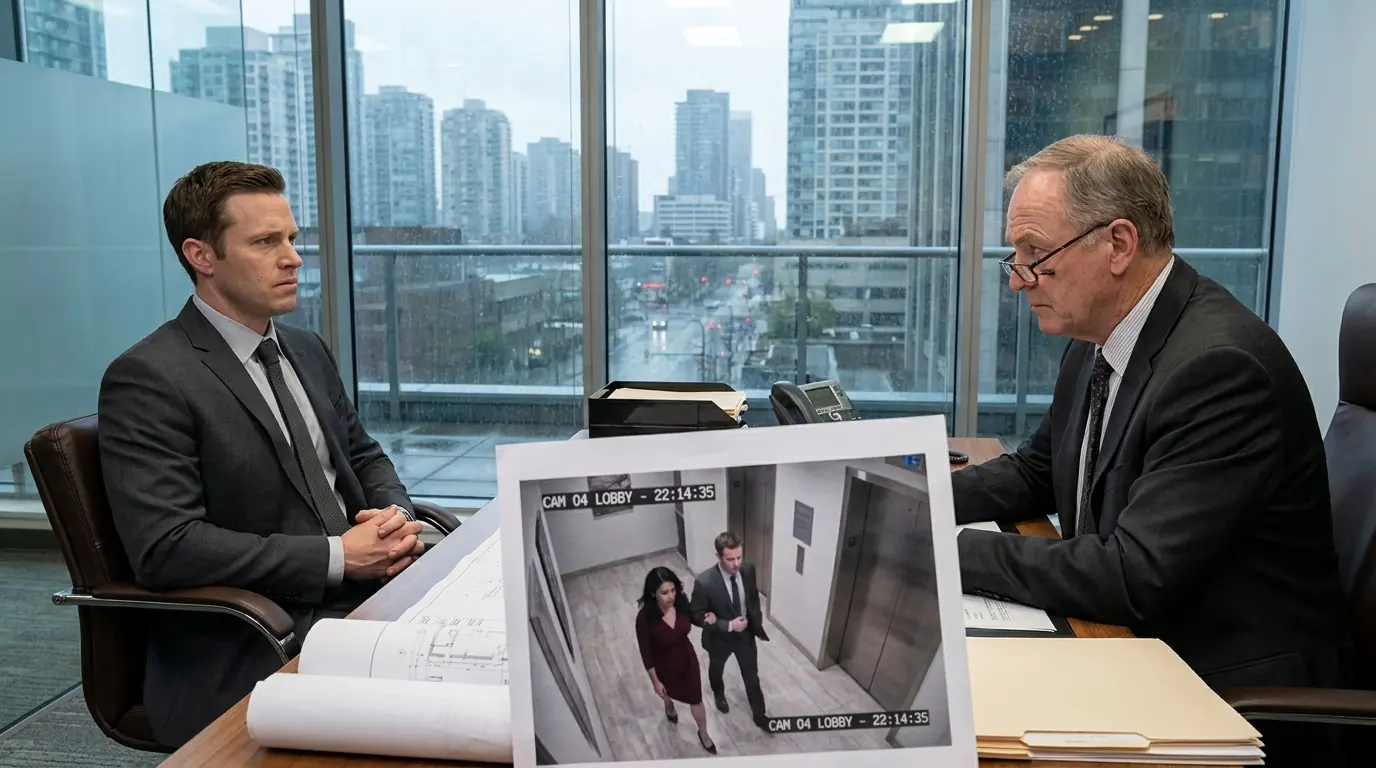
Morris watched me from behind his reading glasses and said nothing.
Let me back up.
My name is Hugh Callender. I'm 37 years old and I work as a civil engineer at Langford Development, a sustainable real estate firm headquartered in downtown Vancouver. I grew up in Hamilton, Ontario in a neighborhood where the houses had uninsulated basements and every Saturday morning smelled like somebody's dad cleaning a car in the driveway. My father worked maintenance at Stelco for 22 years. My mother ran the front office at a dental clinic. They taught me three things: show up on time, finish what you start, and don't make other people's problems worse.
I carried those principles into everything, including a marriage that ended quietly 2 years before any of this happened. My ex-wife, Allison, and I had been together 9 years. We split without a fight, without any single moment we could point to. Just two people who had grown in directions that no longer overlapped, the way roads do when one curves gently and by the time you notice you're kilometers apart.
She stayed in Hamilton. I moved to Vancouver because I needed somewhere large enough to get lost in for a while.
By the time this story starts, I had been at Langford Development for 3 months, still on probation, technically. Still learning which elevators were the slow ones and how Morris liked his project summaries: concise, no hedging, numbers before conclusions. Morris ran the company the way a Swiss watch runs, and he had 40 years of reputation to back it up. He did not tolerate sloppiness, in concrete pours or in character, and I had spent 3 months making sure he had no reason to think about me at all.
The only person I was close to at the office was Rupert, a senior project manager who had been at Langford for 4 years and had made it his mission to prevent me from spending every Friday evening in my apartment with a book and a bowl of soup. In his words, I was turning into a very competent hermit, and he found this unacceptable.
In October, Rupert convinced me to attend the annual Langford development fundraiser, a charity gala at the Fairmont Pacific Rim in Coal Harbour. Black tie, live auction, open bar. I owned exactly one suit that fit properly. I wore it, found a corner near the window overlooking the harbor, nursed a Granville Island Lager, and counted the minutes until I could leave without it seeming rude.
That's when I saw her.
She was at the far end of the bar, sitting on a stool with one heel hooked over the rung, holding a glass of red wine that was clearly not her first. Dark hair, burgundy dress, shoulders that were trying very hard to hold themselves straight. She had the look of someone who had been holding something together all day and had decided tonight to finally stop.
The bartender caught my eye and nodded in her direction, the universal signal that means is she with anyone?
I shook my head, but I walked over anyway.
She looked at me when I settled onto the stool beside her, and her eyes were red-rimmed but sharp. "I'm not looking for company."
I told her I wasn't offering any in particular. I just wanted to know if she was getting home all right.
"I always get home all right," she said.
10 minutes later, she nearly stepped off the stool sideways, and I caught her elbow with both hands. She didn't fight me on it. That told me more than the wine glass did.
I asked her where she lived.
"East Van," she said. "The Drive. I can't—" She stopped, pressed her fingers to her temple. "The street's not coming."
Commercial Drive, East Vancouver. Could be Venables or Charles or Victoria or 20 other streets. I could no more put her in a cab with that information than I could aim at a fog bank.
I stood in the middle of a hotel ballroom doing a quick accounting of my options. Call her a cab to nowhere, leave her at the bar, or...
We were already in a hotel.
The front desk was 60 seconds across the lobby. A standard room was probably 170, maybe $200, which was most of what was left in my checking account until the 15th, but it was a number I could absorb without borrowing from anyone. It meant she'd be in a locked room with a bed and a deadbolt and a bottle of water and not in the back of a cab she might not remember taking.
I made the decision in the time it took her to lose her balance a second time.
The room was 189 plus HST. I put it on my Visa. The night clerk didn't ask questions. I helped her upstairs, got the door open, guided her to the bed, filled a glass of water from the bathroom tap, and set it on the nightstand. I pulled the duvet over her without thinking about it too much. She was already mostly asleep.
Before I left, I tore a page from the notepad on the desk and wrote six lines: You're safe. You're at the Fairmont, room 714. I paid for the night. No one will bother you. Water's on the nightstand. Take your time. Hugh Callender, Langford Development.
I set the hotel receipt beside the note so she'd know the name was real, so she'd know it was just a receipt and nothing else had happened.
I was pulling the door shut behind me when her phone lit up on the nightstand. I wasn't trying to look. The room was dim and the screen was the only light, and the name on it was large enough to read from the doorway: Dad, Morris L.
I stood with my hand on the door handle and felt something drop through my chest like a stone through still water.