The Duke of Mereth came home from the war to find his bride gone and her sister standing in the doorway of Greymoor Hall, her hands clasped, her expression carefully composed, and a child balanced on her hip who had unmistakably his own gray eyes. He stood in the November rain for a long moment. The carriage behind him dripped, and the moors stretched in every direction, brown and immense, the heather flattened by three days of wind. His coat was still damp from the journey north, his jaw still shadowed from Calais, and his left hand still bore the pale seam of a saber cut received at Waterloo three years and four months before.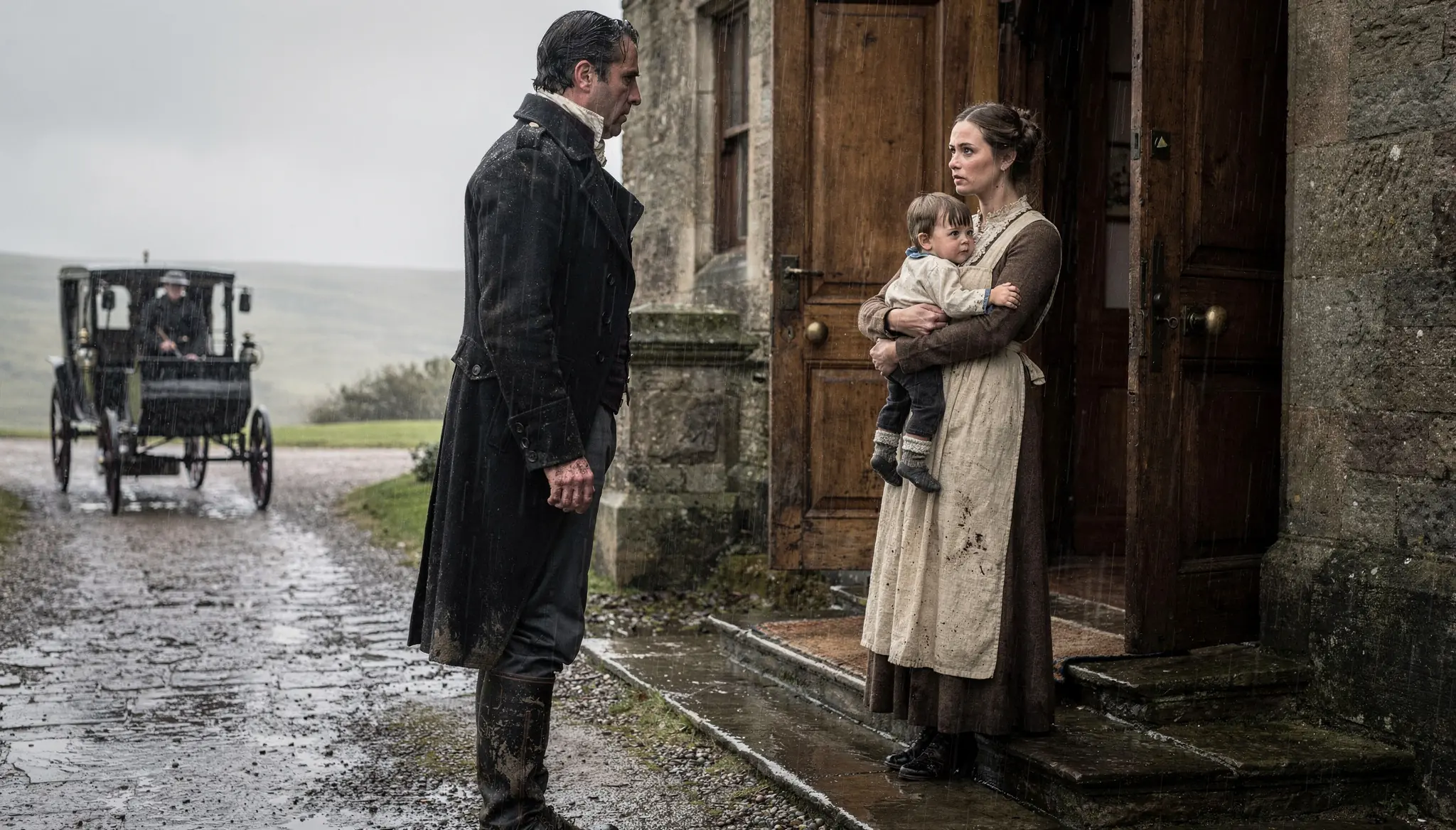
He had written from Brussels. He had written from Paris. He had written from the coast. He had received in return eleven letters from his solicitor, two from his steward, and none at all from his wife.
“Where is Cecily?” he asked.
The woman in the doorway was Margaret Ashcroft, twenty-six, the elder of the two sisters, the plain one, the overlooked one, the one no one had ever crossed a ballroom to speak to. In a voice that did not waver, she said, “She left fourteen months ago. She is in Bath, I’m given to understand, though I have not had a letter in some time.” She shifted the child higher on her hip. “This is James. He will be three in February.”
The Duke of Mereth, whose full name was Alister Vane, was thirty-four years old. He had commanded cavalry through six engagements and seen what men were capable of at their worst and at their finest. He had believed, arriving at the end of this damp road, that there was nothing left in England capable of surprising him. He looked at the child, then at Margaret, and slowly came inside.
What no one in that house yet understood was that Margaret Ashcroft had been protecting three people simultaneously for three years, and that the cost of that protection had been everything she had.
The story, as Margaret had maintained it to the village, to the tenants, and to the solicitor who visited twice a year and asked very careful questions, was orderly and almost ordinary. The Duke had gone to war. His young wife, unused to the isolation of the Yorkshire moors, had suffered a difficult lying-in. Arrangements had been made, the child was with family, the Duke would return, and all would be set to rights in due course.
It was, as stories went, thin enough to be believed by people who wished to believe it, and that was most people. The alternative required too much imagination about what the Honorable Cecily Ashcroft, beautiful, golden-haired, and the toast of two London seasons, might actually have done.
What Cecily had actually done was this. She had married the Duke of Mereth in April of 1815, six weeks before he returned to the Continent for the Waterloo campaign. She had spent a season at Greymoor Hall in his absence, bored, cold, and furious at her own mother for engineering a match to a man who was more title than warmth, and who had kissed her once on the cheek at their wedding, then departed for Belgium by morning. She had taken a great deal of consolation from the company of her neighbor, Mr. Philip Crane of Hartfield, charming, warm, attentive, and catastrophically unsuitable.
She had found herself with child by Christmas. With admirable practicality, she had brought her elder sister north. It was Margaret she had written to. It was Margaret who had come without asking too many questions, who had managed the lying-in with the calm competence of a woman who had run her father’s household since she was sixteen, and who had sat with Cecily through the long February nights.
It was Margaret who held James Vane on the first morning of his life while his mother slept. It was Margaret who negotiated, very quietly, with the solicitor. It was Margaret who told James, once he was old enough to ask, that his father was a great man who had been away serving England and would come home when he could. It was Margaret who, when Cecily left for Bath with Mr. Crane fourteen months ago, simply continued.
She had nowhere else to go. That was the plain truth of it, though she had not dwelt on it much. Her father had died two years prior, and the family estate in Lincolnshire had passed to a cousin who made it clear that the sisters were welcome as guests for a season and not beyond. Cecily had Bath and Mr. Crane. Margaret had Greymoor Hall, a three-year-old child who called her Mama because he had heard no one else to call by that name, and a set of household accounts that balanced because Margaret made them balance.
She had, she supposed, made herself indispensable. She had not intended to. It was simply that there were things that needed doing, and she was the person present who knew how to do them. She had not anticipated Alister Vane.
He came inside, and she showed him the house. In the sitting room, before a fire she had laid herself that morning because the housekeeper had taken ill, he asked a series of questions in a voice that gave nothing away. How long had his wife been gone? Had there been any correspondence with him? Was the child healthy? Were the estate accounts in order?
Each question was asked with the same flat precision, and Margaret answered each one without embellishment because she had learned very early in her life that embellishment was the province of those who could afford to be disbelieved. Then he looked at her for a moment, the firelight catching the gray of his eyes.
It was not a question.
“Someone had to,” Margaret replied.
He said nothing further that evening. He ate in his study. Margaret ate in the kitchen with James, who had decided, after approximately ten minutes of observing the tall man in the hall, that he was interesting and wished to investigate further. He was redirected with the help of a bowl of stewed apple and a carved wooden horse.
Margaret put James to bed at eight. She sat for a while at the writing table in the old schoolroom, which she had made her own because it was warm and because no one else wanted it. She wrote in the household ledger and listened to the rain come down against the moorland.
She was not afraid of the Duke. She was not afraid of anything particularly, which was perhaps unusual in her situation. She was, if she was honest with herself, tired. Had anyone been watching closely, they might have seen the way she carried tiredness, not as a weight, but as a kind of ballast.
It kept her upright. It kept her precise. It was the tiredness of a woman who had been the most competent person in every room she had entered for three years, had never once been thanked for it, and had decided somewhere around the second winter that gratitude was not the thing she was doing this for. She was doing it for James, and she would continue doing it until someone made her stop.
She expected the Duke to make her stop rather quickly. She expected a solicitor’s letter, or a carriage, or a conversation that began with the words, “I am grateful for your service,” and ended with, “But of course you will understand you cannot remain.” She prepared for it with the same methodical care with which she prepared for everything.
She packed the two trunks she kept in the schoolroom. She wrote a letter to a former governess in Edinburgh who had once said in passing that there might be a situation there for a woman of Margaret’s capabilities. She set the letter aside, unaddressed, and waited.
No solicitor came. No carriage arrived. No conversation took place. What came instead, three mornings after the Duke’s return, was Alister Vane himself appearing in the kitchen doorway at half past seven to find Margaret standing at the range with her hair still pinned loosely from sleep, turning rashers in a pan.
The kitchen smelled of wood smoke, rendered fat, and the particular damp-wool warmth that had come to mean to Margaret something close to safety. She did not startle. She turned and looked at him.
“There is porridge if you want it. The rashers will be done in five minutes.”
“You cook,” he said.
“I do a great many things,” she replied, and turned back to the range.
James regarded him with round gray eyes that Margaret had long since ceased finding remarkable, almost identical to the Duke’s own. After a moment, James offered him a piece of bread. Some negotiation occurred that Margaret observed only from the corner of her eye. By the time she set a plate before Alister Vane, James had moved to sit beside him and was explaining at some length, and with moderate coherence, something about a dog he had seen near the stables the previous day.
The Duke listened. He ate. He answered James’s questions with the same flat precision with which he had answered Margaret’s, and James found this entirely satisfactory. When the nursemaid retrieved James and the kitchen had gone quiet, the Duke sat for a moment with his cup and looked at Margaret.
“Tell me what happened,” he said. “All of it, from the beginning.”
She told him about the letters she had received from Cecily. She told him about arriving in November of 1815, the state of the house, the lying-in, and the February morning. She told him about the conversations with the solicitor and precisely what she had and had not told that man.
She told him about Mr. Crane, Cecily’s departure, and the fourteen months since. She told him about the household accounts, about the tenants she had dealt with, and about the drainage problem in the South Field that she had resolved in his absence. Three men had initially declined to take instruction from a woman, then, once the matter was presented in terms of what would happen to their quarterly rents if the South Field flooded again, discovered that they could.
She did not tell him she was tired. That was not his concern. He listened to all of it without expression. When she finished, he was quiet for a moment.
“The child does not know?” he asked.
“He knows his father was at war,” Margaret said. “He knows his father is a great man. He knows his father has come home. Beyond that, we have not gone.”
“And Cecily?”
“She wrote once, six months after she left. She said she was well. She said she hoped James was well.”
“No.” His voice was very even. “I would not expect she does.”
He left the kitchen then, but he did not call for a carriage or a solicitor. He walked out to the stables in the rain and was gone for two hours. When he returned, he reviewed the household accounts with the thoroughness of a man who had managed logistics for a cavalry regiment.
He found them, Margaret gathered from his expression, entirely in order. That evening, he said, “You will stay for now, until I determine what is to be done.”
“Yes, Your Grace,” Margaret replied.
She unpacked the trunks. She did not address the letter to Edinburgh.
What followed was not easy, but it was less difficult than Margaret had anticipated. He was a man who had learned, somewhere in the schoolroom or the regiment, she could not be certain, that silence was not absence. He was present in the house in a way Cecily had never been, and in a way Margaret herself had nearly forgotten was possible.
He came down to breakfast. He went out to the estate. He sat with James in the evenings and let the child read to him haltingly from a picture book, and he did not correct his mistakes. Once a week, he asked Margaret to go through the accounts with him and listened without interrupting while she explained.
He did not explain himself. He did not offer the history of his wound, his marriage, or the years at war that had carved the lines in his face and settled the particular quality of stillness about him. It was not peace, but something adjacent to it. He gave nothing freely, but he listened to what was given to him, remembered it, and acted on it.
Margaret noticed in the third week that he had spoken to the village physician about a winter ailment in one of the tenant families and arranged for medicine. She noticed in the fourth week that a structural repair to the stable roof, which she had flagged in a household note three months before his return, had been commissioned. She noticed that he knew James’s name for his wooden horse and used it correctly.
She noticed these things in the way she noticed everything, quietly and without remark.
In December, a letter arrived from Cecily. It was addressed to the Duke. He read it in the study, then came and handed it to Margaret without a word.
Margaret read it standing in the corridor, with the winter light coming through the window at the end and her hands quite still on the paper. Cecily wrote that she had heard her husband had returned. She wrote that she supposed he was very angry and that she supposed she deserved it. She wrote, in a paragraph of unusual clarity, that she had not been suited to the life she had been given, that she had done a great wrong, and that she did not ask forgiveness, only to be left as she was.
In the final paragraph, Cecily wrote that Margaret would manage Greymoor better than she ever had. She wrote that she had always known this and had found it, in younger years, insupportable to be outdone so thoroughly by a sister who was plain.
Margaret stood in the corridor for rather a long time. She was not entirely sure what she was feeling. Something moved in her chest that was not quite grief and not quite relief. It was perhaps simply the long-deferred recognition that she had been wronged, named plainly by the person who had wronged her, and that the naming was, in its way, a form of being seen.
She heard a step in the corridor.
“Are you all right?” the Duke asked without approaching.
“Yes,” she said. Then, because it was true, she added, “It is strange to be told you have been overlooked, and to have it confirmed, and to find that being confirmed is strange.”
He was quiet for a moment. “I have been overlooked also, in different ways.”
She looked at him properly then, with the letter still in her hands. He leaned against the corridor wall at a careful distance, watching her with the particular attentiveness he brought to the accounts or James’s haltingly read sentences. It was the look of a man who was not expecting to be moved, but who was being moved nonetheless.
“By the war?” she asked.
“Before the war, mostly.”
She understood then what was not said. A father with no warmth to give, a title that had come too soon and too heavily, or some particular season in which he had learned that the world saw the rank and not the man. She did not ask him to specify.
“I will put this in the accounts file, where the solicitor can find it if he needs to,” she said, folding the letter.
“Yes,” he replied. “That is sensible.”
But he did not move, and neither did she for a moment longer than was required. The winter light lay between them on the flagstones like something that had been set down carefully and not yet retrieved. It would be many weeks before she understood what that moment was the beginning of.
James became ill in January, a chest ailment that kept them both at the child’s bedside in turns through three nights of high fever and half-coherent waking. In the exhaustion and the vigil, something altered. The Duke sat on one side of the small bed and Margaret on the other, and they passed between them a lamp, a cloth, and a bottle of the physician’s preparation.
When James reached out in the third night and put his hand in Margaret’s, the Duke looked at that joined grip for a long moment.
“He would have had none of this without you,” he said very quietly.
“He has you now,” Margaret replied.
He looked at her, and she looked back. The fever broke that morning, James’s small body loosening into ordinary sleep. They both stayed until they were certain, then Margaret excused herself to take an hour of rest.
She went to the schoolroom and sat in the chair by the window. For the first time in three years, she felt the particular quality of not being alone, something she had almost forgotten existed. She also felt, somewhat alarmingly, the particular quality of something else, something warmer, something she had not permitted herself before and did not quite know what to do with now.
She was not a woman who allowed herself things she could not afford. She was not a woman who built expectations from materials that would not support them. She knew her position with a precision that verged on the mathematical.
She was the sister of his runaway wife, the guardian of his son, and the manager of his estate. She was plain, twenty-six, without fortune or prospects, and with nothing to recommend her except that she knew how to keep a household, a child, and a set of accounts functioning in the absence of anyone better. But he had said, “He would have had none of this without you.”
Something in the way he said it, not as a compliment, not as a performance, but as a simple recognition of truth, moved in her like a fault line, quiet and deep. She put it away. She was very good at putting things away.
She put it away for six weeks. She managed the household, James, the accounts, the late winter repairs, and a dispute between two tenant families that required careful navigation. She was very nearly successful.
She was nearly successful until a Tuesday morning in late February, the first warm morning of the year, when she was in the south garden cutting dead stems from the rose beds with her coat pushed back and her hair coming loose. The Duke came around the garden wall and stopped.
“There you are,” he said.
“Here I am,” she replied without turning.
He came and stood beside her. After a moment, he said, “James told me this morning that you have been teaching him to read in French.”
“He will need it eventually,” Margaret said. “Better to begin young.”
“He told me also that you are teaching him to count.”
“He can count to thirty already. We are working on thirty-one.”
She cut another dead stem with perhaps more precision than the task strictly required.
“What will you do when this is resolved?” he asked. “When the legal matter of the marriage is settled, the child is secured, and the estate is properly in hand, what will you do?”
She was still for a moment. Then she said carefully, “I have not decided. There is a situation in Edinburgh.”
She hated immediately that she had said it because it sounded like a prepared exit, and it was, and he would know it.
“You have been preparing to leave,” he said.
“I have been preparing to be sent away. Those are different.”
A silence followed. She cut another stem. The morning was cold and clear and smelled of turned earth, wet stone, and the faint green beginning of something under the dead garden.
“I am not going to send you away,” he said.
Margaret turned to look at him because she could not help it. He was looking at the rose beds, not at her. There was something in his profile, the jaw, the saber cut visible below his left cuff, that was not cold precisely, but very controlled.
It was the face of a man saying something true that he had not said before, proceeding with careful deliberateness.
“I am aware that what I am about to say is not uncomplicated, given the circumstances,” he said, “and I would not press you for an answer now.”
She waited.
“But I am asking you to consider, not as a household arrangement, not as James’s guardian, but as a thing that might be wanted by both parties.”
The spring garden was very quiet.
“You are asking me to consider,” she said slowly.
“Yes.”
“While the marriage is still legally in place.”
“The solicitor assures me it will not be so for long. Cecily has written to him also. The grounds are clear.”
“And you are asking me, while it is not resolved, to consider.”
“I am asking you,” he said.
Now he did look at her, with the gray eyes that James had inherited and that she had been looking at for three years.
“Whether you would be willing to be considered.”
“That is not the same as being asked.”
Margaret Ashcroft was plain and twenty-six. She had spent three years holding a household together with no assistance, no acknowledgement, and no prospect of any future that was not the Edinburgh situation or some other version of the same useful invisibility. What she felt then was not collapse, but release, the particular sensation of a weight carried so long it had become load-bearing and was then carefully, deliberately set down.
“I would be willing to be considered,” she said.
He nodded once. “Precisely.”
She turned back to the roses.
But the season was not yet finished with her.
Cecily came in March. She arrived in a hired carriage without Mr. Crane in the early afternoon. She was thinner than Margaret remembered, her famous golden hair dressed with less care than it once had been.
She stood in the hall of Greymoor Hall and looked at her sister. They went to the sitting room. Cecily sat with her hands folded and said without preamble that Mr. Crane had gone, that the situation in Bath had become untenable, and that she had come to see if there was, she paused and chose her words with something like honesty, any help to be had.
Margaret looked at her sister. At various points over the past three years, she had been angry at Cecily. She had been exhausted by Cecily. In dark moments, she had felt something close to hatred, though she had not permitted herself to examine it too carefully.
In lighter moments, she had felt something close to pity, which she had also put away. She looked at Cecily now and felt quite simply sad. Sad for the woman her sister had needed to be and the woman she had failed to become. Sad for the great bright force of Cecily’s beauty and charm, always pointed outward, which had in the end found nothing solid to hold.
“The house is not mine to offer,” Margaret said. “I will speak to the Duke.”
Cecily’s expression shifted. “You will speak to him as a household manager?”
“As someone he will listen to.”
Cecily looked at her slowly. “Margaret,” she said, and then, “I see.”
Alister Vane, informed of the situation that evening, considered it for less than a minute. He arranged for Cecily to be established in the dower house, which was smaller and colder but habitable, and for a quarterly allowance. There would be no contact with James beyond what James himself might wish for when he was old enough to know the whole of it.
He did this methodically. Then he went to the study, closed the door, and was not seen for the rest of the evening. Margaret did not knock on the study door.
She sat in the schoolroom and let him have the evening he needed. The next morning, he came to breakfast, and she set his plate before him.
“That is done with,” he said.
“Yes,” Margaret replied.
“Then we may proceed.”
“To what, Your Grace?”
He looked at her steadily. “To what we agreed to consider.”
Nearly a year later, for the legal machinery had moved with reasonable speed, the spring had been warm, the tenants had enjoyed a good harvest, and James had learned to count to one hundred and was beginning, with some confidence, what he called simple sums, Margaret Ashcroft became Margaret Vane.
They married in Greymoor Church on a Tuesday morning in early April. James was the only witness who truly mattered, and the moors outside the narrow windows were green and enormous under a gray sky. There was no announcement in the London papers.
There were, Margaret was given to understand, some raised eyebrows in the county, and probably more in town, had anyone in town taken sufficient interest in the second sister of the woman who had run away from the Duke of Mereth to trouble themselves to comment. No one who mattered to her raised an eyebrow. The ones who did had never been required for her happiness.
Alister Vane stood in the April sun in the Greymoor churchyard with James on his hip and his new wife beside him. He was not a demonstrative man. Over the course of the year, he had not become one.
He had become precise in his generosity. There was the look across the kitchen table that was not the look of an employer, the question about Edinburgh that he never raised again, and the January morning when James had been ill and the fever had broken, and he had said what he had said.
“You did not have to stay,” he said now in the churchyard.
“No,” Margaret replied.
“You stayed because of James.”
“In the beginning, yes.”
He was quiet for a moment. James was pointing at a rabbit that had emerged from behind a headstone, and both of them watched it.
“And now?” he asked.
“Now I stay because it is my home, because James is mine, and because you asked me to consider. I considered, and I found the answer was not ambiguous.”
He looked at her. Something moved in the gray eyes, the eyes she had looked at for three years across kitchen tables, account books, and a sick child’s bedside. She knew them now the way one knows a landscape lived in until it is less a thing seen than a thing felt.
“No,” he said. “I found that also.”
The rabbit crossed the churchyard wall and was gone. They went home.
Many years later, it was recorded in a small memoir of household correspondence preserved by the family, letters between two women a century old when they were finally bound and cataloged, that the Duchess of Mereth, née Ashcroft, the elder sister, had managed the estate of Greymoor Hall through the Napoleonic years and her husband’s long absence. She had done so with a competency that the steward’s records bore out in careful detail.
The letters mentioned in passing, and with more detail than might have been expected, an Edinburgh situation that had never been taken up. They mentioned, in a single sentence, that she had found the answer not ambiguous. The catalog entry, written by a scholar who had read a great many family papers, noted simply that the letters demonstrated unusual practical intelligence and a marked capacity for endurance.
The scholar had missed, as scholars sometimes do, the sentence about Edinburgh, or had not known how much weight to give to the word not.
James Vane grew up on the Yorkshire moors with a father who counted things carefully and a mother who had taught him French and numbers. He knew more of his own history than most thought he did and had chosen, with the particular wisdom of children given good models, to be satisfied with what he had.
James married well, managed his estate well, and was known in the county as a man of uncommon steadiness. His own daughter, riding out to the moors in the early years of a new century, found in the schoolroom at Greymoor Hall a writing table with a single drawer. In the drawer was a letter addressed to an Edinburgh governess, unsealed and never sent.
She kept it. She did not entirely understand it, but she kept it because it felt like something that had mattered once. It was a road not taken, a door that had stood open and then had not been walked through. Holding the letter and standing in the schoolroom in the winter light, she could understand at least a little of the particular quality of the woman who had sat there and had decided.