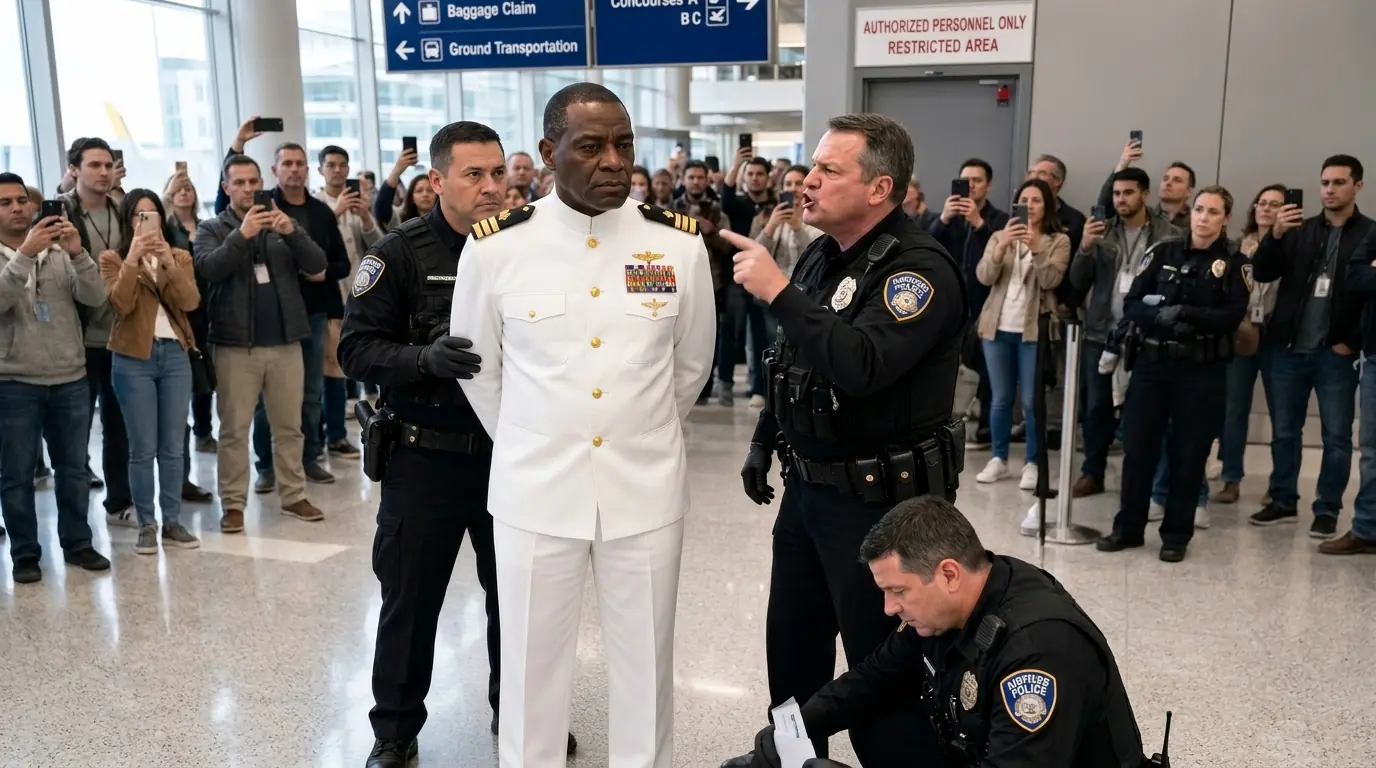
Nine minutes before Commander Isaiah Bennett stood handcuffed beside Gate C14 at Raleigh-Durham International Airport, he had been thinking about coffee.
Nothing more important than that.
His flight to Washington was scheduled to depart shortly after ten, his briefing materials were secured inside a locked document case, and the black coffee he had bought near security was terrible even by airport standards. Around him, families pulled rolling suitcases across polished floors while boarding announcements echoed through the terminal and morning sunlight poured through the high glass windows.
At forty-eight, Isaiah had served in the United States Navy for twenty-six years, long enough to know that the moments preceding trouble rarely announced themselves properly. Sometimes danger came with alarms, shouting, and people running toward cover. Other times it arrived wearing a badge and using the language of procedure.
That morning it used both.
Isaiah had walked perhaps thirty yards from the coffee stand when an airport police officer stepped directly into his path. The officer was white, early forties, broad through the chest, with a shaved head and the name MORGAN clipped above his shirt pocket. His right hand hovered near his belt without touching anything.
“Sir, stop right there.”
Isaiah stopped.
A second officer approached from his left.
She was younger, maybe twenty-nine, Black, with the name ELLIS on her uniform.
“Keep your hands where we can see them,” Officer Morgan said.
Isaiah did exactly that.
“What is the issue?”
“We received a report about an armed individual matching your description.”
Passengers began slowing around them.
Isaiah noticed immediately.
He also noticed something else.
Morgan had said armed individual, not armed suspect.
That distinction suggested whoever made the original report had known enough to avoid alleging an actual crime.
“My military identification is inside my left breast pocket,” Isaiah said. “I have official travel orders and a secured service weapon declared for transport inside the locked case in my bag.”
Morgan’s eyes narrowed.
“Put the bag down.”
Isaiah lowered the black travel bag carefully.
“My weapon declaration is inside the transparent sleeve attached to the interior case. You can verify the serial number and command authorization before opening anything else.”
Morgan looked toward Ellis.
“Check it.”
Ellis knelt beside the bag.
She opened only the outer zipper, found the clear document sleeve exactly where Isaiah said it would be, and removed the declaration. Her eyes moved from the paper to Isaiah’s identification, then to his printed travel orders.
“Numbers match,” she said.
Morgan did not move.
Ellis checked again.
“Commander Bennett, Navy. Travel order is current. Weapon serial on declaration matches the case label.”
Isaiah waited.
That should have ended it.
Maybe Morgan would call the number printed on the form.
Maybe another supervisor would check the locked case.
Five minutes of inconvenience.
An apology.
Then everyone would continue their morning.
Instead, Morgan looked over Isaiah’s shoulder.
A supervisor was approaching.
The man was tall, lean, somewhere around fifty, with closely cut gray-brown hair and the controlled stride of someone who expected people to move before he reached them. His uniform identified him as airport police lieutenant GRAHAM WOLFE.
Isaiah recognized him.
Not from Raleigh.
Eight months earlier, Isaiah had chaired part of a Naval logistics-security review in Norfolk. Several civilian contractors had been questioned about unusual access permissions surrounding restricted cargo transfers between military and commercial facilities.
Graham Wolfe had been there.
Not as a police lieutenant.
As a contracted aviation-security liaison.
Isaiah remembered him because Wolfe had challenged nearly every request for access records.
Not openly.
Nothing that would have justified removing him from the review.
He simply had a reason why every document would take another day.
Different database.
Different administrator.
Incomplete release authority.
Vendor confidentiality.
Routine bureaucracy used like sand poured into machinery.
Now Wolfe stood six feet away in a Raleigh-Durham police uniform.
Isaiah looked directly at him.
“You attended the Norfolk logistics review last winter.”
Wolfe’s eyes met his.
Recognition flickered.
Gone instantly.
“I don’t know what you’re talking about.”
Isaiah felt the morning change.
Not because Wolfe denied remembering him.
Because the denial came too fast.
No confusion.
No attempt to place the face.
No question.
A prepared no.
Officer Ellis looked between them.
Morgan asked, “Lieutenant?”
Wolfe ignored Isaiah’s military documents.
“What do we have?”
“Reported armed subject.”
Ellis corrected him immediately.
“Declared firearm, sir. Everything I checked matches.”
Wolfe finally looked toward the papers.
He did not pick them up.
“Search the entire bag.”
Isaiah’s voice remained level.
“There is no basis to expand the search after verification.”
Wolfe looked at him.
“You’re not directing this.”
“I’m stating the sequence your officer already confirmed.”
Wolfe’s expression hardened.
“Restrain him.”
Ellis turned.
“Sir?”
“You heard me.”
Morgan moved first.
Isaiah did not resist.
He placed both hands behind his back before being ordered a second time because he understood something Wolfe seemed to underestimate.
There were cameras everywhere.
Airport cameras.
Police body cameras.
Security cameras over checkpoints.
Passenger phones.
If someone was creating a false story, Isaiah wanted every physical action on his side to remain boring.
Metal cuffs closed around his wrists.
A woman waiting near the departure board raised her phone.
A college-aged man near a charging station did the same.
An older white man in a Navy veteran cap stopped walking.
Isaiah saw their faces.
Confusion first.
Then attention.
Morgan opened Isaiah’s travel bag.
Shirts came out.
Toiletries.
A spare uniform shirt.
Chargers.
A small leather case containing medals.
Finally, the locked weapon case remained on the floor beside the verified paperwork.
Isaiah watched everything placed across the carpet.
Wolfe watched too.
Then a terminal security manager arrived.
Her badge identified her as Dana Whitaker.
“What’s happening?”
Wolfe answered before anyone else.
“Potential military impersonator with a concealed weapon. Became confrontational when officers attempted verification.”
Isaiah turned his head.
Three lies in one sentence.
His identification had been verified.
The weapon had been declared.
His voice had never risen.
Whitaker looked toward him.
Isaiah said, “Ask Officer Ellis whether my documentation matched.”
Wolfe stepped between them.
“This is an active law-enforcement investigation.”
The people recording moved slightly closer.
Wolfe noticed.
“Phones down. Give us room.”
Nobody obeyed.
The woman near the departure board said, “We’re not blocking anybody.”
Morgan looked irritated.
“You need to stop recording police activity.”
The older veteran spoke.
“No, she doesn’t.”
Morgan stared at him.
The veteran pointed toward the papers in Ellis’s hand.
“I watched her tell you his documents were good.”
Morgan said, “Sir, move along.”
The older man folded his arms.
“I’ll move when he does.”
Isaiah almost smiled.
Not because he wanted confrontation.
Because independent witnesses had just become part of the evidence.
Then Isaiah saw the airport employee near the far pillar.
Blue operations vest.
Gray slacks.
Credential hanging from a lanyard.
Trevor Maddox.
Another name from Norfolk.
Isaiah had seen his photograph in contractor-access logs connected to altered cargo-transfer authorizations. Investigators had never proven wrongdoing, but Maddox had appeared repeatedly around shipments that later required corrections.
Maddox was staring directly at Isaiah.
Their eyes met.
The airport employee turned immediately.
Typed something into his phone.
Then started toward a restricted service door.
Isaiah watched him swipe his credential.
Green light.
Door open.
Gone.
At that moment, the detention stopped looking accidental.
Bad policing remained possible.
Bias remained possible.
But those explanations were no longer sufficient.
Someone who had appeared inside a restricted military inquiry had just recognized him and disappeared into an employees-only corridor while another person from that same inquiry controlled the police response.
Isaiah looked toward Wolfe.
“I need to make a command-verification call.”
“No.”
“The number is printed on my orders.”
“I said no.”
“Then document that you are refusing command verification.”
Morgan laughed.
Wolfe did not.
Isaiah continued.
“I need to call Rear Admiral James Ridley.”
Something moved across Wolfe’s face.
Fear.
Brief.
But Isaiah saw it.
Officer Ellis saw something too.
She looked toward Wolfe.
“Lieutenant, command verification is permitted.”
“No call.”
“His paperwork—”
“I know what the paperwork says.”
That sentence came out too fast.
Isaiah watched Ellis process it.
Wolfe had just admitted familiarity with documents he had barely examined.
Ellis removed one cuff.
Morgan stared.
“What are you doing?”
“Verification.”
Wolfe stepped forward.
“Officer Ellis.”
She held Isaiah’s phone toward him.
“If the number is invalid, we put the cuff back on.”
Wolfe’s jaw tightened.
Isaiah unlocked the phone with his thumb.
Dialed from memory.
Rear Admiral James Ridley answered on the second ring.
“Bennett?”
“Sir.”
Isaiah looked directly at Wolfe.
“We have a problem.”
Ridley’s tone changed immediately.
“Location.”
“Raleigh-Durham International. Main departure terminal.”
“Physical condition?”
“Uninjured. One wrist restrained.”
“Why?”
“Lieutenant Graham Wolfe.”
Silence.
Long enough to matter.
“Say that again.”
“Graham Wolfe.”
Isaiah continued.
“Trevor Maddox just entered a restricted service corridor after seeing me detained.”
Another pause.
Then Ridley said:
“Do not leave the airport.”
Isaiah almost laughed.
“That should be easy.”
“I’m coming.”
The call ended.
Morgan smirked.
“You think calling some Navy buddy changes airport law?”
Isaiah looked toward him.
“No.”
Then toward Wolfe.
“But he knows why Lieutenant Wolfe remembers Norfolk.”
Wolfe pointed.
“Replace the cuff.”
Ellis did not move.
“Sir, there is still no basis.”
“That is an order.”
Ellis held the cuff in one hand.
Then slowly lowered it.
“No, sir.”
The terminal became very quiet.
She was not shouting.
Not making a speech.
Simply declining.
Wolfe stepped close enough that the cameras captured both faces.