A six-year-old girl walked into an animal shelter and almost immediately noticed something that everyone else had been walking past.
At the very end of the kennel row lay a dog so thin it was hard to look at for long.
His ribs showed through his fur, and he barely moved as he rested against the wall.
A bowl of food sat right beside him, untouched.
Visitors stopped there for a moment, shook their heads, and quietly moved on, but this girl didn’t.
What happened next would later be replayed again and again on the shelter’s security cameras, because none of the workers could believe what they were seeing, because this dog hadn’t eaten for a long time.
The shelter staff had tried everything, but day after day, the bowl remained full while the dog slowly grew weaker.
The girl’s name is Alice, and she is 6 years old.
Alice has always been a little different from other children her age.
She is quiet, patient, and often feels more comfortable around animals than around people.
At school, she sometimes struggles to make friends, not because she is unkind, but because she speaks softly and prefers calm moments instead of noisy games.
Animals, however, seem to understand her immediately.
There is a neighbor who lives a few houses away from Alice’s family, an older man who travels often for work.
Whenever he leaves town, Alice is the one who walks over to his yard to help take care of his dog.
She fills the bowl, brushes his fur, and sits beside him on the porch while he rests his head against her knee.
The dog listens to her in a way that surprises even the neighbor.
But Alice’s parents have always been careful about one thing.
They don’t want a dog at home.
They worry it would be too much responsibility for a six-year-old child.
So when Alice’s school organized a visit to Greenwood Animal Shelter, her parents agreed.
It was just a field trip, a chance for the children to learn about animals and maybe help the shelter by bringing drawings and toys.
None of them expected that the visit would change two lives forever.
While the other children walked excitedly through the building, stopping at every kennel and pointing at the playful puppies jumping against the gates, Alice kept thinking about the dog at the end of the hallway, the thin one, the one that hadn’t even lifted his head when people passed.
After a few minutes, she quietly walked back toward that kennel.
The dog was still lying in the same place.
The bowl of food was still untouched.
Alice stood there watching him for a long moment.
Then she did something that surprised one of the volunteers nearby.
She opened the gate and stepped inside the kennel.
The volunteers started to say something, but Alice had already sat down on the floor beside the dog, leaving enough space so he wouldn’t feel trapped or afraid.
For several seconds, nothing happened.
The dog didn’t move.
He didn’t even look at her.
Alice reached slowly toward the bowl of food, picked up a small piece, and held it gently in her hand.
She didn’t push it toward him.
She simply waited.
The security camera above the hallway recorded the moment clearly.
The dog slowly lifted his head.
For the first time since arriving at the shelter, he looked at someone with real attention.
Then, very carefully, he leaned forward and took the food from Alice’s hand.
The volunteer watching from the hallway froze, because that dog had refused every meal for many days, but now he was eating from a child’s hand.
When the shelter staff reviewed the footage later that evening, they couldn’t believe what they were seeing.
Several of them replayed the moment again and again, watching the same quiet scene where a starving dog finally accepted food.
From that day forward, Alice returned to the shelter every afternoon after school with one of her parents.
She would sit beside the dog and feed him small pieces of food from her hand while speaking to him softly.
At first, he only ate a little, but slowly, day after day, the bowl beside him started to empty.
The dog began to regain strength.
Within two weeks, he started standing when Alice arrived.
Within a month, he wagged his tail.
During that time, the shelter staff also discovered the rest of his story.
The dog’s name was Atlas.
He had belonged to a retired firefighter named Daniel Harris.
For nearly eight years, the two of them had been inseparable.
Daniel had rescued Atlas as a puppy during a call to a house fire, and from that day forward, the dog followed him everywhere.
But several months earlier, Daniel had passed away suddenly.
Family members tried to care for Atlas, but the dog never adapted to the new home.
Eventually, he ran away and was found weeks later near a highway outside the city, thin, exhausted, and completely alone.
Atlas had been found late in the evening on the side of a highway just outside the city.
A driver had noticed him standing near the edge of the road.
They thought the dog might run, but he didn’t.
He just stood there, thin, exhausted, and completely still, as if he no longer had the strength to care where he was.
When animal control arrived, Atlas didn’t resist.
He didn’t bark.
He didn’t try to run.
He simply allowed himself to be led into the vehicle, lowering his head the entire time.
When they brought him to the shelter, the staff immediately noticed how severe his condition was.
His ribs were visible.
His movements were slow.
And his eyes carried a kind of emptiness that experienced workers recognized right away.
This wasn’t just hunger.
This was something deeper.
They gave him food that same night.
He didn’t touch it.
The next morning, the bowl was still full.
By the second day, the staff began to worry.
They tried different types of food, different feeding schedules, quieter rooms, even hand-feeding.
Nothing worked.
Atlas didn’t react to anyone.
People would stop in front of his kennel, some of them whispering, laughing, others shaking their heads in disbelief at how thin he was.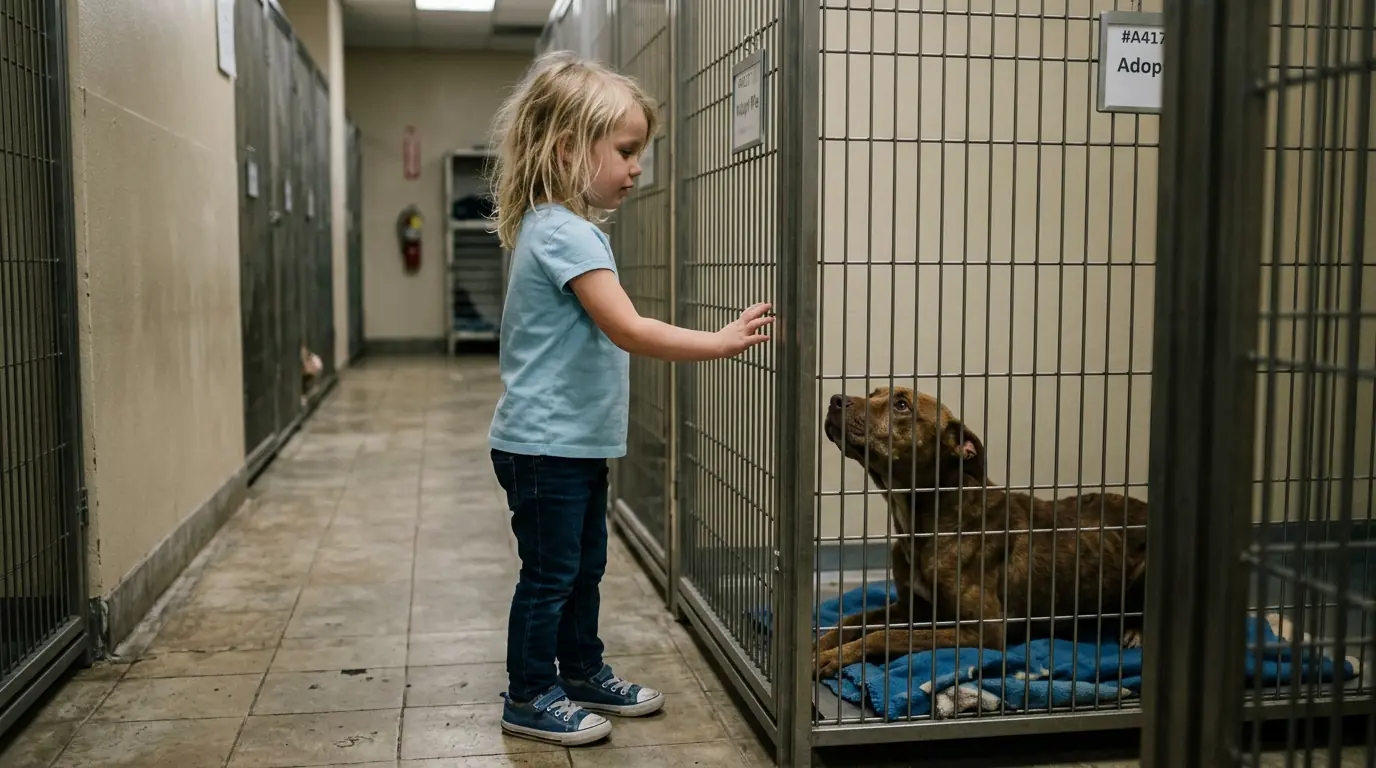
No one understood what was really happening.
The shelter arranged a full medical examination.
They checked for injuries, infections, internal problems, anything that could explain his condition.
The results came back clear.
Physically, he could recover.
But emotionally, something was broken.
The veterinarian explained it quietly to the staff.
Severe stress.
Loss.
He’s shutting down.
Days passed, and Atlas grew weaker.
The staff continued trying, but each attempt ended the same way.
The bowl stayed full, and the dog remained still.
By the time Alice walked into the shelter that day, Atlas had already begun to fade in a way that no medication could fix, because what he had lost couldn’t be replaced with food or treatment.
When Alice heard that story, she sat quietly beside Atlas and gently placed her hand on his head.
“You’re not alone now,” she said softly.
From that day on, she didn’t miss a single visit.
Every afternoon after school, Alice came back to the shelter.
Sometimes she brought small pieces of food.
Sometimes she just sat beside Atlas and talked to him in that same calm, steady voice.
She never rushed him.
Never forced him.
And never seemed disappointed on the days he ate a little less.
But little by little, things began to change.
Atlas started lifting his head the moment he saw her.
Then he began to stand.
Then one afternoon, his tail moved for the first time.
The staff noticed it immediately.
“He’s waiting for her,” one of them said quietly.
Weeks passed, and the routine stayed the same.
Alice would sit beside him, feed him from her hand, and stay longer than anyone expected a six-year-old to have the patience for.
At home, she talked about Atlas constantly.
At first, her parents listened without saying much.
They had always been firm about not having a dog, but now something felt different.
They could see it in the way Alice spoke.
In the way she smiled when she mentioned his name.
One evening, after another visit, Alice looked at them and asked the question again.
“Can he come home with us?”
This time, they didn’t answer right away.
A few days later, they went back to the shelter together.
And before Alice even realized what was happening, the paperwork was already being prepared.
Atlas was going home.
The first weeks were quiet.
Alice stayed close to him, giving him space when he needed it, sitting beside him when he rested, and continuing the same gentle routine she had started in the shelter.
They took him to the veterinarian regularly, making sure his recovery stayed on track.
Slowly, steadily, Atlas began gaining weight.
His energy returned.
His movements became stronger.
And the tired, empty look in his eyes started to disappear.
Month by month, he changed.
His ribs were no longer visible.
His coat became healthier.
And most importantly, he began to act like a dog again.
He ran in the yard.
He chased a ball.
He followed Alice everywhere.
Every morning, he walked with her to the front of the house when it was time for school.
And every afternoon, he was already waiting near the door before she even stepped inside.
Alice changed, too.
At school, her teachers began to notice that she was more open, more confident, more willing to talk and laugh with other children.
She still preferred quiet moments, but now she wasn’t alone during recess.
Sometimes she told stories about Atlas.
Sometimes other kids asked to see him.
And slowly, things became easier for her.
At home, their days were filled with simple moments.
Playing in the yard.
Sitting together in the evenings.
Walking through the neighborhood with Atlas proudly trotting beside her.
Even the neighbor’s dog, the one Alice used to take care of, became part of their routine.
The two dogs learned to trust each other, running together across the grass while Alice watched and laughed.
It wasn’t something dramatic.
It wasn’t something loud.
But it was everything they both needed.
Because the dog who had once stopped eating had found a reason to live again.
And the girl who had struggled to be understood had found someone who understood her without words.
And in the end, they didn’t just save each other.
They gave each other a life that neither of them could have found alone.
“Feel your tummy moving. It’s like waves. You’re safe. I’m right here.”
Dưới đây là phần tiếp theo của câu chuyện đã được định dạng mỗi câu một dòng và cách thưa giống hệt như yêu cầu của bạn:
Alice had a habit of speaking to Atlas the way some children speak to the moon, softly, as if they believed every quiet thing in the world was listening.
On anxious nights, when thunder rolled in the distance or wind pressed its fingers against the windows, she would sit cross-legged beside his bed, place one small hand against his side, and whisper, “Feel your tummy moving. It’s like waves. You’re safe. I’m right here.”
Atlas would blink slowly, his breathing matching the rhythm of her voice, and after a few minutes the tension would leave his body.
It became their ritual, one no one taught them, one neither of them ever had to explain.
By the time spring arrived, the dog who had once lain motionless in the last kennel at Greenwood Animal Shelter was almost unrecognizable.
His coat had grown back thick and glossy.
His shoulders were strong again.
He no longer carried the hollow, faraway look that had frightened the shelter staff so much.
He moved with purpose now, with that easy, grounded confidence dogs have when they know where they belong.
And he belonged with Alice.
The shelter workers noticed it the first time Alice brought him back for a visit.
She had insisted on going.
Not because Atlas needed anything, but because, in her six-year-old way, she seemed to understand that some places deserved a different ending than the one they were used to.
So on a bright Saturday morning, Alice walked through the shelter doors with Atlas beside her, his leash loose, his head high, his tail moving in a slow, steady arc.
At first, the volunteers didn’t recognize him.
One of them stared for a second, then covered her mouth with both hands.
“No way,” she whispered. “That’s Atlas?”
Another worker came out from the office, stopped in the hallway, and laughed through tears when Atlas trotted straight toward her and leaned his full weight into her legs.
The same dog who had once refused to lift his head for anyone now stood in the middle of the shelter calmly accepting affection, glancing back every few seconds to make sure Alice was still there.
“She did it,” one of the volunteers said quietly.
But the older shelter manager, the one who had reviewed Atlas’s file so many times she knew every line by heart, shook her head.
“No,” she said softly. “They did it.”
Alice, meanwhile, had already crouched down near the kennel row, talking to Atlas like she always did.
“Remember this place?” she asked him. “This is where I met you. You were very skinny.”
Atlas pressed his nose into her shoulder, and Alice giggled.
“You don’t have to be sad anymore,” she told him. “This is just a visit.”
There was something about that sentence that made the room go still.
Adults often used bigger words than children.
They said things like trauma, grief, rehabilitation, transition.
But children sometimes stepped straight into the truth with almost painful simplicity.
You don’t have to be sad anymore.
It was not a command.
It was not even reassurance.
It was permission.
That afternoon, the shelter asked if they could take a new photograph of Atlas for the wall where they kept stories of recovered animals and successful adoptions.
Alice agreed immediately, but only on one condition.
“I have to be in it too,” she said.
The staff laughed and told her of course she did.
So they took the picture outside near the flower boxes by the entrance.
Alice sat on the ground with Atlas pressed close against her side, one arm wrapped around his neck, both of them looking slightly off-camera because Alice had just spotted a butterfly.
When the photo was printed and placed in a frame a week later, the shelter added a small handwritten card beneath it.
Atlas and Alice
Sometimes healing begins when someone sits beside the pain instead of trying to pull it away.
Over the next months, that story spread farther than anyone expected.
At first, it traveled through the neighborhood.
The shelter volunteers told it to visitors.
Parents told it to other parents at school pickup.
Teachers mentioned it quietly in the faculty lounge when they talked about the changes they had seen in Alice.
Then a local newspaper called.
Then a community radio host.
Then someone from a regional morning show asked if the family would be willing to share Atlas’s story on camera.
Alice’s parents, Megan and Thomas, were hesitant.
They had never wanted their daughter turned into a feel-good headline.
She was a child, not a symbol.
But the shelter manager explained that stories like this sometimes helped overlooked animals get adopted.
Not every dog in the back row of the kennel was aggressive.
Not every dog that refused food was sick beyond saving.
Some were grieving.
Some were waiting.
Some just needed to be understood in a language people rarely thought to speak.
So they agreed to one interview.
The crew came to the house on a Sunday afternoon.
They were polite, careful, and clearly expecting a simple story about a little girl saving a dog.
But what they found was quieter and stranger and somehow more moving.
Atlas did not perform tricks for the camera.
He did not leap around or bark excitedly.
He simply stayed close to Alice.
If she sat down, he lay beside her.
If she walked, he followed.
When she stopped to think before answering a question, he leaned his head gently against her leg as if reminding her that there was no rush.
The reporter smiled at Alice and asked, “What made you sit down in the kennel with him that first day?”
Alice thought very hard about it.
Then she said, “He looked like nobody was waiting with him.”
That answer made the cameraman lower his eyes for a second.
“And why did you keep coming back?” the reporter asked.
“Because he ate from my hand,” Alice replied, as if that explained everything.
In a way, it did.
To a six-year-old, trust was not abstract.
It was as real as touch.
He ate from my hand.
He trusted me.
So I came back.
When the segment aired, people across the county responded in ways the family could not have predicted.
The shelter received donations.
Several older dogs were adopted that month, more than they had seen in nearly a year.
A retired couple came in asking specifically for “the dog nobody notices first.”
A widower adopted a shepherd mix who had been labeled too withdrawn.
A nurse took home a thirteen-year-old beagle with arthritis.
One woman who had watched the segment while caring for her dying father later wrote the shelter a letter that said: Your story reminded me that some creatures are not difficult.
They are heartbroken.
At school, Alice’s life continued to change in smaller, more personal ways.
Before Atlas, she had often spent recess near the fence or under the shade tree, content but separate.
She did not dislike other children.
She simply had trouble stepping into their noise.
Her thoughts moved slowly and carefully, while most six-year-olds seemed to sprint through every feeling they had.
But now the other children had questions for her.
“Does Atlas sleep in your room?”
“Can he do tricks?”
“Can we see him sometime?”
“Is he still sad?”
“How did you know he was nice?”
At first, Alice answered quietly and then retreated as she always had.
But over time, something shifted.
Talking about Atlas felt easier than talking about herself, and in talking about him she began, without realizing it, to show people who she was too.
She told stories.
About the first time Atlas ran after a tennis ball and brought it halfway back before dropping it proudly in the grass.
About the way he hated the vacuum cleaner but tolerated baths.
About how he would not eat unless she told him, “It’s okay, this bowl is yours.”
About how he slept sideways and somehow still took up the whole room.
The children laughed.
They listened.
They remembered.
And because children can be kinder than adults when given the right doorway, some of them began sitting with her more often.
A little girl named June, who was afraid of loud games too, started drawing dogs beside Alice during art time.
A boy named Mateo, usually too restless to stay in one place, discovered that if he asked about Atlas, Alice would talk longer than she did with almost anyone else.
Before long, those conversations spread beyond the dog.
They talked about cartoons, books, the strange smell of the cafeteria fish sticks, whether frogs got lonely in winter, and all the ordinary little things that build friendship before anyone notices it is happening.
Mrs. Campbell, Alice’s teacher, saw it all.
One afternoon she knelt beside Alice’s desk while the other children were lining up for music class.
“You know,” she said gently, “you seem happier.”
Alice looked up from her worksheet.
“I am.”
Mrs. Campbell smiled.
“Why do you think that is?”
Alice considered the question with the seriousness she brought to everything.
Then she said, “Atlas likes quiet too.”
It was such a small answer, but Mrs. Campbell understood.
It wasn’t only that Atlas had needed saving.
It was that Alice no longer felt strange for the way she moved through the world.
In Atlas, she had found not just a companion but recognition.
Summer came, and with it longer walks, greener grass, and evenings that stretched almost lazily into dusk.
Atlas loved summer.
He would lie under the maple tree in the yard, half asleep, one ear always angled toward the back door as if monitoring Alice’s movements by instinct.
The moment she stepped outside, his tail would thump once against the grass before he rose to join her.
Sometimes they played.
Sometimes they simply wandered.
Sometimes Alice sat in the yard reading out loud from a picture book while Atlas rested beside her, listening with the solemn attention of someone who understood that stories mattered even when you could not follow every word.
Megan watched them often from the kitchen window.
There were nights when she still remembered the first time she had said no to having a dog in the house.
She had thought she was protecting her daughter from disappointment, from responsibility, from one more thing that could break a child’s heart.
She hadn’t understood then that refusing connection can wound a child too, especially one who feels the world so deeply.
One evening, after Alice had gone to bed, Megan sat on the porch steps beside Thomas and watched Atlas sleeping near the door.
“He saved her too,” Megan said quietly.
Thomas nodded.
“I know.”
“No,” Megan said, eyes still on the dog. “I mean really saved her.”
Thomas took a slow breath.
He had seen it too.
The way Alice laughed more freely.
The way she no longer seemed to brace herself before entering a room full of children.
The way she rested easier, slept better, moved with more confidence.
Atlas had done for her what adults had been trying to do for years: he made her feel understood without asking her to explain herself first.
As the years passed, the story of Alice and Atlas settled into family history, but it never became ordinary.
At eight, Alice taught Atlas a hand signal for “slow,” because she worried he ran too fast near the street.
At nine, she read chapter books aloud to him in the evenings.
At ten, she insisted they celebrate the anniversary of the day he came home with a cake-shaped dog treat and a tiny paper crown she made from construction paper.
At eleven, when she had her first truly terrible day at school and came home with red eyes and trembling hands after being laughed at during a class presentation, Atlas met her at the door, pressed his body against her legs, and refused to leave her side until she calmed down.
She cried into his fur for nearly an hour.
When Megan later asked what had happened, Alice only said, “They were loud.”
That night, Atlas slept with his head across her feet as if standing guard over whatever part of her had been hurt.
By twelve, Alice was volunteering at Greenwood Animal Shelter on weekends.
The staff welcomed her like family.
Some of them had been there the day she first sat down in Atlas’s kennel, and none of them ever forgot it.
The younger volunteers called her “the whisperer” behind her back, though not in a mocking way.
They said there was something about her that made fearful animals settle faster.
It wasn’t magic.
It was patience.
Alice had no need to dominate a room, no urge to rush healing, no fantasy that love should be loud to be powerful.
Wounded animals understood that in her immediately.
She developed a special tenderness for the dogs everyone else found difficult to approach.
The ones who stayed in the corner.
The ones who wouldn’t eat with people watching.
The ones who flinched when hands reached too quickly.
She never forced contact.
She simply sat nearby and made room for whatever trust might decide to do.
One winter afternoon, she found herself sitting in the exact same kennel Atlas had once occupied.
The metal gate was open.
A skinny shepherd mix named Junebug lay curled against the far wall, refusing to look at anyone.
Alice sat on the floor with a paper cup of kibble in her hands and waited.
A new volunteer stood in the hallway and asked, “How long do you usually stay?”
Alice answered without looking up.
“However long it takes him to believe I’m not leaving because he needs something from me.”
The volunteer fell silent after that.
By fourteen, Alice had stopped being the quiet little girl teachers worried about and become something else entirely.
She was still gentle.
Still more comfortable in stillness than chaos.
But there was a new steadiness in her now, the kind that comes from having known what it means to restore life simply by staying present.
She joined the school’s animal welfare club.
She organized donation drives.
She gave a short presentation once—clear, calm, unexpectedly moving—about emotional shutdown in rescue animals and why people should not mistake withdrawal for indifference.
Afterward, one of the teachers told Megan, “She has a way of speaking that makes people feel the silence around words.”
Megan did not fully understand the sentence, but she knew it was true.
Atlas grew older alongside her.
His muzzle silvered.
His pace slowed.
He no longer chased tennis balls with reckless joy, but he still followed Alice everywhere, still slept near her bed, still looked for her first when something startled him.
One autumn evening, when Alice was sixteen, she sat on the back porch with Atlas lying beside her and looked out over the yard washed gold by the setting sun.
“You know,” she told him, “if you hadn’t eaten that day, I would’ve stayed anyway.”
Atlas blinked slowly.
She smiled.
“But I’m glad you did.”
He rested his head on her shoe.
There are some bonds that are built not by grand rescue but by repeated return.
By choosing, over and over, to come back.
To feed.
To wait.
To trust.
To make a life around another living thing and let that life change your own.
When Atlas eventually grew old enough that stairs became difficult and walks turned shorter, Alice adapted without hesitation.
She moved slowly because he did.
She spread blankets where the floor was cold.
She learned how to lift him gently when his hips ached.
She sat beside him on evenings when pain made him restless and said the same words she had once said when she was six years old and he was relearning how to live.
“Feel your tummy moving. It’s like waves. You’re safe. I’m right here.”
And every time, he settled.
By then, she understood something she hadn’t been old enough to name as a child.
Saving a life is rarely one dramatic act.
Most often, it is a long series of small mercies repeated faithfully until fear loosens its grip.
People still told the story of the little girl and the starving shelter dog.
They told it at fundraisers, at school assemblies, in volunteer orientations, in interviews whenever the shelter wanted to remind the public why patience matters.
They showed the old security camera footage sometimes: the small child sitting down on the concrete floor, the bowl in her hand, the dog slowly lifting his head.
Every time, someone in the room cried.
But the part Alice valued most was never the footage.
It was what came after.
The ordinary days.
The walks.
The waiting by the door.
The quiet companionship.
The years.
Because in the end, the miracle was not that a thin dog finally took food from a little girl’s hand.
The miracle was that both of them kept choosing each other long after the rescue was over.
And maybe that is what people miss when they tell stories like these.
They look for the turning point, the dramatic frame, the moment everything changes.
But lives are not changed in a single moment alone.
They are changed in what follows.
In what is built.
In who stays.
Atlas had once been a dog with an untouched bowl and eyes too empty to hope.
Alice had once been a little girl who knew how to love quietly in a world that often rewarded louder children.
Together, they became something stronger than either of them had been alone.
Not because they were extraordinary.
But because, when the world had looked past one and failed to understand the other, they recognized each other instantly.
And neither one turned away.