He was the monster every server prayed they wouldn't get. Alistair Blackwood, a billionaire whose temper was more famous than his fortune. Staff at The Gilded Spoon would fake illnesses, drop trays, do anything to avoid his table. For years they tiptoed around the dragon, enduring his cold fury and impossible demands in terrified silence.
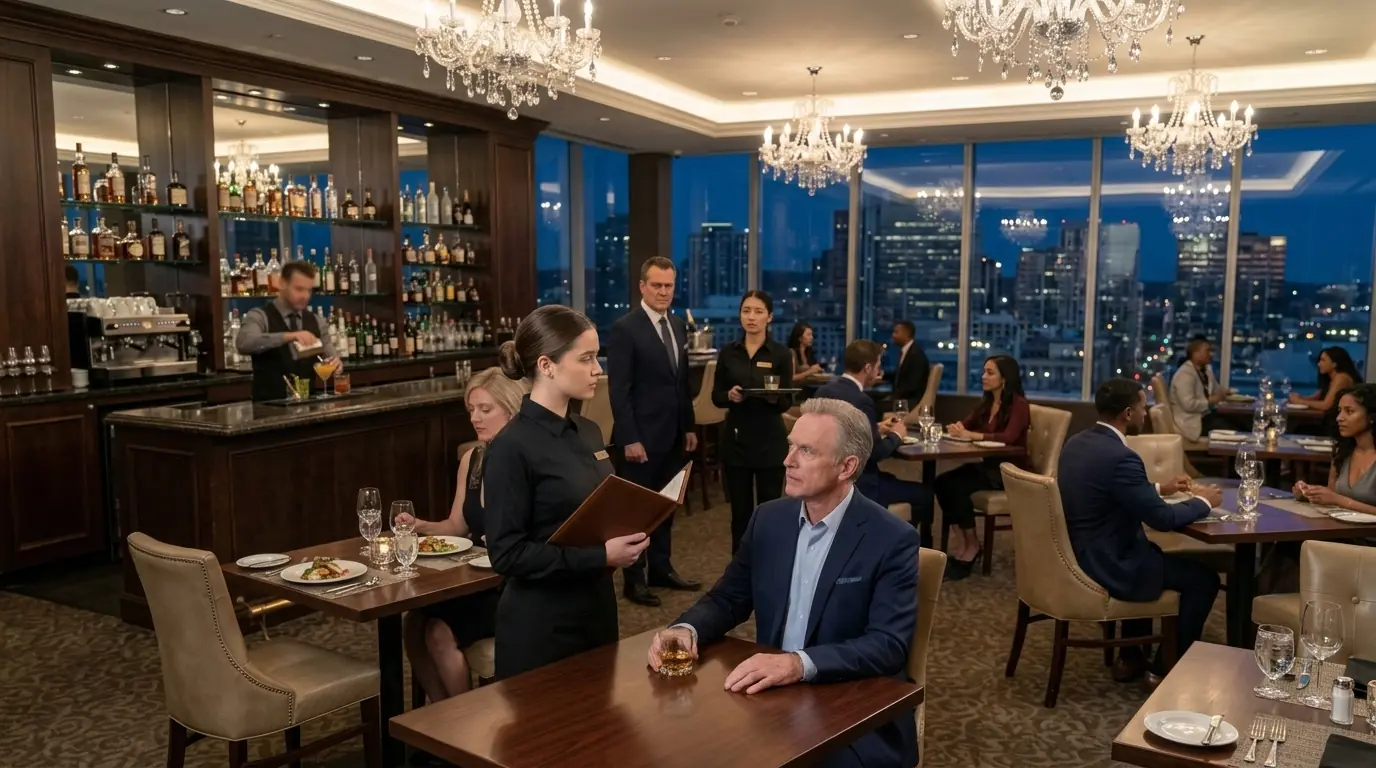
They all knew the rules: never make eye contact, never speak unless spoken to, and never ever challenge him. Then a new waitress, Sophia Rossi, started her shift completely unaware of the legend. And when she looked the monster right in the eye and refused to break, she unknowingly lit a fuse that would expose a secret so devastating it would change everything.
The Gilded Spoon wasn't just a restaurant. It was a theater. Every night a performance of wealth and status played out under the warm glow of crystal chandeliers. Its patrons were the city's elite old-money scions, tech moguls, and the politicians who courted them.
Its staff were seasoned professionals trained to be unobtrusive ghosts who anticipated every need before it was voiced. They moved with a synchronized silent grace, their faces placid masks of impeccable service. But on Tuesday evenings a different kind of performance took place, a one-man show of intimidation, and the entire staff became its unwilling, trembling audience.
Tuesday was Mr. Blackwood's night, Alistair Blackwood. The name was spoken in hushed tones in the kitchen, a verbal curse that seemed to cool the air. He was a titan of industry, a man who had built a global logistics empire from the ground up. His face, etched with severe lines and framed by steel-gray hair, often graced the covers of business magazines.
But in the hushed carpeted corridors of The Gilded Spoon, he wasn't a titan. He was a terror. Stories about him were the restaurant's own grim folklore. There was the tale of the sommelier he'd had fired on the spot for recommending a wine that was, in Blackwood's opinion, presumptuous.
There was the young busboy who'd accidentally spilled a single drop of water on the tablecloth and was met with a glare so withering he'd quit midshift. The fear was primal. When his polished black Rolls-Royce would pull up to the curb, a wave of silent panic would ripple through the establishment. The host, Gregory, a man who'd once stared down a charging bull in Pamplona, would visibly pale.
Senior waiters would suddenly find urgent tasks in the wine cellar. Junior staff would become intensely interested in polishing already gleaming silverware in the back. The unenviable task of serving him fell to whoever drew the short straw. It was a grim ritual overseen by the floor manager, Mr. Peterson.
Into this den of carefully managed anxiety walked Sophia Rossi. Sophia was new, not just to The Gilded Spoon, but to this level of dining. She was 24, with eyes the color of warm honey that held a fire of determination. Her life had been a series of hard knocks and sidesteps.
She was working two jobs to put her younger sister Maya through community college while also helping to manage the growing pile of medical bills for their mother who was battling a chronic illness. For Sophia, this job wasn't about prestige. It was about survival. It paid better than any place she'd ever worked, and she was determined to excel to become one of those seamless professional ghosts.
She'd spent her first week in a daze of learning, memorizing the dizzying wine list, the precise placement of seven different forks, and the subtle social cues of the fabulously wealthy. She hadn't yet been indoctrinated into the cult of fear surrounding Alistair Blackwood. Her training had focused on menus and protocol, not the psychological profiles of problem patrons.
On her second Tuesday, the short straw was metaphorically handed to her. The designated waiter for Blackwood's usual corner booth, a secluded alcove offering privacy and a panoramic view of the city, had called in sick with a sudden violent stomach flu that everyone knew was a diplomatic fiction. Mr. Peterson, his face tight with stress, scanned the floor. His eyes, desperate, landed on Sophia.
She was polishing glasses behind the bar, her movements quick and efficient. "Rossi," Peterson said, his voice low and urgent. "You're up."
"Up for what, Mr. Peterson?" she asked, setting a crystal flute down with care.
"Table 7. Mr. Blackwood." The name meant nothing to her.
"Okay. Any allergies or preferences I should know about?" A nervous laugh escaped a nearby waiter, which he quickly stifled into a cough when Peterson shot him a death glare. "Just be perfect," Peterson whispered, his eyes wide.
"Don't make conversation. Don't offer suggestions unless he asks. Your name is waitress. Your opinion is none.
Do you understand? Be quick. Be quiet. Be gone."
The intensity of the warning was strange, but Sophia simply nodded. She'd dealt with difficult customers before. How bad could one man be? She straightened her black apron, took a deep breath, and grabbed a leather-bound menu.
As she approached table 7, she felt the ambient energy of the dining room shift. It was as if a hundred conversations had simultaneously lowered in volume. The other servers moved with a new stilted caution, their eyes darting towards her, then away like frightened birds. She could feel their collective gaze on her back, a heavy cloak of shared dread.
He was already seated, staring out the vast window at the glittering city below. He didn't look up as she approached. He was a man built on a large imposing scale, his bespoke navy suit fitting his broad shoulders perfectly. A half-empty glass of what looked like scotch sat by his hand.
"Good evening, sir," Sophia said, her voice clear and steady. "Welcome to The Gilded Spoon. May I present you with the menu?" Alistair Blackwood turned his head slowly.
His eyes, a startlingly pale, icy blue, scanned her from head to toe. It wasn't a leer. It was an appraisal, cold and dismissive, as if he were inspecting a piece of furniture for flaws. He said nothing.
The silence stretched thick and uncomfortable. Sophia held his gaze, refusing to be the first to look away. She'd been taught that direct eye contact was a sign of confidence and sincerity. Peterson's warning echoed in her head, but instinct took over.
Cowering felt like a form of dishonesty. Finally, with a soft grunt, he gestured curtly at the table. "Leave it." Sophia placed the menu down.
"Can I get you another scotch while you decide?" He picked up his glass, swirled the amber liquid, and took a slow sip, his eyes never leaving hers. "You're new," he stated. It wasn't a question.
"Yes, sir. My second week." "They're letting novices handle this table now?" he asked, a subtle, cutting disdain in his tone.
"Standards must be slipping." Sophia felt a flash of heat rise in her cheeks, but she suppressed it. She thought of her mother's prescription costs. She thought of Maya's tuition payment due next month.