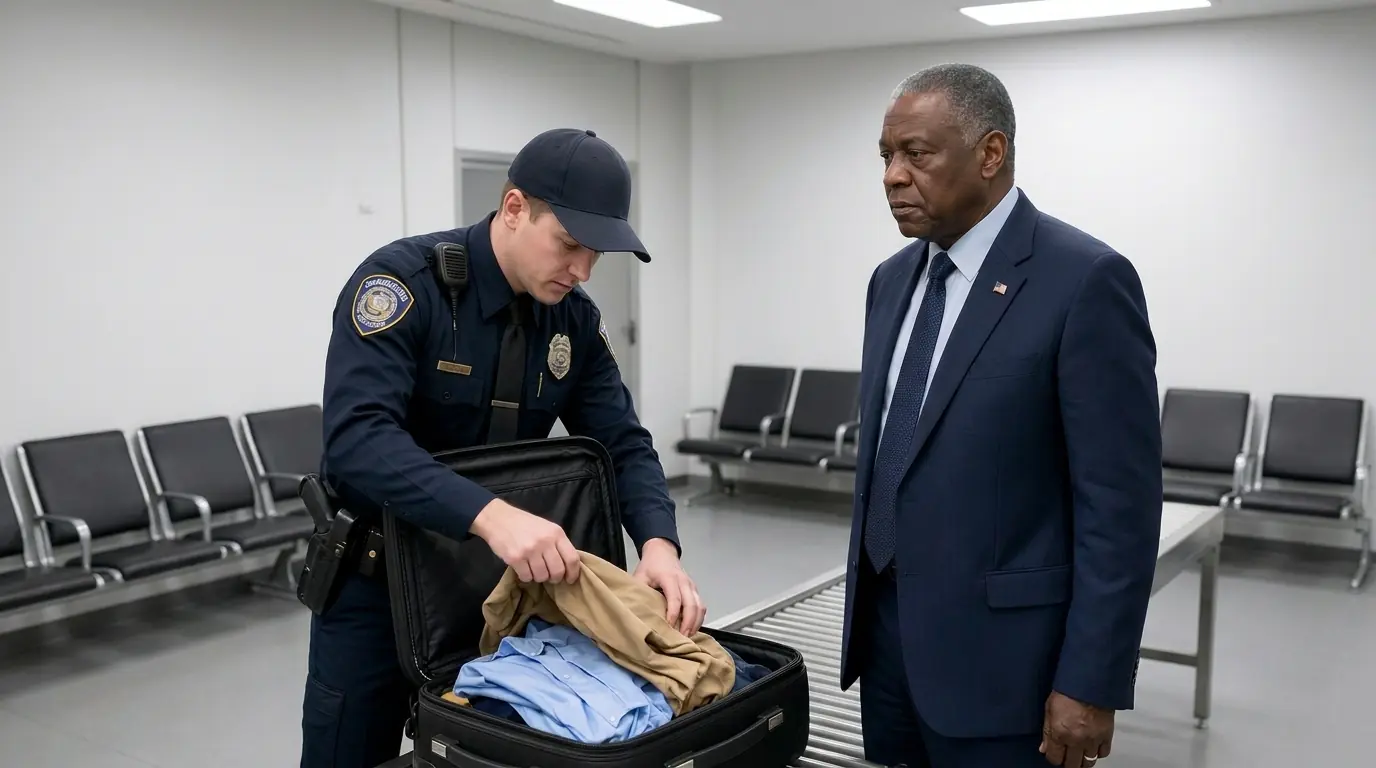
Officer Brent Larkin was still holding the little evidence pouch when I closed my suitcase and told him I was not worried about missing my flight. He gave me the same thin smile he had been wearing since he pulled me out of the priority line and said, “You should be worried about a lot more than a flight right now.” I looked at the clear packet in his gloved hand, then at the security camera above his shoulder, and answered, “That’s probably true.” What Brent did not know was that I had never bought a ticket to anywhere.
My name is Raymond Cole, and I was sixty-two years old when I walked into Carolina Gateway International Airport outside Charlotte carrying a dark leather suitcase that had been inspected, photographed, weighed, sealed, and documented by federal investigators less than an hour earlier. I had spent thirty-four years in federal law enforcement, the last nine supervising complex misconduct investigations involving public officers, federal contractors, and transportation-security programs. That morning I wore khaki pants, an old navy blazer, and loafers my wife said made me look like a retired college professor. Nothing visible identified me as a senior special agent with the Department of Homeland Security Office of Inspector General.
That was intentional because for six weeks our team had been watching Checkpoint Four. Complaints from Black travelers described being pulled aside without explanation, searched longer than other passengers, questioned about expensive luggage, challenged over business-class tickets, and sometimes accused of carrying prohibited items they insisted were not theirs. Most complaints ended the same way because the passenger either missed a flight, accepted whatever citation or seizure followed, or decided fighting an airport security officer would cost more time and money than they had. Then one mother refused to let the complaint disappear.
Her name was Monica Sanders, and her seventeen-year-old son Malik had spent eight months in juvenile detention after officers claimed they found a packet of narcotics inside the outer pocket of his carry-on bag. Malik had been flying home from his grandmother’s funeral in North Carolina when Brent stopped him near the same checkpoint and asked how a teenager wearing a discount-store hoodie had purchased a premium boarding pass. Malik explained that his aunt had used airline miles, but Brent searched his bag anyway and claimed he found drugs inside a zipper compartment. Malik insisted from the first minute that the packet was not his, and nobody at the airport treated that denial as information worth investigating.
The prosecutor eventually dismissed the case after laboratory and chain-of-custody problems made the evidence impossible to defend, but by then Malik had lost most of his junior year. He returned home thinner, quieter, and unwilling to enter crowded buildings without checking every exit first, while Monica began requesting airport footage, officer histories, screening records, and internal complaint files. She discovered that sections of the checkpoint video covering Malik’s encounter had been labeled corrupted and later overwritten. When she asked why, airport officials told her retention failures sometimes happened and encouraged her to consider the matter closed because the criminal charge was gone.
Monica did not close it. She found three other Black travelers online who described Brent making nearly identical comments about whether they belonged in the priority lane, and one man said Brent seemed unusually interested in the outside pockets of his luggage before another officer suddenly “discovered” a small packet inside. That information reached a civil-rights attorney, who compared the reports and sent a detailed referral to our office. Six weeks later, I entered Checkpoint Four carrying a bag designed to give Brent every opportunity to make his own decision.
The plan was simple because good investigations usually are. We did not tell Brent whom to stop, where to search, what to say, or what outcome we wanted, and we did not place contraband in my suitcase or create a fake violation for him to discover. Two independent investigators documented every compartment before I entered the terminal, and a controlled chain of custody established exactly what was inside. My job was merely to walk through the checkpoint as an ordinary Black traveler and respond lawfully to whatever happened next.
Agent Nicole Ramsey stood twelve people behind me wearing jeans, a university sweatshirt, and headphones around her neck. Special Agent Daniel Cho sat near a charging station pretending to argue with an airline reservation app, while investigator Luis Mendoza had been temporarily assigned behind the secondary-screening desk under an approved joint operation. Nobody knew whether Brent would even notice me that morning. We had learned enough during six weeks of observation to know he was far less interested in travelers who looked like Daniel.
The first twenty minutes proved nothing. A white businessman carrying a Tumi suitcase walked through with two laptops and joked with Brent about the Panthers, while an older white woman forgot a bottle of water and received a friendly reminder before being allowed to step back and throw it away. A Black nurse in blue scrubs was pulled aside and asked whether the designer handbag on her shoulder belonged to her, though she was released after showing a receipt on her phone. Brent never asked the white businessman for proof that his suitcase belonged to him.
Then I joined the priority lane. Brent looked first at my face, then at the gold stripe printed across my boarding document, and asked, “You sure you’re supposed to be over here?” I told him the boarding pass said priority security, and he answered that people sometimes wandered into the wrong line because they saw shorter traffic. When I offered to let him scan the pass, he said, “We’ll get to that.”
The scanner accepted it immediately. Brent looked at the screen, then at me, and said the airline system had been making mistakes recently. I asked whether my pass showed a problem, and he replied, “Not necessarily, but guys come through here using somebody else’s points, somebody else’s card, somebody else’s bag, and suddenly everything is supposed to be normal.” He emphasized the word guys while looking directly at me.
I asked what made him think anything I carried belonged to someone else. Brent smiled and said, “Experience.” A white man behind me shifted uncomfortably, but nobody spoke. Brent pointed toward the secondary table and said, “Let’s see what experience tells us today.”
I moved where he instructed. He asked what I did for work, where I was traveling, who purchased my ticket, why I carried an expensive leather suitcase, and whether anyone had given me anything before I entered the airport. Some of those questions can be entirely legitimate during actual security screening, which is why I answered calmly and never tried to turn an unpleasant conversation into evidence of misconduct by itself. What mattered was the way Brent kept attaching suspicion to facts that had already been verified.
I told him I worked in consulting. He asked what kind, then laughed softly when I said compliance and told me, “Everybody’s a consultant when they don’t want to say where the money comes from.” When I asked whether my employment related to the search, he replied that honest passengers usually did not become defensive. I had not raised my voice once.
Brent opened my suitcase while another officer named Tyler Mason watched from several feet away. Shirts, socks, a shaving kit, two paperback books, and an empty document folio were packed exactly where our evidence photographs showed them. Brent pushed through everything quickly, then stopped at the exterior side pocket. His body shifted enough to block Tyler’s direct view.
From where I stood, I saw Brent’s right hand move beneath the edge of the counter. It disappeared for less than two seconds and returned closed, while his left hand kept the suitcase pocket open. Then his right hand entered the pocket.
I did not react. That was one of the hardest things I had done in years because I knew what I had just seen, and I also knew any movement from me could become the excuse he had been waiting for. Luis Mendoza saw it from behind the desk. Two fixed cameras recorded the angle from opposite directions.
Brent withdrew his hand and pretended to continue searching. A few seconds later, he reached back into the same pocket with more exaggerated care and pulled out a small sealed packet containing white powder. His expression became almost theatrical. “Well, well,” he said, holding it up between two fingers.
Tyler Mason stepped closer. “Where was that?” Brent answered that it had been hidden deep inside the side pocket. I said, “That did not come from my suitcase.” Brent laughed and told Tyler, “They always say that.”
The word they hung there. Tyler glanced at me but said nothing. Brent placed the packet into an evidence pouch and asked whether I still wanted to claim the bag was mine.
“I do,” I answered. Brent smiled and said, “Interesting choice.” I told him claiming my own property was not the same thing as claiming something another person had placed inside it.
His eyes narrowed. “You accusing me of planting drugs?” I said, “I’m telling you the packet was not in that suitcase when I entered this checkpoint.” Brent stepped closer and said I should think carefully before making allegations against an airport police officer.
A few travelers had stopped walking. Brent seemed to enjoy the audience and raised his voice enough for people behind the rope line to hear that I had been caught carrying suspected narcotics through a secure checkpoint. Then he told me I would be detained while the airport police narcotics unit was called. I asked him to preserve the suitcase exactly as it was, including all checkpoint video and his body camera.
That request changed his expression. “You giving me instructions now?” he asked, and I answered that I was making a request about evidence connected to my detention. Brent said I had watched too many television shows.
Then he reached for my wrist. Before he touched me, I said, “Officer Larkin, I suggest you leave the suitcase open.” He laughed and asked why.
I closed the case myself without moving anything inside. “Because I didn’t come here to catch a flight,” I said. Brent stared at me.
Nicole Ramsey stepped out of the line and removed her sweatshirt jacket. A federal credential hung from her neck. Daniel Cho stood from the charging station and opened his own badge wallet.
Brent’s face lost color. Luis came around the screening desk holding another credential. Tyler Mason took one full step away from his partner.
“What is this?” Brent asked. I opened my jacket and showed him the federal identification he had never thought to request. “A six-week integrity investigation,” I answered.
For several seconds, Brent simply stared. Then he looked at Nicole, Daniel, Luis, and the cameras above us. “You set me up.”
I shook my head. “Nobody made you touch that suitcase.” Brent looked toward the packet in his hand as though it had suddenly become radioactive.
Luis instructed Tyler not to touch the evidence pouch. Nicole called the supervisory team waiting outside the checkpoint, and Daniel began securing the documented chain-of-custody materials showing exactly what had been inside my luggage before I entered the terminal. Brent kept repeating that somebody was misunderstanding what happened. Nobody argued with him.
Instead, Luis placed a tablet on the inspection counter. The first video showed Brent stopping a Black businessman named Andre Lewis three weeks earlier and directing him toward the same secondary station. Brent watched himself angle his body away from another officer before searching the traveler’s side pocket.
The second video showed a Black college student. The third showed a retired postal worker. The fourth showed a young woman returning from a nursing conference.
Different people. Different bags. Same officer.
The same half-turn toward the counter. The same right hand disappearing below the work surface. The same sudden discovery seconds later.
Brent looked at the tablet and whispered, “Those videos don’t prove anything.” I told him he was correct that a pattern alone did not establish every allegation. That was why we had brought a suitcase whose contents were independently documented before he touched it.
Nicole changed the screen. Malik Sanders appeared in the next photograph wearing a gray detention jumpsuit and standing beside his public defender outside juvenile court. His mother was several feet behind him.
Brent looked away.
I said, “He was seventeen.” Brent’s jaw tightened.
I continued, “He spent eight months detained because you reported finding narcotics in his backpack.” Brent said Malik’s case had been dismissed and that I was trying to use a bad prosecution to make him responsible for the court system.
“You wrote the report,” I said. Brent answered, “I found what was there.”
Luis displayed another clip. It came from a camera investigators had recovered from an older airport backup system after Monica’s attorney identified the missing time window. The image quality was poor, but Brent’s movement beside Malik’s backpack was unmistakably similar.
Brent stopped talking.
Nicole asked who supplied the packets. He said nothing.
I asked again.
Finally, he looked past us toward a frosted-glass office at the end of the checkpoint corridor. Gold lettering on the door read DIRECTOR OF AIRPORT SECURITY — WARREN DALTON.
“You don’t understand,” Brent whispered. I followed his eyes.
“No,” I said. “But I think you’re about to help us.”
Warren Dalton was fifty-eight, white, silver-haired, and had spent thirty-one years in law enforcement before becoming security director at Carolina Gateway. His photograph appeared in airport newsletters beside mayors, governors, airline executives, and federal transportation officials, and his biography described him as a nationally respected authority on interdiction strategy. Under his leadership, airport police had doubled narcotics seizures and increased what the airport authority proudly called proactive passenger interventions. Nobody had examined closely enough who was being intervened upon.
Our team had. During the six-week review, Black passengers represented roughly nineteen percent of travelers moving through the monitored checkpoint during sampled periods but nearly sixty percent of discretionary secondary police contacts initiated by Brent’s unit. Numbers alone did not prove racial discrimination because behavior, intelligence reports, travel patterns, and actual calls could affect lawful screening decisions. What demanded explanation was how often those contacts began with remarks about clothing, luggage, ticket class, neighborhoods, employment, or whether somebody “looked like” a business traveler.
One officer wrote that a Black software engineer appeared suspicious because his designer backpack was “inconsistent with presentation.” Another report described a Black grandmother carrying $4,600 for a family wedding as possessing cash “unusual for passenger type.” A third said a twenty-two-year-old Black Army reservist wearing sweatpants did not “match first-class profile.” None of those phrases appeared in reports involving comparable white travelers during the same review period.
Dalton had defended the pattern before knowing about our operation. During an earlier records interview, he told auditors that experienced officers developed instincts impossible to reduce to statistics. He said, “If you police an airport long enough, you know who doesn’t fit the travel they’re claiming.” When asked what fit meant, he talked for six minutes without defining it.
Now federal supervisors approached his office while Brent stood beside the suitcase. The door was locked. Airport administration confirmed Dalton should have been working inside.
Luis called him. No answer.
A camera near the employee hallway showed Dalton leaving his office less than three minutes after Nicole revealed her badge. He entered an elevator leading to the parking structure with a laptop bag under his arm. That did not prove guilt.
Running from a building is not automatically a confession. Neither is carrying your own computer. But timing can become evidence when other facts join it.
Federal agents met Dalton near the parking exit before his vehicle left the garage. They did not tackle him or drag him back through the terminal. They informed him of the investigation, preserved his airport-issued devices under the authority already obtained, and told him counsel could be present for questioning.
Dalton immediately demanded to know what Brent had said. Nobody answered.
That question interested investigators.
Brent was placed on administrative leave and separated from the other officers. Before formal questioning, he requested a lawyer and union representative. Both were provided.
For nearly six hours he denied planting anything. He claimed the movement beneath the counter came from changing gloves, disposing of swabs, or retrieving approved screening tools. Investigators let him explain each video separately.
Then they showed him mine.
Two camera angles captured his hand clearly enough. One showed him removing a small object from a recessed space beneath the counter and closing his fingers around it. The second showed the same hand entering my previously empty side pocket.
Brent stopped explaining.
His attorney asked for a break.
When the interview resumed, Brent said he had been following a security initiative developed by Dalton. He claimed officers were instructed to make high-value narcotics interceptions because federal grant funding and airport budget allocations increasingly depended on measurable interdiction numbers. Investigators asked whether the initiative included planting drugs.
Brent said, “Not officially.” Nobody in the room needed the qualification explained.
Dalton allegedly called fabricated discoveries “controlled pressure cases.” According to Brent, he started by encouraging officers to stop people who would be unlikely to challenge the process successfully. Travelers alone.
Young passengers. People with cash.
People who looked nervous. People who looked, in Dalton’s words, “socially disposable.”
When investigators asked what that meant in practice, Brent stared at the table. Finally he said, “Mostly Black passengers.” The room became very quiet.
He tried to distance himself immediately. Dalton had chosen the profiles, he said. Dalton supplied the packets.
Dalton told officers which surveillance cameras were least reliable. Dalton controlled complaint reviews and could make footage disappear.
I asked one question. “Who put the packet in my suitcase?”
Brent looked at me.
“I did.”
That answer mattered more than everything he said about Dalton. Orders could explain a system. They could not erase the person who moved his hand.
Brent agreed to cooperate after prosecutors became involved. His account led investigators to a secured storage room used for training materials, surrendered contraband, and temporary evidence awaiting transfer. Inventory irregularities reached back nearly four years.
Some packages were missing. Others contained weights that did not match older records. Several evidence-control signatures appeared under employees who denied signing them.
The investigation widened beyond one checkpoint.
Dalton had created a unit called the Passenger Interdiction Initiative three years earlier. Publicly, it focused on narcotics, human trafficking, weapons, and cash smuggling. Internally, officers received monthly rankings based partly on stops, seizures, arrests, and “actionable contacts.”