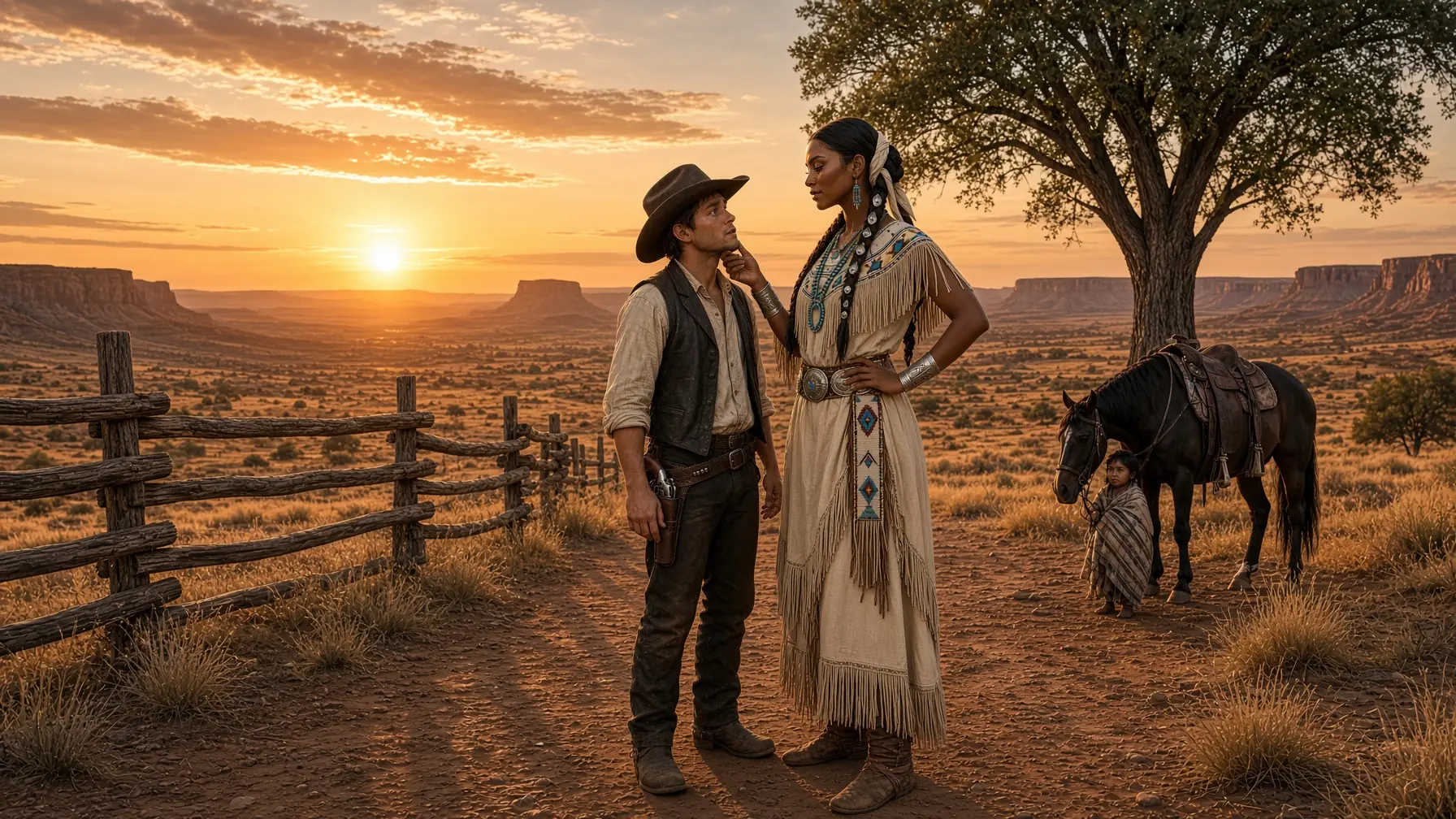
The desert wind rolled low across the New Mexico plains, carrying dust, silence, and secrets that had slept beneath the red earth for generations. Eli Carter stood alone near the fence line of his small ranch, hands rough from work, heart untouched by anything but the land. At 27, he was known across nearby settlements as a quiet man, too quiet for some, strange for others. He had never touched a woman, never shared a bed, never tasted the kind of life men whispered about in saloons. His world was cattle, sky, sweat, and prayer.
That evening, as the sun bled gold into the horizon, Eli noticed movement near the old cottonwood by the dry creek. A horse emerged first, slow and careful, then a woman, tall, proud, and wounded in ways that could not be seen at a distance. She was Apache. Her dark braids moved gently with the wind, and wrapped against her chest was a small child, barely 2 years old. Eli's hand drifted instinctively toward the rifle slung over the fence, not in fear, but habit.
Then he stopped. The woman did not carry a weapon. Her eyes met his across the space between them, and something ancient passed silently through the air. She took one step forward, then another, until she stood just beyond the fence, her posture strong, but tired, as if the road had taken more from her than she was willing to admit. The child stirred, pressing his face against her shoulder.
Eli cleared his throat, words failing him. He had never spoken to a woman like this, never to an Apache woman, never to a mother whose gaze held both fire and grief. She spoke first, her voice low and steady, accented, but clear. She asked if this was his land. He nodded.
She said her name was Naya. She said she was a widow. She said nothing else for a moment, only looked at him as if measuring not his strength, but his soul. Then she whispered the words that would change his life forever: "My child needs a father."
Eli felt his breath leave him as if struck. He didn't understand at first. He stammered, tried to protest, but she raised her hand gently, silencing him. She told him she was not asking for passion, nor pity, nor coin. Her husband had died months earlier, killed in a skirmish with men who did not care if a woman carried a baby or not.
Her tribe had scattered. The land had become cruel, and the world, she said, was not kind to a child born into blood and loss. She had watched Eli from afar. She had seen how he treated his animals, how he spoke to the earth before dawn, how he never drank, never fought, never took what was not offered. She said such a man was rare.
Eli's heart pounded so loud he was sure she could hear it. He had never been needed like this, never been chosen. He tried to explain that he had no experience, that he was not a man women sought out, that he had lived his life alone by design. Naya listened without judgment. When he finished, she simply said that loneliness was not weakness, and purity was not shame.
She said a child did not need a perfect man, only a present one. The sun dipped lower, casting long shadows over the land as silence wrapped them both. The child began to cry softly. Eli moved before he thought, opening the gate, gesturing them inside. He offered water, shelter, food.
He told himself it was temporary, charity, kindness, nothing more. But when Naya stepped onto his land, something invisible crossed with her. That night, as the stars stretched wide above the ranch, Eli lay awake in his bed, listening to the unfamiliar sounds of another life under his roof. He heard the child breathe. He heard Naya hum a low Apache lullaby, haunting and beautiful.
And for the first time in his life, Eli felt fear, not of the world, but of what it might ask of him next. Over the following days, Naya stayed. She helped without being asked, rose before dawn, worked beside him with quiet strength. The child, whom she called Taza, began to follow Eli with wide, curious eyes. Eli felt awkward, unsure how to act, but the boy smiled at him, reached for his finger, laughed when Eli pretended to be stern.
The ranch no longer felt empty, yet whispers began to travel. Neighbors noticed smoke from Eli's chimney at night, noticed the Apache woman in his fields. Some warned him, others mocked him. A few threatened him. Eli said nothing.
He did not yet know what he was becoming, only that when Naya looked at him with that steady gaze, he felt seen in a way no one had ever seen him before. One night, as a storm rolled across the plains, thunder shaking the windows, Naya stood beside him in the doorway, watching lightning tear the sky open. She told him that storms reveal the truth of the land, what stands firm, and what washes away. Then she turned to him and said softly that the world would test him soon. Eli swallowed hard, knowing deep down she was right.
The storm outside was nothing compared to what was coming. The test came sooner than Eli expected. Three riders arrived at the ranch just after sunrise, dust-coated and armed, eyes sharp with suspicion and hate. They were men who believed the land belonged only to them, that kindness was weakness, and that an Apache woman had no place under a white man's roof. Eli stood between them and his home, heart pounding, but spine straight.
He had never faced violence head-on before, never drawn a line that could not be erased. The men demanded that he send the woman away, accused her of stealing, of witchcraft, of worse things they laughed about. Eli's hands shook, but his voice did not. He told them to leave. When one reached for his gun, Naya stepped forward, placing herself beside Eli, not behind him.
Her presence was calm, unyielding. She did not threaten. She did not beg. She simply looked at them as if they were already ghosts. The men hesitated.
Something in her eyes unsettled them. With curses and warnings, they rode away, promising they would return. That night, Eli confessed his fear. He told Naya he was not made for violence, that he had no desire to kill or dominate. Naya listened, then told him that strength was not the absence of fear, but the decision to stand anyway.
She said a father protects not only with fists or guns, but with presence, with sacrifice, with the courage to stay when leaving would be easier. Over time, Eli began to change. He learned how to hold Taza, how to soothe him, how to laugh freely. He learned Naya's stories, of her people, her husband, the love they had shared, and the grief she carried quietly each day. One evening, as they sat by the fire, Naya told Eli that she did not expect him to replace the dead.
She said love does not erase what came before. It grows beside it. Eli felt something break open inside him, something tender and terrifying. He realized that his virginity, his solitude, his untouched life had not been emptiness. It had been waiting.
Weeks later, the men returned, this time with more numbers, but Eli was not alone. Neighbors who had watched silently now stood with him. They had seen the change in him, the dignity in Naya, the joy in the child. When the dust settled, no shots were fired. The men left, knowing they were outnumbered by something stronger than guns, community, conviction, and love.
That night, under a sky thick with stars, Naya stood close to Eli. She told him she would leave if he wished, that she had never intended to trap him. Eli took her hand, his voice steady despite the tremor in his chest. He told her that a father was not someone who shared blood, but someone who shared life. He told her he wanted them to stay.
Tears slipped down Naya's face, not of sorrow, but of release. Months passed. The ranch flourished. Laughter replaced silence. Eli learned what it meant to be a man, not through conquest, but through care.
One morning, Taza called him father for the first time. Eli fell to his knees and cried, not ashamed. Years later, travelers would speak of the quiet rancher who became a legend, not by killing men, but by choosing love when the world expected hate, and the Apache widow who whispered a simple truth that changed three lives forever. "My child needs a father." And the man who listened became one.