The first time Addie Mercer saw the old John Deere, she did not notice the rust.
She noticed the dent.
It was barely visible from twenty feet away, a shallow crescent pressed into the left side of the hood just beneath the fading yellow stripe. Most of the farmers inside the Mercy County Auction Barn probably saw nothing more than another scar on a machine that had spent too many years outdoors.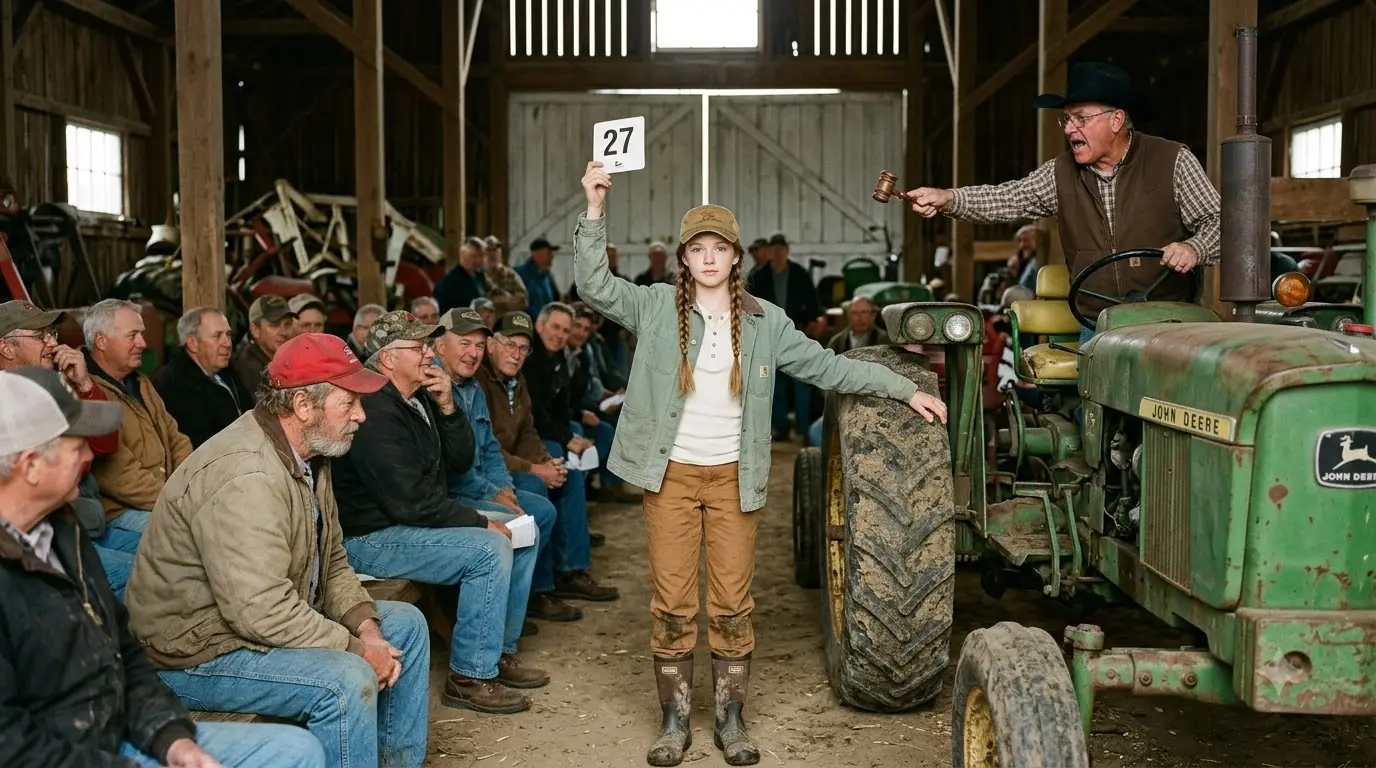
Addie stopped walking.
Her grandmother nearly bumped into her.
“What is it?”
Addie said nothing.
She stared at the tractor.
The barn around them was already filling with the Saturday auction crowd. Men in denim jackets and faded caps sat on rows of folding chairs, drinking coffee from paper cups while tractors, balers, plows, cultivators, and wagons waited beneath the timber rafters.
The old John Deere stood beside the auctioneer’s platform.
Its green paint had faded almost gray in places.
Rust climbed around the grille.
One rear fender was bent.
The seat had split so badly that yellow foam showed through.
A handwritten card hung from the steering wheel.
NON-RUNNER. UNKNOWN CONDITION. SOLD AS-IS.
Addie stepped closer.
Her grandmother, Ruth Mercer, followed.
Ruth was seventy-one, small and wiry, with silver hair tucked beneath a plain brown scarf and hands shaped by five decades of farm work. She had raised Addie for the last four years after Addie’s father died and her mother left Iowa to take a nursing job in Nebraska that paid enough to send money home but not enough to move the whole farm with her.
Ruth looked from the tractor to Addie.
“You know that machine?”
Addie swallowed.
“I think so.”
“You think so?”
Addie moved toward the hood.
The dent was still there.
Years earlier, when she was seven, her father Daniel Mercer had backed a hay wagon too sharply while turning beside their north barn. The wagon tongue had swung around and struck the tractor hood.
Daniel had stared at the dent for almost a minute.
Then Addie, terrified that he was angry, had whispered:
“Are you going to fix it?”
Daniel laughed.
“No.”
“Why?”
“So next time I get too proud, the tractor can remind me I’m not as good at backing wagons as I think.”
Addie remembered running her fingers over that dent afterward.
She remembered the exact shape.
Now the same crescent sat beneath her hand.
Her heart began beating faster.
“Grandma.”
Ruth looked concerned.
“What?”
“I think this was Dad’s.”
Ruth stared at the tractor.
“No.”
“I’m serious.”
“Daniel’s Deere went away six years ago.”
“I know.”
“It was sold.”
“I know.”
“Some equipment broker bought it.”
“I know.”
Ruth stepped closer.
Her face changed.
The Deere had once been the most valuable machine on the Mercer farm.
Daniel bought it used before Addie was born. It had already been old then, but he rebuilt nearly everything that mattered over the years.
Transmission.
Hydraulics.
Electrical system.
Cooling system.
Finally the engine.
Then drought hit.
Corn prices fell.
Daniel borrowed money to keep the farm going.
After his death from a sudden heart condition at thirty-nine, Ruth discovered how much debt remained.
They kept the land.
Barely.
Most machinery did not stay.
The Deere was one of the first things sold.
Addie had watched it leave on a flatbed.
She had cried behind the barn where Ruth could not see.
Now it was standing fifteen feet away.
Ruth whispered:
“It can’t be.”
Addie walked to the left side.
She crouched.
Mud and old grease covered the frame where the identification plate should have been.
She rubbed it with the cuff of her sleeve.
Nothing.
Too dirty.
She rubbed harder.
A few stamped characters began to appear.
Before she could clear them completely, a voice behind her said:
“You planning to crawl under it too?”
Several men laughed.
Addie turned.
Earl Tatum, the auctioneer, stood on the raised wooden platform holding a microphone in one hand and a small gavel in the other.
He was sixty-three, thick through the chest, with a black cowboy hat and brown vest over a white shirt. Earl had been selling farm equipment longer than Addie had been alive twice over, and his booming voice was familiar at nearly every county sale within fifty miles.
He smiled down at her.
“Careful, young lady. That thing’s probably got spiders older than you.”
More laughter.
Addie stood.
Ruth frowned.
“She’s looking.”
“I can see that.”
Earl pointed toward the chairs.
“Inspection’s almost done. We’re starting in five.”
Addie looked toward the identification plate again.
She needed to know.
Ruth saw it in her face.
“Go.”
Addie crouched again.
A man sitting nearby shook his head.
“Kid thinks she found treasure.”
Another replied:
“Probably saw one of those restoration videos.”
Addie ignored them.
She scraped grime away with the edge of an old plastic card from her pocket.
Numbers emerged.
Slowly.
She could not read all of them yet.
But enough appeared to make her stomach tighten.
4020D...
Her father’s tractor had been a diesel 4020.
That proved almost nothing.
Thousands existed.
She kept cleaning.
A farmer walked past.
“Wouldn’t bother, sweetheart. Motor’s locked.”
Addie looked up.
“You checked?”
“Earl said.”
“That wasn’t what I asked.”
The farmer laughed.
“Got some bite.”
He walked away.
Ruth came closer.
“Addie.”
“I need another minute.”
The barn microphone crackled.
Earl began welcoming bidders.
Addie stood reluctantly.
Ruth guided her toward the chairs.
They sat near the aisle.
Ruth carried bidder card 27.
The card was registered in Ruth’s name because Addie was twelve and obviously could not legally purchase heavy equipment herself. But Ruth had already told Addie she could raise it for small items if they agreed beforehand.
Their purpose that morning was simple.
Buy a cheap three-point cultivator.
Maybe a used blade.
Nothing more.
They had $2,400 available.
That money represented almost an entire year of careful saving.
Their current tractor, an old Ford 3000, still ran but its hydraulics were weak and the clutch slipped under heavy load.
A second tractor would help.
A major repair would hurt.
Ruth leaned toward Addie.
“If that is Daniel’s tractor, it does not mean we can buy it.”
“I know.”
“You hear me?”
“Yes.”
“We cannot spend emotion.”
“I know.”
Ruth watched her.
“You sound exactly like your father when you say that.”
Addie almost smiled.
The auction began.
Small equipment first.
Toolboxes.
Chains.
Shop equipment.
A portable welder.
Three manure spreaders.
Addie barely heard any of it.
She kept looking at the Deere.
The dent.
The bent right fender.
The rectangular patch near the side panel where Daniel had once welded a bracket.
Everything looked familiar.
But memory could lie.
She needed the serial number.
Lot twenty-three sold.
Twenty-four.
Twenty-five.
Then Earl lifted his gavel.
“All right, ladies and gentlemen, now we’ve got ourselves a conversation piece.”
Laughter began before he continued.
Earl pointed toward the Deere.
“Old John Deere 4020 diesel. Came out of county storage after a creditor seizure. Been sitting longer than anybody can document. We’ve got no verified running history and nobody here got it started.”
A man shouted:
“Because it’s dead!”
The barn laughed.
Earl grinned.
“Possibly.”
He continued.
“Sold strictly as-is, where-is. Loader not included. No guarantee on engine, transmission, hydraulics, brakes, marriage prospects, or spiritual condition.”
More laughter.
Addie looked at Ruth.
Ruth already knew.
“No.”
Addie whispered:
“We don’t know the price.”
“No.”
“Grandma.”
“No.”
“What if it starts at five hundred?”
“It won’t.”
“What if nobody wants it?”
“Somebody always wants parts.”
Earl began.
“Who gives me two thousand?”
Silence.
“Fifteen hundred?”
A machinery dealer raised his hand.
Earl pointed.
“Fifteen hundred.”
Another bidder lifted.
“Sixteen.”
The number rose.
Addie’s heart sank.
Seventeen hundred.
Eighteen.
Then silence.
Earl searched the room.
“Eighteen hundred. Anybody nineteen?”
Addie stared at the tractor.
Ruth watched her.
“No.”