Walter Hayes had spent seventy-eight years learning how to leave places.
Some departures were easy.
His childhood home in western North Carolina had been a sagging farmhouse with a roof that leaked every spring. When Walter left at eighteen, he carried one suitcase and enough excitement to make the cracked front porch look smaller than it had ever seemed before.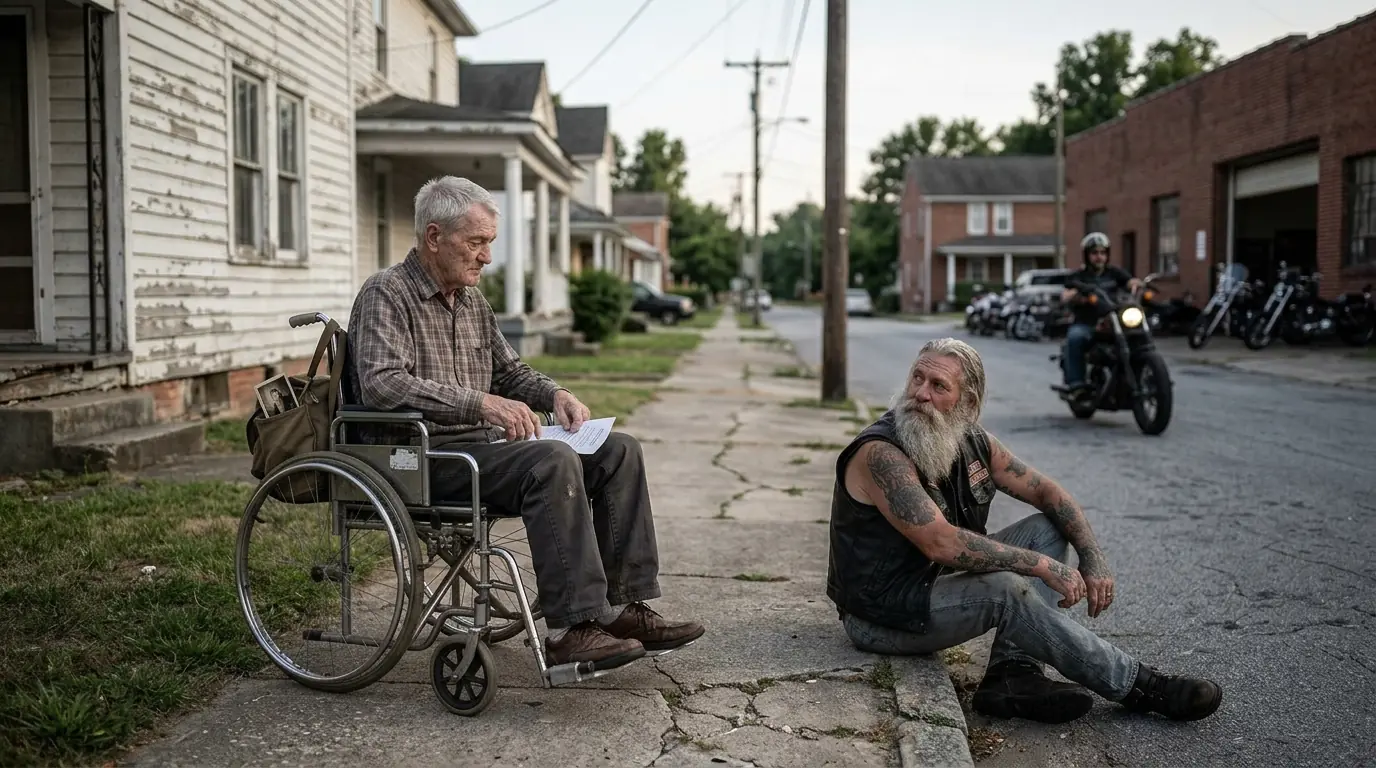
Other departures were harder.
He remembered leaving his first apartment after marrying Ruth. They had lived there only eleven months, but she cried while packing the dishes because it had been the first place where they had ever closed a door and understood that everything behind it belonged to the two of them.
Then there were departures no one prepared you for.
Hospital rooms.
Funeral homes.
A bedroom after the person who slept beside you for fifty-three years stopped coming back to it.
And now this.
Walter sat in his wheelchair at the edge of the sidewalk on Chestnut Lane in Asheville, staring at the house that had been his for thirty-seven years.
The white paint peeled from the siding.
One porch column leaned slightly.
A shutter hung crooked upstairs.
The roof needed work.
The front steps had become difficult long before Walter admitted he needed a ramp.
It was not beautiful.
But Ruth had planted roses beneath the kitchen window.
Their son David had once thrown a baseball through the upstairs glass and tried to blame a bird.
Their daughter Melissa had learned to ride a bicycle on the sidewalk.
Walter had repaired the porch three times.
Ruth had painted the dining room four colors before finally deciding the first one had been right.
Every board, crack and stain carried something.
Now a bank representative had placed a lockbox on the front door.
Walter had been given until six that evening to remove what remained.
It was 4:17.
Most of his belongings were already gone.
Not because he had somewhere to put them.
Because he had sold them.
Dining table.
Tools.
Lawn mower.
Ruth’s china cabinet.
Television.
The old Ford.
Anything worth enough to delay the inevitable.
The rest had been donated.
Walter kept one duffel bag.
Clothes.
Medication.
Toiletries.
A small framed photograph of Ruth.
A file containing discharge papers from a military career he rarely discussed.
A pocket Bible Ruth had given him in 1968.
And two letters from his children.
David lived in Oregon and had health problems of his own.
Melissa lived in Florida and was raising two grandchildren after her daughter died.
They had both offered to take Walter.
He refused.
Partly pride.
Partly logistics.
Mostly because he knew their lives were already carrying more weight than they admitted.
Walter told them he had arranged something locally.
That was a lie.
He told himself he would figure it out before sunset.
That was another.
The left front wheel of his chair slipped into a broken seam in the sidewalk.
Walter pushed.
Nothing.
He adjusted his hands and tried again.
His fingers hurt.
Arthritis.
His shoulders were weaker than they had been a year earlier.
The wheel stayed trapped.
Walter sighed.
“Come on.”
He rocked the chair.
The wheel moved half an inch.
Then dropped back.
Across the street stood Asheville Ironworks Motorcycle Shop.
Walter had watched the place for years.
Brick building.
Wide front windows.
Usually six or seven motorcycles parked outside.
Sometimes twenty.
On weekends, more.
Men and women in leather came and went.
Some loud.
Some quiet.
Walter had never spoken to any of them.
Ruth had.
Of course she had.
Ruth spoke to everybody.
She once took a plate of lemon bars across the street after seeing several riders working late.
Walter told her:
“You don't even know those people.”
Ruth replied:
“Then they won't know to avoid my cooking yet.”
She returned an hour later with an empty plate and three new names.
That was Ruth.
Walter looked toward the shop.
He hoped nobody noticed him struggling.
Someone did.
Ray Callahan was standing near the entrance when he saw the old man's wheelchair catch.
Ray was sixty years old and looked older from a distance.
Long gray hair.
Huge gray beard.
Broad shoulders.
Tattooed arms.
Black leather vest faded nearly charcoal from years of weather.
Heavy boots.
He was carrying a motorcycle carburetor in one hand.
Ray stopped.
Watched Walter try again.
Then set the carburetor on a workbench outside the door.
He crossed the street.
Walter heard boots behind him.
He turned.
Ray raised one hand.
“Need a little push?”
Walter immediately answered:
“No.”
Ray looked at the trapped wheel.
“Good.”
Walter frowned.
“Good?”
“Means I can help without ruining your independence.”
Walter almost smiled.
Almost.
Ray stepped behind the chair.
“Okay if I touch it?”
Walter looked at him.
That question mattered more than Ray probably knew.
Most people simply grabbed wheelchair handles.
As though the chair erased the person inside it.
Walter nodded.
“Go ahead.”
Ray tilted the chair slightly.
The wheel lifted free.
He moved Walter onto level concrete.
Then immediately took his hands away.
“There.”
Walter looked toward the broken seam.
“Thank you.”
“Sure.”
Ray glanced at the duffel hanging from the back.
Then toward the house.
The lockbox on the door.
The empty windows.
An eviction notice folded on Walter’s lap.
Ray did not need a degree to understand the outline.
He also knew better than to ask the wrong way.
“So.”
he said.
“Moving day?”
Walter looked toward the house.
“Something like that.”
Ray waited.
Walter hated silence when someone used it kindly.
It created room.
Room made honesty dangerous.
Ray nodded toward the street.
“Family coming?”
Walter looked down.
“No.”
“Friend?”
“No.”
“Moving company?”
Walter laughed softly.
“I don't have enough left to need one.”
Ray's expression changed.
Not pity.
Walter would have hated pity.
Something quieter.
Concern.
“Where you staying tonight?”
Walter did not answer.
Ray looked toward the declining sun.
Then back.
“That bad?”
Walter rubbed the edge of the paper on his lap.
“My wife died two years ago.”
Ray remained still.
“Sorry.”
“Thank you.”
“Long marriage?”
“Fifty-three years.”
Ray whistled softly.
“That's a sentence.”
Walter smiled faintly.
“She'd say it was a life sentence.”
Ray laughed once.
Walter continued before he could stop himself.
“Cancer.”
“Three years.”
“Most of our savings went with treatment.”
Ray's smile disappeared.
“Insurance?”
“Covered enough to keep us hopeful.”
“Not enough to keep us solvent.”
Walter hated how bitter that sounded.
He looked toward the house.
“After she died, I tried catching up.”
“Mortgage modification.”
“Taxes.”
“Medical debt.”
“Then I fell.”
Ray looked at the wheelchair.
“Hip?”
“Spine.”
“Partial damage.”
“Some days I can stand.”
“Some days I'm smarter not to.”
Ray nodded.
Walter continued.
“I sold everything worth selling.”
“The house went anyway.”
Ray said nothing.
Walter looked at the duffel.
Then the lockbox.
Then finally at Ray.
“I lost everything.”
The words came out quietly.
No dramatic breakdown.
No tears.
They were too tired for that.
Just four words.
A statement.
Ray looked toward the house.
Then sat down on the curb.
Walter frowned.
“You don't need to—”
“I know.”
Ray positioned himself so they were almost eye level.
Not towering over him.
“What's your name?”
“Walter Hayes.”
“Ray Callahan.”
Walter glanced at the leather vest.
“I figured you had a name.”
Ray smiled.
“Most days.”
Walter looked toward the motorcycle shop.
“You work there?”
“Own it.”
“Really?”
“Unfortunately.”
“Doesn't look unfortunate.”
“You haven't seen the plumbing bill.”
Walter almost laughed.
Ray pointed toward the duffel.
“That everything?”
“Enough.”
“Medication in there?”