Blue and red lights exploded across Hawthorne Ridge Court just after nine on a humid Atlanta night. Sixteen-year-old Jordan Ellis was bent over the hood of a patrol cruiser with one arm twisted behind his back, his cheek pressed against warm metal that smelled faintly of rain and engine heat. 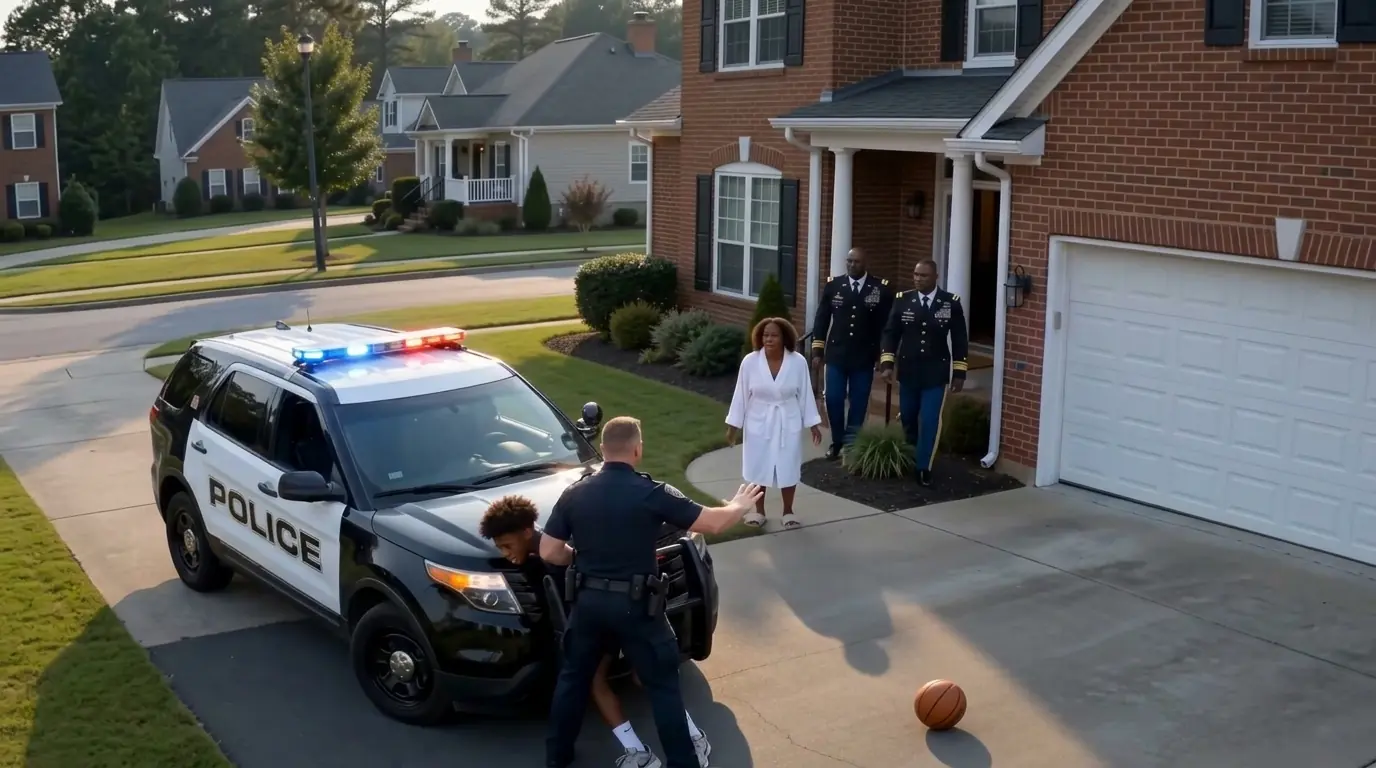
Officer Nolan Price stood behind him with one hand between the teenager’s shoulder blades while demanding identification as though a boy playing basketball in his own driveway had somehow become an emergency. Across the cul-de-sac, Douglas Harland watched from his driveway with his arms folded and the satisfied expression of a man seeing the machinery he had summoned finally begin to move.
Jordan’s mother, Denise Ellis, burst through her front door before the second cruiser had fully stopped. She was still wearing the loose house clothes she had changed into after work, and one slipper nearly came off as she ran across the lawn shouting that the boy lived there. Nolan told her to stay back without turning around, then pressed harder when Jordan tried to lift his face enough to breathe comfortably. Denise pointed toward the brass numbers beside the door and shouted, “His name is on the mailbox, his key is in his pocket, and you are standing in front of his house.”
Several neighbors had already come outside. Phones rose from porches and driveways, but people remained behind invisible boundaries created by fear, uncertainty, and years of learning that police encounters could become more dangerous when witnesses stepped too close. One woman started to say that Jordan belonged there, then stopped when Nolan looked toward her. Douglas Harland took a slow sip from an empty coffee mug and said quietly, “This is what happens when standards stop being enforced.”
Jordan tried to remember the breathing exercise his basketball coach taught before free throws. Four seconds in, hold, then release slowly. The rhythm disappeared under panic as Nolan pushed him more firmly against the cruiser. Jordan could hear his mother arguing, neighbors whispering, and Douglas speaking somewhere beyond them as though the entire scene confirmed something he had believed for years.
Then the front door of the Ellis house opened again. Two men stepped onto the porch, neither wearing a uniform, neither moving quickly, and neither appearing confused about what they were seeing. The taller man descended first, broad through the shoulders with close-cropped gray hair, while the second moved slightly behind him and guided Denise out of the direct line between the officers and Jordan. Something in their posture changed the energy of the street before either man said a word.
Officer Price noticed them and straightened. The taller man stopped several feet away with both hands visible and said, “Ease the pressure on the kid, because he can’t breathe correctly with your weight positioned like that.” Nolan told him to step back and warned that interfering with police activity could result in detention. The man did not move and answered, “Speaking to you from six feet away is not interference, and every phone on this street is going to show that.”
Twenty minutes earlier, none of those people had expected the evening to become memorable. Hawthorne Ridge Court was the kind of Atlanta subdivision built around trimmed lawns, beige mailboxes, decorative trees, and an homeowners association that treated uniformity almost like a civic religion. Jordan had spent most of the day shooting baskets in the driveway while Denise prepared dinner inside. To him, the steady bounce of the ball against blacktop was simply the sound of home.
A framed photograph of Jordan’s father stood on a shelf beside the dining room. Terrence Ellis wore a Marine dress uniform in the photograph, one hand resting lightly against Denise’s back while Jordan, still a toddler, stared toward the camera from his father’s arms. Terrence had died years earlier after injuries connected to his service, leaving Denise to raise their son in the house they had purchased together. She touched the photograph almost every morning, not because she expected answers from it, but because some habits become a way of continuing a conversation.
Douglas Harland lived directly across the street. At fifty-eight, he had served as Hawthorne Ridge HOA president for seven years and had slowly turned a volunteer neighborhood position into something closer to personal government. He issued warnings about trash cans, outdoor decorations, grass length, basketball hoops, driveway guests, fence stains, and any other detail that allowed him to remind people that his signature appeared beneath community rules. Residents called him organized when he was nearby and controlling after he walked away.
Douglas had disliked the Ellis family almost from the beginning. He never used the language clearly enough for anyone to quote him comfortably, but Denise recognized the pattern in the complaints that seemed to find her address more often than others. Jordan’s basketball was too loud, visiting cousins parked too long, the trash bin remained visible for an extra hour, and one birthday banner supposedly violated temporary-sign restrictions. Each incident looked small when separated from the others, which was precisely why Douglas preferred them that way.
That morning, Douglas stepped onto his porch carrying coffee and watched Jordan sink three shots in a row. A woman walking her dog passed near him and heard him mutter that certain families changed the character of a neighborhood. She looked down and continued walking because confronting Douglas usually meant discovering a violation notice in the mailbox two days later. From her kitchen window, Denise saw him watching Jordan and felt the familiar tightening in her stomach.
Jordan came inside for water around noon. Denise handed him a glass and told him not to wander far from home that evening, disguising the concern beneath a joke about wanting him nearby when dinner was ready. Jordan laughed and told her he had no plans to go anywhere because he wanted to work on his jump shot. Denise smiled, but her eyes moved toward the window where Douglas had been standing.
Later that afternoon, a dark gray sedan stopped in front of the Ellis house. Two men stepped out carrying a small black case and a thick sealed envelope, and Denise recognized one of them before he reached the porch. Aaron Mitchell had served with Terrence nearly two decades earlier, while Julian Foster had been a young captain when Terrence’s unit deployed overseas. Neither man had seen Jordan since he was a child.
Denise opened the door before they knocked. Aaron introduced himself anyway, then nodded toward Julian and said they had come to deliver something they should have brought years earlier. Inside the case rested a twisted fragment of shrapnel mounted against dark velvet, recovered from the blast that injured several members of Terrence’s unit. Julian placed it carefully on the dining table and told Jordan that his father had pulled Aaron behind a concrete barrier seconds before the second explosion.
Jordan stared at the metal. He had heard many stories about his father, but most came from his mother and relatives who remembered the man rather than the Marine. Aaron spoke differently, describing terrible coffee, endless rain, practical jokes, long nights, and the way Terrence could make frightened young men laugh when everybody needed the pressure to break. The memories made Jordan feel closer to someone he barely remembered and farther away at the same time.
Julian removed a heavy challenge coin from his pocket and placed it in Jordan’s palm. He explained that Terrence used to teach younger Marines a breathing rhythm whenever panic began narrowing their thinking. Jordan looked at the coin and said his basketball coach taught almost the same method. Aaron smiled and answered, “Your father probably stole it from somebody too.”
They laughed, and for a while the house felt lighter. Denise brought coffee, Aaron complained that hers was stronger than anything the Marines had served, and Julian handed her a sealed letter written years earlier by their commanding officer. Jordan listened to stories until his back straightened almost unconsciously. Outside, several neighbors noticed the unfamiliar sedan and began watching.
Douglas watched longest. He stood near the edge of his driveway pretending to check the irrigation controls while studying Aaron and Julian whenever they stepped near the porch. He did not know who they were, but their comfort around Denise bothered him because it made the Ellis house appear grounded rather than temporary. Control depended partly on making other people feel as though their place could always be reconsidered.
As evening approached, Aaron and Julian prepared to leave. Denise asked them to stay for dinner, and after pretending to refuse twice, both men accepted because Terrence had apparently taught them that saying no to food at the Ellis house was pointless. Douglas saw them remain after sunset and decided the visitors gave him the justification he had been waiting for. He stepped into his study, closed the blinds halfway, and picked up his phone.
His wife, Caroline, stood near the doorway with a glass of wine. She asked why he was pacing and told him the men across the street seemed perfectly polite. Douglas answered that politeness was not the issue because neighborhoods changed when people stopped protecting standards. Caroline stared at him for several seconds and said, “Jordan has lived across from us since elementary school.”
Douglas ignored her. Through the blinds, he could see Jordan outside again, bouncing the basketball near the hoop while Aaron and Julian talked with Denise on the back patio. He dialed emergency services and lowered his voice into the careful tone he used during HOA board meetings. When the dispatcher answered, Douglas said there was a suspicious young Black male loitering around a residence and claimed several neighbors felt unsafe.
The dispatcher asked whether the person was attempting to enter a house. Douglas said no. She asked whether he had threatened anyone, displayed a weapon, damaged property, or been seen committing a crime. Douglas answered no to each question, then added that the teenager simply did not appear to belong there and that unfamiliar adults had also been around the property.
The dispatcher asked for a physical description. Douglas described Jordan’s height, basketball shorts, dark T-shirt, and skin color while watching the boy take another shot. He did not tell her Jordan’s name. He did not tell her the teenager lived in the house directly across from his own.
Two cruisers entered Hawthorne Ridge Court less than twelve minutes later. Their lights painted every house in alternating blue and red, and people began stepping onto porches before the vehicles stopped. Douglas came outside carrying his coffee mug as though he had merely wandered into the scene rather than created it. Denise heard the engines through the kitchen window and immediately knew something was wrong.
Officer Nolan Price exited the lead cruiser. He was forty-two, physically imposing, and had spent more than a decade on patrol long enough to develop confidence without necessarily developing curiosity. His partner, Officer Ethan Shaw, came around the other side and rested one hand near his duty belt. Jordan stood beside the basketball hoop holding the ball against his hip.
Nolan approached quickly. “Hey, what are you doing here?” Jordan looked confused and answered that he was playing basketball. Nolan asked whether the property belonged to him, and Jordan said it was his house.
“Where’s your identification?” Nolan asked. Jordan explained that his wallet was inside and that his house key was in his pocket. Instead of checking the mailbox, asking a neighbor, or letting Jordan call his mother, Nolan stepped closer and told him not to get smart.
Jordan tried to explain again. Nolan seized his wrist. The basketball fell from Jordan’s other hand and rolled toward the gutter.
“Stop resisting,” Nolan shouted. Jordan had not resisted. The words arrived before the behavior they supposedly described.
Denise heard the shout and ran outside. She saw Nolan twisting Jordan’s arm and screamed for him to let go of her son. Nolan ordered her backward without releasing Jordan. Denise continued moving toward them.
Ethan stepped between her and the cruiser. Denise pointed toward the house and shouted that Jordan lived there, that his bedroom window was visible from where they stood, and that the officers could verify everything in seconds. Ethan looked toward the address beside the front door. Nolan did not.
Douglas remained across the street. A neighbor asked whether he had made the call. Douglas answered that somebody needed to protect the neighborhood.
Nolan pushed Jordan against the hood. The metal rattled beneath the teenager’s chest. Jordan cried out.
Denise lunged forward. Ethan blocked her again, but this time his expression showed discomfort rather than authority. “Ma’am, give us a minute.”
“You’ve already had a minute,” Denise shouted. “You’re hurting my child.” Nolan told Jordan to produce identification while keeping both of his hands restrained behind his back.
Jordan gasped that the identification was in the house. Nolan demanded to know why he did not have it on him. Jordan answered, “Because I came outside to play basketball.”
Several neighbors murmured. One man said everyone knew Jordan lived there. Another woman whispered that somebody should step in.
Nobody did. Douglas looked toward them and said, “Let the officers work.” His tone carried the old HOA authority that had kept people quiet through countless smaller conflicts.
Jordan tried to breathe. Four in, hold, release. Panic shortened every inhale.
The challenge coin Julian had given him rested inside the pocket of his basketball shorts. Jordan felt its edge against his thigh. He tried to remember his father’s breathing method.
Then Aaron Mitchell stepped onto the lawn. Julian Foster followed beside him. Their movements were calm enough to make Nolan turn.
Aaron stopped several feet away. “Officer, reduce the pressure on his upper back.” Nolan told him this was police business and ordered both men to return to the house.
Julian’s eyes moved across Jordan’s position. “Your leverage point is causing pain without improving control.” Nolan looked toward him. Julian continued, “The boy is already restrained against the vehicle.”
Douglas raised his voice from across the street. “Officers, the HOA supports whatever you need to do.” Nobody answered him.
The silence bothered Douglas. He stepped closer to the curb. “That household has been causing problems for years.”
Denise stared at him. “You called them.” Douglas answered that he called for neighborhood safety.
Aaron looked toward Douglas briefly, then returned his attention to Nolan. “Let the kid lift his chest enough to breathe.” Nolan tightened his hand instead.
“That’s your last warning.” Aaron did not move. “Then make sure the warning is clear for every camera.”
Nolan looked around for the first time. At least eleven phones were raised. One neighbor had begun livestreaming.
Another had recorded almost from the moment the cruisers entered. Ethan noticed the phones too.
Nolan told Aaron and Julian he would arrest them for interference. Julian answered that neither man had crossed the officer’s working distance or touched anyone. He asked Ethan to confirm that. Ethan hesitated.
Aaron looked toward him. “You know the answer.” Ethan finally said, “They haven’t touched us.”
Nolan glared at his partner. The fracture was small. Everyone heard it.
Douglas tried again. “This is exactly why I called.” A neighbor named Susan Parker stepped away from her mailbox and looked directly at him.
“Jordan has lived there eight years.” Douglas told her that residence did not excuse suspicious behavior. Susan asked what behavior he meant.
Douglas had no clean answer. Jordan had been playing basketball. Everyone knew it.
Nolan pressed Jordan harder and asked again for identification. Jordan cried out, “I told you it’s inside.” Denise’s face changed when she heard his voice crack.
Aaron’s tone became firmer. “Release pressure now.” Nolan turned his head.
“And who exactly are you supposed to be?” Aaron reached slowly toward his back pocket and removed a worn leather credential wallet.
He opened it. The identification inside listed him as a retired Marine gunnery sergeant. Then he nodded toward Julian.