There were places in Southern California where a Black woman could arrive without becoming a question. Arroyo Crest Estates was not one of them, and Special Agent Lena Brooks understood that before the security gate had even finished opening. The guard scanned the resident decal on her windshield, watched the tablet flash green, and then leaned forward to study her face for several seconds longer than necessary. Lena smiled politely, drove through the gate, and memorized everything.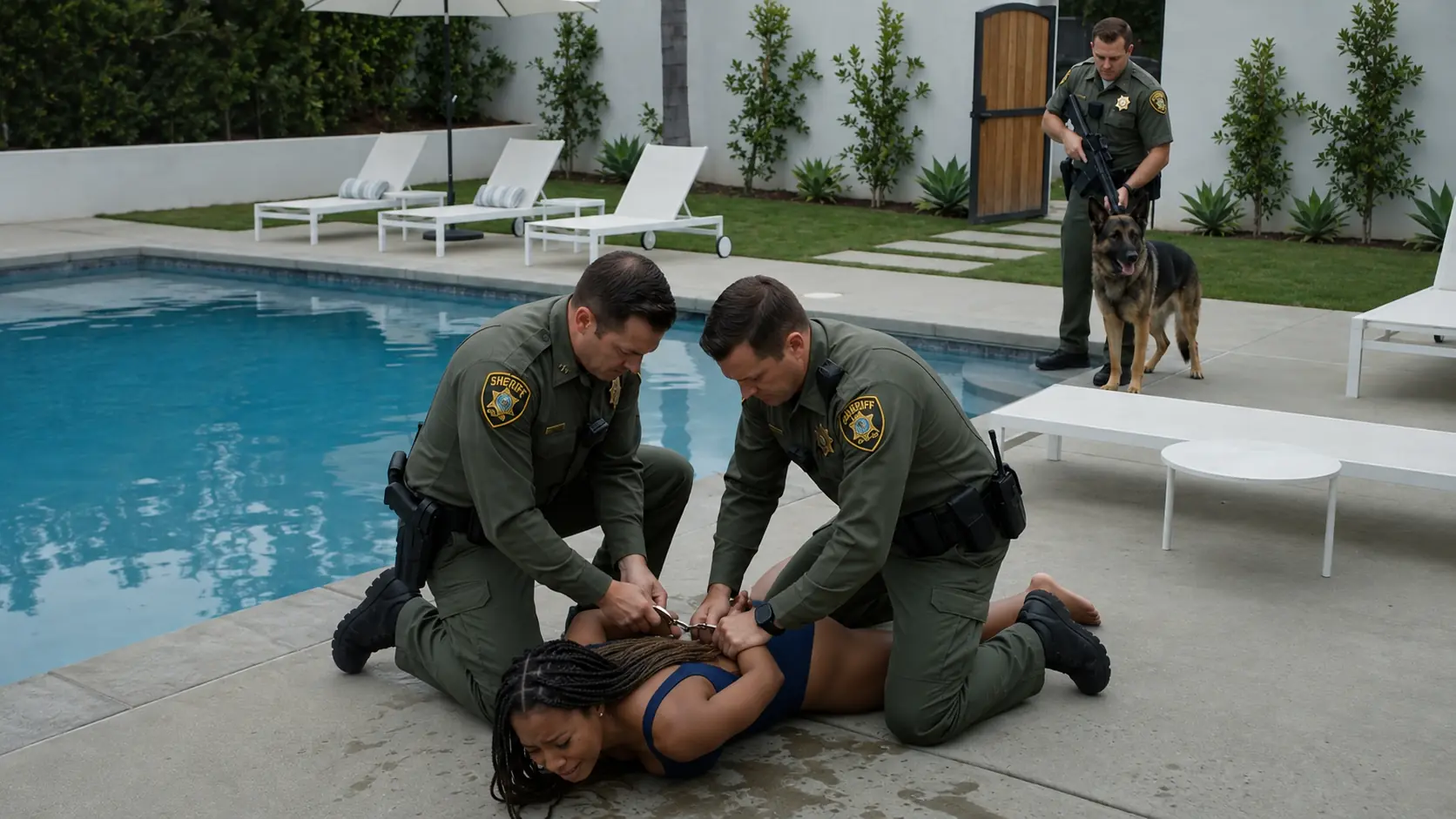
Officially, Dr. Lena Brooks was a thirty-nine-year-old biotechnology consultant who had recently purchased a furnished home in an exclusive hillside development outside Calabasas. She worked strange hours, traveled often, kept mostly to herself, and supposedly advised pharmaceutical startups on infectious-disease research. None of those details were entirely false, which made the cover easier to maintain. What nobody in Arroyo Crest knew was that Lena had spent fourteen years with the FBI.
Her actual assignment came through a joint counterintelligence and civil-rights task force operating out of Los Angeles. Federal investigators had spent almost a year following a private security company called Meridian Shield Group, which managed surveillance contracts for gated communities across California. The company sold residents the language of safety, predictive monitoring, and risk prevention while quietly building unauthorized databases on people who had never consented to be tracked. Arroyo Crest appeared to be one of Meridian Shield’s most sophisticated testing grounds.
The first week gave Lena more information than three months of subpoenas had produced. Cameras covered every entrance, intersection, clubhouse, walking path, and recreational area in the development. Residents assumed the feeds were used only for theft prevention and gate security, but metadata showed that certain cameras were being manually redirected toward specific homes. The pattern was too deliberate to be an accident.
Camera Eight pointed toward Lena’s driveway. According to the system map, it was supposed to monitor the intersection thirty yards beyond her house. Instead, somebody had changed its angle less than two hours after she moved in. Lena photographed the configuration, encrypted the image, and sent it to Supervisory Special Agent Adrian Cole without adding a comment.
Adrian replied four minutes later. “Copy. Do not correct it.” Lena smiled when she read the message because she had not planned to.
The most obvious human problem arrived on her fifth day. Gregory Whitman, sixty-three, appeared at Lena’s front door wearing khaki shorts, a pale blue polo shirt, expensive boat shoes, and an HOA badge clipped to his belt like a police credential. Gregory had retired as the chief executive of a regional investment firm and had served as president of the Arroyo Crest Homeowners Association for six years. He introduced himself with the smile of a man who had practiced appearing friendly while asking questions that were none of his business.
“Just welcoming you to the neighborhood,” he said. Lena thanked him. Gregory glanced beyond her shoulder into the foyer and asked whether she happened to have her resident identification card nearby. Lena did.
He studied the card, compared the photograph to her face, and handed it back. “We’ve had some issues with unauthorized occupancy.” Lena smiled.
“I own the house.” Gregory nodded immediately. “Of course.”
The conversation should have ended there. Instead, he asked how long she planned to stay, whether anyone else would be living with her, whether she expected regular visitors, and why she seemed to leave the neighborhood at unusual hours. Lena answered only what sounded normal for her cover. Gregory left after nine minutes.
She watched through the front window. He reached the end of her driveway, stopped beneath the jacaranda tree, and removed his phone. He typed for nearly thirty seconds, looked back toward Lena’s front door, and then drove away.
Gregory returned four days later. He said the HOA was updating emergency records. He asked for Lena’s resident card again.
She showed him. He stared at it almost exactly as long as he had the first time. Then he thanked her and left.
The third visit happened the following week. This time he claimed someone had reported a vehicle parked overnight at Lena’s address without authorization. The vehicle was hers, registered properly, and had never left her driveway. Gregory called the matter a harmless system error.
Lena watched him walk away again. He stopped beside the same jacaranda tree. He opened the same encrypted-looking app on his phone.
That night, Lena entered the HOA management server through a credential her team had acquired under federal authority weeks earlier. She found nothing criminal in Gregory’s standard administrative account. Then she found a hidden permissions layer attached to a contractor profile used by Meridian Shield. Gregory’s name appeared as an approved community liaison.
Lena leaned back in her chair. “You’re not suspicious of me,” she whispered. “You’re coordinating me.”
The harassment remained small enough to sound ridiculous when described individually. Her mail arrived with envelopes already slit along one edge. A guard began asking her to verify the house number even though the gate system recognized her vehicle every time.
Parking citations appeared on her windshield while the Bentley sat legally inside her own driveway. Each citation claimed a different violation. One said overnight commercial parking. Another cited an expired guest permit.
Lena challenged them through the HOA portal. Each fine disappeared. Each apology blamed software.
Then another citation appeared.
Three weeks into the operation, Lena noticed the black Range Rover. It first appeared behind her near the grocery store in Woodland Hills. Two days later, the same vehicle followed her through three unrelated turns before disappearing near the freeway.
She altered her routes. The Range Rover returned anyway. It never stayed close enough to make the surveillance obvious to an untrained driver.
Lena was trained. She knew the difference between coincidence and discipline.
One Thursday night she turned off the lights at eleven and waited in the upstairs bedroom. At 2:38 a.m., headlights rolled slowly along the street. The Range Rover appeared.
It passed her house once. Then it returned. The driver’s window lowered.
A small white flash illuminated Lena’s front entrance. Someone inside had taken a photograph. The vehicle continued down the hill and disappeared.
Lena opened the HOA file associated with her property. Standard information appeared first. Purchase date, emergency number, license plate, gate credentials, landscaping approvals.
Then she found a line added manually that afternoon.
SUBJECT STATUS: ACTIVE MONITOR.
Lena stared at the words. They were not part of any legitimate HOA field. No homeowner should have been categorized as a subject.
She took a screenshot. Then she opened the encrypted FBI channel and sent it to Adrian.
His response appeared almost immediately. “Escalating. Maintain cover.” Lena closed the laptop but did not sleep.
The next Tuesday, a package landed on her porch. Lena heard the cardboard hit concrete while she was making coffee. She waited thirty seconds before opening the door.
The box looked normal from five feet away. Up close, the tape had clearly been cut. Somebody had resealed it badly along the original seam.
Lena carried it inside and photographed every side before opening it. Inside were resistance bands, a yoga mat strap, and two paperback books. Nothing remotely connected to federal work.
She checked the gate delivery logs. The courier entered at 1:14 p.m. and left nine minutes later. No security incident had been recorded.
The package reached her porch at 1:21. Whoever opened it had been inside Arroyo Crest. That narrowed the possibilities considerably.
Two days later, gate security stopped her again. The guard was named Kevin Rusk, a thirty-year-old contractor who usually avoided eye contact when questioning her. Lena’s decal scanned green.
The gate opened. Kevin still stepped in front of her car. “I need you to verify your address.”
“You already scanned the pass.” Lena kept her voice polite. “The system approved it.”
Kevin shifted his weight. He glanced toward the security office, then lowered his voice. “Just following orders.”
“What orders?”
“Certain residents get additional verification.”
Lena went completely still. Kevin seemed to realize he had said too much.
“Certain residents?” she repeated.
He did not answer. Instead, he stepped aside.
Lena drove through the gate. In the rearview mirror, Kevin immediately lifted his radio. He watched her Bentley until it disappeared around the curve.
Six mornings later, the harassment stopped pretending to be administrative. Lena opened her front door before sunrise and saw her car sitting strangely low. All four tires had been slashed.
Not punctured. Not deflated. Cut deeply through the sidewalls.
The damage required somebody to kneel beside each wheel and deliberately work a blade through reinforced rubber. Lena lived behind a controlled-access gate surrounded by eighteen security cameras. Somebody had expected the system to protect the attacker rather than the homeowner.
She accessed the surveillance archive. At 3:11 a.m., her driveway was visible. At 3:13, Camera Eight dissolved into gray static.
The interference lasted nine minutes. At 3:22, the image returned perfectly. No other camera in Arroyo Crest lost signal during that window.
Lena walked to the guard station after sunrise. Kevin was not working. The morning supervisor pulled up the camera feed and shrugged.
“Looks like a glitch.”
“Only one camera failed.”
“Happens.”
“For exactly the period when someone cut all four tires?”
The supervisor looked toward the screen. “We’ll submit a maintenance ticket.”
“Will you file an incident report?”
“Sure.”
He never did.
That afternoon, an HOA email arrived. The subject line read SECOND NOTICE: AMENITY VIOLATION. Lena opened it.
The letter accused her of repeatedly using the community pool outside approved hours and allowing unauthorized guests into the recreation area. Lena had never used the community pool. Her home had a private one.
She logged into the investigative database and cross-referenced her address against traffic captured from Meridian Shield servers. A hidden table appeared under an encrypted analytics directory. Lena’s house was there.
Her name appeared beside an identification code. The profile listed arrival times, vehicle movements, visitor counts, camera observations, and something called community compatibility. Race was not written anywhere.
It did not need to be. Almost every high-priority profile belonged to a Black, Latino, Middle Eastern, or Asian household. White residents with identical security patterns remained uncategorized.
Lena opened the secure FBI messenger. She typed three words.
Red layer confirmed.
Adrian answered, “Continue collection. Warrants nearly ready.”
Across Arroyo Crest, Gregory Whitman sat inside his home office. His encrypted phone displayed a black screen with no visible app name. A cursor blinked.
Gregory typed one sentence.
Subject remains active.
He pressed send.
Lena had been living undercover for twenty-seven days. Her sleep had broken into three-hour pieces. Every car behind her required evaluation.
Every neighbor’s smile carried a second possibility. Every package, camera, gate delay, and HOA notice became another data point. By Saturday morning, exhaustion had begun to feel physical.
The California sky was clear. Sunlight covered the backyard. For once, no overnight alert waited on her encrypted phone.
Lena decided to give herself sixty minutes. One hour without the laptop. One hour without running surveillance routes in her head.
She changed into a dark green swimsuit. She tied her braids up, carried a book outside, and placed her federal earpiece on the patio table. Her German Shepherd, Rex, stretched beneath an umbrella near the pool.
For the first minute, nothing happened. Lena sat on a lounge chair. Warm air moved across the yard.
She opened the book. She read one paragraph. Then she noticed Gregory Whitman.
He stood across the street at the end of his driveway. He was not checking mail. He was not watering flowers.
His phone was pressed to his ear. He was staring directly toward Lena’s backyard through the gap between properties. Their eyes met.
Gregory did not look away.
His mouth moved slowly. His free hand gestured toward Lena’s house. Then he angled his body slightly away while keeping his eyes fixed on her.
Lena’s stomach tightened. She reached toward the phone beside her chair. Her thumb hovered above the secure contact icon.
Maybe it was nothing. The thought lasted less than a second. Lena had spent fourteen years learning how dangerous it could be to ignore what her instincts noticed before her conscious mind explained it.
Rex rose suddenly. The dog’s body changed from relaxed to rigid. His head turned toward the side gate.
A low growl came from his chest. Lena set down the book.
Then she heard footsteps.
Multiple people. Heavy. Fast.
Not on the sidewalk.
They were approaching the gate.
Lena stood. The latch moved. Rex barked sharply.
The side gate swung open.
Three Ventura County sheriff’s deputies entered Lena’s backyard.
The first deputy, Sergeant Paul Mercer, had one hand resting on his holster. Deputy Kyle Benson entered behind him already carrying handcuffs. The third, Deputy Aaron Pike, moved along the fence line while scanning the patio and house.
None of them knocked. None asked whether Lena was the homeowner. None announced a warrant.
Paul looked at Lena. “Hands where I can see them.”
Lena’s mind went cold.
She raised both hands slowly. “I live here.”
Kyle stepped toward her. “Turn around.”
“This is my property.”
“Hands behind your back.”
“My identification is inside the house.”
Paul’s voice sharpened. “Stop talking and follow instructions.”
Lena felt adrenaline flood her body. Training moved ahead of emotion.
Do not reach suddenly.
Do not argue with the weapon.
Survive first.
Correct later.
She looked past them toward Gregory’s house.
He stood near the edge of his driveway. Arms folded. Watching.
Lena understood immediately.
Gregory made the call.
Aaron’s hand moved onto the grip of his pistol. He did not draw it. The motion was enough.
“Get down.”
Lena moved carefully. Apparently not quickly enough.
Paul grabbed her shoulder. He shoved her forward.
Her knees struck the concrete pool deck hard.
Pain shot upward through both legs. Before Lena recovered, Paul drove one hand between her shoulder blades and forced her flat.
Her cheek hit the hot concrete. Her lip split against the rough surface. She tasted blood.
“Hands behind your back.”
Lena complied. Kyle pulled her wrists together.
The cuffs closed too tightly.
Metal dug into the skin. Kyle pulled her arms higher than necessary.
Something shifted painfully in Lena’s shoulder. She gasped.
Paul put his knee against the middle of her back.
The pressure pushed her ribs into the concrete.
“Do not move.”
Lena tried to breathe. The breath stopped halfway.
“I can’t breathe.”
Paul leaned forward.
“Should’ve thought about that before breaking into somebody’s house.”
“This is my house.”
Kyle spoke into his radio. “Female suspect detained. Possible burglary. Providing false residency information.”
Lena turned her head enough to look toward the street.
Neighbors had emerged everywhere.
Two people stood on a driveway filming. Another woman watched through an upstairs window.
Nobody approached.
Nobody said Lena owned the house.
Gregory remained across the street.
Calm.
Satisfied.
Aaron crouched near Lena’s face. His right hand remained close to his pistol.
“Listen carefully,” he said. “We got a report of a break-in.”
Lena tried another shallow breath.
“You match the description.”
“What description?”
“Stay quiet.”
Aaron leaned closer.
“You are inside a backyard that does not belong to you.”
Lena closed her eyes.
“You make one sudden move and this gets much worse.”
She believed him.
For the first time during the assignment, Lena seriously considered destroying her cover.
Three words could change the entire situation.
I am FBI.
Then Meridian Shield would know federal investigators had penetrated Arroyo Crest. Servers could disappear within minutes.
Accounts could be wiped. Gregory could destroy communications. Other targets across six counties could receive warnings.
Months of work would collapse.
Paul increased pressure.
Lena’s lungs struggled.
The calculation changed.
Protecting an investigation did not require dying on a pool deck.
Lena rotated her left wrist against the concrete. A black fitness band rested near the cuff.
Inside it was a concealed federal distress transmitter.
She pressed the underside against the ground.
One second.
Two.
Three.
A silent emergency pulse left the device.
No beep.
No vibration.
No visible light.
Thirty miles away, an FBI tactical operations screen flashed red.
AGENT DISTRESS. LENA BROOKS. PRIORITY RESPONSE.
Adrian Cole was already inside the Los Angeles field office.
He saw the location.
Arroyo Crest Estates.
His face changed.
“Tactical team moving now.”
Back in Lena’s yard, Paul shifted his knee.
“Any sudden move and this ends badly.”
Lena nodded as much as the concrete allowed.
Her vision blurred at the edges. Her lip burned.
Her hands were beginning to lose sensation.
Then she heard an engine.
Fast.
Too fast for a residential street.
Aaron stood.
Tires screamed somewhere beyond the house.
Gregory turned toward the entrance of the cul-de-sac.
A black Chevrolet Suburban exploded around the corner.
Blue and red federal emergency lights flashed behind the windshield.
A second SUV followed.
Then a third.
The lead vehicle stopped hard beside Lena’s driveway.
Doors opened before the suspension settled.
Two agents in tactical vests moved first.
Then Adrian Cole stepped out.
He was fifty, six-foot-two, broad across the shoulders, and normally so controlled that junior agents sometimes mistook silence for indifference. Nothing about his face looked indifferent now. He crossed the yard almost at a run.
Paul stood.
“Sir, stay back.”
Adrian did not slow.
He reached Lena.
She was still face down.