The first snow of autumn always arrived quietly in Pine Creek Valley. It never announced itself with thunder or fierce winds. Instead, it drifted down from the Colorado Rockies like a promise whispered across the mountains, reminding every ranch family that another hard winter waited just beyond the golden hills. On mornings like this, one could almost believe the valley itself was holding its breath, as though it already knew that one unexpected visitor would soon change everything.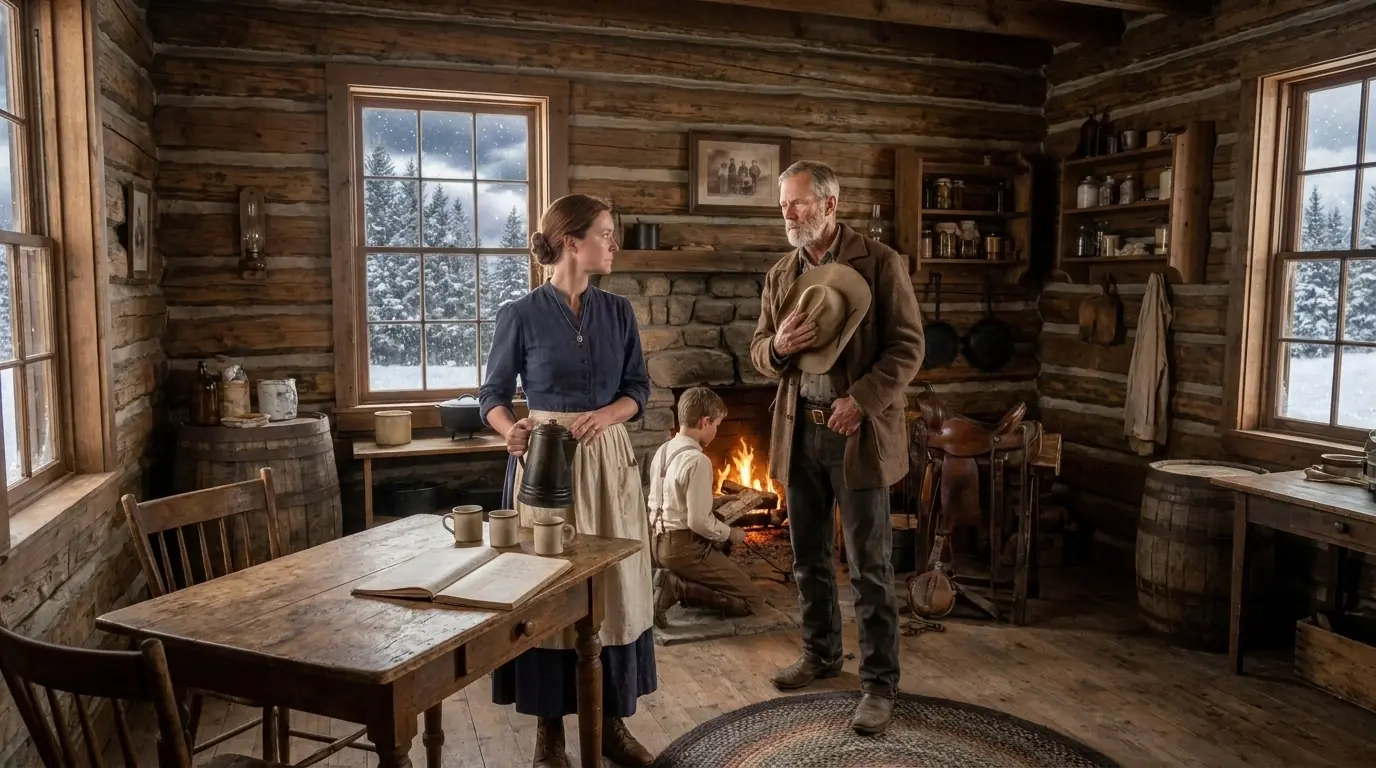
The Whitfield Ranch stood at the edge of a wide meadow where golden grass rolled toward towering pine forests. The buildings were weathered but sturdy, their faded wood bearing the marks of countless Colorado winters. Every fence post, barn beam, and gate carried the fingerprints of years spent building a life through stubborn determination.
Sarah Whitfield tightened the final strand of barbed wire along the pasture fence before stepping back to inspect her work. At thirty-six, she had long since traded soft hands for capable ones. Her faded navy-blue pioneer dress was covered by a cream work apron, while brown leather gloves protected hands that had repaired fences, broken horses, and planted crops without complaint. A silver wedding band rested against her chest, hanging from a simple chain beneath the fabric of her dress.
Nearby, twelve-year-old Samuel Whitfield carried a wooden bucket toward the horse trough. Though still a boy, he already moved with the quiet confidence of someone raised on a working ranch. His cream work shirt was rolled to his elbows, suspenders stretched across his shoulders, and his worn leather boots kicked up dust as he hurried across the yard.
“The fence looks better than it did yesterday,” Samuel said with an encouraging grin.
Sarah smiled softly. “It should. You did half the work.”
Samuel laughed. “I only handed you the tools.”
“And sometimes that is exactly what keeps a ranch running.”
The boy’s smile widened as he hurried toward the horses waiting beside the corral. The ranch was not wealthy. Some neighboring families had sold their land after years of drought and difficult cattle markets. Others had accepted offers from businessmen eager to buy every acre they could find.
Sarah had refused every offer placed before her. This ranch had belonged to Thomas Whitfield. As long as she could stand, it would remain a Whitfield ranch.
By late afternoon, the chores were nearly finished. Smoke drifted lazily from the stone chimney while chickens wandered freely around the barnyard. Samuel carried fresh firewood toward the house as Sarah collected the last of the tools before sunset.
Then both of them noticed movement near the distant trail.
A lone rider.
He was not traveling quickly. His horse moved with slow, weary steps, lowering its head after what looked like many miles on the road. The rider sat straight despite his obvious exhaustion, his weathered tan cowboy hat shading a deeply lined face framed by a neatly trimmed gray beard.
Neither Sarah nor Samuel reached for a weapon. There was nothing threatening about the old cowboy, only fatigue.
When he reached the front gate, he removed his hat before speaking.
“Ma’am,” he said politely, his voice rough from years beneath open skies, “could I trouble you for a drink of water?”
Sarah studied him for only a moment. His horse was nearly as tired as he was.
“No one gets turned away thirsty here,” she answered.
A look of quiet gratitude crossed the stranger’s face. “I appreciate your kindness.”
Samuel quickly unlatched the gate while Sarah led the horse toward the hitching rail beside the porch.
“You have both traveled a long way,” she observed.
“We surely have.”
Samuel disappeared inside and returned carrying a bucket filled with fresh well water for the horse before hurrying back for another pitcher. The old cowboy accepted the glass with both hands.
Sarah smiled. “That is because it comes straight from the mountain spring.”
After finishing the water, the cowboy hesitated. “I do not mean to impose.”
“You are not,” Sarah replied. “Come inside. I will put on coffee.”
The warmth of the Whitfield home wrapped around them as soon as the front door closed. The stone fireplace crackled gently beneath a thick wooden mantel polished by years of careful hands. Shelves held old ranch ledgers, family keepsakes, worn leather-bound books, and neatly arranged tools that had belonged to another generation.
Samuel placed another log on the fire. “I will bring fresh coffee.”
The old cowboy removed his hat once again before stepping farther into the room. His sharp blue eyes wandered quietly across the cabin: a saddle carefully preserved in one corner, an old cavalry canteen hanging beside the fireplace, and weathered spurs resting on a shelf. Every object seemed strangely familiar.
Sarah busied herself pouring steaming coffee while Samuel arranged three simple mugs on the wooden table. The stranger barely noticed. His attention had drifted elsewhere.
Slowly, almost unwillingly, his eyes lifted toward the wall above the stone fireplace.
There, inside a dark wooden frame, hung an old photograph faded by time. Three young cowboys stood shoulder to shoulder beneath the Colorado mountains.
The old cowboy stopped breathing.
His hands trembled almost imperceptibly. The room fell completely silent.
Sarah turned, immediately noticing the change in his expression. He stared at the photograph as though twenty-five years had vanished in an instant.
Finally, without taking his eyes from the frame, he spoke in a voice barely louder than a whisper.
“Where did you get that photograph?”
Sarah followed his gaze, and her expression softened. “That is my husband.”
The room remained perfectly still. The fire cracked softly inside the stone hearth, but neither Sarah nor Samuel moved. The old cowboy continued staring at the faded photograph as though it had carried him back through a lifetime of memories.
At last, he stepped closer. With weathered fingers, he gently traced the edge of the wooden frame, careful not to touch the photograph itself.
“We were just boys,” he said quietly. “Or at least we thought we knew enough to call ourselves men.”
Sarah exchanged a puzzled glance with Samuel. “You knew Thomas?”
The old cowboy slowly nodded. “My name is Caleb Dawson.”
He removed his hat again, holding it respectfully against his chest.
“Your husband once saved my life.”
The words settled over the room with surprising weight. Sarah had heard many stories about Thomas Whitfield during the years they were married. Neighbors often spoke of his fairness, his willingness to help anyone in trouble, and his quiet courage. But never, not once, had she heard the name Caleb Dawson.
Samuel leaned forward. “My father really saved your life?”
Caleb’s eyes never left the photograph. “He surely did.”
He smiled faintly. “It happened twenty-five years ago, during one of the worst cattle drives I ever saw.”
Sarah quietly carried three cups of coffee to the table. “I think you should sit down.”
Caleb lowered himself carefully into a wooden chair. For a few moments, he simply warmed his hands around the mug before speaking again.
“We were driving nearly two thousand head of cattle through Monarch Pass before winter closed the trail.”
Samuel’s eyes widened. “That many?”
Caleb nodded. “More than any of us should have attempted.”
Outside, the first snow had begun drifting gently across the ranch yard. Inside, the fire painted warm light across the weathered log walls.
“Three of us rode point every morning,” Caleb continued. “Thomas, another trail hand named Henry Lawson, and me.” He chuckled softly. “I was young enough to think nothing could hurt me.”
His smile slowly disappeared. “Then the mountain reminded me otherwise.”
He described how a frightened herd had broken across a narrow ridge after a sudden rockslide. His horse lost its footing, and Caleb was thrown toward the edge of a steep ravine.
“Only Thomas reacted quickly enough,” Caleb said. “He never hesitated. He grabbed my arm before I disappeared over that cliff.”
The old cowboy looked down at his scarred right hand. “I have carried this scar ever since.”
Sarah noticed the faded mark stretching across his hand. “I wondered where it came from.”
“The rope burned straight through my glove while Thomas held on.”
For a long moment, no one spoke. Samuel finally broke the silence.
“My father never told us.”
Caleb smiled gently. “That sounds exactly like Thomas. He was not the kind of man who talked about what he had done.”
Sarah looked toward the photograph again. “I wish I had known this.”
“So do I.”
Caleb slowly reached into his old leather saddlebag and carefully removed several worn belongings wrapped inside a faded cloth.
“I have carried these for years.”
He placed them gently on the table. Sarah immediately recognized them: Thomas’s old brass compass, a weathered leather notebook, and a folded hand-drawn trail map.
She stared in disbelief. “Those belonged to my husband.”
“They did.”
“You have kept them all this time?”
Caleb nodded. “Thomas left camp one morning to meet a surveyor before we finished that drive. He asked me to keep these until he returned.”
“But he came back.”
“He did, and he collected most of his belongings.” Caleb carefully unfolded the map. “But not this.”
The yellowed paper showed mountain trails, rivers, old cattle routes, and landmarks drawn in Thomas Whitfield’s unmistakable handwriting. Caleb studied it quietly.
Then his expression changed. He leaned closer, and his finger rested on the lower corner.
“That is strange.”
Sarah looked over his shoulder. “What is it?”
“There should be another page.”
He carefully turned the folded map over. Nothing.
“The map originally continued.”
“You remember that?”
“I do. Thomas always folded two sheets together.”
Samuel frowned. “Then where did the other one go?”
Caleb remained silent for several seconds. Finally, he answered, “I do not think it was lost.”
“You think someone took it?”
The old cowboy slowly shook his head. “No. I think Thomas removed it himself.”
Sarah folded her arms. “Why would he do that?”
Caleb looked thoughtfully toward the fire. “Because he wanted someone to find it.”
Silence settled over the room again. Snow continued drifting outside the windows while daylight slowly faded across Pine Creek Valley.
Samuel broke the silence. “If you have been looking for us...”
Caleb smiled sadly. “I have. For years.”
Sarah looked at him with quiet curiosity. “Why did you not come sooner?”
The old cowboy sighed. “I wish I could have.”
He explained that shortly after the cattle drive, he had accepted work driving herds into Wyoming and Montana. Years passed. When he finally returned to Colorado, he learned that Thomas had died unexpectedly.
“I went looking for the Whitfields, but the drought had already forced many families to move. I searched county records. I visited ranches. I asked anyone who remembered Thomas, but every trail ended cold.” He looked around the cozy ranch house. “Until today.”
Sarah’s eyes softened. “You never stopped searching.”
“No. I made a promise.”
“What promise?”
Caleb looked back down at Thomas’s map. “That if anything ever happened to him, I would find his family and finish what he started.”
The room grew quiet once more. Caleb carefully smoothed the folded map across the table. His eyes scanned every line, every river, and every mountain trail.
Then suddenly, he stopped.
Near the edge of the page, almost hidden among Thomas’s hand-drawn contour lines, was a tiny symbol sketched in pencil. Caleb’s breathing caught. He knew that mark. Only three men had ever known what it meant.
He slowly raised his eyes to Sarah. His voice was barely above a whisper.
“Thomas left something behind.”
The words hung in the warm cabin long after Caleb Dawson spoke them.
Sarah looked from the old map to Caleb’s weathered face, searching for any sign that he might be mistaken. Instead, she found only quiet certainty.
“What did he leave?” she asked softly.
Caleb slowly folded the map again. “I do not know.”
Samuel frowned. “You just said he left something.”
“I knew Thomas,” Caleb replied. “Or at least I knew the man he was. He never marked anything without a reason.”
He carefully pointed to the tiny pencil symbol near the edge of the map. “It is not a survey mark. It is not a cattle-trail marker, and it is not something a stranger would notice.”
Sarah leaned closer. “What is it?”
Caleb smiled faintly. “Twenty-five years ago, only three men knew what that symbol meant: Thomas, Henry Lawson, and me.”
Samuel’s eyes widened. “So it was your secret?”
Caleb slowly nodded. “Our trail sign. Whenever one of us found something important along a cattle route, we would carve or draw that mark so the others could find it later.”
Sarah looked thoughtfully toward the window, where snowflakes drifted across the ranch yard. “If Thomas used it, he wanted one of you to come back.”
“Exactly,” Caleb said quietly.
The room fell silent again.
At last, Sarah stood. “If my husband trusted that symbol, I trust it too.”
She crossed the room and opened an old cedar chest near the fireplace. Inside lay Thomas Whitfield’s carefully preserved saddle blanket, a thick wool riding coat, and several leather saddlebags. She lifted the coat with both hands before smiling sadly.
“He always packed this first whenever he rode into the mountains.”
Samuel watched quietly. “We are going tomorrow, are we not?”
Sarah looked at Caleb. The old cowboy gave a slow nod.
“If the weather allows. Outside, the wind has begun to strengthen. We will leave at first light.”
Morning arrived beneath clear blue skies. The overnight snow had covered the higher peaks, but the valley trails remained open.
Sarah saddled her bay mare while Samuel tightened the cinch on his small sorrel gelding. Nearby, Caleb carefully checked his aging chestnut horse. Though slower than in years past, both horse and rider still carried themselves with quiet dignity.
Sarah secured Thomas’s folded map inside her saddlebag. “We follow your memory?”
Caleb smiled. “And Thomas’s map.”
The three riders left the Whitfield Ranch just after sunrise. Golden cottonwood leaves shimmered beside the creek while brilliant aspen forests painted the mountainsides with autumn color.
Samuel looked around in amazement. “I have never ridden this far west.”
Caleb chuckled. “I spent half my life out here.” He pointed toward a distant ridgeline. “That pass used to carry thousands of cattle every spring.”
They followed narrow trails climbing steadily into the Rockies. As the morning passed, Caleb occasionally stopped. Sometimes he closed his eyes. Sometimes he simply studied the mountains.
“I remember this bend. The creek used to run deeper. That rockslide was not here.”
The mountains had changed, but not enough to erase every memory.
Hours later, Caleb suddenly raised his hand. “Stop.”
The horses halted. Ahead stood an enormous pine tree unlike any other nearby. Its trunk was nearly six feet across, and thick green moss covered much of the bark.
Caleb slowly dismounted. For several moments, he simply stared.
“I would know this tree anywhere.”
Samuel hurried over. “You remember it?”
“I tied my horse here the day Thomas showed us the trail mark.”
Caleb gently brushed away years of moss with his leather glove. At first, nothing appeared. Then a carved arrow slowly emerged beneath the bark. Though weathered by decades of wind and snow, it remained unmistakable.
Samuel gasped. “It really was here.”
Sarah reached out, carefully touching the old carving. “My husband made this.”
Caleb nodded. “With his own knife.”
The arrow pointed toward a cluster of large boulders resting farther up the slope. Without speaking, the three of them walked toward the rocks.
The largest boulder leaned against the mountainside at an unusual angle. Caleb knelt. So did Sarah. Samuel immediately dropped beside them. Together, they cleared away fallen branches, loose stones, and years of thick moss.
After several minutes, Caleb stopped. “There.”
Hidden beneath layers of dirt lay a flat stone unlike the others. Its edges had been shaped by human hands.
Sarah’s heartbeat quickened. With Caleb’s help, she pushed against it. The stone shifted.
Beneath it rested a narrow cavity carefully built into the mountain. Inside sat a weathered iron box. Its surface was covered with rust, but it remained remarkably intact.
For several seconds, none of them moved.
Samuel whispered, “Open it.”
Caleb slowly lifted the heavy lid. Inside lay a neatly wrapped oilcloth bundle that had protected its contents for years.
Sarah unfolded it carefully. Her breath caught.
There was Thomas Whitfield’s leather journal, original county survey maps, signed witness statements, land-ownership records bearing official seals, and several sealed letters. Every document had been preserved perfectly.
Caleb opened the journal. On the very first page, Thomas had written only one sentence:
“If you are reading this, I was not able to return. Protect the truth, and protect our valley.”
Sarah closed her eyes as emotion overwhelmed her. She pressed the journal gently against her chest. For the first time in five years, she felt as though Thomas had spoken directly to her.
Caleb quietly gathered the documents and placed them back inside the iron box.
“We have what we came for.”
They secured the box behind Sarah’s saddle and began the journey back toward Pine Creek Valley.
None of them noticed that they were no longer alone.
Far across the valley, three mounted riders stood silently on a distant ridge. One of them raised a small brass spyglass. He watched Sarah carefully fasten the iron box behind her saddle.
Without saying a word, he turned his horse toward town. The other two riders followed.
Miles away, someone was already riding to deliver one message: Horace Blackwood must know that the hidden evidence had finally been found.
Far below the mountain ridge, Sarah Whitfield, Samuel, and Caleb Dawson continued riding toward Pine Creek Valley, unaware that another race had already begun.
The autumn sun settled lower behind the Rockies, painting the valley in shades of gold and amber. The iron document box remained securely fastened behind Sarah’s saddle, while Thomas Whitfield’s leather journal rested safely inside her saddlebag.
No one spoke for several miles. Each of them understood the weight of what they carried.
Finally, Samuel broke the silence. “My father really knew this might happen.”
Caleb nodded slowly. “I believe he did.”
“He hid those papers because he knew someone would come after them.”
Sarah looked toward the distant valley. “He trusted that someone would eventually find them.”
“He trusted the right people,” Caleb answered quietly.
By early afternoon, the three riders entered Pine Creek. Word traveled quickly in a frontier town. Before they reached the courthouse, curious townspeople had already begun gathering outside the weathered brick building.
Sheriff Benjamin Hayes stepped onto the wooden porch as Sarah dismounted. His experienced eyes immediately noticed the seriousness on every face.
“Sarah?”
She carefully removed the leather journal from her saddlebag. “I believe my husband left something you need to see.”
The sheriff looked toward Caleb. “You must be Caleb Dawson.”
The old cowboy removed his hat. “I am.”
Benjamin extended his hand. “Thomas spoke highly of you many years ago.”
Caleb accepted the handshake. “I only wish we had met again under better circumstances.”
Inside the courthouse, county records clerk Abigail Mercer prepared the large oak table where official land ledgers had rested for decades. She adjusted her spectacles as Sarah carefully placed the recovered documents before her.
The room slowly filled. Neighboring ranch families arrived, along with merchants, farmers, and old friends who had known Thomas Whitfield.
Even Horace Blackwood entered calmly, wearing an expensive black frock coat and carrying the confident smile of a respected businessman. He glanced briefly toward Sarah.
“What seems to be today’s excitement?”
No one answered.
Sheriff Hayes closed the courtroom doors. “I believe we will soon find out.”
Abigail carefully opened Thomas’s journal. She examined every page, then compared the original survey maps against the county’s official land records. One by one, she unfolded the witness statements.
Every signature matched. Every survey marker aligned perfectly.
The room became quieter with each passing minute.
Finally, Abigail removed her spectacles. She looked directly at Sheriff Hayes.
“These documents are authentic.”
She reached for another ledger. “The original boundary records were altered after Thomas Whitfield filed his first survey.”
She turned another page. “The altered records benefited only one buyer.”
Her eyes slowly lifted toward Horace Blackwood.
“You.”
The courtroom erupted with whispers. Horace remained remarkably calm.
“This is absurd. Old papers prove nothing.”
“They prove quite a lot,” Abigail replied.
She carefully laid Thomas’s original survey over the county copy. The differences were unmistakable. Entire property lines had been moved. Neighboring ranches had lost hundreds of valuable acres. Water rights had disappeared.
Every alteration pointed toward one man: Horace Blackwood.
Horace stepped forward. “I have been an honest businessman for thirty years. You expect people to believe a dead rancher over me?”
Before anyone answered, Caleb quietly stood. The room fell silent.
The old cowboy slowly reached inside the weathered leather saddlebag he had carried across the frontier for twenty-five years. From inside, he removed a carefully folded envelope. The paper had yellowed with age, but its wax seal remained unbroken.
Caleb looked toward Sarah. “Thomas gave me this. He told me never to open it unless he could not return himself.”
Sarah nodded gently. “You kept your promise.”
“I tried.”
Caleb handed the letter to Sheriff Hayes. The sheriff carefully broke the seal. He read silently for several moments, then looked up.
His voice carried through the entire courtroom.
“If this letter is being read, then the evidence I gathered has become more important than my own name. The survey maps, witness statements, and land records hidden in the mountains reveal every false claim made against the ranch families of Pine Creek Valley. Trust Caleb Dawson. He knows where the truth rests.”
Sheriff Hayes lowered the letter. “There is no doubt.”
He turned toward Horace. “You knowingly stole land from honest families.”
Horace’s confident expression finally disappeared. For the first time, fear crossed his face.
Sheriff Hayes stepped forward calmly. “Horace Blackwood, I am placing you under arrest for fraud, forgery, and unlawful transfer of county land.”
Without resistance, Horace quietly surrendered. The sheriff secured handcuffs around his wrists.
No one cheered.
Justice needed no celebration, only truth.
Several weeks later, winter had not yet fully reached Pine Creek Valley. Morning sunlight poured across the Whitfield Ranch. Healthy cattle grazed peacefully beside the creek, new fence posts lined the repaired pastures, and neighboring ranchers worked land that had finally been returned to them.
Inside the ranch house, Thomas Whitfield’s photograph once again rested above the stone fireplace. This time, it no longer represented unanswered questions. It represented a promise kept.
Outside, Caleb tightened the saddle on his faithful chestnut horse. Samuel hurried toward him.
“Do you have to leave?”
The old cowboy smiled kindly. “I have spent most of my life riding from one horizon to another.”
He reached into his coat pocket and carefully placed Thomas Whitfield’s old pocketknife into Samuel’s hands.
“It is yours now.”
Samuel stared at it in amazement. “My father’s?”
Caleb nodded. “He carried it the day he saved my life.”
Samuel looked at the worn wooden handle before closing his fingers around it. “I will take good care of it.”
“I know you will.”
Sarah stepped onto the porch. For a long moment, neither she nor Caleb spoke.
Finally, Caleb smiled. “I came here hoping to keep one promise.”
Sarah’s eyes filled with quiet gratitude. “You kept much more than that.”
The old cowboy tipped his weathered hat. Then, before climbing into the saddle, he looked once more toward Thomas’s photograph through the front window.
Softly, almost as if speaking to an old friend, he said, “You can rest easy now.”
He turned his horse toward the western mountains. Sarah and Samuel stood together at the ranch gate, watching until the old cowboy disappeared beyond the golden hills.
The cold autumn breeze stirred the cottonwood leaves one last time. Inside the Whitfield home, sunlight fell across the photograph above the fireplace. Three young cowboys stood shoulder to shoulder, smiling at a future they could never fully know.
Yet one thing had endured across twenty-five years: a promise made in friendship, and a promise kept with honor.
In Pine Creek Valley, that was a legacy worth more than all the land in Colorado.