By the time the rain began to fall over Millbrook, Ohio, Harold Whitaker had already turned off the lights in his repair garage.
It was a small place at the edge of town, the kind of business people passed without noticing unless their car started making a sound it was not supposed to make. The wooden sign above the door had faded from red to a tired shade of brown. The white letters that once read Whitaker Auto Repair had peeled at the corners, and one side of the sign hung slightly lower than the other, as if it had grown old along with the man who owned it.
Harold was seventy-six years old.
He was tall once, or at least that was what people said when they wanted to be kind. Now his shoulders bent forward a little, and his left knee complained whenever the weather turned cold. His hair, what remained of it, was silver and thin, combed neatly back every morning out of habit. He wore the same kind of clothes almost every day: a clean plaid shirt, faded work pants, a thick brown cardigan with one loose button, and old boots polished more out of pride than necessity.
He had lived alone for nearly twelve years.
His wife, Margaret, had passed away on a Sunday morning in spring, when the dogwoods were blooming and the whole town seemed too bright for grief. Their only son, Daniel, had moved to Chicago long before that, chasing a bigger life, then a bigger job, then a bigger silence. He called on holidays if he remembered. He sent cards sometimes, always signed with quick words that sounded more like obligation than love.
Harold did not resent him.
At least, that was what he told himself.
He had learned, as old men often do, that loneliness could become a room you lived in. At first, it felt unbearable. Then it became familiar. Eventually, you knew where everything was inside it: the chair by the window, the chipped mug in the sink, the quiet dinner for one, the television left on just to keep voices in the house.
That evening, Harold locked the cash drawer, wiped his hands on an old rag, and looked around the garage.
Two cars sat inside under the fluorescent lights. One belonged to Mrs. Calloway, who taught third grade and always brought him banana bread when he changed her oil. The other was a blue pickup belonging to a roofing contractor who never paid on time but always promised he would.
Harold did not mind much.
Work gave shape to his days. Bolts, belts, engines, oil filters, tire pressure, brake pads. Machines were easier than people. Machines made noise when something was wrong. People smiled and said they were fine.
He was just reaching for the final switch near the office door when he heard something outside.
At first, he thought it was the rain tapping against the metal awning.
Then he heard it again.
A small sound.
Not a knock. Not exactly.
More like a shoe dragging against gravel.
Harold stood still.
The rain thickened outside, rushing down from the dark sky in cold silver lines. It was late October, the kind of night when dusk came early and the air smelled like wet leaves and smoke from distant chimneys. The street beyond the garage was mostly empty. The laundromat across the road had closed an hour ago. The gas station down the block kept its lights on, but no cars waited at the pumps.
Harold listened.
There it was again.
A soft scrape.
Then a breath.
He walked slowly to the front window and pulled back the blind with two fingers.
At first, he saw only the rain.
Then he saw a boy.
He was standing under the edge of the awning, pressed close to the garage wall as if trying to disappear into it. He looked about nine or ten years old, maybe younger because of the fear on his face. His hair was dark blond and plastered to his forehead. His jacket was thin, bright blue, soaked through at the shoulders. One of his shoes was untied, and the other looked muddy enough to have lost a fight with a ditch.
The boy held a small backpack against his chest.
He was trembling.
Harold unlocked the door before he had time to think.
The bell above it gave a tired little jingle.
The boy jumped back.
“Easy now,” Harold said, lifting one hand. “I’m not going to hurt you.”
The boy stared at him with wide blue eyes. Rain ran from his hair down his cheeks, making it look as if he had been crying even if he had not.
Harold stepped aside, opening the door wider.
“Come inside before you catch your death.”
The boy did not move.
Harold knew that look. He had seen it in stray dogs, in children outside the county office, in grown men who had lost work and did not want to ask for help. It was the look of someone who needed kindness but did not yet trust it.
“I’ve got heat in here,” Harold said gently. “And I’ve got a towel somewhere that’s cleaner than I look.”
The boy swallowed.
“My mom said not to go with strangers.”
“She was right,” Harold said. “Smart woman.”
That seemed to confuse him.
Harold pointed toward the office behind him.
“You can stand right there by the door where you can see outside. I’ll stay over here. How’s that?”
The boy looked down the street, then back at the garage. Wind pushed rain under the awning, and he shivered so hard his teeth clicked together.
At last, he stepped inside.
Harold closed the door but did not lock it.
The boy noticed.
“You can leave it unlocked,” Harold said. “So you know you’re not trapped.”
The boy clutched the backpack tighter.
The garage smelled of motor oil, rubber, old coffee, and the lemon cleaner Harold used every Friday whether the place needed it or not. The heaters along the wall hummed softly, spreading a dry warmth through the open space. Under the fluorescent lights, the boy looked even smaller.
“What’s your name?” Harold asked.
The boy hesitated.
“Mason.”
“Mason,” Harold repeated, as if the name mattered. “I’m Harold.”
The boy said nothing.
Harold walked to the office doorway and stopped, keeping distance between them.
“You hungry?”
Mason looked down.
That was answer enough.
Harold had not planned on dinner. He usually went home to soup from a can, crackers, and one of the apples Mrs. Calloway kept leaving in a paper bag on his desk. But in the office refrigerator, there was half a turkey sandwich from lunch, a bottle of orange juice, and a small container of potato salad he had forgotten about.
“I don’t have much,” Harold said. “But I’ve got a sandwich. No mustard. I hate mustard.”
For the first time, the boy’s face changed slightly.
“My dad hates mustard too.”
The words came out before Mason seemed ready for them. His eyes filled at once, and he turned his face away.
Harold felt something twist in his chest.
“Well,” he said softly, pretending not to see, “then your dad is a sensible man.”
He went into the office, took the sandwich from the refrigerator, and placed it on a clean paper towel. He also found a dry shop towel, one of the softer ones he kept for polishing chrome, and carried both out.
He set them on the corner of a workbench.
“I’ll step back,” he said. “You can take them.”
Mason approached slowly, as if the sandwich might vanish. He picked it up with both hands and took a bite too big for his mouth. Harold turned away to give him privacy, busying himself with a box of old receipts.
The boy ate quickly.
Too quickly.
Harold poured orange juice into a paper cup and placed it beside him.
“Slow down,” he said. “Food doesn’t run off unless you owe it money.”
Mason looked at him.
Then, unexpectedly, he laughed.
It was a small laugh, almost broken, but it warmed the room more than the heater.
Harold smiled.
“There it is,” he said.
Mason wiped his mouth with the back of his hand. “What?”
“Nothing. Just sounded like a person in here for a second.”
The boy did not seem to know what to do with that.
When the sandwich was gone, Harold pulled one of the rolling chairs from the office and pushed it near the heater.
“You can sit.”
Mason sat on the very edge, ready to spring up.
Harold took another chair, but he sat far enough away that Mason could breathe.
“All right,” Harold said. “Now we’ve got to figure out how to get you home.”
The boy looked toward the rain-black window.
“I don’t know where home is.”
Harold kept his face calm.
“That’s all right. Lots of roads look different in the rain.”
“No,” Mason whispered. “I mean I don’t know the address.”
“Do you know the street name?”
Mason shook his head.
“Do you know your last name?”
“Parker.”
“All right. Mason Parker. That’s a start.”
The boy pulled at a loose thread on his backpack strap.
“Do you know your mom’s phone number?”
Mason shook his head again, and shame moved across his face like a cloud.
“She made me practice it,” he said. “I knew it. I promise I knew it. But I got scared and forgot.”
“Nobody remembers numbers when they’re scared,” Harold said. “That’s why I still keep my wife’s recipes written down. Fear and age will empty a head faster than a leaky bucket.”
Mason looked at him. “Where is your wife?”
Harold glanced at the framed photo on the office shelf.
Margaret stood there in a blue dress, smiling in front of the lake, her hand raised as if she had just been caught laughing. In the photo, Harold still had brown hair and a straight back. He looked like a man who believed the future was something generous.
“She passed,” Harold said.
Mason’s voice dropped. “I’m sorry.”
“Me too.”
They sat with the rain.
After a moment, Harold stood carefully. “I’m going to call the town office. They can help find your family.”
Mason’s head snapped up.
“No!”
The fear in his voice was sharp enough to cut.
Harold froze.
“No?” he asked gently.
The boy’s breathing turned quick.
“Please don’t call anyone. Please. I’m not supposed to be here. I didn’t mean to go so far.”
“Mason, if your mother doesn’t know where you are, she’s worried sick.”
“I know.”
“Then we need to tell her you’re safe.”
Mason pressed his lips together. His eyes filled again, but he refused to cry.
Harold waited.
Old age had taught him one useful thing: silence could open doors that questions slammed shut.
Finally, Mason whispered, “She’ll be mad.”
“Maybe,” Harold said. “But mad is better than terrified.”
Mason shook his head. “You don’t understand.”
Harold lowered himself back into the chair.
“Then help me.”
The boy gripped the backpack.
“My mom and me were at the mall.”
Millbrook did not have a mall, but the county mall was twenty minutes away near Fairview.
“She was buying shoes for my sister because we have pictures tomorrow. I was supposed to stay by the bench. But there was this guy doing magic with cards near the food court, and I only watched for a minute. Then I turned around, and Mom wasn’t there.”
Harold listened without interrupting.
“I looked for her,” Mason continued. “I went where the shoes were, but I couldn’t remember which store. Then I thought maybe she went to the car. So I went outside. But there were too many cars. And then I saw a bus.”
“A bus?”
Mason nodded miserably. “I thought it went back near our street. I rode buses with my grandma before. I got on. Nobody asked me anything. I thought I could get off when I saw something I knew.”
“But you didn’t.”
“No.”
Harold’s chest tightened.
A lost child could travel miles before anyone understood what had happened. A small mistake could become a countywide panic by supper.
“How long ago was this?”
Mason looked at the office clock.
“I don’t know. It was still light.”
Harold glanced at the time.
7:48 p.m.
By now, Mason’s mother was likely losing her mind.
“Mason,” Harold said carefully, “your family is looking for you right now.”
The boy swallowed hard.
“I didn’t mean to run away.”
“I know.”
“I just wanted to fix it before she noticed.”
Harold felt the ache of that.
How many grown people had done the same thing? Made a mistake, panicked, wandered farther from help because they wanted to fix it before anyone saw?
“You listen to me,” Harold said. “Getting lost is not a crime. Being scared is not a crime. Asking for help is not a crime either, though most folks treat it like one.”
Mason looked at him.
“My dad says men solve problems.”
“Your dad is partly right,” Harold said. “But the first part of solving one is admitting you’ve got one.”
Mason’s face trembled.
Harold stood and reached for the phone.
This time Mason did not stop him.
Harold called the Millbrook town office first, but no one answered after hours. Then he called the non-emergency county number printed on a magnet by his desk. He explained slowly and clearly that a boy named Mason Parker had come into his garage, lost and wet but unhurt.
The woman on the line became alert at once.
“Sir, please stay where you are. We have a missing child report matching that name. Officers are already searching.”
Harold glanced at Mason, who was staring at his shoes.
“His mother know he’s found?”
“We’ll contact her immediately.”
“Tell her he’s safe,” Harold said. “Tell her he ate. Tell her he’s scared, but he’s safe.”
“We will, sir. What’s your address?”
Harold gave it.
After hanging up, he turned back to the boy.
“They’re going to tell your mother.”
Mason nodded but did not speak.
“You did the right thing coming inside,” Harold said.
“I almost didn’t.”
“I know.”
“You looked scary.”
Harold glanced down at his oil-stained cardigan and rough hands. “I’ve been told I look like a barn door with eyebrows.”
Mason’s mouth twitched.
“My grandma would like that.”
“Your grandma sounds like a woman of taste.”
“She died last year.”
Harold’s smile softened. “Then maybe she and Margaret are somewhere comparing notes on stubborn men.”
Mason looked at the photo again.
“Do you miss her every day?”
“Yes,” Harold said.
“Does it stop hurting?”
Harold thought about lying. Adults loved to lie to children about pain, dressing it up as lessons. But Mason had already been through enough fear for one evening.
“No,” he said. “It changes shape. Some days it’s a storm. Some days it’s just a stone in your pocket. You still feel it, but you can walk.”
Mason seemed to consider this.
“My dad left.”
The words were nearly too quiet to hear.
Harold did not move.
“When?” he asked.
“Two months ago. Mom says he needed time to think. But he took his tools, and his fishing pole, and the coffee mug I made him. I think people don’t take mugs if they’re coming back.”
Harold felt the old anger rise, not loud, but deep. He had no use for men who left children wondering which part of themselves had not been enough.
“I’m sorry,” he said.
Mason wiped his nose with his sleeve.
“My mom cries in the laundry room because she thinks we can’t hear. My sister pretends she doesn’t care. I tried to be good. I really did. I don’t know why I walked away.”
Harold knew.
Not the exact reason, but the shape of it.
A child’s grief did not always look like grief. Sometimes it looked like disobedience. Sometimes it looked like wandering. Sometimes it looked like watching a card trick in a mall because for one minute, something impossible became possible and nobody had left yet.
“You saw something interesting,” Harold said. “You were tired of being sad. Then things got away from you.”
Mason stared at him as if Harold had opened a locked box.
“Yes,” he whispered.
The rain struck harder against the roof.
Harold went to a cabinet and pulled out a thick gray sweatshirt he kept for cold mornings. It had Whitaker Auto Repair printed on the front in cracked letters.
“Here,” he said. “Your jacket’s soaked.”
Mason looked uncertain.
“You can change in the office,” Harold said. “I’ll stand out here.”
The boy took the sweatshirt and disappeared behind the office door. When he came out, it hung nearly to his knees, sleeves covering half his hands. His wet jacket was folded over his arm.
Harold tried not to smile too much.
“You look like you joined the crew.”
Mason glanced down. “Can I keep it until my mom comes?”
“Wouldn’t trust it with anyone else.”
Mason sat again, this time not quite on the edge of the chair.
Minutes passed.
Harold put water in the electric kettle he kept by the desk and made hot chocolate from a packet left behind by Mrs. Calloway’s grandson months ago. It had tiny marshmallows in it, dry and uneven, but Mason held the cup with both hands like it was treasure.
“My mom says sugar after dinner makes kids wild,” Mason said.
“Then we won’t tell her until she’s less worried.”
Mason drank.
“You fix cars?”
“Since I was fourteen.”
“That’s old.”
“Fourteen?”
“No. Since then.”
Harold laughed. It surprised him, the sound of his own laughter. “Fair enough.”
“My dad fixes things too.”
Harold nodded.
“He used to let me hold the flashlight.”
“That’s an important job.”
“He said I always pointed it wrong.”
“Everybody points it wrong. That’s part of the tradition.”
Mason smiled into his cup.
Harold felt something open inside him, painfully and tenderly. It had been years since a child’s voice had filled the garage. Once, Daniel had run through this same space with a toy car in each hand, asking questions faster than Harold could answer. He had sat on that very stool, swinging his legs, watching Harold change brake pads and rebuild carburetors.
Back then, Harold had believed there would always be more time.
That was the great trick life played on people.
It made ordinary days look endless.
A car passed outside slowly, tires hissing through water. Mason stiffened.
“Is that them?”
Harold looked through the window. “No. Just Mr. Bell’s delivery van.”
Mason nodded.
Then, after a moment, he asked, “Will my mom hate me?”
Harold turned away from the window.
“No.”
“You don’t know her.”
“I know mothers.”
“Not all mothers are the same.”
“No,” Harold said. “But fear has a sound. When she comes through that door, she may sound angry because fear has been driving her for hours. But underneath it, she’ll be glad enough to fall apart.”
Mason stared down at the sweatshirt sleeves.
“I don’t want her to fall apart.”
“Then hug her before she tries not to.”
The boy absorbed that as if it were instruction for fixing an engine.
Outside, the rain began to soften.
Harold checked the clock again.
8:19 p.m.
The county office had said help was coming. But minutes stretch differently around frightened children. Harold decided the boy needed something to hold his mind.
He opened a drawer and pulled out a small tin box.
“What’s that?” Mason asked.
“Treasure.”
Mason’s eyes widened.
Harold set it on the workbench and opened it.
Inside were old matchbox cars, most with chipped paint. A red fire engine with one missing wheel. A yellow taxi. A black pickup. A blue race car with silver stripes.
“These were my son’s,” Harold said. “He left them here a long time ago.”
Mason reached toward the blue race car but stopped before touching it.
“Can I?”
“Of course.”
Mason picked it up carefully.
“It’s heavy.”
“They made them better back then,” Harold said, then realized he sounded exactly like every old man he used to roll his eyes at.
Mason rolled the car along the workbench.
“My dad used to have a blue car.”
“What kind?”
“I don’t know. Loud.”
“Lots of men think loud is a kind.”
Mason smiled again.
Harold picked up the black pickup. “This one was Daniel’s favorite. Took it everywhere. Bathtub, backyard, church, once into a bowl of oatmeal.”
“Why?”
“Because he said the truck got hungry.”
Mason laughed, really laughed this time.
Harold felt the sound settle in his bones.
They played cars on the workbench while rainwater dripped from the awning outside. Harold made a road out of masking tape and an old calendar. Mason created a bridge with two socket cases. For twenty minutes, the lost boy was not lost. He was an engineer, a driver, a builder of impossible roads.
Then headlights turned into the lot.
Mason froze.
A white SUV pulled up fast outside the garage, stopping crookedly near the door. The driver’s side opened before the engine fully shut off.
A woman ran through the rain.
She was in her early thirties, wearing a tan coat over a green sweater, her brown hair pulled loose from a ponytail, her face pale with terror and exhaustion. Behind her, an older woman hurried after her, holding a pink umbrella that turned inside out in the wind.
Harold opened the door.
The young woman stopped at the threshold.
For one second, she looked at Harold.
Then she looked past him.
“Mason.”
The boy’s cup slipped from his hands, spilling hot chocolate across the floor. He did not seem to notice.
“Mom.”
She crossed the room in three steps and dropped to her knees, pulling him into her arms so hard the sweatshirt bunched between them.
“Oh my God,” she sobbed. “Oh my God, Mason. I found you. I found you.”
Mason clung to her.
“I’m sorry,” he cried. “I’m sorry, Mom. I didn’t mean to. I got scared.”
“I don’t care. I don’t care. You’re here. You’re here.”
The older woman stood in the doorway, one hand pressed to her mouth, tears running down her face. She looked at Harold and mouthed, “Thank you.”
Harold nodded and looked away.
Some reunions were too private to watch.
Two police cruisers arrived a minute later, their lights flashing red and blue across the wet windows. Harold’s stomach tightened at the sight, though he had done nothing wrong. A young officer came in first, followed by a woman in a dark raincoat carrying a clipboard. They asked questions gently, took notes, confirmed Harold’s name, and spoke with Mason’s mother, whose name was Claire Parker.
Harold remained by the workbench.
He noticed Mason never let go of his mother’s hand.
The officer turned to Harold.
“You did exactly the right thing, Mr. Whitaker.”
“Boy was cold and hungry,” Harold said. “Didn’t seem complicated.”
Claire looked up then.
Her eyes were red, her face wet from both rain and tears.
“It is complicated,” she said. “You could have ignored him. You could have sent him away. You could have scared him more. But you didn’t.”
Harold shifted uncomfortably.
“Well. I had a sandwich.”
Claire gave a broken laugh.
Mason tugged at her sleeve.
“Mom, he gave me hot chocolate. And this sweatshirt. And he didn’t lock the door.”
Claire looked at Harold again, and something in her expression changed. She understood what that meant.
“Thank you,” she said.
Harold nodded.
The officer explained that Mason had been missing for nearly three hours. The mall security team had searched the building. Claire had called 911 when they realized he was not anywhere on the property. Bus routes were checked. Volunteers had started forming search groups. His photo had already been shared among nearby towns.
Harold looked at Mason.
The boy’s face crumpled.
“I made everybody scared.”
Claire took his face in both hands.
“Yes,” she said, voice shaking. “You did. But that does not mean you are bad. It means we love you.”
Harold felt his throat close.
He turned toward the coffee machine, though no one needed coffee.
After the questions were finished, Claire tried to return the sweatshirt, but Harold shook his head.
“Let him keep it.”
Mason looked up quickly. “Really?”
“Uniforms shouldn’t be taken back on the first day.”
Mason smiled through his tears.
Claire rose and held out her hand to Harold. He took it, expecting a handshake. Instead, she used it to pull him into a hug.
Harold went stiff.
Then slowly, awkwardly, he patted her shoulder.
“You saved my son,” she whispered.
“No,” Harold said. “He found my door. That’s all.”
But when they left, the garage felt different.
Not empty exactly.
Emptier.
Harold cleaned the spilled hot chocolate from the floor. He threw away the paper cup. He set the toy cars back into the tin box one by one, pausing over the blue race car Mason had liked best.
Then he sat in the office chair and stared at Margaret’s photograph.
“Well,” he said softly, “that was a night.”
Margaret smiled back from the lake.
Harold went home late.
His house stood behind the garage, a small white place with a narrow porch and two maple trees in the yard. He heated soup but forgot to eat it. He sat at the kitchen table, listening to the refrigerator hum and the distant sound of tires on wet pavement.
For the first time in years, he wished someone would call.
Not because something was wrong.
Just because something had happened, and he wanted to tell it.
He thought about calling Daniel.
He even picked up the phone.
Then he put it down.
What would he say?
A lost boy came into the garage tonight. I gave him your old toy cars. Remember those? Remember when you used to sit on the stool and ask me why engines needed oil? Remember when you needed me?
The words felt too heavy.
He went to bed instead.
But sleep did not come quickly.
He kept seeing Mason under the awning, thin jacket soaked, eyes full of fear. He kept hearing the boy ask whether grief stopped hurting. He kept seeing Claire collapse around her son.
Somewhere in the middle of the night, Harold realized he had not felt useless that evening.
Old age had a cruel way of making people invisible. The world began to move around you, then past you, then without you. People spoke louder than necessary, explained things you already knew, assumed your stories were finished because your steps were slow.
But Mason had needed him.
For one evening, Harold had been the open door.
The next morning, he woke early.
The rain had passed. The world outside was washed clean, bright with pale October sunlight. Wet leaves stuck to the sidewalk. The air smelled sharp and new.
Harold shaved, combed his hair, and put on his cleanest plaid shirt. He opened the garage at seven-thirty as usual.
At eight-ten, Mrs. Calloway arrived for her car.
“I heard,” she said before he could greet her.
Harold sighed. “Morning to you too.”
She stepped closer, eyes shining behind her glasses. “The whole town heard. Harold Whitaker, you old saint.”
“Don’t start that.”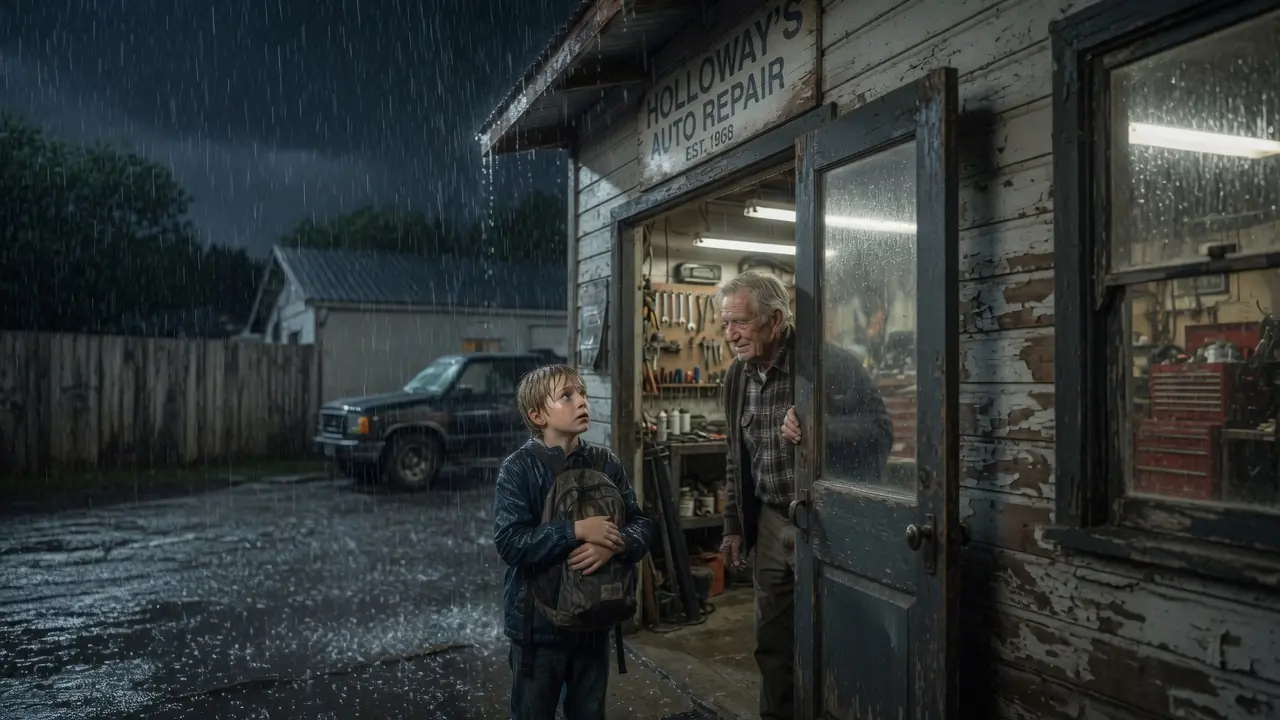
“You found that poor child.”
“He found me.”
“You fed him.”
“I had half a sandwich.”
“You kept him calm.”
“I gave him hot chocolate from a packet that expired last winter.”
Mrs. Calloway waved this away. “Details.”
By nine o’clock, three more people had stopped by.
Mr. Bell from the delivery van brought a box of donuts. The woman from the laundromat brought coffee. A man Harold barely knew from the hardware store shook his hand twice and said, “Good work, sir,” as if Harold had completed a public service project instead of opening a door.
Harold found it all embarrassing.
Then at ten-thirty, a black sedan pulled into the lot.
Harold looked up from under the hood of the blue pickup.
Claire Parker stepped out.
This time, she was dry, composed, and carrying a covered dish wrapped in a checkered cloth. Mason climbed out the other side, wearing the gray Whitaker Auto Repair sweatshirt. It still hung too large, but he wore it proudly, sleeves rolled up.
Behind them came a little girl with brown curls, perhaps six years old, clutching a stuffed rabbit. She stared at Harold with great seriousness.
Mason ran forward.
“Hi, Mr. Harold!”
Harold wiped his hands quickly. “Morning, Mason.”
“This is my sister, Lily. She wanted to see you.”
Lily stepped behind Claire’s leg.
Claire smiled. “She wanted to make sure you were real.”
Harold bent slightly, hands on his knees.
“I am, last I checked.”
Lily studied him.
“You gave Mason a sandwich.”
“I did.”
“Was it turkey?”
“Yes.”
“Did it have mustard?”
“No.”
She nodded, satisfied. “Good.”
Mason grinned. “See? I told you he was nice.”
Claire came forward and handed Harold the dish.
“I made chicken casserole. I didn’t know what else to bring.”
Harold accepted it carefully. “You didn’t need to bring anything.”
“I know. I still needed to.”
There was a difference, and Harold understood it.
Claire looked around the garage. “Mason talked about you all night.”
“He talked about my toy cars, I expect.”
“And the way you didn’t make him feel stupid.”
Harold looked down at the dish.
“Well. Feeling stupid never helped anybody get smarter.”
Claire smiled, but her eyes were emotional.
Mason pulled something from his pocket.
It was the blue race car.
Harold blinked.
“Now, how did that get out of my tin?”
Mason’s face turned red. “I accidentally put it in my backpack. I promise I didn’t steal it.”
Harold took the little car and turned it over in his palm.
The paint was chipped on the left side. Daniel had once thrown it against the garage wall after Harold refused to let him ride his bike in the street. Harold had been angry then. Margaret had laughed later and said boys were storms with shoes.
Harold looked at Mason.
“You like this one?”
Mason nodded.
“Then it should be driven, not kept in a box.”
He held it out.
Mason’s eyes widened.
“I can have it?”
“On one condition.”
“What?”
“You take care of it. That car has survived oatmeal, bathtubs, and one angry seven-year-old. It deserves respect.”
Mason accepted it with both hands.
“I will.”
Claire opened her mouth as if to protest, but Harold gave her a look that said not to.
The little girl tugged her mother’s coat.
“Can I see the cars too?”
Harold glanced toward the office, then toward the vehicles waiting for repair.
He had work to do.
Bills to send.
A pickup to finish.
But Lily was still staring at him with the grave hope of a child who believed adults had access to hidden wonders.
Harold sighed with theatrical heaviness.
“I suppose the museum can open for a short tour.”
Mason lit up.
He led them into the office and placed the tin box on the desk. Lily climbed into the chair while Mason showed her each car like a curator. The yellow taxi. The red fire engine. The black pickup. Harold watched from the doorway.
Claire stood beside him.
“My husband left in August,” she said quietly.
Harold did not answer at once.
“Mason told me.”
Claire closed her eyes briefly. “Of course he did.”
“He’s carrying more than a boy should.”
“I know.” Her voice broke, but she held herself together. “I’m trying. Some days I think I’m doing all right. Then something happens, and I realize both my children are watching me pretend not to fall apart.”
Harold looked at the children.
“Pretending is hard work.”
Claire gave a small laugh without humor. “I’m exhausted.”
“Then don’t do all of it alone.”
She looked at him.
He lifted one shoulder. “I’m not offering wisdom. Just stating a mechanical fact. Too much pressure on one part, whole machine wears down.”
Claire smiled faintly. “You explain life like a car.”
“Cars are honest.”
“That must be nice.”
“It is.”
She watched Mason roll the blue car across the desk.
“He asked if he could come back sometime,” she said. “I told him we would ask, not assume.”
Harold felt the room go very still.
He looked at Mason.
The boy was making engine sounds under his breath, teaching Lily how to steer the taxi around a coffee mug.
Harold had lived long enough to recognize dangerous hope. It came quietly. It wore ordinary clothes. It asked simple questions that could hurt if answered wrong.
“Garage isn’t much of a playground,” he said.
“Mason doesn’t need a playground,” Claire said. “He needs steady people.”
Harold swallowed.
“I’m not family.”
“No,” she said. “But neither was the woman who watched my children when I had to take a double shift last week. Neither was the neighbor who fixed our porch light. Sometimes family is what keeps showing up.”
Harold looked away.
“I’m old,” he said.
“You’re kind.”
“Kind doesn’t keep up with children.”
“Mason doesn’t need you to run. He needs you to be here.”
Those words landed somewhere deep.
He thought of Daniel. Of the phone he had not picked up. Of years spent waiting for someone to remember he was still alive. Of Margaret’s empty chair. Of the tin box of toy cars closed away because memories hurt too much when no one asked about them.
Mason looked over.
“Mr. Harold?”
“Yes?”
“Did this car ever win races?”
Harold cleared his throat.
“Many.”
“Against who?”
Harold walked into the office and sat down slowly.
“Against the fire engine mostly. Fire engine cheated.”
Lily gasped. “Fire engines don’t cheat.”
“This one did.”
Mason laughed.
And that was how Saturday visits began.
At first, Claire brought Mason and Lily only for twenty minutes. Then thirty. Then an hour. Harold showed Mason how to check tire pressure, how to tell a Phillips screwdriver from a flathead, how to organize sockets by size, and why one should never put a magnet too close to a watch. Lily drew pictures at the office desk, mostly of cars with smiling faces and Harold with very large ears.
Claire always brought something: soup, bread, muffins, coffee, a pot roast once that made Harold nearly emotional at first bite.
Harold protested every time.
Claire ignored him every time.
By November, Mason had a stool in the corner with his name written on masking tape underneath.
By December, Lily had claimed the lower drawer of Harold’s filing cabinet for crayons, stickers, and emergency animal crackers.
By Christmas, Harold had bought a small tree for the garage office for the first time since Margaret died.
He told himself it was for the children.
But on Christmas Eve, when he plugged in the lights and the little room glowed red, green, and blue, he sat quietly for a long time.
Then he called Daniel.
The phone rang six times.
Harold nearly hung up.
“Dad?”
Daniel’s voice sounded older than Harold expected.
“Hello, son.”
There was a pause. “Is everything okay?”
“Yes. Everything’s okay.”
Another pause, longer this time.
Harold looked at the tree.
“I just wanted to hear your voice.”
On the other end, Daniel did not speak.
Harold almost apologized. It was his first instinct, strange as that was. Sorry to bother you. Sorry to need anything. Sorry to remind you I exist.
But Mason’s voice echoed in his memory.
My mom cries in the laundry room because she thinks we can’t hear.
Children heard more than adults knew. Sons too, maybe.
“I should’ve called more,” Daniel said at last.
Harold closed his eyes.
“Well,” he said. “Phones work both ways. I could’ve done better too.”
Daniel exhaled shakily.
They talked for fourteen minutes.
Not about anything grand. Weather. Work. A bad knee. Chicago traffic. A woman Daniel had been seeing. The garage. Mason and Lily.
“You sound different,” Daniel said.
Harold looked around the office, at the crooked tree and Lily’s drawing taped to the wall.
“I suppose some lost things found their way in.”
Daniel did not understand, not fully, but he listened.
That was enough for a start.
Winter settled over Millbrook.
Snow came early that year, covering the rooftops and sidewalks in white. Harold kept a space heater near the office desk and a jar of peppermints by the register because Lily insisted all proper businesses needed candy. Mason came every Saturday unless Claire had work or the roads were bad.
The boy changed slowly.
At first, he apologized for everything. If he dropped a wrench, he flinched. If he asked a question twice, he looked ashamed. If Claire was five minutes late picking him up, he stood by the window and went quiet.
Harold never rushed him.
He taught him small certainties.
A wrench belonged back where it came from. A battery had a positive and negative side. Oil needed changing every few thousand miles. A stripped screw required patience, not force. A door could stay unlocked until you felt safe.
One Saturday in January, Mason came in unusually silent.
Claire gave Harold a look before leaving to run errands.
“Rough morning,” she murmured.
Harold nodded.
Mason sat on his stool, not touching the tools.
After a while, Harold set down the air filter he was cleaning.
“Want to tell me?”
Mason shook his head.
“All right.”
They worked in silence.
Ten minutes later, Mason said, “My dad called.”
Harold kept his eyes on the engine. “How’d that go?”
“He said he misses me.”
“That’s something.”
“He said maybe we can go fishing in spring.”
“That could be good.”
Mason’s voice tightened. “But what if he doesn’t come?”
Harold slowly closed the hood.
There were answers adults liked to give. He will come. Don’t worry. Everything will be fine. But children who had been disappointed did not need bright lies. They needed sturdy truth.
“Then it will hurt,” Harold said. “And you’ll still be here. Your mom will still be here. Lily will still ask too many questions. And I’ll still have work for you if you want it.”
Mason stared at the floor.
“You won’t leave?”
Harold’s throat tightened.
“No, sir.”
“Promise?”
Harold looked at him carefully.
Promises made to children were not decorations. They were load-bearing walls.
“I promise I won’t leave without telling you why.”
Mason thought about that.
“Okay.”
It was not a perfect comfort.
But it was honest enough to stand on.
In March, the town held its annual spring fundraiser at the community center. Harold had not attended in years. Margaret used to drag him there, saying a man who fixed half the town’s cars could at least eat pie with the people who owned them. After she died, people invited him for a while, then stopped because he always said no.
That year, Claire asked.
“You should come,” she said.
Harold was checking her oil while Mason handed him a rag.
“I’m not much for crowds.”
“There will be pie.”
“Pie is not a crowd.”
“Mason’s class is singing.”
Harold looked at Mason.
The boy suddenly became very interested in a lug nut.
“You singing?” Harold asked.
“Everybody has to.”
“That so?”
“It’s dumb.”
“Most public performances are.”
Claire gave Harold a warning look, but she was smiling.
Mason kicked lightly at the floor.
“You could come if you wanted.”
There it was again.
Dangerous hope.
Harold pretended to inspect the dipstick.
“What time?”
Mason’s head lifted.
“Six.”
“I’ll see what I can do.”
That evening, Harold put on a button-down shirt and his least worn jacket. He stood in front of the mirror longer than necessary. He looked old. There was no getting around it. His face had folded in places he did not remember folding. His hands were rough, his knuckles swollen from decades of work. But his eyes, he noticed, did not look as empty as they once had.
He drove to the community center.
The parking lot was full. Through the windows, he saw bright lights, folding tables, paper decorations, children running, adults carrying plates. He almost turned around.
Then he saw Mason near the entrance, standing on tiptoe, scanning the parking lot.
Looking for him.
Harold parked.
When he walked in, Mason’s face broke open with relief.
“You came!”
“Said I’d see what I could do.”
“You did it.”
“Appears so.”
Lily ran up and hugged his leg.
Claire looked at him from across the room with an expression so grateful it embarrassed him.
The fundraiser was loud, warm, and crowded. People greeted Harold as if he had returned from a long trip. Mrs. Calloway pressed pie into his hands. Mr. Bell asked about his brakes. Someone from the town paper tried to talk to him about the night he found Mason, but Harold escaped by pretending to need coffee.
Then the children lined up on the small stage.
Mason stood in the second row, wearing a white shirt and a crooked red bow tie. His eyes searched the crowd until he found Harold seated beside Claire and Lily.
Harold gave him a small nod.
Mason stood straighter.
The song was simple. Something about sunshine, kindness, and planting seeds. Half the children sang too loud. A few did not sing at all. One boy waved at his grandmother through the whole second verse.
Mason sang quietly.
But he sang.
Harold felt pride rise in him so suddenly it hurt.
Afterward, Mason came down from the stage.
“Was it bad?”
“Terrible,” Harold said.
Mason’s face fell.
Harold added, “But you were good.”
Mason shoved him lightly in the arm. “That’s not funny.”
“It was a little funny.”
Claire laughed.
Later that evening, after the raffle and speeches, the town mayor stood near the microphone.
Harold prepared to leave.
He did not trust microphones. They had a way of turning private things public.
But then the mayor said his name.
“Before we finish tonight, we want to recognize someone whose quiet act of kindness reminded all of us what community means.”
Harold froze.
Claire touched his arm.
“I didn’t know,” she whispered.
He believed her.
The mayor continued, telling the story of a frightened boy, a rainy night, an old garage, a sandwich, hot chocolate, and a door left unlocked.
People turned toward Harold.
He hated it.
He wanted to disappear under the table.
Then Mason walked onto the stage.
Harold stopped breathing.
The boy held a folded piece of paper. His hands shook, but he unfolded it and stepped to the microphone.
“My name is Mason Parker,” he said, voice small but clear. “Most of you know I got lost last October. I was really scared. I thought everybody would be mad at me. But Mr. Harold let me come inside. He gave me food and dry clothes and didn’t make me feel stupid.”
The room was silent.
Mason glanced at Harold, then back at the paper.
“I used to think being brave meant not being scared. Mr. Harold taught me that being brave means asking for help when you need it. He also taught me that a garage can be a safe place, cars need oil, and fire engines sometimes cheat.”
Laughter moved gently through the room.
Harold wiped at his eye and pretended something was in it.
Mason continued.
“My mom says when people help you, you should say thank you. So thank you, Mr. Harold. For finding me when I was lost. And for letting me come back after I was found.”
That did it.
Harold pressed his hand over his mouth.
The room rose to its feet.
Applause filled the community center, not loud like celebration, but deep like gratitude. Harold stood slowly because staying seated would have looked ungrateful. Mason came down from the stage and walked straight to him.
Harold bent, and Mason hugged him around the middle.
For a second, Harold was back in the past, holding Daniel when he was small, feeling the fierce weight of a child who trusted him completely.
Then the past loosened.
This was not Daniel.
This was Mason.
A different boy. A different love. Not replacement. Not repair.
Something new.
Harold hugged him back.
Spring came green and bright.
Daniel visited in April.
He arrived on a Friday afternoon in a gray rental car, wearing a nice coat and carrying guilt like luggage. Harold saw him through the garage window and felt his heart stumble.
Daniel looked like him in certain ways. The set of his shoulders. The line between his brows. But he also looked like Margaret around the mouth, especially when nervous.
“Hi, Dad,” Daniel said.
Harold wiped his hands on a rag.
“Hi, son.”
For a moment, they stood awkwardly in the open garage, surrounded by all the things they had not said for years.
Then Mason came from the office carrying a box of filters.
“Mr. Harold, where do you want—”
He stopped when he saw Daniel.
Harold cleared his throat.
“Mason, this is my son, Daniel. Daniel, this is Mason.”
Daniel looked startled, then smiled.
“So you’re the famous assistant mechanic.”
Mason looked at Harold.
“Assistant?”
Harold shrugged. “Apprentice, then.”
Mason straightened. “Apprentice mechanic.”
Daniel held out his hand solemnly. Mason shook it.
“I’ve heard a lot about you,” Daniel said.
“I’ve heard nothing about you,” Mason replied honestly.
Harold coughed to hide a laugh.
Daniel blinked, then laughed too. The sound eased something.
That weekend, Daniel stayed in Harold’s spare room. They did not fix everything. Life was not a movie where one visit erased twelve years of distance. They stumbled through conversations. They disagreed about old things. Daniel apologized. Harold apologized badly, then tried again. They ate Claire’s casserole leftovers and went through Margaret’s old photo albums.
On Sunday, Daniel watched Mason and Harold work together.
“He’s good with you,” Daniel said quietly.
“He’s a good boy.”
“You needed that.”
Harold looked at his son.
“So did he.”
Daniel nodded.
After a while, he said, “Maybe I did too, once.”
Harold felt the words hit.
He wanted to defend himself. To explain work, bills, exhaustion, the way he had believed providing was the same as being present. But age had taken some of his pride and left him with something more useful.
“Yes,” he said. “You did.”
Daniel looked at him.
“I’m sorry.”
“I know.”
The apology did not fix everything either.
But it opened another door.
In June, Harold turned seventy-seven.
He did not tell anyone. He had long ago stopped expecting birthdays to matter.
But on the morning of his birthday, he arrived at the garage to find balloons tied to the handle, a handmade banner taped across the window, and Mason, Lily, Claire, Mrs. Calloway, Mr. Bell, Daniel, and half a dozen townspeople waiting inside.
The banner read Happy Birthday Mr. Harold in Lily’s uneven letters.
There was cake on the workbench, coffee near the register, and a stack of cards on his desk.
Harold stopped in the doorway.
“What is this?” he demanded.
“A birthday,” Lily said, as if explaining weather.
“I don’t do birthdays.”
“You do now,” Mason said.
Harold looked at Claire, who smiled without apology.
Daniel came forward, holding a small wrapped box.
“Don’t blame me,” he said. “I only flew in because I was ordered.”
“By who?”
Lily raised her hand.
Harold took the box.
Inside was a new sign for the garage. Not large, not flashy. Just painted wood, red with clean white letters.
Whitaker Auto Repair.
Underneath, in smaller letters, someone had added:
Since 1968. A Safe Place Since Always.
Harold stared at it.
The room blurred.
“I can’t hang that,” he said roughly.
“Why not?” Mason asked.
Harold ran his thumb along the letters.
Because it was too much.
Because it named something he had not known he was allowed to be.
Because for years, he had thought his life had narrowed to oil changes, quiet dinners, and waiting for the phone to ring.
Because a lost boy had stood under his awning one rainy night and accidentally brought the whole world back inside.
“It’s fine,” Harold said, voice thick. “We’ll hang it.”
They did.
Right above the door.
By late summer, people in Millbrook had started to refer to Harold’s garage differently.
Not officially. The sign still said Whitaker Auto Repair. But parents whose cars were being fixed let their children sit in the office with crayons. Teenagers came by to ask about engines. Mrs. Calloway’s students drew thank-you notes when Harold fixed the school bus heater without charging full price. A jar appeared on the counter labeled Community Repair Fund, though Harold had no idea who placed it there. People put money in. People took help out.
Mason came every week.
Sometimes he talked about his father. Sometimes he did not. His dad did come fishing once in spring, then missed the next two plans. Mason was hurt, but not destroyed. He had more than one place to stand now.
Claire grew steadier too.
She laughed more. She stopped apologizing when she needed help. She cut her hair shorter in July and took a better job at the county library in August. Harold attended Lily’s kindergarten graduation and clapped louder than anyone.
One afternoon in September, almost a year after the rainy night, Mason and Harold stood beneath the raised hood of Claire’s sedan.
The problem was minor. Loose battery connection. Mason identified it before Harold did, though Harold pretended he had known all along.
“You saw it fast,” Harold said.
Mason grinned. “Apprentice.”
“Don’t get cocky.”
Mason tightened the connection carefully.
After a while, he said, “Mr. Harold?”
“Yes?”
“Do you think people get lost for a reason?”
Harold leaned against the fender.
“I think people get lost because the world is big, and fear makes it bigger.”
Mason considered this.
“But sometimes they find good places.”
Harold looked toward the sign above the door. The red paint still looked new. The smaller letters caught the afternoon light.
A Safe Place Since Always.
“Yes,” Harold said. “Sometimes they do.”
Mason wiped his hands on a rag.
“I’m glad I found your garage.”
Harold looked at the boy, no longer quite as small as he had been that night, though still wearing the same oversized sweatshirt whenever the weather allowed.
“I’m glad you did too.”
Mason rolled the blue race car from one hand to the other. He still carried it sometimes, not as a toy exactly, but as proof. Proof that something old could be given a new road. Proof that being found did not mean forgetting what it felt like to be lost.
Claire pulled into the lot then, Lily waving wildly from the back seat.
Mason ran to meet them.
Harold stayed by the garage door.
The evening was clear. No rain. No fear under the awning. Just the ordinary sounds of a small town settling toward supper: a lawn mower in the distance, a dog barking behind a fence, tires on pavement, someone laughing near the laundromat.
Harold thought of the man he had been a year before.
A man who locked up early.
A man who ate alone.
A man who thought his useful years had slipped behind him.
Then he thought of a shivering boy with a backpack clutched to his chest, standing outside in the rain, brave enough to step through an open door.
People liked to say Harold had sheltered Mason.
That was true.
He had brought him out of the cold. He had fed him. He had kept him safe until his mother came.
But in the quiet truth of Harold’s heart, Mason had sheltered him too.
The boy had walked into Harold’s loneliness and given it a name other than empty. He had turned an old garage into a place of return. He had made Harold’s hands useful in a way no engine ever could.
Harold reached up and touched the new sign gently.
Then he went inside, where Lily was already stealing peppermints from the jar, Claire was pretending not to see, Mason was setting tools in order, and the garage was filled with voices.
For the rest of his life, whenever rain struck the awning after dark, Harold would look toward the door.
Not with dread.
With gratitude.
Because sometimes the person standing lost outside is not the only one waiting to be found.
And sometimes, all it takes to change two lives is one old man, one frightened child, and a door left unlocked in the rain.