An elderly woman with silver hair tied in a bun entered the jiu-jitsu academy, kimono neatly pressed. “Get out, Grandma!” sneered Coach Jackson, causing laughter throughout the class. But when he challenged Edith Simmons to spar, nobody expected what happened next, least of all him.
Edith Simmons carefully folded her white kimono and placed it in her weathered gym bag. At 72, her movements were deliberate but precise, a lifetime of discipline evident in every gesture. She ran her fingers over the faded black belt, its frayed edges telling stories of four decades on the mat.
The morning light filtered through her modest apartment’s windows. She had moved to this suburban community just three weeks ago following the death of her husband. Starting over wasn’t easy, but Edith had never been one to surrender to circumstances. After unpacking the essentials and arranging her new living space, there was only one thing left to do: find a place to continue her lifelong practice.
“Your joints aren’t getting any younger, Edie,” she muttered to herself, wincing slightly as she stood. Her doctor had been clear: keep moving or start declining. For Edith, there had never been any question about which path she’d choose.
She checked her reflection in the mirror, silver hair neatly pulled back in a practical bun, face lined with experience, eyes still sharp and alert. She nodded at herself, a silent affirmation she’d given before every training session since 1980, when she’d first stepped onto a mat at the age of 28.
Few people knew about Edith’s remarkable journey in jiu-jitsu. She’d trained under Master Takahashi for 15 years before his passing, earning her black belt when women in the sport were rarities. While raising two children and supporting her husband’s career as a school principal, she’d quietly continued her training, eventually becoming a second-degree black belt.
It wasn’t something she broadcast. Edith had never been one to boast, but the knowledge lived in her muscles, in her reflexes, in the quiet confidence with which she moved through the world.
“First day at a new dojo,” she reminded herself, grabbing her car keys, “just like riding a bicycle.”
The drive to Elite Martial Arts Academy took only 15 minutes. From the outside, the facility looked impressive: large windows, modern signage, a spacious parking lot filled with expensive vehicles. Edith’s modest sedan seemed out of place among the shiny SUVs and sports cars.
She observed several young men and women entering the building, most in their 20s and 30s, all looking fit and athletic in their branded gymwear. Edith adjusted her plain white kimono one last time before exiting her car.
The receptionist, a young woman with perfectly styled hair and a skeptical expression, looked up as Edith approached the front desk.
“Can I help you?” she asked, her tone suggesting she doubted the elderly woman had arrived at the right place.
“Yes, I’m interested in joining your jiu-jitsu program,” Edith replied, her voice clear and unwavering.
The receptionist’s eyebrows rose slightly. “Our adult classes are quite intensive. Perhaps you’d be interested in our senior yoga sessions on Tuesday mornings.”
Edith smiled patiently. “I’ve been practicing jiu-jitsu for over 40 years, dear. I’m looking for a place to continue my training.”
A flicker of disbelief crossed the receptionist’s face, but she maintained her professional demeanor. “Well, we do have an open mat session starting in 15 minutes. New students can observe and then speak with one of our instructors about placement.”
“That sounds perfect,” Edith replied.
“You’ll need to sign these waivers.” The receptionist slid several forms across the counter. “And Coach Jackson will evaluate your abilities.”
Edith signed the papers with a steady hand, ignoring the receptionist’s barely concealed skepticism. As she walked toward the changing area, she could feel the young woman’s eyes following her, no doubt wondering what an old lady was doing in a competitive jiu-jitsu academy.
Edith smiled to herself. It certainly wouldn’t be the first time she’d been underestimated.
The main training floor at Elite Martial Arts Academy was impressive: spacious, well lit, with state-of-the-art equipment and pristine mats. About 20 students were already warming up, most wearing blue or white kimonos with colored belts indicating various ranks. Their movements were sharp, energetic, accompanied by the sounds of bare feet pivoting on mats and controlled breathing.
Edith stood at the edge of the training area, taking in the scene with an experienced eye. The techniques being practiced were familiar, fundamentals she had drilled thousands of times. She noted the clean execution, the attentive coaching, and the respectful atmosphere. It seemed like a solid academy, exactly what she’d been hoping to find.
Then she spotted him, the head instructor.
Coach Adam Jackson was in his mid-30s, tall and powerfully built, with a confident stride that bordered on arrogance. His blue kimono was emblazoned with competition patches, and his black belt was tied with meticulous precision around his waist. He moved through the room, correcting stances, demonstrating techniques, and receiving nods of deference from his students.
When Jackson’s gaze finally landed on Edith, he froze momentarily. His expression shifted from surprise to something resembling amusement. He said something to a nearby student, a muscular young man with a purple belt, who glanced at Edith and snickered.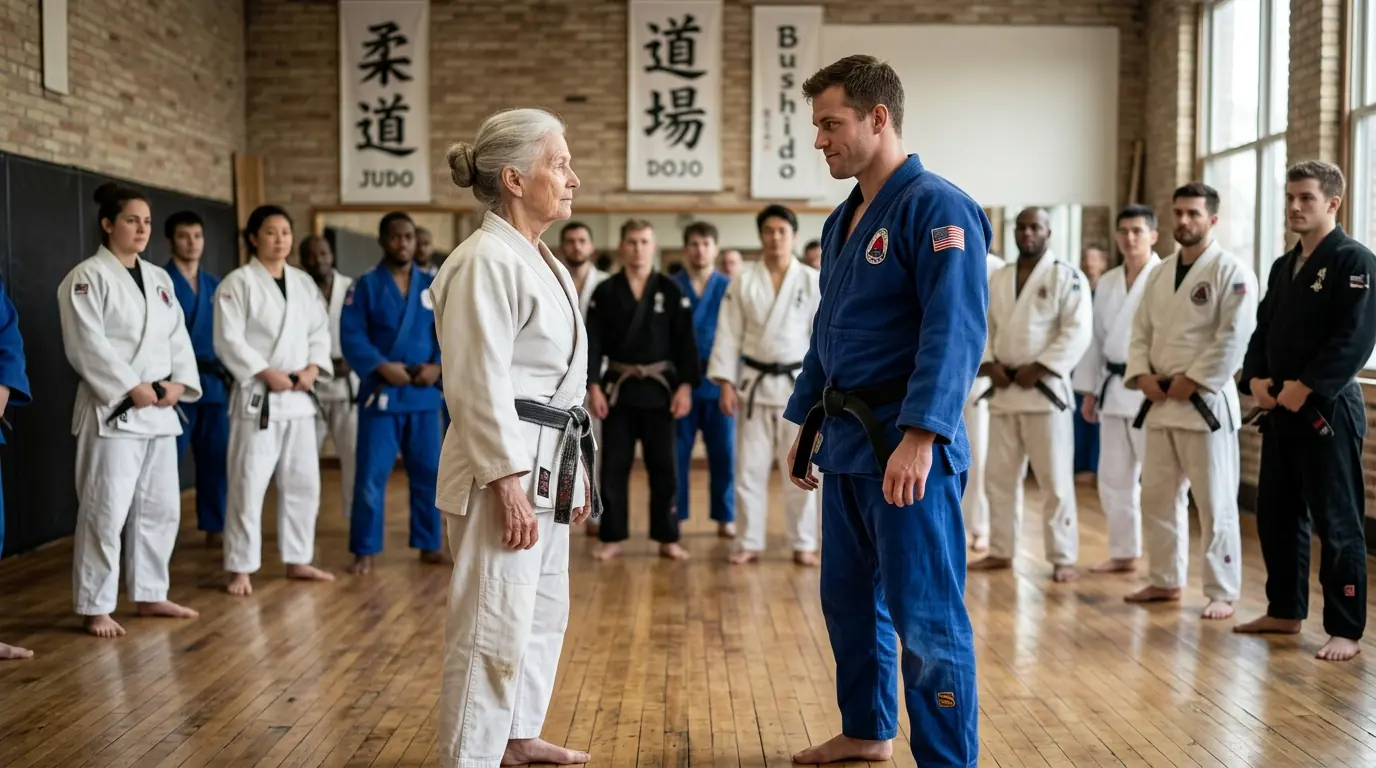
Undeterred, Edith stepped onto the mat and bowed, following traditional dojo etiquette. The chatter in the room gradually diminished as more students noticed the elderly woman in a white kimono.
“Can I help you, ma’am?” Coach Jackson called out, his voice carrying across the suddenly quiet room. “I think you might have wandered into the wrong class. Senior Tai Chi is in the small studio down the hall.”
A wave of suppressed laughter rippled through the room.
Edith remained composed, her expression neutral. “I’m here for the jiu-jitsu class,” she replied, her voice clear and steady. “I recently moved to town, and I’m looking for a new place to train.”
Jackson exchanged glances with several of his senior students, his smile widening. “Train at your age?” He made no attempt to hide his incredulity. “No offense, ma’am, but jiu-jitsu is a physically demanding combat sport. We focus on competition-level training here.”
“I’m aware of what jiu-jitsu involves,” Edith replied calmly. “I’ve been practicing since 1980.”
This elicited more muffled laughter from the class.
Jackson’s smile turned condescending. “Look, Grandma,” he said, emphasizing the word to draw more snickers, “I appreciate your enthusiasm, but this isn’t a beginner-friendly environment. We don’t have time to teach basics to someone who might hurt themselves.”
Edith remained still, her eyes fixed on Jackson. “I understand your concern, but I assure you I can manage.”
“Can you even get up from the ground without help?” called out one of the blue belts, causing another wave of laughter.
Jackson raised his hand, silencing the class, though his own amusement was evident. “What belt do you claim to be?” he asked, emphasizing “claim” with obvious skepticism.
The name meant nothing to most of the students, but Jackson’s expression flickered momentarily. Takahashi was a legendary figure in certain circles, though he had never sought mainstream recognition.
“Well,” Jackson recovered quickly, his smirk returning, “I’m sure things were different back then. Standards have evolved considerably.”
He gestured toward the door with exaggerated courtesy. “Why don’t you observe today’s class from the visitors’ area? That might help you decide if this is really suitable for someone of your… experience.”
The dismissal was clear, delivered with a veneer of professional concern that couldn’t quite mask the underlying mockery. Several students were openly grinning now, clearly enjoying the spectacle.
But Edith Simmons hadn’t spent four decades on the mat to be dismissed so easily.
“I didn’t come to watch,” Edith said, her voice carrying a quiet authority that momentarily silenced the room. “I came to train.”
Coach Jackson’s patronizing smile faltered slightly. Around the room, students exchanged glances, their amusement now tinged with curiosity.
“Ma’am,” Jackson began, his tone deliberately patient, “we have insurance regulations and safety protocols. I can’t just let someone of your condition join an advanced class without proper assessment.”
Edith nodded. “That’s reasonable. Assess me, then.”
A few snickers broke out among the students.
Jackson crossed his arms, his smirk returning. “You want me to assess you? Right now?”
“That’s why I’m here,” Edith replied simply.
Jackson turned to his class with an exaggerated shrug. “Well, folks, looks like we’re changing today’s lesson plan. Apparently, we need to conduct a special evaluation.”
He gestured to a young man wearing a blue belt. “Mike, come here. I need you to help with a demonstration.”
Mike stepped forward, grinning, as Jackson turned back to Edith. “This is Mike Peterson, one of our intermediate students. If you’re serious about training here, show us you can handle a basic exchange with him.”
Edith met Jackson’s gaze steadily. “I’d prefer to work with you, Coach Jackson.”
The room went completely silent.
Someone in the back let out a low, “Oh,” that was quickly hushed.
Jackson’s expression hardened, the mocking humor replaced by something colder. “Me?” he asked. “You want to roll with me?”
“If you’re going to evaluate my abilities, it should be done properly,” Edith said calmly. “You’re the head instructor, aren’t you?”
The challenge hung in the air. Jackson was trapped. Refuse, and he’d lose face. Accept, and he’d have to engage.
After a moment’s hesitation, his arrogance reasserted itself. “Fine,” he said, his confident smile returning. “We’ll do a light demonstration roll, three minutes, just to assess your movement.”
He turned to the class. “Everyone clear the center mat, please.”
As the students formed a circle, Jackson removed his instructor’s patch and laid it aside, making a show of preparation. Edith quietly took her position, her movements unhurried but fluid.
“I’ll go very light,” Jackson announced. “Just basic positions, no submissions. Ready, Mrs. Simmons?”
“Edith Simmons,” she replied. “And I’m ready when you are, Coach.”
“Begin.”
Jackson circled slowly, performing restraint for his audience. “We’ll just work on some basic positioning,” he explained loudly.
He reached for Edith’s sleeve.
What happened next occurred so quickly that many students would later disagree about the sequence.
As Jackson’s hand made contact, Edith shifted her weight almost imperceptibly. Her grip closed over his wrist. In a flash, she executed a perfect sleeve drag, breaking his balance.
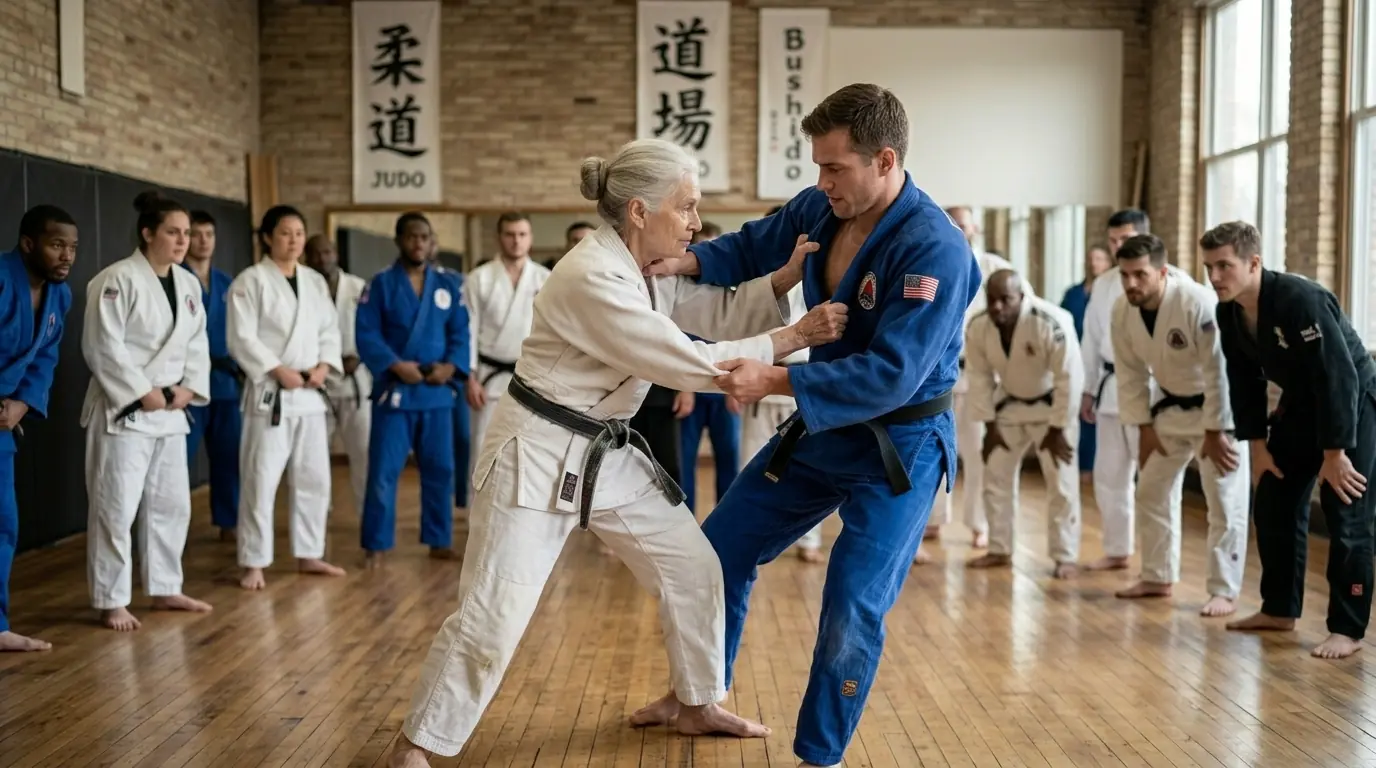
Jackson stepped forward to compensate, walking directly into her setup.
In the next instant, Edith dropped, her legs threading between his, hooking his ankle. Her grip shifted to his collar, pulling him forward as her hips rotated.
Fluid. Precise. Inevitable.
Jackson toppled.
By the time his knees hit the mat, Edith had already transitioned into a dominant mount position, a position no one expected her to achieve.
A collective gasp filled the room.
“What the—”
Jackson tried to recover, but Edith was already moving. Her hands established grips impossible to break without proper technique.
He pushed instinctively.
Mistake.
She redirected, created space, and transitioned seamlessly into an armbar.
Locked.
Perfect.
“Tap!” Jackson gasped, slapping the mat.
Less than 10 seconds.
Silence.
The academy stood frozen.
Edith released immediately, rose, straightened her kimono, and bowed respectfully.
“Thank you for the assessment opportunity, Coach Jackson,” she said calmly. “I hope that addresses your concerns.”
No one spoke.
Jackson slowly stood, his face flushed. “Who are you?” he asked quietly. “Really?”
“I told you,” Edith replied. “Edith Simmons. Second-degree black belt under Master Takahashi.”
Recognition spread.
“You were his top female competitor,” one student said. “Eastern Regionals, three-time champion.”
“That was a long time ago,” Edith said simply.
Jackson bowed. “I owe you an apology.”
Edith nodded. “We all judge. What matters is correcting it.”
A student stepped forward. “Can you show that again?”
Edith glanced at Jackson.
He nodded. “We could all learn something.”
For the next hour, the class became a masterclass. Edith demonstrated technique after technique, explaining leverage, timing, balance.
The room transformed.
Mockery became respect.
Jackson trained beside her, learning.
By the end, he approached again. “I’d like to offer you a position here.”
“I came to train,” Edith replied.
“And we want to learn.”
She considered. “One condition. This dojo must be a place of respect for everyone.”
Jackson nodded. “Agreed.”
Three months later, the academy had changed. Edith’s classes became the most attended. Older students joined. Younger ones improved.
Respect replaced arrogance.
And one afternoon, as Edith stood on the mat, she saw an elderly man with a cane at the door.
Jackson walked to greet him first.
Edith smiled.
Some lessons had nothing to do with fighting.
And everything to do with respect.
By the end of that first hour, the atmosphere inside Elite Martial Arts Academy had changed so completely it felt like a different building.
When Edith had walked in, the room had treated her like an interruption.
Now no one wanted her to leave.
Students who had laughed at her age stood in a loose circle around the mat, listening with the kind of attention they usually reserved for visiting champions. Even the ones who had tried hardest not to be caught staring were staring openly now, but for a different reason. Not mockery. Curiosity. Respect. A kind of disbelief that hadn’t yet settled into understanding.
Coach Adam Jackson stood off to one side, arms folded across his chest, but this time the posture wasn’t defensive. He was watching Edith the way a serious martial artist watches something rare—something that humbles him and sharpens him at the same time.
“Again,” said the student who had recognized her from the old regional championships. His name was Leo, a brown belt in his late twenties. “Please. Can you show the entry again?”
Edith glanced at Jackson first.
He nodded once. “Please do.”
So she did.
She called Jackson back to the center of the mat, though this time he approached without swagger. He bowed properly. She returned the bow. The room quieted.
“The mistake was not his strength,” Edith said, her voice calm and measured. “The mistake was assumption. He assumed I would react late. He assumed my age meant my timing would be slow. In jiu-jitsu, most errors begin before the first grip.”
She positioned Jackson’s hand on her sleeve and demonstrated the opening sequence again, but slower. Now everyone could see it. The slight shift in her weight. The way her hips turned before her upper body moved. The angle of the pull. The redirection of force instead of a collision with it. Nothing about it looked violent. That was what made it so shocking. There had been no explosion, no dramatic athletic burst. Just efficiency. Timing. Structure. The sort of mastery that only came after years of repetition and the humility to stop relying on strength.
“Leverage is a language,” Edith said, resetting the position again. “If you learn it well enough, your body speaks before the other person understands they’ve been answered.”
She looked around the room. “Most of you are trying to win with power. That works right up until it doesn’t. Then you panic. Technique should calm panic, not create it.”
A few students smiled uneasily because she was right.
For the next twenty minutes, the open mat became less of a class and more of a revelation. Edith showed transitions, grip breaks, frames, pressure, and balance. She corrected postures with the lightest touch, and somehow every correction felt more exact than anything they were used to. She never raised her voice. She never embarrassed anyone. But no one left a mistake unexamined after she saw it.
At one point, a young woman with a blue belt named Tasha tried to muscle her way through a guard pass demonstration. Edith gently stopped her.
“You’re trying to force the door,” she said.
Tasha, breathing hard, wiped sweat from her forehead. “Isn’t that the point?”
“No,” Edith replied. “The point is to realize the door was never locked. You’re just pushing in the wrong direction.”
That earned a few quiet laughs, but Tasha laughed too. Then she tried again, slower this time, and finally felt the opening. Her face lit up immediately.
“Oh.”
Edith smiled. “Yes. ‘Oh’ is one of the most important sounds in this room.”
Even Jackson laughed at that.
By the time the session ended, the room was no longer divided into instructor and students, newcomer and regulars, young and old. They were simply practitioners, all standing in the same uncomfortable, wonderful place that growth always required: the realization that there was more to learn than they had been willing to admit.
As students bowed off the mat, several lingered near Edith, wanting to ask questions, wanting to know about Master Takahashi, about the old days, about whether she had really competed in the Eastern Regionals three times, about what jiu-jitsu had looked like when women were still treated as novelties in most dojos. Edith answered what she wished and gently deflected what she did not.
Coach Jackson waited until the crowd thinned.
When he finally approached her, the showmanship was gone. There was no audience left to impress.
“I meant what I said,” he told her. “I owe you an apology.”
Edith slipped a water bottle back into her bag and looked at him steadily. “Yes, you do.”
Jackson took that without complaint.
“I was arrogant,” he said. “And worse than that, I let the room follow me.”
Edith nodded. “People usually do.”
He glanced toward the emptying mats. “I built this place from nothing. At some point, I started thinking that meant I could read everyone the moment they walked in.”
“And can you?” she asked.
His mouth twisted into something like embarrassment. “No.”
“No,” she echoed. “You can’t.”
There was no cruelty in the way she said it. Just truth.
He exhaled slowly. “I want to fix what happened today.”
“You can’t un-happen it,” Edith replied. “You can only learn from it.”
He nodded once. “Then teach me how.”
That question hung in the air longer than he expected. Edith studied him carefully, not as an enemy, not even as a foolish man who had insulted her, but as someone standing at the exact point where character is tested. Regret was easy. Transformation was not.
“You want a real answer?” she asked.
“Yes.”
“You stop treating respect like a reward,” she said. “You stop handing it out only after someone proves themselves useful, impressive, or profitable to you. Respect is the starting point. Everything else comes later.”
Jackson lowered his eyes briefly.
“You make that sound simple.”
“It is simple,” Edith said. “Not easy. Simple.”
Then she picked up her bag and added, “The difficult part is that it must apply to everyone, even the ones who cannot do anything for you.”
That stayed with him long after she left.
When Edith stepped out into the parking lot, the afternoon sun had shifted lower in the sky, turning the academy windows gold. She stood for a moment with her bag slung over one shoulder, feeling the usual ache in her knees, the pull in her lower back, the familiar tiredness that came from using a body honestly. It had been a long time since she’d felt this kind of satisfaction.
Not victory.
Not vindication.
Something quieter.
Alignment.
She had come looking for a place to train.
Maybe, she thought, she had found more than that.
At home that evening, her apartment felt less temporary than it had the day before. The framed photograph of her husband on the bookshelf no longer looked like an accusation. It looked like company.
She set her belt carefully on the kitchen table and made tea. Then she lowered herself into the armchair by the window and looked out at the rows of identical suburban roofs stretching into dusk. Moving here after Harold’s death had felt like being erased and redrawn at the same time. Forty-six years of marriage, and suddenly every room in every place she had known held an absence too large to live beside. So she had sold the house, downsized, and moved to a place where no one knew her history.
For three weeks she had been surrounded by boxes, silence, and the stubborn suspicion that at seventy-two, beginning again was an activity meant for younger people.
Then today had happened.
She smiled to herself and wrapped both hands around the mug.
“You would have loved that,” she said to Harold’s photograph.
In her mind, she could hear his answer as clearly as if he were standing in the doorway grinning. Of course I would have. You always did enjoy proving idiots wrong.
Edith laughed out loud.
The next morning, she wasn’t surprised to find a voicemail waiting on her phone.
“Ms. Simmons, this is Adam Jackson from Elite Martial Arts Academy. I’d really appreciate the chance to speak with you again. Not just about training. About… other possibilities. If you’re willing.”
She listened to the message twice, not because she needed to, but because she wanted to hear whether the humility in his voice held up on a second listen.
It did.
She called him back that afternoon.
When she arrived at the academy again, the receptionist stood up so quickly she nearly knocked over her chair.
“Mrs. Simmons,” she said, cheeks flushing, “I’m really sorry about yesterday. I shouldn’t have suggested yoga just because—”
“Because I looked old?” Edith supplied.
The young woman’s face turned crimson. “Yes. No. I mean—”
Edith lifted a hand. “The honest answer is usually the best one.”
“I’m sorry,” the receptionist said again, more quietly.
Edith nodded. “Then let it make you kinder.”
The young woman swallowed and returned the nod with visible seriousness, as if she understood that this wasn’t a casual exchange. Edith appreciated that.
Jackson was waiting for her in the office overlooking the mats. Without the crowd, the room felt smaller, less theatrical. He didn’t offer her flattery this time. He offered coffee, a chair, and a conversation.
“I want to make you an offer,” he said.
“You said that yesterday.”
“This one’s more specific.”
Edith sat. “Go on.”
“I want you to teach here.”
She raised an eyebrow. “I came looking for a place to train.”
“And we need someone who remembers what training is supposed to be.”
That answer was better than she expected.
Jackson leaned forward, forearms on his knees, no desk between them. “I’ve built a successful academy,” he said. “Competition results, memberships, sponsorships. We’ve grown fast. But somewhere along the way, I think I confused intensity with substance. People are getting tougher here. I’m no longer sure they’re getting better.”
Edith watched him quietly.
“I can teach technique,” he said. “I can coach athletes. But what you did yesterday—what you changed in that room—was bigger than technique.”
She let the silence stretch before responding. “You think one afternoon revealed all that?”
“No,” he said. “I think one afternoon exposed what had already been there.”
That was honest too.
Edith folded her hands in her lap. “If I teach here, I set conditions.”
“I expected that.”
“Everyone bows when they step on the mat, and they understand why. Not because it’s quaint. Because humility is part of the training.”
“Done.”
“No mocking new students. Ever. Not for age, weight, inexperience, nerves, or anything else. A dojo that humiliates beginners is a gym for egos, not a school.”
“Agreed.”
“I’m not here to become your mascot. I will not teach ‘senior self-defense’ while you run the ‘real’ classes.”
Jackson shook his head immediately. “That’s not what I’m offering.”
“Good,” Edith said. “Because I’m not interested.”
He hesitated, then smiled slightly. “Neither am I.”
She continued. “You will have more older students if I stay.”
“That would be a good thing.”
“You’ll also have some uncomfortable younger ones who resent being corrected by someone old enough to be their grandmother.”
“I’m aware.”
“And?”
“And they can either grow up,” Jackson said, “or leave.”
For the first time in that meeting, Edith looked pleased.
Three weeks later, “Coach Simmons” had become a reality no one in the academy could quite imagine they had ever lived without.
Her classes were technically listed as fundamentals and advanced concepts, but that description missed the point. Students left her sessions sweating, frustrated, enlightened, and strangely calmer than when they had arrived. She had a gift for reducing complicated mechanics into principles the body could actually understand. She also had no patience for waste, wasted motion, wasted ego, wasted words.
“Again,” she would say, when a student tried to rush.
Or, “Slower.”
Or her favorite, “If you can’t explain why you did it, you probably didn’t do it on purpose.”
The academy began to change around her.
First came the older students.
A fifty-eight-year-old accountant named Bernard, who had spent years wanting to train but too embarrassed to start, signed up after watching one of Edith’s classes through the viewing window. Then came a sixty-three-year-old retired nurse named Alina, whose doctor had told her to improve her balance before the next fall might break something important. Then a widowed school librarian. Then a grandfather with two replaced hips and a stubborn desire not to spend the rest of his life being fragile.
They came because Edith existed.
They stayed because she never treated them like charity.
“You are not too late,” she told them on the first day. “You are just beginning from where you are. That’s all anyone ever does.”
Younger students started changing too, though more slowly and with greater resistance. Some were embarrassed by how much she saw. Others were quietly thrilled by it. Her classes forced them to confront habits they had mistaken for skill. Muscling through passes. Rushing submissions. Chasing taps instead of understanding positions.
One evening, Leo, the brown belt who had first recognized her name, stayed after class while the others bowed out.
“I think I’ve been doing jiu-jitsu wrong for six years,” he admitted.
Edith, wiping down the mat with a towel, shrugged. “Then you’ve still got time to do it better.”
He laughed. “You make devastating realizations sound very practical.”
“They are practical,” she said. “That’s why people avoid them.”
Leo became one of her most attentive students after that. He arrived early, asked thoughtful questions, and, most importantly, stopped trying to prove he already knew the answers.
Even Jackson changed under her influence, though not all at once. He stopped performing authority so often. He corrected students more carefully. He listened more than he spoke. Once, Edith caught him kneeling on the mat showing a frightened new teenager how to shrimp without making him feel foolish for not understanding the first explanation.
That pleased her more than she let on.
One rainy Thursday, after the evening class, Jackson found Edith sitting on the edge of the mat stretching her left hip with slow concentration.
“I’ve been meaning to ask you something,” he said.
“Then ask it.”
He sat down across from her. “Why did you stay? After what happened the first day, I mean. Most people would’ve walked out.”
Edith didn’t answer immediately.
Finally she said, “Because if I had left, you would have learned embarrassment. Not respect. Those are not the same thing.”
Jackson absorbed that.
“You really think I’m different now?”
“Yes,” she said.
He looked almost relieved. “How can you tell?”
“Because your apologies used to be about how you felt,” Edith replied. “Now they’re about how others were affected. That’s improvement.”
She stood carefully, suppressing a wince as her knee straightened.
Jackson noticed. “You need ice for that?”
“I need twenty-five fewer birthdays,” she said dryly.
He laughed. “That, I can’t help with.”
“No one can,” she said. “Which is why I move.”
By the end of the third month, Elite Martial Arts Academy had a waiting list.
That wasn’t entirely because of Edith, but no one denied her influence. Parents liked what they heard from students. Older adults who had once felt unwelcome in martial arts spaces suddenly had somewhere to go. Young competitors kept training there because, inconveniently for their egos, they improved faster under someone who could dismantle them with a sentence before ever touching them on the mat.
Then came the afternoon that made Edith realize the academy had changed more than even she expected.
It was late, and the regular class had just begun warm-ups. The front door opened, and a man in his late seventies stepped inside. He leaned heavily on a cane, his coat damp from the drizzle outside. His face carried the uncertainty of someone who had convinced himself three times in the parking lot to turn around and go home.
Edith saw him first from across the mat.
So did Jackson.
Without hesitation, Jackson walked straight to the entrance.
No pause.
No look of doubt.
No receptionist redirection.
No skepticism.
He extended his hand and smiled.
“Welcome,” he said. “I’m Coach Jackson. How can I help you?”
The man looked startled by the warmth. “I’m not sure I belong here,” he admitted.
Jackson glanced toward Edith briefly, then back to the man. “That’s alright. Most people who end up belonging somewhere start with that feeling.”
Edith smiled to herself.
The man nodded uncertainly. “My physical therapist said I should look into something for balance and coordination. My daughter thinks I’m crazy.”
Jackson laughed softly. “Families are useful that way. Come in anyway.”
He led the man toward the bench, brought him water, asked his name, and listened.
Listened.
Edith felt something move in her chest then, something close to pride.
Not because Jackson had memorized her language.
Because he had understood it.
After class, when the mats were nearly empty, Jackson approached her with a strange look on his face.
“What?” Edith asked.
He shook his head. “Nothing.”
“That isn’t true.”
He smiled. “I just realized you were right.”
“About what?”
“Respect as a starting point.”
She tilted her head. “And?”
“And I think this place finally feels like a school.”
Edith looked around. Students were laughing while they cleaned the mats. A seventeen-year-old white belt was helping Bernard tape his fingers. Tasha was demonstrating hip movement to the new older student near the wall. No one looked out of place.
“Yes,” Edith said quietly. “I think it does.”
Winter came early that year.
The suburban streets outside the academy turned silver in the morning frost, and the windows fogged from the contrast between cold air outside and hard work inside. Edith arrived each day in the same modest sedan, same plain gym bag, same careful walk from the car. But now when she stepped through the doors, conversations shifted for an entirely different reason.
“Coach Simmons is here.”
Not mockery.
Recognition.
One Saturday, the academy hosted an in-house belt ceremony. Families filled the viewing area. Phones came out. Children bounced on their heels. Adults stood straighter than they needed to. Jackson was scheduled to give the closing remarks, but at the last minute he stepped aside and handed Edith the microphone.
She frowned at him. “What are you doing?”
“Something overdue,” he said.
So Edith stood before a room full of students and families, the microphone feeling ridiculous in her hand, and looked out at faces of all ages.
“I didn’t prepare a speech,” she began.
That earned a few laughs.
“So I’ll say what matters.”
The room quieted.
“A belt is not proof that you are better than someone else,” she said. “It is proof that you are less frightened of learning than you used to be. That’s all. If your rank makes you arrogant, then it is wearing you. You are not wearing it.”
She paused.
“Some of you came here because you wanted confidence. Some of you came because you were afraid of becoming weak. Some of you came because your children insisted, or your doctors warned you, or your lives became smaller than you could bear. All of that is fine. But if you stay, if you truly stay, it must be for something deeper. You stay because learning how to fight should make you gentler with people, not crueler. You stay because discipline without humility becomes vanity. You stay because the mat is one of the few places left where the truth still arrives quickly.”
The room was utterly still.
“And if you ever forget that,” Edith said, glancing once at Jackson before returning her gaze to the students, “start again.”
When she handed back the microphone, the applause rose slowly, then fully.
Not because it was dramatic.
Because it was true.
That night, back in her apartment, Edith placed her black belt across the back of a chair and sat with a heating pad draped over one knee. Her body ached in the ordinary ways it often did now, but she felt an unfamiliar stillness inside herself. Not loneliness. Not even grief. Something better.
Continuation.
She looked at Harold’s photograph on the bookshelf.
“Well,” she said softly, “we did it again.”
She liked to imagine he would have answered the same way he always had when she came home from tournaments or seminars or hard classes years earlier.
Of course you did. You never were very good at becoming less yourself.
Edith smiled.
Outside, a thin layer of snow began to fall.
Inside, the apartment was quiet but no longer empty.
Because grief, she had learned, did not disappear. It changed shape. Sometimes it became memory. Sometimes discipline. Sometimes the courage to walk into a room where no one expects you to matter and matter anyway.
And in the months that followed, people kept joining the academy.
Older men.
Older women.
Teenagers who had almost quit.
Young fighters who suddenly understood that speed and strength were not the same as mastery.
They came for jiu-jitsu.
They stayed for something else.
For the atmosphere Edith had insisted on.
For the culture Jackson had finally learned how to protect.
For the rare experience of entering a room and not having to prove they deserved basic dignity before the lesson even began.
Years later, some of those students would become instructors themselves. Leo would open his own school across town and place one rule above the door: Respect First. Tasha would begin teaching girls’ self-defense workshops and credit Edith with showing her that patience was a force multiplier. Bernard would lose thirty pounds, throw away his blood pressure medication, and tell anyone who asked that beginning at fifty-eight had saved his life.
And whenever they told the story of Elite Martial Arts Academy, they never started with the business growth or the medals or the waiting list.
They started with the day an elderly woman with silver hair tied in a bun walked into the dojo in a neatly pressed kimono and was laughed at by a room full of people who believed youth and appearance could tell them everything.
Then they would pause.
Smile.
And say, “You should’ve seen what happened next.”
Because sometimes the most important lesson in a martial arts school has nothing to do with violence.
Sometimes it begins the moment someone is underestimated.
Sometimes it begins when pride is thrown to the mat in under ten seconds.
And sometimes the most powerful technique a teacher can ever demonstrate is not an armbar, or a sweep, or a choke.
It is respect.
Given early.
Given freely.
Given before anyone has earned the right to impress you.
That was the lesson Edith Simmons brought to Elite Martial Arts Academy.
And that was the lesson that outlasted every bruise, every belt promotion, every class, every season.
Some lessons had nothing to do with fighting.
And everything to do with who you become while you learn.