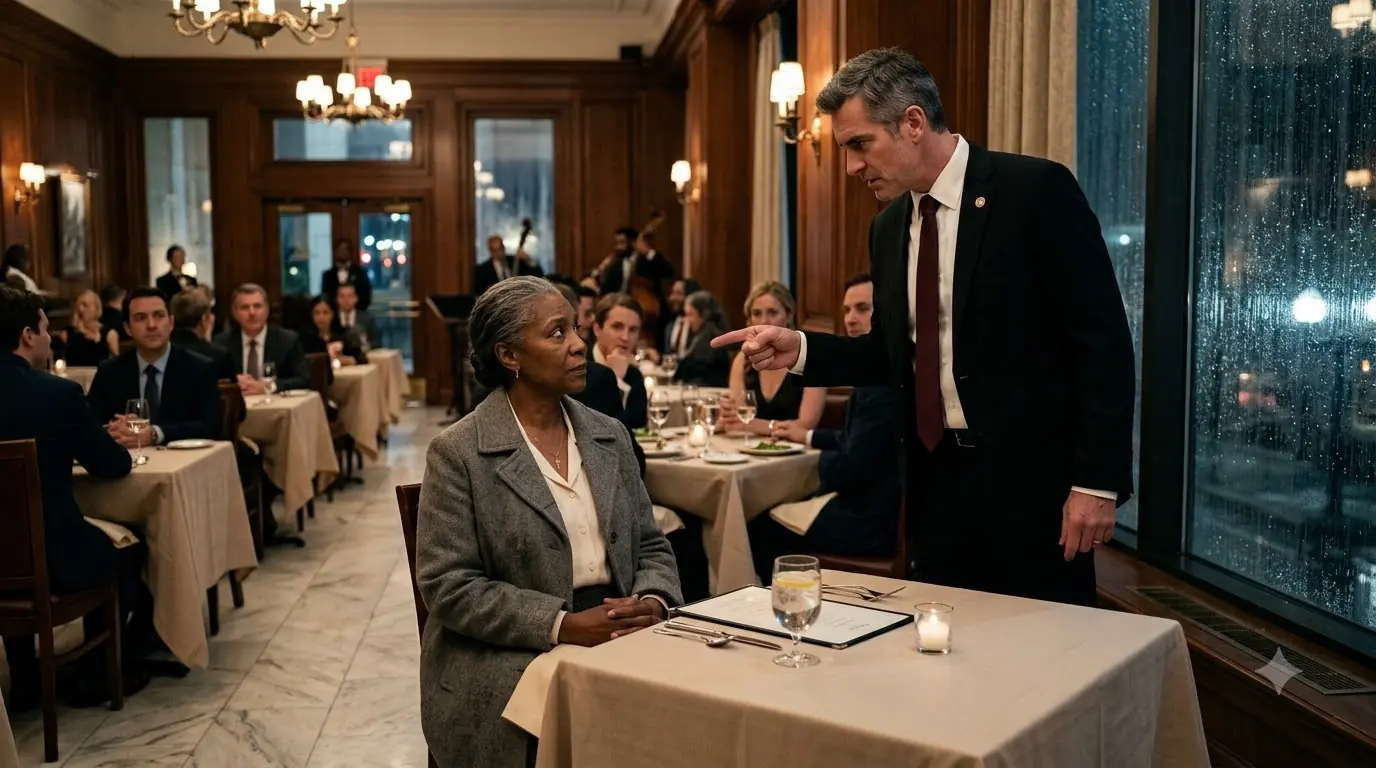
“Get out! You are embarrassing every single person in this room. Get out of my restaurant right now!” Victor Marlow’s voice cut through the elegant dining room of The Meridian like glass breaking across marble.
Victor Marlow’s voice cut through the elegant dining room of The Meridian like glass breaking across marble.
The jazz quartet in the corner stopped playing.
The soft rhythm of forks against porcelain went still.
Forty guests sat beneath warm amber lights and linen tablecloths, staring at the corner table near the rain-streaked window. A candle flickered between polished silverware and a folded white napkin shaped like a fan. Outside, rain slid down the tall glass in thin crooked lines, turning the city lights into blurred gold.
At that table sat sixty-four-year-old Rosa Alvarez.
She did not flinch.
She did not shrink.
She looked up at Victor slowly, unhurried, the way someone looks at a storm they have already decided not to run from.
“My son asked me to meet him here,” she said. “He made a reservation.”
“Your son?” Victor laughed.
It was not a kind laugh.
Several people in the room laughed with him, though not all of them knew why. Some laughed because powerful people make weakness look contagious, and no one wanted to be seen standing too close to it. Others laughed nervously because the sound gave them somewhere to hide their discomfort.
“Lady,” Victor said, loudly enough for everyone to hear, “I do not know what your son told you, but people like you do not walk into places like this on a Saturday night in a coat like that and sit for forty minutes drinking tap water.”
He gestured sharply toward the front windows.
“I have paying guests waiting outside in the rain.”
Rosa glanced toward the windows. Beyond the glass, a small crowd stood under black umbrellas, their reflections wavering in the wet sidewalk light. Some held phones and looked irritated. Some peered inside, hoping a table would open.
Then she looked back at Victor.
“Paying guests?”
He leaned closer, his face tight with irritation.
“Let me be very clear. Your son is not coming. Nobody is coming. If you are not out of that chair in ten seconds, I will have security remove you. Do you understand me?”
Rosa sat perfectly straight.
Her hands were folded in her lap.
In front of her, untouched except for one sip, sat a glass of tap water. A small slice of lemon floated near the rim because a waiter named Eli had placed it there without asking, the way thoughtful people add dignity to small things.
Rosa wore a plain gray coat over a simple blouse, dark slacks, and flat shoes that had walked many miles. She had no jewelry except a thin gold cross at her neck, the one her mother had given her when she was sixteen and the one she had never taken off. Her hair, silver at the temples and pinned neatly at the back, had loosened slightly from the rain.
She had come directly from the hospital.
The old gray coat made her look poorer than she was.
Tired, yes.
Ordinary, certainly.
Invisible to the kind of people who measured worth by fabric, reservations, and the confidence with which someone entered a room.
But Rosa Alvarez had never been ordinary.
Victor did not know that.
He only saw the coat.
The plain shoes.
The absence of diamonds.
The soft voice.
The patient posture.
He saw an elderly Black American woman sitting alone at a prime table in a restaurant where dinner reservations were often made six weeks ahead. He saw someone who did not match the polished atmosphere he believed he had been hired to protect. He saw a problem.
He saw someone easy to remove.
He turned toward a broad-shouldered security employee standing near the entrance.
“Carlo,” Victor said. “Escort this woman out. Now.”
Carlo Torres, thirty-two years old, broad-chested and kind-eyed, shifted uncomfortably. He had worked security at clubs, office towers, charity galas, and private events, and he knew the difference between someone causing trouble and someone being made into trouble. Rosa had done nothing except wait quietly.
“Yes, sir,” he said, though his voice carried reluctance.
He took one step forward.
At that exact moment, the front door opened.
Rain blew in with the cold air.
Daniel Alvarez stepped inside.
He was thirty-eight, tall, composed, and slightly breathless. Water clung to the shoulders of his dark wool coat, and his hair was damp from the sprint between the cab and the entrance. He paused long enough to shake the rain from his sleeve, then scanned the room with anxious eyes.
His meeting had run long.
Traffic had been terrible.
His phone battery had died five minutes before arrival.
For the last twenty minutes, he had been trapped in the back of a cab, staring at a black screen and silently cursing every delayed driver, closed lane, and rain-slicked street between him and his mother.
Then he saw her.
Rosa.
At the corner table near the window.
For one brief second, his face opened into the full smile that still looked exactly as it had when he was seven years old and running into her kitchen after school. He crossed the room quickly, relief breaking through his polished restraint. Then he bent and kissed her cheek.
“Mom, I am so sorry,” he said. “The Marchetti call went forty minutes over, and then the cab got stuck behind an accident near Fifth. I tried to text you, but my phone…”
He stopped.
The smile faded.
He felt the tension before he fully understood it.
The room was too still.
The quartet had stopped playing.
People were watching him with the tense discomfort of those who had witnessed something ugly and were waiting to see whether it would become uglier.
His mother sat too straight.
Too composed.
Too controlled.
Rosa only sat that way when she was holding something in.
Daniel turned toward Victor.
“Is everything all right here?”
Victor took one look at Daniel’s tailored coat, expensive shoes, and controlled expression, and his tone adjusted instinctively.
“Sir, your mother was just leaving. We have a policy.”
Daniel’s eyes narrowed slightly.
“What policy?”
“Guests must be actively dining. We cannot have people occupying tables without ordering.”
Daniel looked at the glass of water.
Then at his mother.
Then back at Victor.
“She told you she was waiting for someone?”
Victor straightened.
“Sir, I understand that it is frustrating, but…”
“Did she tell you she was waiting for someone?” Daniel asked. “Yes or no?”
Victor hesitated.
“Yes, but…”
“And you still asked her to leave?”
Victor did not like Daniel’s tone.
He did not like being questioned in his own dining room.
He did not yet understand that it was not his dining room.
“Look,” Victor said, regaining his sharpness, “I do not know who you are, but I run this restaurant, and I make the decisions here. Your mother sat for forty minutes without ordering. She was holding up a prime table on a Saturday night, and I was not sure either of you planned to order anything at all.”
The room became impossibly quiet.
Victor heard himself.
But pride pushed him forward anyway.
“So while I am still being polite,” he said, “get out. Both of you.”
Silence filled the restaurant again.
Daniel did not raise his voice.
He did not move toward Victor.
He simply looked at him, not with anger or threat, but with something quieter and heavier than both.
Then he reached inside his jacket and placed a plain white business card on the table.
Victor stared at it.
Daniel did not push it toward him.
He let Victor decide whether to pick it up.
After a second, Victor did.
His fingers were still steady then.
They would not be for long.
The card bore Daniel’s name.
Beneath it were four words.
Founder, Rosa Group Holdings.
Victor’s eyes moved once.
Twice.
Then again.
His expression changed slowly, the way a man’s expression changes when the floor under him begins to move and he realizes it is too late to step off.
Rosa Group Holdings owned The Meridian.
Rosa Group Holdings owned eighteen restaurants across four states.
Rosa Group Holdings had purchased The Meridian six months earlier, invested two million dollars in renovation, retained the original staff, and kept Victor as general manager after glowing recommendations from the previous owners.
Victor looked from the card to the framed note on the wall behind the host station.
He had passed that note every day.
Had even quoted it during staff meetings when investors visited.
It read:
Every person who walks through this door is someone’s whole world. Treat them that way.
Victor looked at Rosa.
Then Daniel looked at his mother first.
She sat perfectly straight with her hands folded, completely composed, as though she had already decided to let the entire thing go.
That was what quietly broke something inside him.
“Mom,” Daniel said softly, “did he…”
Rosa did not look away from Victor.
“Ask him yourself.”
Daniel faced Victor again.
“Why did you treat her that way?”
Nothing useful came out of Victor’s mouth.
“Daniel,” Victor began, because now he had found the name on the card and understood the shape of his disaster. “Mr. Alvarez, there has been a misunderstanding.”
Daniel’s voice stayed quiet.
“She told you she was waiting.”
Victor swallowed.
“Yes, but…”