When thirteen-year-old Clara Holt walked into the Red Oak Hollow County Auction Hall carrying a dented cardboard shoebox, every farmer in the room noticed.
Not because she was loud.
Clara rarely wasted words.
Not because she was particularly tall.
She barely reached five feet.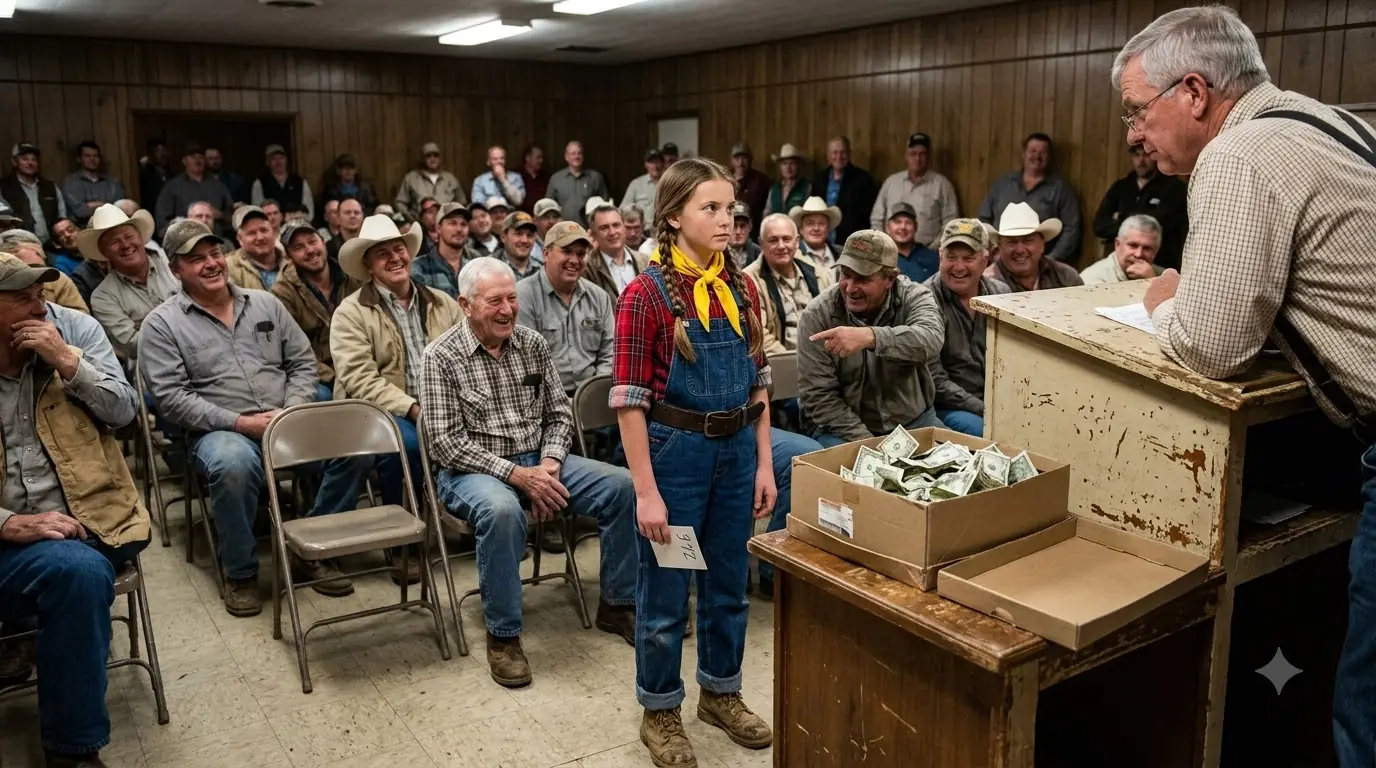
They noticed because she looked like somebody’s daughter who had wandered into the wrong building.
The auction hall was crowded with men who had spent most of their lives measuring land in acres, rain in tenths of an inch, and success by whether the bank manager returned their telephone calls.
They wore washed-out denim.
Brown canvas jackets.
Work caps.
White cowboy hats yellowed around the sweatbands.
Clara stood among them in a cherry-red plaid shirt beneath deep-blue bib overalls, a sunflower-yellow neckerchief tied around her throat, muddy tan boots, and the oversized leather belt that had once belonged to her grandfather.
Her long light-brown hair hung in two thick braids.
Freckles crossed her nose.
The shoebox in her arms was held shut by twine.
Someone near the back laughed before she had even reached the registration table.
“Girl Scout selling cookies?”
Another man answered:
“Wrong season.”
Several people chuckled.
Clara kept walking.
The woman at registration, Ruth Collins, knew her.
Everybody in Red Oak Hollow knew the Holts.
Or knew what remained of them.
Ruth lowered her voice.
“Clara, honey, is your aunt with you?”
“She’s outside.”
“Does she know you're in here?”
“Yes.”
That was technically true.
Aunt May knew Clara had entered the auction hall.
May did not approve.
That was different.
Ruth looked toward the shoebox.
“What are you doing?”
“Registering.”
“For what?”
“Parcel seventeen.”
Ruth stopped.
Behind her, the auctioneer’s assistant glanced up.
Parcel seventeen.
Holt Creek Farm.
The laughter began again before Ruth could answer.
An older farmer named Walter Briggs leaned across two chairs.
“That old death patch?”
Clara looked toward him.
Walter was seventy-two and had known her grandfather.
He was not cruel.
But he was smiling.
“Honey, your granddad couldn't save that place.”
Clara answered:
“He wasn't trying to grow what I’m going to grow.”
That brought louder laughter.
Walter’s smile faded slightly.
“What exactly are you planning?”
Clara looked at him.
“Something that doesn't need me to pretend Oklahoma is Iowa.”
A few men stopped laughing.
Others did not.
Ruth leaned closer.
“Clara, parcel seventeen has almost three years of unpaid county tax attached.”
“I know.”
“Opening bid is twenty-five hundred.”
“I know.”
“You understand this is a real auction?”
Clara set the shoebox on the table.
“Yes.”
Ruth looked toward the front door.
Through the glass, Clara’s aunt May stood beside an old Chevrolet pickup with both arms crossed.
She looked furious.
But she remained outside.
Ruth sighed.
“Your guardian has to authorize.”
Clara reached into her bib pocket and removed a folded document.
Ruth opened it.
Then read again.
The Holt Family Agricultural Trust.
Created by Clara’s grandfather, Samuel Holt, two years before his death.
Beneficiary: Clara Elizabeth Holt.
Temporary trustee and guardian for property transactions: May Holt.
Attached was May’s notarized authorization allowing trust funds and Clara’s separately documented earnings to be used for acquisition of agricultural property at county tax sale, not exceeding $3,200.
Ruth stared through the window at May.
May raised one hand helplessly.
Apparently she had lost an argument at home.
Ruth looked back.
“Where did you get three thousand dollars?”
“Two thousand eight hundred and sixteen.”
“Clara.”
“I sold eggs.”
“I know you sell eggs.”
“And helped Mr. Foster during calving.”
“Mrs. Hensley pays me for garden work.”
“I cleaned stalls at the rodeo grounds.”
“I saved birthday money.”
“I sold my calf.”
Ruth’s expression softened at that.
The calf had been Clara’s favorite.
A red heifer named Penny.
“You sold Penny?”
“Yes.”
“For this?”
“Yes.”
Ruth whispered:
“Your grandfather would either be very proud or extremely angry.”
Clara smiled faintly.
“Probably both.”
Ruth registered her.
Bidder number 47.
By the time Clara entered the main room, word had spread.
The farmers were no longer merely amused by the child carrying a shoebox.
They knew what she intended to buy.
That made it funnier.
Holt Creek Farm had become a local warning.
One hundred seventeen acres about nine miles southeast of town.
The north portion consisted of eroded upland.
The south dropped toward a seasonal creek that had not carried reliable water in years.
A shallow irrigation pond sat almost permanently dry.
The soil had been abused by decades of wheat.
Then cotton.
Then wheat again.
One owner tried sorghum.
Another spent money on fertilizer.
Another deep-ripped the fields and nearly lost his tractor payment doing it.
Nothing created dependable profit.
Three owners in eleven years.
Three failures.
The last, Roy Tanner, walked away after two drought seasons and a failed operating loan.
The county took the land for unpaid taxes.
No bank wanted it.
No serious farmer wanted it.
Which was exactly why Clara did.
Auctioneer Harold Vance walked to the front.
Sixty-four.
Silver hair.
Wire-frame glasses.
Beige checked shirt.
Suspenders.
He knew Clara too.
His expression when he saw her bidder number was disbelief followed by irritation.
Auctioneers liked unusual bidders when unusual bidders had money.
Children with shoeboxes created paperwork.
The first sixteen parcels moved normally.
Pasture.
Two residential lots.
Abandoned machine shop.
Forty acres of river bottom.
Then Harold lifted the Holt Creek packet.
“Parcel seventeen.”
The room quieted.
He looked directly at Clara.
“One hundred seventeen acres, more or less, former Tanner holding, previously Holt Creek Farm.”
Walter Briggs whispered:
“Previously disaster.”
Someone laughed.
Harold continued.
“Tax sale transfers subject to recorded easements. No warranty on structures, water rights, improvements, fencing, soil quality, mineral title, or continued sanity of buyer.”
That line was not official.
The room laughed.
Clara did not.
“Opening bid twenty-five hundred.”
Silence.
Harold scanned the room.
“Twenty-five?”
Nothing.
“Gentlemen, somebody needs a place to dump rocks.”
Laughter.
Then Clara raised bidder card 47.
Harold stared.
“Twenty-five hundred.”
More laughter.
He adjusted his glasses.
“Bidder forty-seven, I need the authorized adult representative.”
May entered from the rear.
Every head turned.
She walked to Clara.
May Holt was forty-one, broad-shouldered, exhausted, and clearly wanted to be anywhere else.
“She has authorization.”
Harold frowned.
“May.”
“I know.”
“You're letting her buy Holt Creek?”
May looked at Clara.
“No.”
The room laughed.
May continued:
“I am failing to stop her from buying Holt Creek.”
That made even Harold smile.
He looked around.
“Twenty-six?”
No one bid.
“Twenty-six hundred?”
Walter Briggs raised one hand jokingly.
Harold pointed.
“You bidding?”
Walter immediately lowered it.
“Hell no.”
Laughter exploded.
Clara’s cheeks reddened.
Harold looked at her.
“You sure about this?”
“Yes.”
“Girl, grown men have burned fortunes on that farm.”
Clara held his gaze.
“Then they should stop bidding.”
A few chuckles.
Different now.
Harold resumed.
“Twenty-five hundred once.”
“Twice.”
Then from the rear:
“Twenty-six.”
Clara turned.
Frank Dobbins.
Fifty-six.
Large wheat farmer.
He was smiling.
Not because he wanted the farm.
Because he wanted to tease her.
Clara knew immediately.
Harold frowned.
“Frank?”
“Twenty-six hundred.”
Clara raised her card.
“Twenty-seven.”
Frank laughed.
“Twenty-seven fifty.”
May grabbed Clara’s arm.
“Don't.”
Clara looked at her.
“He doesn't want it.”
“That doesn't mean he won't make you pay.”
Clara looked toward Frank.
“Twenty-eight hundred.”
The room reacted.
That was almost everything.
Frank leaned back.
He could have said twenty-eight fifty.
Clara knew it.
He knew she knew.
Then something in his face changed.
Maybe he saw the shoebox.
Maybe he remembered Samuel Holt.
Maybe the joke stopped being funny.
Frank lowered his hand.
Harold waited.