At the family dinner, I was lifting my glass when I heard it.
My father's voice cut through the chatter like a blade. "Nobody needs your money or you."
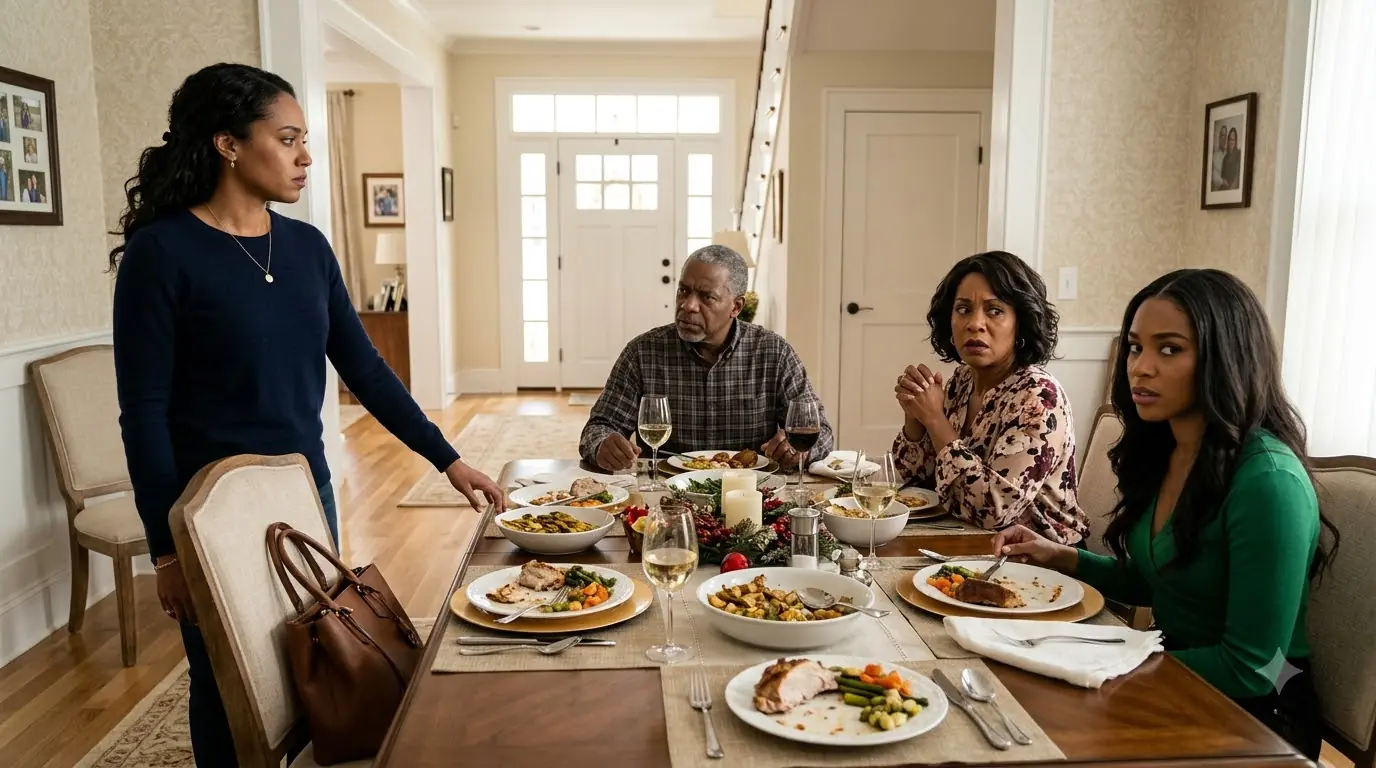
The room didn't even flinch. My sister nodded, almost amused, as if she'd been waiting to hear it said out loud for years.
Heat crawled up my neck, but I kept my face steady, my smile small, my silence sharper than anything they threw at me. They thought I'd swallow it the way I always did, but sitting at that table surrounded by people who only valued what I provided, I knew something they didn't. Their downfall had already begun.
I grew up in that house believing silence was the price of belonging. My parents never said it outright, but it lived in the pauses between their sentences, those tiny, sharp moments where I learned my value came from what I could give, not who I was.
Even as a kid, I filled the gaps. If Sarah forgot her homework, I ran it to school. If Dad needed someone to stay home with Grandma, I canceled my plans. When Sarah hit adulthood and her bills started piling up, somehow they all ended up in my hands, too. They called it being the reliable one, but reliability turns into servitude fast when no one asks how you're doing.
On the outside, my family looked warm, tight-knit, loud in a good way. Holiday photos, matching sweaters, my mom's famous sweet potato casserole sitting in the middle of the table like a trophy. People always said we were lucky, but the kind of luck they meant was the pretty kind, the kind you can frame, not the kind that keeps you safe.
Grandma was the only person who ever looked at me and didn't see utility. I still remember her tiny kitchen, the smell of peppermint tea and old books, the way her hands would rest on mine when she said, "You don't have to save the whole world, honey." Back then, I didn't realize she meant my world, my family. After she passed, that kitchen became my sanctuary. I kept the key, and I kept the memory of someone who saw me.
Back at the dinner table, the same table I'd spent decades setting, clearing, and cooking for, I sat between people who had rewritten me in their heads. Not Maya the project manager, not Maya who paid her own rent and built her own life, but Maya the one who fixes things. The one who always shows up. The one who covers the bill. The one who doesn't complain.
Dad didn't even look up when he said the words. Mom just kept slicing the ham. Sarah smirked into her wine. Somehow, in that moment, everything clicked into place like a door finally shutting. That house wasn't mine. It never had been.
Maybe that's why their words didn't crush me the way they expected. It hurt. God, it hurt, but it didn't break me. It clarified things. It made the air sharp and the path forward clean.
I realized something no one at that table had ever imagined. I didn't need them either. Not their approval, their guilt, their rules, or the seat they thought they had the right to take away. For the first time in my life, the silence didn't feel like surrender. It felt like a beginning.
The dinner kept going as if nothing had happened. Plates scraped, glasses clinked, and someone laughed at a joke I didn't hear. Inside my head, everything went still, like the world had dropped into slow motion. I watched my family the way you watch strangers on a train, curious, detached, wondering how you ever thought you belonged among them.
Sarah leaned back in her chair, swirling her wine like she'd won something. "Mom's right," she added casually. "You take things too seriously, Maya. No one needs all that you do. Not really." She said it like a kindness, like she was easing a burden off my shoulders.
But what she really meant was, "You're only useful when we want you to be." I glanced at the sister whose late bills I'd paid, whose kids I'd bought school clothes for when she was between jobs, whose emergencies somehow always landed in my lap. She never remembered the details, only the convenience, only the expectation.
Mom finally looked up from the ham she was slicing. "You work so much anyway," she said. "It's not like you have a family of your own to worry about. We don't want you burning yourself out for nothing." For nothing. That one stung more than I'd admit.
As if every hour I spent climbing my career, every quiet effort to build a life by myself, was worthless because it wasn't serving them. Dad didn't even glance my way when he muttered, "Let's not make this dramatic. It's just the truth. You take things personally." It was gaslighting with a coat of polite varnish. They had long mastered the art.
I looked around the table, the candles, the holiday centerpiece, the empty chair Grandma used to sit in. I used to think her absence left a simple ache, but now it felt like a warning I hadn't listened to soon enough. Sarah dropped her fork, annoyed by my silence. "Come on, Maya, say something."
But I didn't trust my voice. Not because I was afraid of what they'd think, but because anger like that, quiet, precise, razor-sharp, doesn't want to be spoken. It wants to be acted on.
I reached for my napkin, folded it neatly, and set it by my plate. A simple motion, but it shifted something in the room. Sarah noticed first. Her brow tightened. Mom paused mid-slice.
I stood, calm as the surface of a frozen lake. "I hear you," I said softly, "loud and clear." Dad waved a hand dismissively. "Good. Then we can move on." But the truth was, that was the moment I moved on from the version of myself they'd built.
The Maya who bent, who fixed, who carried. The Maya who gave without asking, who stayed small so others could stay comfortable. As I walked toward the hallway to grab my coat, I felt something inside me settle into place. Not a crack, not a break, but a decision.
They wanted me silent. Fine. Silence was exactly what they would get. And they had no idea what silence from me actually meant.
I didn't slam the door when I left. I didn't storm out or raise my voice. I simply stepped into the cold night, letting the air bite at my cheeks as if it could keep me from sinking too deep into the hurt. The porch light flickered behind me, and for a second I saw my reflection in the window, tired eyes, tense shoulders, the familiar posture of someone who'd carried too much for too long.
The walk to my car felt longer than usual. Each step peeled back another layer of memory: every time I'd shown up with groceries when Sarah forgot payday, every emergency bill Mom guilted me into covering, every moment Dad praised my reliability only to punish me with it later. By the time I reached the driver's seat, a quiet tremor ran through my hands. Not from fear, from recognition, from clarity.
At home, the silence hit harder than their words. I turned on the hallway lamp, soft light spilling across my small, tidy living room. The space had always felt like a pause between battles. That night, it felt like neutral territory finally reclaimed.
I sat at my dining table, pulled my laptop closer, and opened a folder I'd never dared start before. "Family Payments." The name looked foreign, almost clinical. But the truth inside it wasn't new: bank statements, transfers, receipts I'd buried under rationalizations like, "They needed help," or, "It's just this once."
I went through them slowly, like someone sorting through the wreckage of a house after a storm. Patterns jumped out: repeated withdrawals, emergency charges, late-night transfers. The timeline formed itself, sharp and undeniable. For years, I thought speaking up would make me cruel, but silence had made me disposable.
The decision arrived gently, the way dawn touches a dark room. No drama, no breakdown, just a shift. I sent an email to a lawyer whose name Jen had mentioned months earlier. She once told me, "If you ever get tired of being their safety net, call him." Back then, I laughed it off. Now it felt like the most natural thing in the world.
I attached everything, every receipt, every transfer, every message. My cursor hovered over the send button. I breathed once, steady, and clicked. The file left my inbox, quiet and final. They wanted a silent Maya. They were getting one, just not the version they expected.
The reply from the lawyer came faster than I expected. "I've reviewed what you sent," he wrote. "This isn't just family help. It's a pattern of financial exploitation. If you're ready, we can move forward."
Ready? I stared at that word. Then I saw Dad's bored face in my mind, heard him say, "Nobody needs your money or you," and saw Sarah smirking into her wine. I typed back one sentence. "I'm ready."
The days that followed were different. I wasn't patching holes in someone else's boat. I was building a case. I met the lawyer in a small office downtown, and he listened while I laid everything out, from the first borrowed payment to the night they told me I wasn't needed.
He asked questions, dates, amounts, exact phrases from their texts. "You understand," he said once, "once we file, this stops being private. It becomes a legal matter." "They stopped being just family when they treated me like a walking account," I said.