“Sign here.”
Clara Bellwood looked down at the paper as if the ink itself might burn her.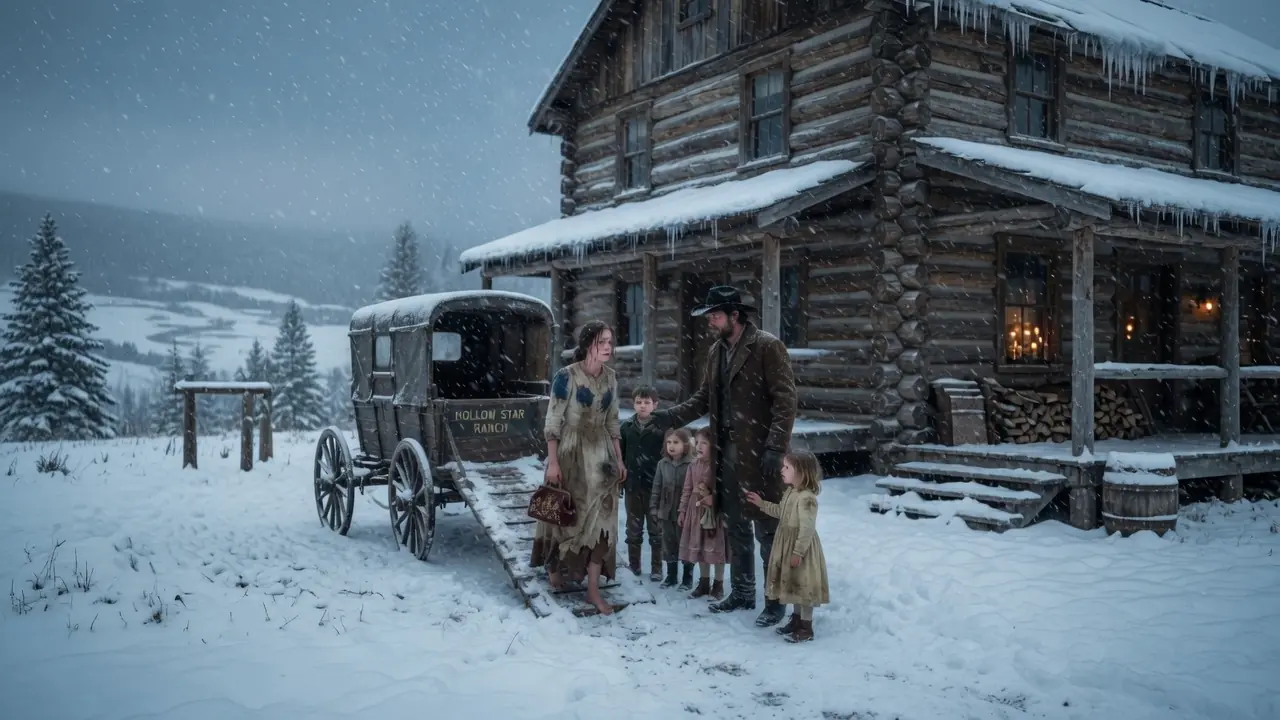
The attorney’s office smelled of dust, tobacco, and old leather. Outside the window, November wind dragged dry leaves along the boardwalk of Elk River Crossing, Montana Territory, making them scratch against the glass like small desperate hands.
Three hundred dollars.
That was the price written into the agreement.
Enough to bury her father properly. Enough to keep her mother and younger siblings from freezing through the winter. Enough to pay the store debt, buy flour, and keep her fourteen-year-old brother out of the mines for at least one more year.
Clara was nineteen years old.
And by morning, she would belong to a man she had never met.
Not belong, she told herself.
That was an ugly word.
But the paper did not soften the truth simply because it used cleaner language. It called the arrangement a lawful marriage contract between Miss Clara Bellwood and Mr. Gideon Rusk of Hollow Star Ranch, a widower in need of domestic care for five minor children.
Domestic care.
That meant cooking.
Cleaning.
Laundry.
Sewing.
Children.
A dead woman’s place at a table that had not yet stopped mourning her.
Mr. Ambrose Peale, the attorney, tapped the end of his pen against the document.
“You understand the terms?”
Clara’s mouth felt dry.
“I understand.”
“Say it clearly.”
Her mother made a small broken sound from the corner chair.
Clara did not look at her.
If she looked at her mother, she might not sign. And if she did not sign, Samuel would go to the silver mines before Christmas. Little Beth would keep coughing through the night. Their father’s grave would remain marked with a rough board instead of a proper stone.
So Clara kept her eyes on the paper.
“I agree to marry Gideon Rusk of Hollow Star Ranch in exchange for three hundred dollars paid to my family.”
Mr. Peale watched her over the rim of his spectacles.
“And you enter the agreement freely?”
Freely.
The word was almost cruel.
Choice looked different when hunger stood behind it with both hands on your shoulders.
“Yes,” Clara said. “Freely.”
The pen scratched across the page.
Her name appeared in black ink.
Clara Bellwood.
It looked too small to carry the end of a life.
Mr. Peale sanded the signature, folded the document, and stamped it with his seal.
“The stage leaves at dawn. Mr. Rusk’s foreman will meet you in Cedar Vale. The wedding will be performed once you reach the ranch.”
Clara stared at him.
“That quickly?”
Mr. Peale finally lifted his eyes.
“My dear girl, you are not being courted. You are solving a problem.”
Her fingers tightened around the edge of the chair.
“A problem.”
“Five children without a mother. A ranch without a woman to run the household. A family in financial distress on your side. Everyone receives what they require.”
Clara stood.
Her legs felt distant from her body.
“And what do I receive?”
Mr. Peale’s expression did not change.
“Survival.”
That night, Clara packed everything she owned into one trunk.
Three dresses.
A winter shawl.
A pair of worn boots.
Her mother’s Bible.
A small framed photograph of her father from before sickness carved his face thin.
A book of poems her schoolteacher had once given her because she said Clara had “a mind that should not be wasted on washing floors forever.”
Clara stared at the book for a long while before placing it in the trunk.
She had wanted to teach.
That had been the plan once, back when plans were things her family could afford. She had imagined a little schoolhouse, chalk dust on her fingers, rows of children learning words that might open doors.
Now she was going to a ranch to raise someone else’s children.
Maybe, she thought, the plan had changed its clothes but not its heart.
A knock came at her bedroom door.
“Clara?”
It was Samuel.
His voice had started cracking that autumn, half boy, half man, all grief.
“Come in.”
He slipped inside, tall and thin, with their father’s brown eyes and their mother’s stubborn chin.
“I heard what you did.”
“It is not a secret.”
“You sold yourself.”
Clara folded a dress and placed it carefully in the trunk.
“I made an arrangement.”
“For us.”
She did not answer.
Samuel crossed the room and grabbed her wrist.
“I can work. I told Mama. I can go to the mines. Mr. Harlan says they take boys my age if they’re strong enough.”
“The mines killed Papa.”
“Papa was sick already.”
“Samuel.”
She turned and took his face between her hands, forcing him to look at her.
“You are fourteen. Beth is eleven. Daniel is six. Mama has not eaten a full meal in two days because she keeps pretending she is not hungry. If I do not do this, you will all suffer for my pride.”
His eyes filled.
“What about you?”
Clara smiled, though it hurt.
“I have survived worse than fear.”
“No, you haven’t.”
That nearly broke her.
Because he was right.
She hugged him hard.
“You will write to me.”
“I don’t want to write. I want you to stay.”
“You will write,” she repeated. “Tell me about school, and Mama, and whether Daniel still puts frogs in his pockets. Tell me everything.”
Samuel clung to her.
“I should be protecting you.”
“You are,” she whispered. “By living.”
The stagecoach left before sunrise.
Clara did not look back until Elk River Crossing was a blur behind the dust and frost on the window.
Three days later, she arrived in Cedar Vale with numb feet, a stiff back, and a heart that had gone quiet from too much dread.
The town was smaller than she expected.
One main street.
A church with a plain steeple.
A mercantile.
A livery stable.
A saloon with music leaking from the door even before noon.
Beyond it all rose the mountains, dark blue and snow-capped, watching over the valley like old judges.
A man waited beside a wagon.
He was in his fifties, broad through the chest, with a gray mustache and a hat held politely in both hands.
“Miss Bellwood?”
“Yes.”
“Jonas Pike. Foreman at Hollow Star. Mr. Rusk sent me.”
Clara looked past him.
“He did not come himself?”
Jonas hesitated.
“Mr. Rusk has five children and a calving season that came early. Man’s been stretched thin for a long while.”
That was not an answer.
But Clara was learning that most answers did not arrive whole.
Jonas loaded her trunk and helped her into the wagon. As they pulled away from Cedar Vale, the sky darkened with the promise of snow.
“What are they like?” Clara asked after nearly an hour of silence.
“The children?”
“Yes.”
Jonas exhaled slowly.
“Well. Adam is ten. Thinks he’s grown and the rest of the world is disappointing him. He’s been trying to run the house since his mother passed.”
Clara looked down at her gloved hands.
“And the others?”
“Lucy is eight. She hasn’t spoken a full sentence in nearly a year. Not since she saw her mother die.”
Clara’s throat tightened.
“Micah is six. Quick temper. Good heart, but he hides it under noise. Elsie is four and frightened of her own shadow. And the baby, Pearl, is near three. Doesn’t remember her mama, which may be mercy or tragedy. I haven’t decided.”
Five children.
Five wounds.
“And Mr. Rusk?”
Jonas’s eyes stayed on the road.
“Gideon Rusk is a good man who forgot how to be one where anyone could see.”
That answer stayed with Clara for the rest of the ride.
Hollow Star Ranch appeared near dusk, spread across a wide valley edged by pines and frozen creek beds. The main house was two stories, built of sturdy timber and gray stone, with smoke rising from two chimneys. A large barn stood to the east, and beyond it cattle moved like dark shadows against the snow.
Before the wagon stopped, the front door opened.
A little girl with honey-brown hair and solemn green eyes stood in the doorway, clutching a rag doll by one leg.
“That’s Elsie,” Jonas said softly. “Don’t be troubled if she runs.”
Clara climbed down.
Her whole body ached from travel, but she crouched slowly to the child’s level.
“Hello,” she said. “I’m Clara.”
Elsie stared.
Then she took three careful steps forward.
She reached out and touched Clara’s cheek with one finger, as if testing whether she were real.
“You’re warm,” Elsie whispered.
The words pierced Clara straight through.
Before she could answer, a boy’s voice came from inside the house.
“Elsie, get back.”
Adam stood in the doorway with a face too hard for ten years old. He had dark hair, gray eyes, and the posture of someone who had been carrying adult burdens so long he had forgotten how to set them down.
“We know why you’re here,” he told Clara.
“Then perhaps you can explain it to me later,” Clara said.
That surprised him.
From the corner of the house came another voice.
“Children inside.”
It was deep.
Rough.
Tired.
Clara turned.
Gideon Rusk stood near the barn, snow dusting his shoulders. He was thirty-one, maybe thirty-two, but grief had carved extra years into his face. Dark beard. Broad frame. Work-worn hands. A man who looked as if he had not slept properly since the last time he was happy.
His eyes were not cold exactly.
They were guarded.
Like a house with every window boarded from within.
“Miss Bellwood.”
“Mr. Rusk.”
The children disappeared into the house.
Elsie went last, looking back once.
Gideon removed his hat.
“Walk with me.”
It was not quite a request.
Clara followed him to the corral fence. The wind cut through her coat, but she refused to shiver where he could see it.
“I need to say this plainly,” Gideon began. “I did not want this.”
Clara looked at him.
“Neither did I.”
He nodded once, as if that was fair.
“I tried for two years to manage alone. I told myself the children needed their father more than they needed a stranger.”
“But?”
“But Adam is turning into an old man before he reaches eleven. Lucy vanished inside herself. Micah fights every boy in sight. Elsie cries if the pantry door slams. And Pearl…”
His voice caught.
He looked toward the house.
“Pearl reaches for every woman who comes through that door.”
Clara said nothing.
Snow began to fall between them.
“I cannot be their mother,” Gideon said.
“So you bought one.”
The words came sharper than she intended.
His jaw tightened, but he did not defend himself.
“Yes.”
That honesty was worse somehow.
“Does that make you hate me?” he asked.
Clara looked across the darkening valley.
“I do not know you well enough to hate you.”
Something flickered in his face.
“That may be the kindest thing anyone has said to me in months.”
“It was not meant as kindness.”
“No,” he said. “I expect not.”
They stood in silence.
Then Clara turned back to him.
“I have questions.”
“Ask.”
“Will I be treated as a servant or a wife?”
Gideon’s eyes shifted to her face.
“A wife, in name and household authority. I will not ask obedience beyond reason.”
“Will the children be allowed to decide what I am to them?”
“Yes.”
“Will you expect me to share your bed?”
The silence after that was long and heavy.
Finally, Gideon said, “No. Not unless you choose it. Not tonight. Not after the wedding. Not ever because of a paper signed in an attorney’s office.”
Clara breathed for the first time in what felt like hours.
“Good.”
He looked almost relieved that she had asked.
“The reverend comes in the morning,” he said.
“So soon?”
“The attorney arranged it.”
“Of course he did.”
A faint grimness crossed Gideon’s mouth.
“You will have the house to run as you think best. The kitchen, meals, children’s lessons, clothing, schedules. Jonas can help with supplies. I will not interfere unless asked.”
“And where will you be?”
“In the barn. In the fields. With the cattle. Wherever I am least in the way.”
Clara studied him.
“You think grief makes you dangerous to them.”
His eyes darkened.
“I know it does.”
Then he walked away before she could answer.
The house was quiet when Clara entered.
Too quiet.
She found the children in the main room near the fire, arranged like pieces of a broken portrait. Adam stood by the mantel. Lucy sat in a rocking chair, hands folded, eyes fixed on nothing. Micah lay on his stomach near the hearth, turning a wooden soldier over and over. Elsie hovered near the wall. Pearl slept in a cradle with red curls glowing in the firelight.
“I’m hungry,” Micah announced.
Adam straightened.
“I can make supper.”
“No,” Clara said gently. “You can show me where things are.”
“I know how.”
“I believe you. But I am here now.”
Adam stared at her, suspicion and exhaustion fighting across his face.
Then he nodded.
The kitchen was well stocked but neglected in the way rooms become neglected when nobody has the heart to care for them. Flour sacks leaned open. Potatoes sat in a bin. Jars of preserved peaches and beans lined a shelf. A loaf of bread, hard at the edges, rested under a cloth.
Clara rolled up her sleeves.
“We can make potato soup and biscuits.”
“Mama made biscuits with honey,” Micah said from the doorway.
Clara turned.
“Then I will make biscuits with honey.”
“They won’t taste like hers.”
“No,” Clara said. “They will taste like mine.”
Adam watched her carefully.
“You’re not going to pretend to be her?”
“No.”
“Good.”
That was all he said.
But he stayed in the kitchen and peeled potatoes beside her.
It was not trust.
But it was work shared.
Sometimes work was where trust began.
Supper was awkward.
Pearl woke and stared at Clara with round blue eyes, then immediately reached for her. Clara lifted the little girl without thinking, and Pearl settled against her shoulder like she had been waiting.
Gideon came in late, snow on his boots and fatigue on his face.
Clara had left a bowl warming near the stove.
“Your supper,” she said.
He looked at the table, where the children sat together.
Then toward the back door.
“I usually eat in the barn.”
“Not tonight.”
He looked at her.
“It is our first night under the same roof,” she said. “If we are to become a family, we can start by eating like one.”
Adam looked down at his bowl.
Micah stopped chewing.
Elsie held her spoon very still.
Gideon stood there as if faced with a firing squad.
Then he sat.
The meal did not transform anything.
No angels sang.
Lucy did not suddenly speak.
Gideon barely said three words.
But Micah spilled water across the table, froze in terror, and Gideon did not yell.
Clara saw the child brace.
She saw Gideon see it too.
The shame that crossed his face was quick, but real.
“It’s only water,” Gideon said roughly. “Fetch a towel, son.”
Micah blinked.
Then ran.
Clara felt something shift.
A crack in the wall.
After the dishes were done and the children climbed upstairs, Clara turned to Gideon.
“Micah thought you would be angry.”
Gideon stared at the empty table.
“I have been angry too often.”
“Have you struck them?”
His head snapped up.
“No.”
“I had to ask.”
“I know.”
His answer surprised her.
He rubbed one hand across his face.
“After Elise died, I shouted. Not at them, maybe, but around them. At the house. The doctor. God. The stove when it smoked. A bucket when it tipped. Anything. Everything.”
“Elise was your wife?”
He nodded.
“Elise Rusk. Their mother.”
The name entered the room gently, like a ghost allowed to sit.
“She died giving birth to Pearl,” he said.
Clara’s eyes moved toward the cradle.
“That is why you avoid the baby.”
Pain tightened his mouth.
“I do not avoid her.”
“You do.”
He had no answer.
Clara softened her voice.
“She did not take her mother from you.”
Gideon closed his eyes.
“I know that in my head.”
“Then your heart needs time to learn it.”
He looked at her for a long moment.
“You speak like someone twice your age.”
“I became practical early.”
“I am sorry for that.”
No one had said that to her before.
She looked away first.
The wedding happened the next morning in the main room.
Reverend Silas Crane arrived with snow in his beard and kindness in his eyes. The children stood near the hearth in their Sunday clothes. Pearl chewed on the sleeve of Adam’s jacket. Elsie clung to Clara’s skirt. Lucy sat in the rocking chair, watching with her quiet gray eyes.
Gideon wore a black suit that fit poorly through the shoulders.
Clara wore her best brown dress.
No flowers.
No music.
No mother to kiss her cheek.
No brother to stand proudly by.
Just vows spoken before a fire while wind pressed against the windows.
“Do you, Gideon Thomas Rusk, take Clara Mae Bellwood to be your lawful wife?”
“I do.”
“Do you, Clara Mae Bellwood, take Gideon Thomas Rusk to be your lawful husband?”
Clara swallowed.
“I do.”
When Reverend Crane said Gideon could kiss the bride, the room went so still that even the fire seemed to pause.
Gideon turned to her.
His eyes asked permission.
Clara gave the smallest nod.
He bent and brushed his lips against her cheek.
Brief.
Respectful.
Over before anyone could turn it into something else.
“Mrs. Rusk,” the reverend said.
The name felt borrowed.
After he left, Micah asked, “Does this mean she’s Mama?”
Adam stiffened.
Gideon opened his mouth, but Clara spoke first.
“It means I am Clara, and I will care for you. What you call me can grow in its own time.”
Micah thought about that.
“Can Clara make pancakes?”
“Yes.”
“With honey?”
“Yes.”
“Then Clara is fine.”
Elsie looked up at her.
“You stay?”
The question was so small it hurt.
Clara crouched and took the child’s cold hands.
“I stay.”
“Promise?”
Promises were dangerous.
Clara knew that.
But some children could not live without them.
“I promise.”
Elsie climbed into her arms.
Gideon turned away, but not before Clara saw his face.
Grief.
Relief.
Fear.
All of it at once.
The first weeks were exhausting.
Clara woke before dawn and slept after everyone else. She cooked, cleaned, mended, scrubbed, organized, and learned the rhythm of the ranch house. She found schoolbooks in a trunk and began lessons after breakfast. She gave Adam chores that suited a boy instead of a substitute father. She taught Micah to knead dough when his temper needed somewhere safe to go.
Elsie followed her everywhere.
Pearl became her shadow.
Lucy remained silent.
That silence worried Clara most.
The child sat at windows, watched doorways, held her mother’s old sewing basket, and seemed to exist in a place no one else could enter.
Clara did not force her.
She sat near her sometimes and sewed.
Or read aloud.
Or hummed.
Nothing more.
One afternoon, as snow hammered the windows, Clara began singing without planning to. An old lullaby her own mother had sung when Beth was small.
“Hush now, little sparrow, fold your wings tonight…”
She stirred soup while she sang, keeping her back turned.
Behind her, barely audible, another voice joined on the second line.
Weak.
Rusty.
Real.
Clara’s hand froze around the spoon.
She did not turn.
She kept singing.
Lucy sang with her through the whole verse.
When the song ended, the kitchen fell silent.
Then Clara turned.
Lucy stood near the window, tears running down her face.
“I forgot the words,” she whispered.
Clara crossed the kitchen slowly and knelt.
“Then we will learn them again.”
Lucy’s mouth trembled.
“If I talked, I thought I would forget Mama’s voice.”
Clara felt her own eyes burn.
“Oh, sweetheart.”
Lucy broke then.
Not delicately.
Not prettily.
She folded into Clara’s arms and sobbed with a force too big for her small body. Two years of silence came out in broken words.
“I held her hand.”
“I told her not to go.”
“She went anyway.”
“I thought if I stayed quiet, I could still hear her.”
Clara held her and rocked her gently.
“Your voice does not push hers away,” she whispered. “It carries it.”
When Gideon came home that evening, Lucy met him at the door.
“Papa.”
He stopped as if the earth had shifted beneath him.
Lucy lifted her chin.
“Clara taught me the sparrow song.”
Gideon fell to his knees in the entryway, snow melting around his boots.
He pulled his daughter into his arms.
Clara stood in the kitchen doorway and watched a man lose and find his heart in the same breath.
From that day, the house changed.
Not all at once.
Real healing rarely does anything for dramatic effect.
It changed in dishes clattering louder because children were laughing over them. In Adam sleeping past dawn because he no longer believed everything would collapse without him. In Micah spilling flour across the floor and waiting for anger that did not come. In Elsie leaving Clara’s side long enough to play with Pearl.
And in Gideon coming to supper.
Every night.
At first, he sat stiffly at the head of the table like a guest in his own home. Then slowly, he began telling stories. A calf born during a storm. A mare that hated red scarves. The time Elise tried to teach chickens to stay out of the garden and lost the war completely.
The children listened hungrily.
Especially when he spoke of their mother not as a wound, but as a woman.
Clara learned Elise through those stories.
Elise with red hair and a fierce temper.
Elise who hated overcooked beans.
Elise who sang while folding laundry.
Elise who had loved this house before grief turned it into a tomb.
One night after the children were asleep, Gideon found Clara in the kitchen, mending one of Adam’s shirts.
“I used to think speaking of her would hurt them,” he said.
Clara looked up.
“It probably does.”
His face fell.
“But silence hurt them more.”
He sat across from her.
“You have done more in this house in a month than I managed in two years.”
“No,” Clara said. “I only opened doors. They walked through.”
“And me?”
She met his eyes.
“You are still standing in some doorways.”
A faint smile touched his mouth.
“You always speak plainly.”
“I have found people hear better that way.”
His smile faded into something softer.
“I am grateful for you.”
The words were not love.
Not yet.
But they were real.
Trouble came in January wearing a blue velvet bonnet.
Mrs. Maribel Frost arrived with her daughter Adelaide in a polished sleigh, bringing preserves, church gossip, and a smile sharp enough to cut ribbon. Maribel Frost was the kind of woman who treated charity like a stage and kindness like an investment.
She had expected Gideon to marry Adelaide.
Half of Cedar Vale had expected it.
Adelaide was twenty-four, pretty, ranch-raised, and quiet in the way women became quiet when their mothers had already decided everything for them.
Clara welcomed them in because manners mattered, especially when one wanted to throw someone back into the snow.
“My,” Mrs. Frost said, looking around the clean house. “You have been busy, Mrs. Rusk.”
“There is always work.”
“And so young to have so much of it.”
Clara poured coffee.
“Age has not yet stopped dishes from needing washing.”
Adelaide looked down to hide a smile.
Mrs. Frost’s eyes narrowed.
“I only mean that a ranch household requires more than effort. It requires experience. Knowledge. Standing in the community.”
Clara set the coffee pot down.
“Does it?”
“Gideon needed a partner. Not merely someone desperate enough to accept terms.”
The room seemed to cool.
Adam, standing near the doorway, went rigid.
Elsie hid behind Clara’s skirt.
Clara smiled.
It was not a warm smile.
“Mrs. Frost, the children do not need to hear this conversation.”
“I am only speaking truth.”
“No,” Clara said. “You are speaking disappointment and dressing it in concern.”
Adelaide’s eyes widened.
Mrs. Frost stood.
“You forget yourself.”
“I have been trying very hard to remember myself, actually.”
Clara opened the door.
“Thank you for the preserves.”
Mrs. Frost left stiff-backed and furious.
Adelaide paused in the doorway and whispered, “I am sorry.”
Clara nodded.
“So am I.”
That evening, Gideon laughed when she told him.
Not much.
But enough that Clara stared.
“You sent Maribel Frost out of my house?”
“She was unkind.”
“She has terrified grown men.”
“She should try washing sheets in winter. That is terrifying.”
Gideon laughed again.
This time, the children heard it from upstairs.
Lucy called down, “Papa laughed!”
Micah shouted, “At what?”
Gideon looked startled.
Then embarrassed.
Then happy in a way that made Clara’s chest ache.
“At Clara,” he called back.
“That happens a lot,” Adam replied.
The whole house laughed.
Even Gideon.
By February, the marriage no longer felt like a contract.
It felt like weather changing.
Slowly at first.
Then everywhere.
Gideon began walking Clara to the barn when she wanted to gather eggs. Not because she needed help, but because he wanted ten minutes beside her. Clara began saving him the heel of fresh bread because he liked it best. He watched her with Pearl one morning, the baby’s sticky hand patting her cheek, and his face softened with something he quickly looked away from.
One night, as snow fell gently beyond the windows, Gideon stood beside her in the kitchen after the children had gone to bed.
“I need to tell you something.”
Clara dried her hands on her apron.
“All right.”
“I am falling in love with you.”
The words were rough, almost clumsy.
As if he had wrestled them down and brought them bleeding into the room.
Clara’s heart moved painfully in her chest.
He continued before she could speak.
“I did not mean to. I did not think I could. I thought all the love in me was buried with Elise. But you came here and made this house breathe again. You made my children laugh. You made Lucy sing. You made me want mornings.”
Clara stared at him through sudden tears.
“I do not expect anything from you,” he said quickly. “Not because you are my wife by law. Not because of the arrangement. I just needed you to know that you are not a servant here. Not a solution. Not a bargain.”
His voice broke.
“You are the heart of this house.”
Clara crossed the kitchen slowly.
“I was so angry when I came here,” she whispered. “I thought my life had been taken from me. I thought I would spend my days raising children who resented me beside a man who could never see me.”
Gideon did not move.
“And now?” he asked.
“Now I cannot imagine leaving.”
She took his hand.
“I am falling too.”
He looked down at their joined hands as if they were a miracle.
“May I kiss you?”
This time, there was no reverend.
No children watching.
No contract folded in an attorney’s drawer.
Only Clara’s choice.
“Yes.”
The kiss was gentle.
Careful.
Two wounded people learning that love did not always arrive before marriage. Sometimes it came afterward, quietly, while washing dishes, singing songs, and teaching broken hearts how to beat again.
Spring came late but bright.
Snow melted from the hills and turned the yard to mud. The cattle grew restless. The children dragged in dirt faster than Clara could sweep it out. Pearl began calling Clara “Mama Clara,” and nobody corrected her.
A letter arrived from Elk River Crossing.
Samuel was in school and working part-time at the livery instead of the mines. Beth’s cough had improved. Daniel had lost two teeth and insisted he was now almost grown. Her mother wrote that the three hundred dollars had saved them, but that she prayed every night it had not destroyed Clara.
Clara read the letter at the table and cried.
Gideon sat beside her.
“Do you wish you had stayed?”
She looked around the kitchen.
At Adam helping Micah with sums.
At Lucy teaching Elsie the sparrow song.
At Pearl asleep under the table with one arm around a doll.
Then at Gideon.
“No.”
In May, her mother came to visit.
Catherine Bellwood stepped down from the stage thinner than Clara remembered, older too. But when she saw Clara standing beside Gideon with Pearl on her hip and five children circling around her skirts, she began to cry before she reached the porch.
“You are happy,” Catherine whispered.
“I am.”
“I was so afraid.”
“I know.”
“I thought I had sold my daughter.”
Clara took her mother’s hands.
“You gave me to a life none of us understood yet.”
“That is a kind way to say it.”
“It is the true way now.”
Catherine stayed a week.
She watched Gideon lift Pearl onto his shoulders. Watched Adam laugh like a boy again. Watched Lucy chatter through breakfast. Watched Clara move through the house with the easy authority of a woman who had stopped asking whether she belonged.
On her last night, Catherine sat with Clara by the fire.
“I came prepared to take you home,” she admitted.
Clara smiled.
“This is home.”
“I see that now.”
They forgave each other without naming all the wounds.
Some forgiveness is too large for speeches.
It settles instead into a hand held after years of letting go.
Summer turned Hollow Star Ranch golden.
Grass returned.
The creek ran full.
The children grew wild and loud under the sun.
And Clara began to feel tired in a way she recognized before she admitted it.
When she told Gideon, she did it on the porch at dusk.
He was leaning against the rail, watching Micah and Adam argue over a broken fishing pole.
“Gideon.”
He turned.
She took his hand and placed it gently over her stomach.
At first, he did not understand.
Then he did.
His face changed with such wonder and terror that she almost laughed.
“Clara?”
“I think so.”
He looked toward the yard, then back at her.
“Are you happy?”
“Yes.”
“Scared?”
“Also yes.”
His eyes filled.
“I will not lose you.”
“That is not yours to decide.”
“I know. But I am going to pray like a desperate man and fuss like a fool.”
She smiled.
“You already fuss like a fool.”
He pulled her close.
The children noticed immediately.
Micah shouted, “Why are you hugging weird?”
Lucy gasped.
“Is there going to be a baby?”
Elsie screamed from pure excitement.
Pearl shouted, “My baby!”
Adam looked overwhelmed, then proud, then terrified in the exact same way Gideon had.
The baby came in early winter, on a cold clear morning when frost silvered every fence rail.
The labor was hard enough to frighten everyone and ordinary enough that the midwife kept saying, “This is how babies come, Mr. Rusk, pacing will not improve it.”
Gideon stayed.
He held Clara’s hand through every pain.
He did not leave the room.
Not this time.
When the baby’s cry finally filled the air, Gideon bowed his head over Clara’s hand and wept openly.
“A girl,” the midwife announced. “Strong lungs. Strong heart.”
Clara held the baby against her chest and laughed through exhaustion.
They named her Hope Elise Rusk.
Hope for what had found them.
Elise for the woman whose love still lived in the children who now gathered carefully around the bed.
Adam touched the baby’s tiny hand.
Micah declared she looked like a potato.
Elsie corrected him fiercely.
Lucy sang the sparrow lullaby.
Pearl sulked for three minutes about sharing the title of baby, then climbed onto the bed and decided Hope belonged mostly to her.
Gideon stood beside Clara, one arm around her shoulders, staring at the family that had once been broken so badly he thought it could never be repaired.
“I do not deserve this,” he whispered.
Clara leaned against him.
“Deserving has very little to do with grace.”
One year after Clara had signed the contract in Mr. Peale’s office, Cedar Vale gathered at Hollow Star Ranch for a harvest supper.
The whole town came.
Even Mrs. Frost, though she spent much of the evening pretending she was not impressed.
The house overflowed with food, children, lantern light, and laughter. Clara’s biscuits vanished first. Gideon caught her in the pantry and kissed flour from her cheek. She laughed against his mouth and told him guests would notice.
“Let them,” he said.
Later, after everyone left and the children slept, Gideon took Clara outside.
Snow had begun to fall.
Soft.
Gentle.
Nothing like the storm that had greeted her first arrival.
He slipped a small gold ring onto her finger beside the plain band from their wedding day.
“My mother’s,” he said. “I kept it for the woman I would choose with my whole heart.”
Clara looked at him through tears.
“You already married me.”
“I signed papers with you,” he said. “I married you in truth day by day.”
He took her hands.
“I choose you, Clara. Not because of money. Not because of need. Because I love you. Because you came into this house of grief and did not run from the ghosts. Because you loved children who did not know how to be loved safely. Because you taught me that living again does not betray the dead.”
Snow gathered in her hair.
She smiled.
“I choose you too.”
Years later, people in Cedar Vale still told the story of the nineteen-year-old girl who came to Hollow Star Ranch as part of a bargain.
Some told it like a scandal.
Some told it like a romance.
The people who knew better told it like a resurrection.
A dead house began breathing.
A silent child found her voice.
A father remembered how to hold his baby.
A girl sold for three hundred dollars discovered that her life had not ended on the day she signed her name.
It had turned.
Hard.
Cruel.
Unexpected.
But it had turned toward home.
And if anyone asked Clara Rusk what had changed everything, she never mentioned the money first, or the contract, or even the wedding.
She always said the same thing.
“I showed up. I stayed. And eventually, love showed up too.”
Then she would look toward the yard where children ran, where bread cooled in the kitchen, where Gideon stood mending fence with Hope on his shoulders and Pearl bossing him from the porch.
And she would smile like a woman who had once been priced by desperate men, then learned that the heart, once freely given, was worth more than any paper could ever hold.