“You think she even understands a damn word we’re saying?”
Trent did not even bother to lower his voice as he smirked across the table. Derek chuckled and replied, “Doubt it, but hey, an eight-hundred-million-dollar buyout for a silent sushi doll? I’ll take that deal any day.” That was how it started. A private dinner worth $800 million, set in the heart of San Francisco’s most exclusive rooftop restaurant, with panoramic views stretching across the bay.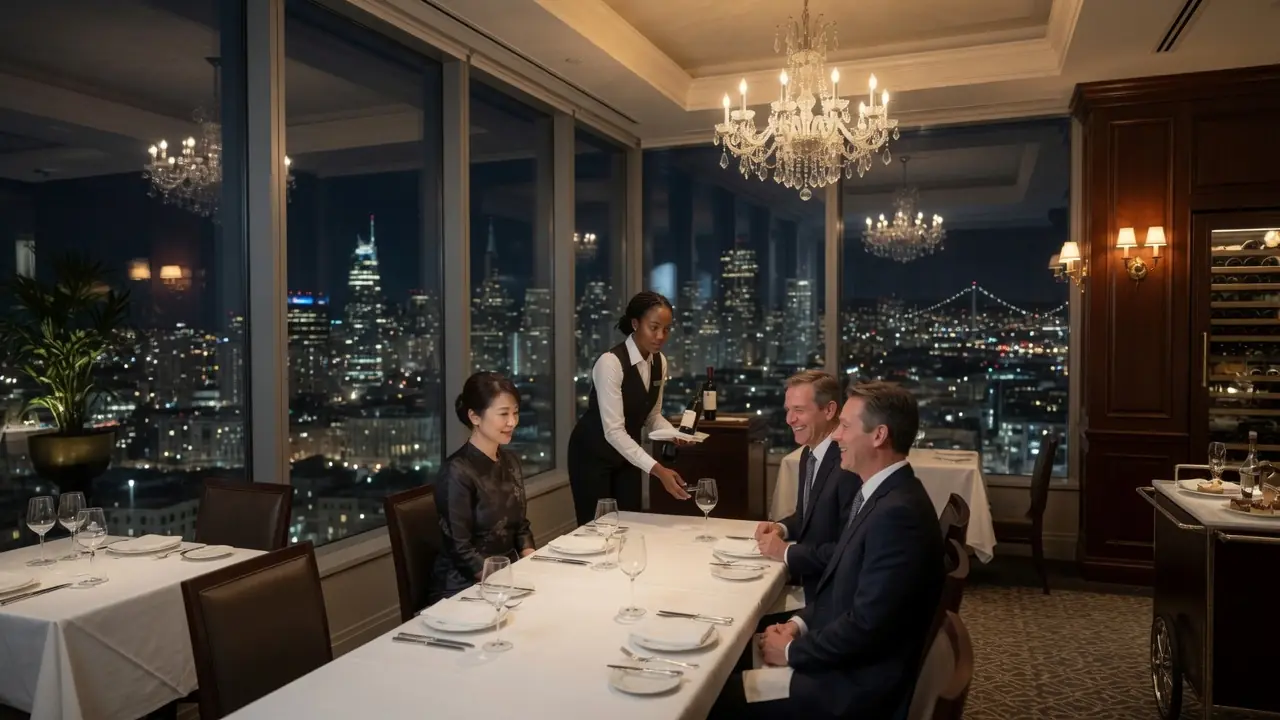
But what should have been a historic partnership turned into something far uglier: an unspoken war of glances, silence, and prejudice. At the head of the table sat Kimiko Hayashi, a Japanese tech billionaire who built her company from scratch. Her silence was not weakness. It was restraint.
She did not speak English tonight. Not because she could not, but because she would not. It was her armor. Behind her, unnoticed and unseen, moved Naomi Brooks, a young Black waitress with a lean frame, almond eyes, and posture like a dancer.
She was not just refilling wine glasses. She was watching everything: every word, every microaggression, every insult whispered like it could not be heard. But Naomi heard it all. The smirks, the “sweetheart,” the snaps of fingers, the racial innuendos, the dismissal of Kimiko as nothing more than an exotic obstacle on their road to conquest.
What happened next was not just a business reversal. It was a revolution disguised as dinner service. This was not just another power play at a negotiation table. This was a Black story, a story about the underestimated, the overlooked, and the powerful silence of women who refuse to be erased.
When Naomi finally opened her mouth, she did not just translate. She flipped the entire room upside down. The restaurant was called The Palisade, perched on the top floor of a glass-and-steel tower in downtown San Francisco. It was not just a place to eat; it was a statement.
The chandeliers did not just hang. They cascaded like frozen waterfalls. The marble floors gleamed under low amber lights and a 360-degree panorama of a city built on ambition. Inside the private room reserved for this dinner, the atmosphere was heavy with exclusivity.
Rich mahogany panels lined the walls. A long curved table of polished walnut reflected the dim glow of the candles. The scent of roasted duck, truffle oil, and expensive bourbon hung in the air. At one end of the table sat Derek Caldwell, CEO of Valancor Biotech.
He was tall, broad-shouldered, in a tailored gray suit that cost more than most people’s monthly rent. His slicked-back blond hair and perfectly timed grin belonged to a man who always expected to win. Beside him sat CFO Trent Langley, younger, sharper, hungrier. His suit was darker, his watch flashier.
If Derek was the king in the boardroom, Trent was the executioner. Together, they were sharks in human skin, calculating, impatient, and utterly convinced of their dominance. Across from them sat the woman they believed they were about to conquer: Kimiko Hayashi, a billionaire in her own right, founder and CEO of Hoshiko AI, the Tokyo-based pioneer in surgical robotics and neural interface technologies. But tonight, she was the mystery in the room.
Her hair was silver, neatly pinned. Her dress, a deep indigo silk, flowed like still water. No jewelry, no makeup, just her presence, calm and unreadable. She said nothing.
Her aide, seated slightly behind her, offered soft translations when needed, but mostly Kimiko listened. Her silence made the men twitch. Then, of course, there was Naomi, the waitress no one noticed, slipping between tables, adjusting wine levels, clearing plates. Her name was not on the guest list.
Her voice was not in the room yet, but her eyes were. She watched Derek’s condescending smirks. She saw Trent’s restless leg bouncing under the table. She watched Kimiko, stoic and regal, holding her ground in a room built to make her feel small.
The first toast was awkward. Derek lifted his glass of bourbon with the confidence of a man used to setting the tone. “To global partnerships,” he said, “and to a future where science knows no borders.” He smiled wide, as if he had just delivered a line worthy of a magazine cover.
Kimiko simply nodded, lifted her glass in silence, and sipped. No words. No translation. Trent leaned over, whispering, “Was that a yes, or just a polite nod?”
He did not bother lowering his voice much. Kimiko said something in Japanese to her aide. The man, expressionless, turned to the table. “Ms. Hayashi appreciates the sentiment.”
That was all, and that was the pattern. Derek would offer long, animated speeches about the transformative potential of merging Hoshiko AI’s surgical robotics with Valancor’s global distribution. He talked numbers, timelines, market capture. He smiled between sentences.
He gestured as if commanding an invisible audience. Kimiko would reply in a short phrase, quiet and measured, and the aide would translate. Always in one sentence. Always neutral.
Trent’s patience thinned first. He leaned in toward Derek and muttered, “Are we seriously negotiating with a statue? This is insane.” Derek forced a polite smile, whispering back, “It’s cultural. She’s playing her game. Just be patient.”
But Trent was not wired for patience. He snapped his fingers toward Naomi, not even looking at her. “Hey, sweetheart, more of that Syrah. We’re going to need it.”
Naomi felt the sting behind the word. Not the request, the tone, the familiarity that was not earned. The way “sweetheart” felt more like a leash than a compliment. She poured the wine without saying a word, her hands steady, but her eyes were watching.
Later, Trent leaned back in his chair, rolling his eyes as the aide translated yet another measured response. “You know,” he said loudly, “we could probably just replace her with a chatbot. Would get more interaction.” Derek chuckled.
Naomi saw Kimiko’s face, still calm, but something in her eyes shifted. A sliver, a wound being registered, then hidden again. They were not talking to her. They were talking over her, around her, through her.
They saw a language barrier, but they did not see what that barrier said about them. To them, Kimiko was a problem to solve, a figure to convert, a name on a contract. To Naomi, she looked like something else entirely: a mirror. And she could feel the tension rising.
The room was not just getting colder. It was cracking. Naomi Brooks had always known how to disappear. She was taught, not directly, but through years of subtle lessons.
In classrooms where she was the only Black girl. In stores where she was followed, not greeted. In interviews where they smiled but never called back. In this restaurant, she was invisible by design.
It was part of the training. Seamless service. Quiet steps. Eyes down, hands quick, never speak unless spoken to.
Make them feel special without ever being seen. But Naomi did not always live in the shadows. There was a time when her world was filled with color, texture, and sound. Kyoto, Japan.
Her mother had been a diplomat stationed there for nearly a decade. Naomi had spent her formative years walking cobbled temple paths, chasing cicadas in the summer heat, and folding paper cranes in a quiet schoolroom with children who never once asked her why her skin was different. She learned Japanese before she learned sarcasm, before she learned to flinch at expectations, before she understood what it meant to be other. The language stayed with her, not just in memory, but in tone and instinct.
She remembered the weight of the words, the cadence of respect embedded in every sentence. She remembered the bowing, not just of the body, but of intention. That world had been hers once. Then came the move back to the States.
Then came the realization that being fluent in Japanese was more impressive when said by someone who did not look like her. That her story was not exotic enough. That her intelligence would always be second-guessed because she did not look like the poster child for excellence. Now, at twenty-four, Naomi was juggling shifts, student loans, and silent dreams.
She worked two jobs to afford tuition at a fine arts college in Oakland. She painted at night, sketched on train rides, and served wine with a poise that came from knowing her worth, even if no one else in the room did. But that night, something stirred in her as she watched Kimiko Hayashi sit through the veiled insults and performative politeness. Naomi did not just see a quiet billionaire.
She saw someone fighting the same quiet war. Someone who had power, but was still being disrespected because of her accent, her gender, her silence. And Naomi knew that silence all too well. She had worn it like armor for years.
But tonight, that silence was beginning to crack. The conversation, or what little was left of it, had begun to unravel. Derek leaned back in his chair, his fingers drumming against the table like he was waiting for someone to cue the next act. Kimiko sat still, calm, composed, answering each question with a few precise words through her aide.
Her silence was steady, her tone respectful, but to the men across from her, it was infuriating. Finally, Trent exhaled loudly, threw his napkin onto the table, and leaned forward with a smirk. “We want to buy your company,” he said, enunciating each word like he was talking to a toddler. “Do you understand?”
Derek laughed, not because it was funny, but because he thought he was in control. “Maybe we should bring out some flashcards,” he added, his voice drenched in condescension. Naomi nearly dropped the carafe in her hand. Her back was turned as she stood by the service station, pretending to check the wine list, but her ears burned.
It was not just the mockery. It was the tone, the assumption that if someone did not speak like them, they were somehow less. Kimiko blinked once, slowly. She did not flinch.
She did not retaliate, but the air in the room changed just slightly. Trent smirked again. “I mean, seriously, is this a business deal or a pantomime?” Then came the final insult, quiet but sharp.
“I swear, man,” Trent muttered to Derek, not realizing Naomi was only five feet away. “This is like negotiating with a bonsai tree.” Derek chuckled. “Silent, decorative, probably older than it looks.”
Naomi turned around slowly. Her heart was racing, not with fear, but with fury. She glanced at Kimiko, still unreadable, still poised. But Naomi saw the tiny shift in her jaw, the quiet storm behind her eyes.
Then Naomi felt a hand on her shoulder. It was her manager, Foster. “Don’t get involved,” he whispered. “You speak only when spoken to. Do your job.”
She nodded, but something inside her had already broken loose. Kimiko spoke in Japanese, a phrase not translated by her aide. Not for the men at the table. A whisper almost to herself.
Naomi heard it clearly. “Is there no one here who sees me?” And just like that, Naomi knew this was not just cultural ignorance. It was intentional.
It was systemic. She could no longer stay silent. The room had fallen into a peculiar kind of stillness. Trent had leaned back, clearly pleased with his bonsai comment.
Derek was pouring himself another finger of bourbon, wearing the smug look of a man who thought he had just closed a deal. The aide, ever professional, sat in silence, and Kimiko had not moved. But then, softly, she spoke again. A sentence, just one, not for translation, not for the men.
It was directed into the space between them, as if she were casting her voice into a canyon and hoping someone, anyone, might echo back. Naomi heard every syllable. “Watashi o hontō ni mite iru hito wa, koko ni dareka iru no ka?” Is there truly anyone here who sees me?
The words struck Naomi like a chord vibrating deep in her chest. It was not just the meaning. It was the ache behind it. That kind of sadness did not come from weakness.
It came from being erased in plain sight. Naomi stepped back from the wall. For a second, her hands trembled. She could feel the pressure of protocol gripping her, the fear of being fired, the warning from Foster still hot in her ear.
But that one sentence, those few soft words from Kimiko, made every rule she had ever followed feel unbearably small. She moved toward the table. The click of her shoes against the hardwood floor echoed in the sudden silence. Derek glanced up, irritated.
Trent frowned. Her manager was frozen in disbelief. Naomi did not stop. She approached Kimiko’s side and bowed low at the waist.
Not the shallow nod of customer service, but the deep, formal bow of reverence. A bow reserved for elders, for sensei, for people whose presence carried weight beyond words. Then slowly, she rose, looked Kimiko in the eye, and spoke in crisp, fluent Japanese. “Hayashi-sama, I am deeply sorry. I know I am not supposed to speak, but silence in the face of this kind of disrespect is its own form of betrayal. If you will allow me, I can help.”
Derek dropped his glass against the table with a dull thud. Trent’s mouth opened, but nothing came out. The aide blinked, stunned. Kimiko’s eyes widened, not in shock, but in recognition, like someone stranded at sea finally spotting a lighthouse through the fog.
She reached forward, gently touched Naomi’s arm, and whispered back in Japanese. “Thank you for seeing me.” And just like that, the balance of power in the room shifted. Naomi had not just spoken.
She had changed everything. Kimiko leaned back in her chair for the first time that night, her eyes never leaving Naomi. She gave a subtle nod. It was not just permission.
It was trust. Naomi stepped forward. Her voice, steady now, filled the room like a current of clarity. “Hayashi-sama has requested that I translate her statements moving forward,” she said, directing her words to Derek and Trent.
“She believes it is time you understand the full weight of what is being said.”
Trent laughed nervously. “Sure,” he said. “Let’s hear it.” Naomi turned back to Kimiko.
They exchanged a brief sentence in Japanese, measured and deliberate. Then Naomi turned toward the table again, her posture straight, her voice calm. “She would like to begin by discussing the revised contract you brought tonight.” Derek reached into his briefcase and slid the leather folder toward Naomi.
“It’s all there,” he said. “Clean, straightforward, more than fair.” Naomi opened the folder and scanned the first few pages. Her heart rate quickened, not from fear this time, but focus.
She was not a lawyer, but she had spent enough nights helping her mother proofread diplomatic briefs to recognize certain patterns, language that sounded generous but had sharp edges. She flipped to section 7B. Her eyes paused. “This clause,” she said slowly, “gives Valancor unrestricted rights to renegotiate all intellectual property licenses post-merger. That includes the surgical AI Kimiko Hayashi personally developed.”
Derek blinked. “That’s standard merger language.” Naomi shook her head. “No, it’s intentionally vague. It allows you to sell off her patents, strip the core technology, without needing approval.”
Trent waved his hand. “It’s a safeguard, just in case things shift post-acquisition.” Naomi did not even look at him. She continued flipping pages. “Section 12,” she said, her tone sharpening.
“This is a non-compete clause, but it is written so broadly, it would not just prevent Ms. Hayashi from starting a new tech firm. It would prevent her from consulting, teaching, or speaking at conferences for ten years.” She looked directly at them now. “You are not just trying to buy her company. You are trying to erase her from the industry.”
The silence that followed was heavy. Derek’s jaw tightened. Trent muttered something under his breath. Their confidence, their smug control, was slipping.
And Kimiko had not said a word, but her face held the quiet satisfaction of a chess player watching a checkmate unfold one move at a time. Naomi had cracked the code, and now the trap was wide open. The air in the room had gone still. Dead still.
Trent fidgeted with his pen. Derek cleared his throat, his eyes darting to the window as if the city lights could offer him an escape. But there was no getting out of this. Naomi closed the contract folder slowly, her hands precise, her eyes unwavering.
Then Kimiko spoke. This time, her voice was soft, but it carried a new kind of weight. She gave a single instruction in Japanese to her aide, who nodded without a word. From the inside pocket of his blazer, the aide produced a small silver device.
It was sleek, no bigger than a phone. He placed it gently on the table and pressed play. At first, there was only static. Then came Derek’s voice, sharp and unmistakable.
“Let’s just get to the final offer. Cut out the incentive clauses. We’ll absorb her execs. She’ll never know the difference.”
Trent’s laugh followed, full of teeth. “She’s lost in her own little world. We feed her whatever we want. The translator does the heavy lifting.”
The audio was clear, damning, echoing against the expensive wood and glass of the private dining room. Naomi did not flinch. She translated the essence of what had been said, even though the meaning was painfully obvious. “They assumed she did not understand,” she said.
“They joked about manipulating the terms. They laughed about silencing her team. They made a plan to dismantle her legacy in front of her, banking on her silence.” Trent stood abruptly.
“You can’t record private meetings without consent. That’s illegal.”
Naomi turned to him, cool and steady. “So is fraud.”
Derek stayed seated, but the color had drained from his face. He looked at Kimiko. Really looked at her for the first time. She was not small.
She was not silent. She was a fortress. And she had just opened fire. Kimiko did not smile.
She did not need to. The recording clicked off with a final metallic beep. The silence that followed was not empty. It was judgment.
A verdict. Naomi folded her hands in front of her. Her voice was low but strong. “You did not just underestimate a woman. You underestimated the wrong woman. And you forgot that silence does not mean surrender.”
This was not business as usual anymore. This was war. And Kimiko Hayashi had just won the first battle. The door slammed open.
Naomi barely had time to turn before her manager stormed in. His face was flushed with fury. Foster was usually cold, composed, the kind of man who spoke in half sentences and raised eyebrows. But not tonight.
Tonight, he looked like a man seconds away from exploding. “What the hell was that?” he hissed, stepping past the stunned executives, ignoring Kimiko completely. His voice was low but venomous. “You left your station. You inserted yourself into a private meeting. You spoke to a guest.”
Naomi stood still. She did not speak. She did not flinch. “You’re done,” he snapped.
“You’re finished here, Naomi. I don’t care what the excuse is. You’re fired. Immediately.”
Trent scoffed in the background. “Finally. Something this place gets right.”
Naomi clenched her jaw. Her hands stayed by her sides. But inside, her chest burned, not with regret, but with something sharper, something heavier. She had done the right thing.
She knew it. And this was her reward. “Pack your things,” Foster spat. “Security will escort you out.”
Naomi was about to reply. She was not sure what she would say, but she did not get the chance. A deep voice cut across the room. “Actually, she’s not going anywhere.”
Everyone turned. A tall, sharply dressed Black man stood just inside the open door. Early forties, clean-shaven, calm as a surgeon in an operating room. He wore a navy suit that did not try to show off.
It did not need to. His presence said everything. “Myles Jones,” he said, stepping forward. “Executive director, North American Innovation Alliance, and one of the key financial partners behind Hoshiko’s expansion into the U.S.”
Foster blinked like he had been slapped. Derek’s face turned a deeper shade of gray. “I’ve been sitting in the main dining room for the past twenty minutes,” Myles continued, “watching this unfold, listening to that recording, watching how each of you behaved.” His eyes locked on Foster.
“You’re not firing Naomi Brooks tonight. In fact, she should be getting a formal apology.” Foster opened his mouth, but no words came. Myles turned to Naomi, and for the first time that evening, she felt truly seen.
Not as staff. Not as background. But as a person of value. “You were the only one in this room who understood what integrity looks like.”
Naomi’s throat tightened, and the balance shifted again, not because of rank or money, but because one voice had the courage to speak, and another had the power to make sure it was heard. The private room was quiet now, still charged, but no longer tense. Foster had backed away, his shoulders stiff with humiliation. Derek and Trent sat silently, their power drained, their arrogance turned into something almost pitiful.
Naomi stood in the middle of it all, her apron still tied neatly around her waist, her posture unchanged. But everything else about her had shifted. She was not just a waitress anymore. She was the woman who had changed the course of a multimillion-dollar deal with her voice and her courage.
Kimiko turned toward her for the first time all night, her expression softened. She spoke gently in Japanese, her words elegant and measured. Naomi listened, her chest rising and falling with each syllable. Then she turned to Myles, translated softly, and gave a quiet nod.
Myles stepped forward. “Miss Hayashi has a request,” he said, addressing Naomi directly. “She would like to formally offer you a position with Hoshiko’s global strategy team, not just as a cultural liaison, but as an executive aide. Someone who understands the unspoken, who listens between the lines.”
Naomi blinked. She was not sure she had heard him correctly. “You’d be based in San Francisco,” Myles continued. “You’d help lead our U.S. expansion, advise on international partnerships, and oversee future diversity initiatives within the company.”
He paused, letting that settle. “Your tuition covered, any graduate program you choose, anywhere in the world, fully funded. You’ll have housing provided near our offices, and a starting salary that reflects the value you’ve already proven you bring.” Naomi felt her breath catch.
The floor beneath her feet suddenly felt foreign, like it belonged to someone else. This could not be real. Kimiko stood. She crossed the room slowly, meeting Naomi face to face.
She did not offer a handshake. Instead, she reached out and took Naomi’s hand gently in both of hers. “You saw me,” she said in soft, accented English, “when no one else did.” Naomi nodded, her voice caught in her throat.
“I’d be honored,” she finally whispered. “Truly.”
Kimiko smiled. “Then come with us. We have work to do. Real work.”
And just like that, the door that had been closed her entire life was not just open. It had been blown off its hinges. A new future was waiting, and Naomi Brooks was finally walking through it. The fallout was swift and brutal.
Within forty-eight hours, news of the failed negotiation leaked. Not from Kimiko, not from Naomi, but through back channels in the tech world that had a life of their own. The recording, discreetly shared with legal counsel and a few key partners, found its way into the hands of corporate oversight committees. Valancor’s board acted fast.
Derek Caldwell was asked to step down voluntarily in a closed-door meeting that lasted less than an hour. His golden parachute was shredded. His name was removed from the company website by noon. Trent Langley resigned two days later, citing personal reasons.
But everyone knew the truth. Investors were rattled. Stockholders demanded answers. And the press, well, the press had a field day.
The story was simple but powerful. Two wealthy white executives caught on tape trying to manipulate and erase the legacy of a foreign female founder, brought down by a Black waitress who simply told the truth. Headlines did not need much help. From server to savior: the woman who stopped an $800 million power grab.
The internet called it poetic justice. Comment sections filled with praise for Naomi Brooks, for Kimiko Hayashi, and for the simple but radical act of speaking up when it mattered most. As for Derek and Trent, their reputations were tarnished beyond repair. Doors that had once opened automatically for them now stayed shut.
Invitations to speak at conferences were quietly withdrawn. Future partnerships vanished like mist in the morning sun. They had underestimated one woman’s silence and another woman’s voice, and in doing so, they reminded the world of a truth they had long forgotten. Real power does not always wear a suit.
Sometimes it wears an apron. And sometimes the people you never thought mattered are the ones who change everything. This was not just a story about corporate betrayal or a surprise twist in a business deal. It was a story about visibility, about dignity, about what happens when the world assumes silence means weakness, and when it dismisses people because of how they look, where they are from, or the uniform they wear.
Naomi Brooks was never just a waitress. She was a young woman carrying years of lived experience, a deep understanding of culture, and a quiet strength most people overlooked. She saw what others refused to see. She heard what others ignored.
And when the moment came, she chose not comfort, but courage. And Kimiko Hayashi, she was a billionaire, yes. But that night, she was also a woman being spoken over, underestimated, and reduced to a stereotype. Her power was not in her money.
It was in her composure, her discipline, and her choice to wait, not for the right deal, but for the right people. Both women faced a room that tried to define them by their silence. But in the end, they redefined that room. The truth is, most people do not see what is right in front of them.
They see a title, a skin tone, a job description. They assume, they categorize, they move on. But the world changes when someone stops and really listens. So here is the takeaway.
Never underestimate the quiet ones. Never ignore the person clearing your table, answering your call, or sitting silently at the far end of a meeting room. You have no idea what they know or what they are capable of. And if you are one of those quiet ones, if you have ever felt invisible, undervalued, overlooked, know this.
Your voice matters. Your presence matters. And one day, when it counts most, the world will finally hear you. This was a Black story, but it was also a human story.