"Get out of this bank right now." The shout cracked through the marble lobby like a whip, and every head in the building turned at once.
A young bank teller had just struck an elderly woman across the face, hard enough that the sound echoed off the high ceiling, and the only reason the woman had been standing at that counter in the first place was because she wanted to open a simple savings account.
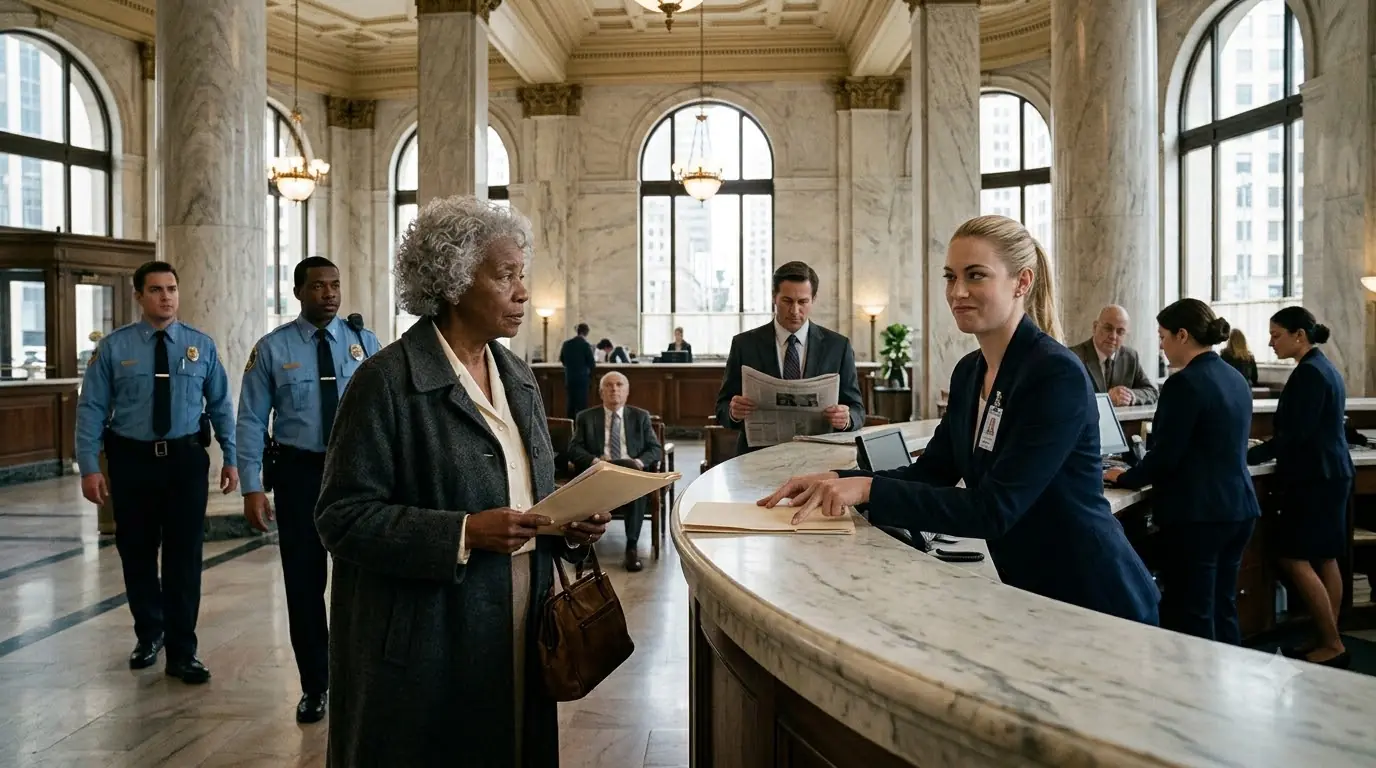
Humiliated in front of dozens of strangers, the old woman bent down slowly and picked up her worn leather bag from the floor. Nobody in that crowded lobby moved to help her.
Nobody said a word in her defense, but less than 30 minutes later, a line of luxury vehicles pulled up outside the bank's front doors, and when the truth about who she really was finally came out, every employee in that building went pale. The woman who had delivered the slap understood in that single moment that her career was already over.
Her name was Martha Johnson, and on an ordinary Tuesday morning, she was 72 years old, a widow who lived quietly in a modest neighborhood on the edge of the city. It was the kind of street where the houses were small, but the gardens were tended with care.
She had lived in that same house for over 30 years, raising two children there, burying a husband there, watching the neighborhood slowly change around her, while she herself stayed remarkably the same.
She wore a coat that had seen better winters, soft at the elbows, and slightly faded at the collar. It was a coat that had belonged to a version of her life she still cherished, not because she could not afford a new one, but because it belonged to a version of her life she still carried with her.
She carried a handbag that had clearly traveled with her for decades, its leather worn smooth at the corners from years of being held the same way, tucked close against her side.
That morning, she rode the public bus into downtown, the way she always did, watching the city blur past the window with the patient calm of someone who had long ago stopped needing to prove anything to anyone. She had taken that same route more times than she could count, past the same bakery, the same dry cleaner, the same corner where a flower vendor set up his cart every morning, rain or shine.
The driver knew her by name, and she always greeted him the same way, with a small nod and a quiet good morning that asked for nothing more than to be left to her thoughts for the ride. Tucked carefully inside her bag was a thin folder of documents held together with a rubber band, the kind of folder a person protects the way they might protect a photograph of someone they loved.