The first thing Elias Boone noticed when he stepped into Bright River Bank was that the old brass bell was gone.
For thirty-one years, that bell had hung above the front door, soft and bright, ringing every time a customer walked in from Mason Street. It was not expensive. It was not fancy. But it had a sound that made people look up and smile, the kind of sound that told a tired man after a double shift, a widow carrying rent money in an envelope, or a young mother opening her first savings account that somebody had seen them arrive.
Now the bell had been replaced with a silent glass sensor above an automatic door. The bank smelled like cold air conditioning, floor wax, and expensive cologne. The original wood counters were gone. The hand-painted mural of the river bend had been covered by a steel panel displaying the bank's new slogan in polished chrome letters.
Building Wealth for Tomorrow.
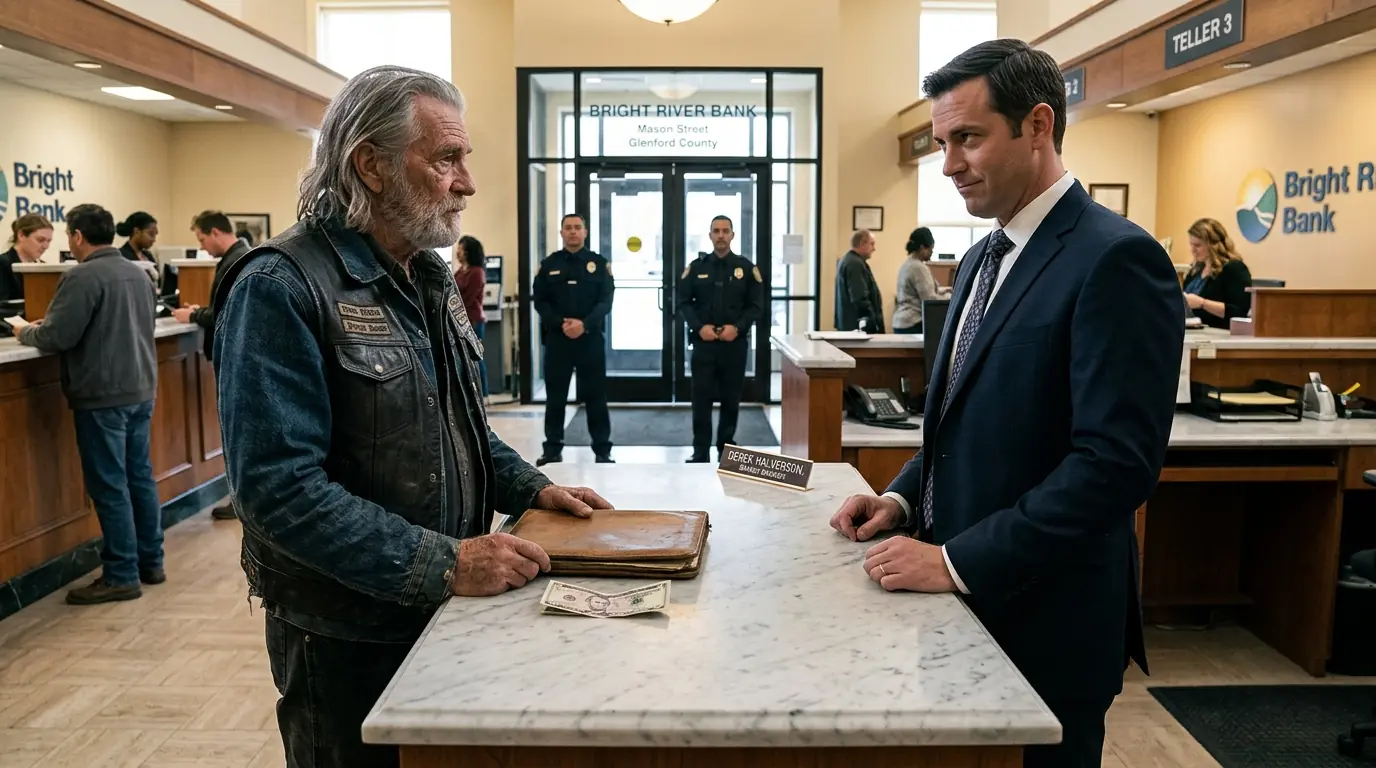
Elias stood beneath those letters with a battered leather folder tucked under his arm and the same five-dollar bill folded in his coat pocket that he had carried for two days.
Nobody in the lobby looked at him twice at first. That was the advantage of being invisible. Gray beard, weathered face, old denim jacket, scuffed boots, and a faded black leather vest half-hidden beneath his coat. The vest was plain from the front, but on the back, stitched under years of sun and road dust, were the words Iron Saints MC.
He had not worn that cut in public for almost eight years.
Most people who had known Elias Boone in his prime would not have recognized him now. They remembered him as Preacher Boone, road captain of the Iron Saints, the man who could lead a hundred bikes through a thunderstorm without losing one rider. They remembered the big laugh, the long silver-streaked hair tied behind his neck, the tattooed hands that could rebuild an engine or hold a scared child steady during a charity toy run.
They remembered the night he helped a group of warehouse workers, diner cooks, mechanics, and widows build the first neighborhood credit union in Glenford County because the big banks would not lend to people who wore work boots.
They did not remember him as an old man standing quietly in a bank lobby with five dollars.
That was exactly what he wanted.
The line moved slowly. Elias watched the tellers work behind the counter, their eyes moving fast between screens, their smiles trained but tired. A young mother bounced a baby on one hip while trying to sign paperwork with the other hand. An older man in a paint-stained cap counted twenties with great care. Two men in suits stood near the loan office, speaking softly about development parcels and foreclosure values.
Elias heard more than they thought he did.
He had been listening for months.
When his turn came, he stepped up to Teller Pam Hargrove, a woman in her forties with perfect hair, a navy blazer, and a smile that froze the instant she saw him clearly.
"Can I help you?" she asked.
The words were polite. The tone was not.
"Yes, ma'am," Elias said. "I'd like to open a checking account."
Pam's eyes moved from his beard to his worn coat to the leather folder beneath his arm.
"Do you have valid identification?"
"I do."
"And an opening deposit?"
"Five dollars."
Her expression tightened.
"Sir, this is a full-service financial institution. If you're looking for assistance programs, there are nonprofit offices downtown."
"I'm not looking for assistance," Elias said. "I'm looking to open a checking account. The minimum opening deposit is five dollars. Unless that's changed."
Pam glanced toward the glass office at the far end of the lobby.
That was where Derek Halverson sat.
Derek had watched the entire exchange from behind his desk, one hand resting on a silver laptop, the other turning a heavy ring on his finger. Regional branch manager. Thirty-eight years old. Expensive suit. Perfect teeth. The kind of man who had learned the language of authority before learning the meaning of service.
He stood slowly, as if the lobby were a stage and he had been waiting for his cue.
His shoes clicked across the marble.
"Is there a problem here, Pam?"
Pam straightened as though a supervisor had walked into a classroom.
"This gentleman wants to open an account."
Derek looked at Elias and smiled without warmth.
"Gentleman?"
A few customers turned.
Elias said nothing.
Derek leaned one elbow on the counter. "What kind of account were you hoping to open, sir?"
"Checking."
"And your initial deposit?"
"Five dollars."
Derek laughed.
It was not loud at first. It was worse than loud. It was intimate, practiced, designed to invite the room to share it.
"Five dollars," he repeated. "Well. That's ambitious."
Elias placed the folded bill on the counter and smoothed it with two fingers. His hands were scarred and steady.
"Money is money," he said.
"Not always." Derek's smile sharpened. "Sometimes it's a warning sign."
"Of what?"
"Of someone wasting staff time."
The lobby grew quieter.
A customer near the back lifted her phone just a little.
Derek noticed, and that seemed to make him perform harder.
"Listen," he said, lowering his voice just enough to sound private while still being heard. "This branch has standards. Our clients are business owners, homeowners, retirees, professionals. People who maintain accounts. People who don't wander in off the street smelling like exhaust and bus stations."
Elias looked down at his boots. They were old, but clean.
"I rode here," he said.
Derek glanced through the front window and saw the motorcycle parked near the curb, a black 1974 Shovelhead with worn chrome and a hand-tooled leather seat. Its tank was clean enough to show the reflection of passing cars.
"Of course you did," Derek said. "That explains the costume."
Elias's eyes lifted.
"It's not a costume."
"Whatever you call it." Derek leaned closer. "This bank isn't a clubhouse. We don't open accounts for every biker, drifter, and sidewalk philosopher with loose change in his pocket."
The security guard by the door shifted uncomfortably.
His name was Luis Ortega. Elias had noticed him three times over the past month, not because Luis was threatening, but because he looked like a decent man trying to keep a job under indecent people. His uniform was crisp. His eyes were tired. He carried himself like someone with responsibilities waiting at home.
Derek snapped his fingers once in Luis's direction.
"Mr. Ortega."
Luis stepped forward.
"Sir?"
"Please help this man find the exit."
Elias looked at Derek for a long moment.
"You refuse to open the account?"
"I'm refusing to let you disturb my lobby."
"The bank's own policy says the minimum deposit is five dollars."
"Policy also gives us discretion."
"Show me where."
Derek's jaw tightened.
"Excuse me?"
"Show me the written policy that says a man can be refused because you dislike his clothes."
A faint murmur moved through the lobby.
Derek's cheeks darkened.
"You need to leave."
"I didn't come here to beg."
"Then why are you here?"
Elias looked up at the steel slogan on the wall. Building Wealth for Tomorrow. Then he turned his gaze toward a small bronze plaque mounted near the old vault door, half-hidden now behind a potted plant.
Bright River Community Trust. Founded 1978. Service. Dignity. Access.
He had written those three words himself at a kitchen table with six mechanics, two diner owners, a retired teacher, and a widow who had put in the first fifty dollars.
"I came to see what happened to a promise," he said.
Derek rolled his eyes.
"There it is. The speech."
He pulled a five-dollar bill from his own wallet, flicked it toward Elias's boots, and let it drift down onto the marble floor.
"Tell you what," Derek said loudly. "If five dollars means that much to you, take mine and leave."
A couple near the loan office laughed nervously.
Derek pointed toward the fallen bill.
"Go on. Pick it up. Consider it a donation."
Elias did not move.
Derek stepped closer, mint on his breath, contempt in his eyes.
"This bank wasn't built for people like you."
The lobby went still.
Elias looked at the five-dollar bill on the floor. Then he looked at Derek.
"That's where you're wrong," he said quietly. "This bank was built exactly for people like me."
Derek's face hardened.
"Luis, remove him."
Luis hesitated.
"Mr. Halverson, maybe we should just process the account."
Derek turned slowly.
"Are you advising me on branch policy?"
Luis swallowed.
"No, sir."