The certified check was still in Martin Heller's hand when Alicia Grant turned the verification screen toward him.
"First Continental is the issuing bank. I can authenticate it from here."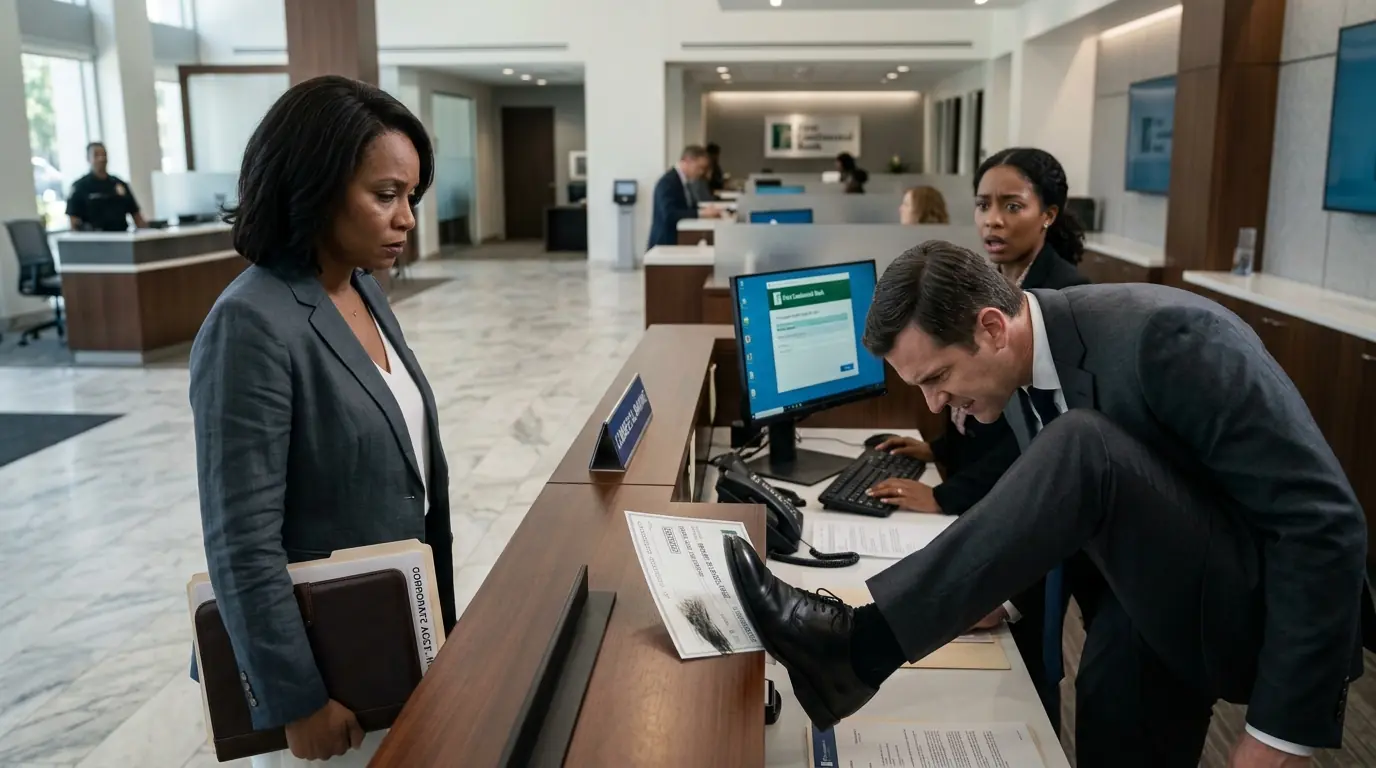
Martin did not touch the keyboard.
I was standing beside Marion Caldwell Price with the commercial onboarding packet open against the counter. The placement instructions listed Southline Community Capital, the community lending fund, and the $10 million deposit we had scheduled for that morning. I had confirmed the appointment two business days earlier. Nothing in the packet was incomplete. Marion had already provided her identification and corporate documents. Alicia had entered the information without difficulty.
The normal next step was issuing bank verification. Instead, Martin looked at Marion again. He had come out of his office after Alicia notified him of the deposit size. Since then, most of his questions had been about Marion rather than the check: How long had the company existed? Why was she opening the account at that branch? Why was a transaction that large being handled in person?
Each answer was already somewhere in the documents in front of him.
Marion finally pointed toward the check. "Is there a problem with the instrument?"
Martin held it beneath the lobby lights. "I'm evaluating the entire presentation."
I looked up from the packet. That phrase was the one that stuck with me. Not signature, not certification, not issuer—presentation.
Alicia kept the verification window open. There was no fraud warning on her screen and no rejection from First Continental, because nobody had contacted First Continental yet.
Martin asked for another source of funds explanation. Marion gave him the same answer contained in the placement letter: Southline was funding a lending pool for small businesses, affordable housing projects, and neighborhood health services. The account was supposed to keep part of that capital in the same area where the projects would operate.
Martin glanced at her linen jacket, then at the check again. "I've seen people walk in here with paperwork that looks impressive."
Alicia's hands stopped above the keyboard.
Marion did not answer the implication. She asked him to authenticate the check.
Martin said he would decide what verification was appropriate. Then he lifted one foot against the lower rail of the counter. I saw the movement; I didn't understand it. He dragged the bottom of his shoe across the face of the certified check once. The paper bent slightly under the pressure. A dark mark crossed the lower corner.
Then Martin looked directly at Marion. He used a racial slur so explicit that Alicia stepped back from her terminal. Nobody needed him to explain what he meant.
Marion reached across the counter and took the check from his hand. She examined the mark. Then she placed the instrument inside the clear sleeve I had brought with the closing documents.
"Are you accepting the deposit?"
Martin straightened his jacket. "I'm referring this for fraud review."
"What fact triggered the referral?"
He did not name one. Instead, he said the branch could retain the check while the review was pending.
Marion looked at me. I already had the custody section of the deposit packet open.
"If the bank is keeping the original," I said, "we need a receipt identifying the instrument and the reason for retention."
Martin told us that was unnecessary because the transaction had not been accepted. That closed the only route for the check to leave Marion's hands.
She placed the sleeve inside her portfolio. "Then give me the branch decision in writing."
Martin's face tightened. He called toward the security desk.
Noah Briggs approached from the lobby entrance. Martin told him we were refusing a fraud review and needed to be removed.
Noah looked at Marion, then at the counter. "Is there a safety issue?"
Martin said it was a fraud matter.
Noah did not move closer. "That's not what I asked."
It was the only challenge he made. He had no authority to authenticate the check; he didn't pretend he did.
Martin returned to Alicia's terminal. He instructed her to close the teller side of the transaction as "customer declined verification."
Alicia looked at the screen. "She asked us to verify it."
Martin repeated the instruction. She simply left the customer disposition field unchanged.
Martin moved around the counter and entered something under his own credentials. A new status appeared beside Marion's transaction: Manual risk review.
Marion read it once. Then she closed her portfolio. "We're done here."
She did not ask for the bank president. She did not tell Martin what Southline managed or what the deposit could mean to his branch. We walked out with the check.
In the parking lot, I called First Continental from the number already printed in our placement file and began documenting the branch disposition. Behind us, Martin's referral had already left the counter. It was now part of the bank's system.
First Continental confirmed the check before we reached Southline's office. The verification officer matched the certification number, issue date, amount, and beneficiary information. He also confirmed something more useful: Heritage National had never contacted them.
I entered the confirmation into our transaction file and stopped there. The check was valid; we did not need three more records proving the same thing.
The harder problem was what Heritage had already done with the transaction. Marion could not leave $10 million waiting while the dispute moved through another institution. The community fund had scheduled commitments coming due, including two small business lending pools and an early-stage clinic project. By that afternoon, our treasury team had placed the money temporarily with an existing custodian. The projects stayed alive. The original Heritage placement did not.