"Beat me, and two hundred million dollars is yours."
Richard glanced at Annie with amused curiosity. "Well," he said lightly. "You heard the offer." 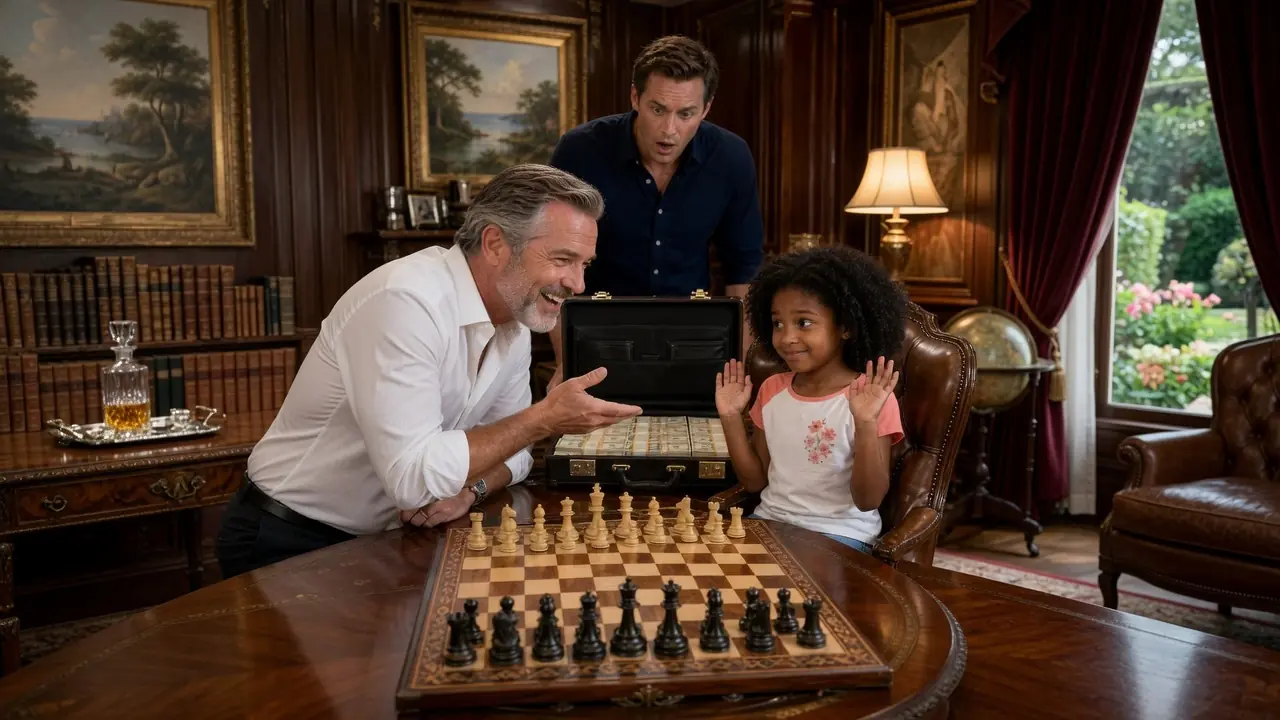
Annie shook her head immediately. "No, sir." Her voice was soft, almost apologetic.
Richard tilted his head. "No?"
Annie looked down at her shoes before speaking again. "I didn't mean to say anything before," she said.
Daniel leaned forward slightly. "You mean when you told me not to move the knight?"
Annie nodded slowly. "Yes, sir."
Daniel chuckled. "That little warning just saved my game."
Richard gave a small laugh. "More than saved it," he said. "It cost me the whole match."
The chessboard between them still held the final position. Daniel's queen stood beside Richard's trapped king. Annie quickly shook her head. "No, sir, that wasn't me."
Richard raised an eyebrow. "Oh?"
"I only said the move because it looked strange," she explained. "I might have been wrong."
Daniel smiled. "Bred you weren't."
Annie lowered her eyes again. "I was just lucky."
Sarah gently placed a hand on Annie's shoulder. "She didn't mean any disrespect, Mr. Coleman," she said politely. "She just spoke without thinking."
Richard waved the concern away. "Oh, I'm not upset." In fact, he looked entertained. He leaned forward slightly, studying Annie with interest. "You saw a mistake in a chess game you weren't even playing," he said. "That's impressive."
Annie shook her head again. "I don't really know how to play like you do."
Daniel chuckled softly. "She's modest, too."
But Annie continued honestly. "I didn't beat you," she said to Richard. "Mr. Brooks beat you."
Daniel lifted his glass. "I like this kid."
Annie added quietly, "I just said something that helped him. It could have been wrong."
Richard watched her carefully. There was no arrogance in her voice. No excitement about the attention. No sign that she understood the strange situation unfolding around her. Richard leaned back again and crossed one leg over the other.
"Well," he said slowly. "That's exactly why I want to play you."
Annie's eyes widened. "Oh, no, sir."
Daniel laughed. "Probably the smartest answer you'll hear today."
But Richard only smiled wider. "Why not?"
Annie answered without hesitation. "I'm not good enough."
"You seemed good enough a few minutes ago."
"That was just luck," Annie said.
Richard studied her for another moment, then he spoke again. "Do you know how much money two hundred million dollars is?"
Annie blinked. She didn't answer.
Richard continued calmly. "It's more money than most people see in their entire lives." He nodded toward Sarah. "It's certainly more than your mother could ever save, even if she worked every day for the rest of her life."
Sarah stiffened slightly, embarrassed by the attention, but Annie looked up at her mother for a moment. The little girl seemed to be thinking very hard. She had watched her mother work late nights. She had seen her come home tired. She had heard quiet conversations about bills and rent and groceries.
Two hundred million dollars. She didn't fully understand the number, but she understood one thing: it was enough to change everything.
Richard leaned forward slightly and rested his hands on the chess table. "So," he said calmly. "Let's make it simple." He gestured toward the board. "Beat me at chess," he paused, "and two hundred million dollars is yours."
Daniel shook his head, laughing quietly. "You're insane."
But Richard didn't take his eyes off Annie. "Well?" he asked.
The little girl looked at the chessboard, then at her mother. Sarah didn't speak, but Annie could see something in her mother's eyes—the kind of hope that usually never visits people like them.
Annie swallowed softly. Then she nodded. "Okay," she said quietly. "I'll try."
Richard Coleman smiled. For the first time that afternoon, the real game had begun.
---
### One
For several seconds after Annie agreed to play, no one in the room moved. Richard Coleman leaned back slowly in his chair. The faint smile on his face remained, but it had changed slightly.
"Well," he said at last, clapping his hands softly once. "Looks like we have a game."
Daniel Brooks let out a low laugh from across the room. "I still can't believe this is happening," he said. "You're actually about to play chess with the housekeeper's kid for two hundred million dollars."
Richard shrugged. "Money only matters if you're afraid to lose it."
Daniel lifted his glass and took a sip of bourbon. "I'll remember you said that."
He glanced up. "Have you ever played on a board like this before?"
Annie shook her head gently. "No, sir." Her voice was calm, but her hands rested quietly in her lap as she looked down at the chessboard.
The pieces were carved from dark ebony and pale ivory-colored wood, heavier and more detailed than anything she had seen before. The knights were shaped like small horses with carved manes. The rooks looked like miniature castle towers.
Daniel stepped closer to the table, folding his arms. "Well," he said, "this might be the most expensive chess game in American history."
Sarah still stood near the wall, watching carefully. She didn't understand chess very well, but she understood something else: the room had changed. The air felt heavier now, as though something important had quietly stepped into the space between the two players.
Richard gestured toward the board. "Go ahead," he said. "You can take white."
Annie looked at the pieces for a moment, then she slowly reached forward. Her fingers gently pushed the pawn in front of the king two squares ahead.
Daniel raised an eyebrow. "Well, now."
Richard didn't react. He immediately slid his pawn forward in response.
"The Sicilian," Daniel said softly.
Richard smirked. "Let's see if luck understands openings across the board."
Annie simply watched. She didn't respond immediately. Instead, her eyes moved slowly across the squares, studying the position. Then she developed her knight. Richard developed his. Move by move, the game began to take shape.
At first, Richard played quickly, confidently. He had played thousands of games in his life—chess tournaments in college, friendly matches with investors, late-night games during long negotiations.
But Annie moved differently. She didn't rush. Every move came after a moment of quiet thought. Her fingers sometimes hovered above a piece before choosing another.
Five moves passed. Then eight. Daniel slowly leaned forward, his expression changing.
Richard noticed. "What?" he asked.
Daniel shook his head slightly. "Nothing yet." But his eyes remained on the board.
Richard contractualized another move. Annie responded. Another, then another. Finally, Daniel spoke again. "She's controlling the center."
Richard looked up. "You're joking."
Daniel pointed quietly. "Look."
Richard's eyes dropped back to the board for the first time since the game started. He paused longer than a second. It was subtle but noticeable, because until that moment he had been moving almost instantly.
Across the board, Annie sat still, waiting patiently. To her, the room had faded away. The giant mansion, the expensive furniture, the billionaire sitting across from her—none of it mattered now. There was only the board.
Richard finally moved his bishop. Daniel tilted his head slightly. "Interesting."
Annie studied the new position. Then she moved her knight.
Daniel let out a quiet breath. "Well, I'll be."
Richard looked up sharply. "What?"
Daniel pointed again at the board. "She's not just moving pieces."
Richard looked down again. This time, his eyes moved slower, from one square to the next, to the next. He leaned forward slightly. For the first time since the game began, Richard Coleman was no longer smiling.
Across the room, Sarah noticed. She didn't know exactly what was happening on the board, but she recognized the look on Richard's face. It was the same look she had seen on businessmen visiting the house before—the moment when confidence turns into concentration.
Ten more seconds passed. Then Richard made his next move.
Across the board, Annie looked carefully at the new position. Outside, the wind rustled through the maple trees. Inside, the grandfather clock ticked softly.
Daniel spoke again, this time barely above a whisper. "You know what the strange thing is?"
Richard didn't look up. "What?"
Daniel watched Annie quietly. "She's not playing like someone guessing."
Richard's eyes stayed on the board. The silence grew thicker. Then Annie reached forward and made her next move.
Daniel blinked, then he laughed quietly. "Well," he said softly, "that's something."
Richard looked down at the board again, and this time he saw it. The game was no longer simple. It was no longer amusing. And for the first time that afternoon, Richard Coleman realized something unexpected: the person sitting across from him might actually be a real opponent.
---
### Two
Richard Coleman did not like being surprised. In business, surprise usually meant someone had hidden a number, buried a risk, or lied about the terms. In private life, surprise usually meant inconvenience. He had built his career by staying three moves ahead of everyone else, by seeing patterns before other men even noticed they were standing inside one. That was why the feeling now was so unpleasant.
He sat in his leather chair, eyes fixed on the chessboard, studying the latest position Annie had created with a calm that no longer looked childish to him. The board had changed in a way he had not expected. Nothing dramatic, nothing flashy, no reckless attack, no foolish early sacrifice—just a quiet, disciplined structure. Her pieces were placed with a kind of natural logic, as if they had found the squares where they were always meant to stand.
Daniel Brooks, still leaning near the fireplace with his bourbon glass in hand, watched the board and let out a low whistle. "That," he said, "is not luck."
Richard did not answer. He moved a pawn. The piece clicked against the board with more force than he intended.
Across from him, Annie lowered her eyes, studying the new position with the same focused stillness she had shown from the first move. She did not fidget. She did not glance at the adults for approval. She did not seem impressed by the room or the man sitting across from her. The chessboard held all of her attention, and somehow that unnerved Richard more than open confidence would have.
Sarah remained near the wall, one hand pressed lightly against the front of her uniform apron. She could not have explained the position on the board or named the opening they were playing, but she knew enough about people to recognize when something had shifted. Richard's posture had changed. He was no longer lounging. He was sitting forward now, elbows close, his jaw tighter than before.
Annie made her move, a knight developing with simple purpose.
Daniel nodded to himself. "Solid."
Richard looked up. "You planning to comment on every move?"
Daniel shrugged. "Only the good ones."
Richard gave him a dry look, then returned his attention to the board. He tried to remind himself what this was: a game, an unusual little scene in his own house, an interruption to an ordinary afternoon. The daughter of his housekeeper had seen a tactical idea, that was all. Sharp eyes, good instincts, nothing more.
But the board refused to support that comforting explanation. He played his bishop, probing at her king-side structure. Annie's response came after a pause long enough to show she was thinking, but not so long that it felt uncertain. She moved a pawn modestly, almost invisibly, and yet the move took away one of the squares Richard had intended to use two turns later.
Daniel laughed softly.
Richard looked up again. "What now?"
"You know exactly what now," Daniel said. "She saw your plan."
Richard gave a faint, humorless smile. "That implies I only had one today."
"It seems you did."
Sarah looked from one man to the other, then back to Annie. She had seen Annie stare at chessboards before at the library, and once in the folding chairs after a church fundraiser. But this was different. At home, Annie sometimes used bottle caps and buttons as pieces across the kitchen table, whispering to herself and replaying games she had only watched once. Sarah had always found it strange and beautiful—a gift she could neither explain nor afford to develop.
A memory rose in her mind now, from one winter evening months earlier. The radiator was hissing in their apartment. The smell of tomato soup was on the stove. Annie was arranging pennies in neat rows on the table.
"What are you doing, baby?" Sarah had asked.
"Fixing the mistake," Annie had answered without looking up.
"What mistake?"
"The one the man made in the library."
Sarah had laughed then, tired from work, not understanding that Annie had carried another man's unfinished game in her head all afternoon. Now, watching the child across from Richard Coleman, she felt something close to fear, but braided tightly with pride.
On the board, Richard exchanged a pair of pawns and leaned back slightly, trying to create the impression of ease. "So tell me something, Annie."
She looked up briefly. "Yes, sir?"
"Where did you learn this?"
Annie looked back down at the board. "I watch."
Daniel smiled. "I asked her that, too."
Richard considered her answer. "Just watch?"
"Yes, sir."
"No lessons?"
"No, sir."
"No coach?"
"No, sir."
The room fell quiet again. Richard looked at Daniel as if waiting for some private confirmation that this was still a joke, still manageable, still beneath him. Daniel only lifted his eyebrows.
"Don't look at me. I'm just enjoying the show."
Richard exhaled through his nose and made another move, this one more ambitious. He pushed a central pawn forward, challenging her position more directly.
Annie did not respond at once. The evening light had grown softer now, deepening from gold into amber. It touched the side of her face and caught in the polished black pieces on Richard's side of the board. Somewhere beyond the room, a door closed gently in another part of the house. The grandfather clock in the hallway marked the quarter hour.
Annie studied the board, then moved her bishop.
Daniel straightened. Richard's eyes narrowed.
The move was quiet, but it changed everything. Not immediately—that was what bothered him. It didn't attack his queen; it didn't threaten a cheap trick. It simply improved her position in a way that suggested she understood what the board would look like later.
He leaned forward and began calculating. If he traded there, she would recapture. If he pushed the pawn, she would take. If he developed the rook first, she could castle and leave him with less space. The lines branched in front of him like roads through unfamiliar country. He realized with a sharp inward irritation that Daniel had stopped drinking. That was never a good sign.
"How bad is it?" Richard asked, not taking his eyes off the board.
Daniel was quiet for a moment. "Bad? Not yet."
Richard looked up.
Daniel continued carefully. "But you're not steering anymore."
That landed harder than Richard expected. Across the board, Annie sat with her hands folded now, waiting. She seemed perfectly content to let him think as long as he needed. There was no cruelty in it, no sign of satisfaction, only patience. That, more than anything, made the room feel older somehow, heavier, like some old truth had entered without asking permission.
Richard made his move—a knight jump, active, sharp, a move meant to seize the initiative and remind everyone, especially himself, that he was still Richard Coleman, that he still understood how to put pressure on an opponent.
Annie looked at it. Her eyes moved once from the knight to his bishop, then to the center, then to the far side of the board. She reached out and moved her queen to a square Daniel had not even been considering.
There was a full two seconds of silence. Then Daniel muttered almost to himself, "Lord have mercy."
Richard stared at the board. The move wasn't immediately crushing; that was the problem. It was better than that. It was flexible, deep. It tied together defense and threat. It made one of his pieces awkward and turned another into a target. If he ignored it, she would gain space. If he challenged it carelessly, he would weaken his king.
A muscle flickered in his jaw. Sarah saw it. Daniel saw it, too. And Annie, though she said nothing, had almost certainly seen it before any of them.
Richard leaned back at last, no longer pretending this was entertainment. His amusement was gone. In its place was something much rarer—respect, perhaps, or the first shadow of it. Outside, the last broad wash of sunlight slipped lower across the lawn. Inside, the room held its breath around the board.
For the first time that day, Richard Coleman understood that the game would not be decided by charm, money, or reputation, but only by what he could actually see—and what Annie could already see better.
---
### Three
Richard Coleman had spent most of his life believing that pressure revealed the truth about people. Pressure, in his experience, stripped away the performance. It removed charm, rehearsed confidence, and empty claims. Under enough strain, a person showed what they really were. Some crumbled, some lied, some begged for time; very few became more dangerous.
Now, seated across from Annie with the chessboard between them, he found himself asking a question he had not expected to ask in his own home: what kind of person becomes calmer when the room grows tense?
The answer, at least in this moment, seemed to be the quiet girl sitting across from him. The board lay between them in a shape that no longer pleased him. His pieces were still active, still alive, but they were no longer harmonized. Annie's last queen move had done more than create a threat; it had changed the rhythm of the game. He could feel it. Every line he calculated seemed to bend slightly in her favor. Every natural plan now carried a hidden cost.
Daniel Brooks, standing near the fireplace with his sleeves rolled back and his glass forgotten on the mantel, was no longer trying to hide his fascination. "Well?" Daniel asked after a long silence.
Richard did not look up. "Well, what?"
"You've been staring at the board like it insulted your mother."
Richard exhaled slowly through his nose. "I'm thinking."
Daniel smiled. "That's exactly my point."
Across the room, Sarah lowered her eyes for a moment, pretending to focus on the shelf she had stopped dusting fifteen minutes earlier. In truth, she had not touched the cloth in all that time. She knew enough to stay quiet. The room belonged to the game now.
Annie sat with her hands folded in her lap, her gaze fixed on the board. She was not smiling. She did not look proud. She looked attentive, the way some children look while listening to a story they do not want interrupted before the ending.
Richard finally made his move. He pushed a pawn forward on the queen's side, trying to gain space and force Annie to react. It was not the move he wanted most; it was the move he trusted least to be wrong. The piece settled into place with a quiet click.
Annie studied it. A few seconds passed. Then she moved a knight—simple, clean, and instantly irritating.
Richard felt a pulse of heat at the base of his neck. Her move did not attack anything directly, but it strengthened the squares around the center and opened a future lane for her bishop. It was the kind of move experienced players respected because it did not ask for applause; it merely improved everything.
Daniel let out a low whistle. "She's building," he said.
Richard gave him a flat look. "You planning to narrate the whole collapse?"
Daniel lifted both hands lightly. "Only if it becomes historic."
Sarah glanced at Annie. *Building.* That word lodged in her heart because that was what her whole life had been—building with too little. Building a home in a small apartment with secondhand furniture and thrift-store lamps. Building meals from whatever was on sale. Building dignity in a world that often confused poverty with failure. Building a child's future one long shift at a time. And now Annie was building something here, too, on a board of black and white squares, inside a house where they were usually expected to leave no mark at all.
Richard leaned forward again. He developed his rook, finally castling and bringing his king to relative safety. It should have felt stabilizing. Instead, it felt late.
Annie responded by castling as well.
Daniel nodded. "Good. Very good."
Richard frowned. "You sound proud."
"I am," Daniel said without apology. "I respect anyone who knows what they're doing."
Richard's eyes flicked toward Annie again. "What exactly do you think she's doing?"
Daniel looked at the board. "She's not chasing your pieces. She's improving her own. That's usually what adults learn after they stop trying to impress each other."
That line stung more than Richard cared to admit. He reached for his bishop, then stopped. He reached toward a knight, then stopped again. For a moment, he simply sat there, fingers hovering above expensive carved pieces, unable to find a move he liked.
Across from him, Annie waited. Her expression was open, almost gentle. But there was no uncertainty in her patience. She was not waiting because she hoped he would make a mistake; she was waiting because she understood that thinking was part of the game and that each person deserved their turn to do it well.
Richard suddenly remembered being twelve years old in his father's den in Hartford, standing beside a card table while two older men played chess under a yellow lamp. His father had not liked interruption, had not liked noise, had not liked many things, if Richard was being honest. But on the rare evenings when those games were played, young Richard had watched in complete silence, trying to understand why one move could make another impossible. He had not thought of that in years. Now the memory came back with a strange sharpness.
He chose a move at last—a bishop retreat, practical and defensive.
Daniel's eyebrows rose. "That's not your style."
Richard kept his voice even. "Today isn't my usual day."
"No," Daniel said quietly. "It isn't."
Annie leaned in, studying the new arrangement. Her eyes moved from one side of the board to the other, lingering only briefly on Richard's king. Then she reached out and advanced a pawn near the center—not far, just one square. But that one square challenged his bishop, restricted his knight, and hinted at pressure still to come.
Richard looked at the board for several seconds, then laughed once under his breath. Daniel heard it. "What's funny?"
Richard sat back slightly. "The fact that I know exactly what she's doing, and I still don't like it."
Daniel smiled. "That's called being outplayed."
Richard did not respond.
Sarah, watching from the wall, felt something tighten in her throat. She had come into this room expecting only embarrassment, some rich man's joke, some harmless little test that would end with polite laughter and a reminder that the world had its place for everyone. But now that script was breaking apart in front of her eyes.
She remembered the first time Annie had asked why some people had so much more than others. They had been in line at the grocery store. Annie was younger then, staring at a magazine cover with Richard Coleman's face on it beside the headline: *The Men Building America's Future.*
"Does he know us?" Annie had asked.
Sarah had almost laughed. "No, baby."
"Then how does he build our future if he doesn't know us?"
Sarah had never found a good answer. Now, that same man sat across from her daughter, struggling to solve a problem that had a small, quiet face and knew how to wait.
Richard straightened in his chair and made another move, this time more assertive. He pushed a pawn toward Annie's king's side, opening a possible line for attack. It was a practical try, but also a message: he was not finished. He still intended to dictate something before the evening was over.
Annie's eyes narrowed just slightly. She considered the move. Then, without hurry, she slid her bishop to a square that connected her rooks, protected a weak point, and placed a silent kind of pressure down the long diagonal toward his side of the board.
Daniel actually laughed out loud this time. Richard looked up sharply. "What?"
Daniel pointed at the board. "You're trying to start a fire, and she just moved the walls."
The room fell quiet again. Richard stared, because Daniel was right. Every aggressive thought Richard had formed in the last three moves now seemed less promising. Her coordination was better. Her pieces spoke to one another. His still felt like talented strangers forced into the same room.
He looked at Annie, then back at the board. A strange thought passed through him—unwelcome, but undeniable. This was no longer about proving whether she belonged at the table. She did. The question now was whether he could survive what she might do next.
---
### Four
Outside, evening deepened. The light beyond the windows softened to copper and rose, and the trees along the drive moved in the wind like old witnesses nodding to one another. Somewhere in the kitchen, a dishwasher started its low mechanical hum. The ordinary sounds of the house continued, but inside the living room, time seemed to slow around the board.
Annie tucked one hand beneath the table and rested the other lightly near her pieces. Richard studied the position again. He saw the weakness on his dark squares. He saw his bishop's limited future. He saw that one careless exchange could leave his king with too little cover. And most of all, he saw that Annie had guided the game into exactly the kind of middle position strong players preferred—quiet on the surface, dangerous underneath.
Daniel's voice came low and thoughtful now, stripped of humor. "Richard."
Richard did not look up. "What?"
"You might want to stop treating this like a story you control."
Richard's jaw tightened, but he did not disagree, because the truth, plain as the board between them, had become impossible to ignore. Whatever happened next, it would not happen because Richard Coleman allowed it; it would happen because Annie saw it first.
By the time the first lamps inside the Coleman estate switched on automatically, Richard Coleman had stopped hearing the room. The soft mechanical click of the lighting system, the faint hum from the kitchen, even Daniel's occasional comments from beside the fireplace seemed farther away now, as though they belonged to another part of the house.
Richard's attention had narrowed to the chessboard and to the increasingly uncomfortable fact that Annie was no longer simply holding her own—she was guiding the game. Not boldly, not theatrically, but with the kind of quiet discipline that made every careless move expensive.
Richard sat forward in his chair, forearms resting on his thighs, studying the position with the seriousness of a man who had finally accepted that he was not entertaining a child. The board had entered that dangerous phase strong players respected most: the middle game, where structure mattered, patience mattered, and one small misjudgment could quietly become irreversible.
Across from him, Annie sat just as she had from the start—still attentive, unbothered by the size of the room or the wealth of the man on the other side of the table. The amber light from the standing lamps touched the side of her face and gleamed softly against the polished white pieces in front of her.
Sarah watched from near the doorway, both hands clasped tightly now. She had long since forgotten the dust cloth draped over the table behind her. Part of her wanted to step in, to end the whole strange scene, to remind Annie that they still had a busier world waiting outside this mansion—a small apartment, dinner to warm, laundry folded on the couch. But another part of her, deeper and quieter, knew better. Something rare was happening, and rare things should not be interrupted.
Richard reached out and moved his knight. It was an active move, one intended to challenge Annie's control over the center and free his pieces for counterplay. Under normal circumstances, it would have been exactly the kind of practical, energetic decision that kept pressure on an opponent.
Annie studied it for only a few seconds, then she exchanged knight for knight. The trade simplified part of the board, but not in Richard's favor. Her remaining pieces became easier to coordinate, while one of his bishops now lacked the support it had depended on.
Daniel let out a low breath. "That's clean," he said.
Richard did not look up. "Do you ever stop talking?"
"Not when something interesting is happening."
Richard ignored him and began calculating again. He had expected fear from Annie by now—at the very least, hesitation. Even experienced adults grew nervous when a game turned serious. Their breathing changed. Their hands betrayed them. Their choices got louder, less careful.
But Annie was becoming more composed as the position deepened. That troubled him because pressure was supposed to reveal weakness. Instead, pressure seemed to be sharpening her.
Annie some moves later made another piece choice—a rook to an open file. Daniel straightened immediately. "Oh, that's good."
Richard's eyes lifted to the board center, then to the file she had claimed. The move looked ordinary at first glance; that was its danger. It gave the rook activity, supported a future pawn push, and increased pressure on one of his backward pawns all at once.
He leaned back slightly. For the first time since the game began, he felt the unpleasant sensation of being behind without being lost. That was often the worst stage—not enough trouble to surrender, too much trouble to dismiss.
Sarah noticed the change in him, too. She had cleaned Richard Coleman's office often enough to know the difference between his moods. There was the polished public charm he used with donors and magazine reporters. There was the clipped impatience he used with employees when numbers disappointed him. And then there was this quieter thing: the controlled silence that settled over him when he realized a situation was no longer bending to his will. She had rarely seen it, and never because of Annie.
A memory came to her then, sudden and sharp. Annie at the kitchen table last spring, moving paper squares Sarah had cut from an old cereal box.
"What are those, chess pieces?" Sarah had said. "They look like paper."
"They are paper," Annie had laughed.
"Then how do you know which one is which?"
Annie had looked up with that serious little face of hers and answered, "Because they move different."
That was Annie. She did not need things to be expensive to understand them; she only needed to see how they worked.
Back in the present, Richard advanced a pawn on the king's side, trying again to create imbalance, trying to force Annie into making a concession somewhere. He could not sit and absorb pressure forever. That was not his game, not his temperament, and certainly not how he had become who he was.
Annie examined the new line carefully. Then, with no sign of alarm, she tucked her king into greater safety with a small defensive adjustment—a move so calm it seemed almost disrespectful.
Daniel smiled to himself.
Richard looked up. "What?"
"She doesn't panic when you push," Daniel said.
Richard's expression hardened. "Noted."
But Daniel was right. Every time Richard tried to create urgency, Annie answered with order. Every time he tried to complicate the board, she found clarity in it. The game had become a quiet argument between two ways of living. Richard believed in force, initiative, action, pressure. Annie believed in shape, patience, timing, and seeing what others overlooked.
Richard studied the board again and decided he needed a sharper idea. He shifted his queen to a more active square, aiming at her king's side and hinting at threats that might force her backward. For a brief moment, he felt better.
Then Annie looked at the position and moved a pawn one square. One square—that was all. But the move closed one avenue of attack, supported a key central point, and gave her bishop a future that Richard had not fully appreciated until the pawn was already in place.
Daniel scanned the squares and shook his head slowly, almost in admiration. "That's how old men in parks beat lawyers," he murmured.
Richard gave a dry, irritated laugh. "And what does that make me?"
Daniel took a sip of bourbon at last. "At the moment? A man paying tuition."
Sarah nearly smiled despite herself.
Richard heard the line, but it did not fully land. He was already calculating again, and the deeper he went, the more one ugly truth emerged: he was running out of easy plans. His bishops were active but awkward. His queen had scope but no clean breakthrough. His pawns on one side of the board were beginning to overextend, while Annie's pieces seemed to support each other naturally, as though each move she had made from the beginning had been preparing for this exact shape.
He glanced at her hands—still steady. He looked at her face—still calm. No gloating, no fear, no hunger—just an attention that unsettled him more than arrogance would have. Arrogance can be manipulated. Fear can be exploited. But calm, true calm, was another matter. Calm forced a man to face his own thoughts without distraction.
Richard made a bishop move designed to challenge her rook and pressure her center at the same time. Annie responded by sliding her queen to a square that defended everything and quietly threatened more.
Daniel actually laughed under his breath. Richard looked up again, his patience fraying. "Say it."
Daniel's smile faded into something more thoughtful. "You know what she's doing?"
Richard looked back down. Yes, he did. She was improving faster than he was. Not by much, not enough to end the game, but enough to make the direction undeniable. And direction mattered. Because chess, like money, like reputation, like life itself, often changed not in one explosion, but in a series of small advantages no proud man noticed soon enough.
Outside, the last natural light drained from the windows, leaving the glass dark and reflective. The room now held their faces like a second audience. Richard could see himself there faintly—a man in a tailored shirt leaning over a chessboard in his own mansion, trying not to admit that the balance had tilted.
Annie waited for him to move. Sarah held her breath. Daniel watched in silence now, no longer amused, only attentive. Richard Coleman looked down at the position and saw with growing clarity that the next phase of the game would demand something he had not brought to the board at the start—humility.
---
### Five
The room had grown quieter than any living room should ever be. Outside the tall windows of the Coleman estate, the evening had settled fully over Greenwich. The sky beyond the trees had turned a deep shade of blue-black, and the last hints of sunset had disappeared behind the distant hills. Inside, the warm glow of the lamps now replaced the daylight, casting soft circles of light across the polished wood and marble surfaces of the house, but no one in the room seemed aware of the hour. The chessboard held all of their attention.
Richard Coleman sat forward in his chair, fingers resting against his chin, studying the position in front of him with the intense focus that had built his fortune. In business meetings, investors often said Richard had a frightening ability to calculate risk faster than anyone else in the room. He could see the consequences of a decision before others even realized a decision had been made. Yet now, staring down at the board, he felt something unfamiliar: resistance. Every plan he tried to form seemed to run into Annie's quiet structure.
Across from him, Annie remained still, her eyes moving calmly across the pieces. The room's expensive decorations, the quiet ticking clock, the presence of one of the richest men in the country—none of it seemed to affect her attention. To Annie, the board was simply a puzzle, and puzzles had answers.
Daniel Brooks shifted slightly near the fireplace, the bourbon glass still resting loosely in his hand. The playful smile he had worn earlier in the afternoon had long since faded.
"You've been thinking for two minutes," Daniel said quietly.
Richard didn't look up. "I'm aware."
Daniel studied the board again. "Two minutes? He repeated, against someone you expected to beat in five?"
Richard exhaled slowly. "Would you like to sit down and try it yourself?"
Daniel chuckled. "No, I'm enjoying the view from here."
Sarah stood near the doorway, her hands folded tightly in front of her. Her heart had been racing since the moment Annie agreed to play, and now each passing minute made her more nervous. Not because Annie was doing poorly, but because she was doing well—too well. Sarah knew what the world often did to people who surprised powerful men.
Richard finally moved. He slid his queen to a more aggressive square, pointing it directly toward Annie's king-side. The move carried a quiet threat.
Daniel raised an eyebrow. "There we go."
Richard leaned back slightly, finally satisfied with the decision. For the first time in several moves, he had created a position that demanded a response.
Across the board, Annie studied the queen carefully. She did not react immediately. Instead, her eyes moved slowly across the entire board again—left side, center, right side, then back to the queen. Several seconds passed. Then Annie moved a pawn, just one square.
The move looked almost insignificant, but Daniel immediately leaned forward. "Oh."
Richard looked at him. "Oh, what?"
Daniel pointed at the board. "You see it?"
Richard followed the line with his eyes, then he saw it. The pawn move did three things at once: it blocked the queen's pressure, it protected one of Annie's weaker squares, and it quietly opened a diagonal for her bishop.
Richard's lips tightened.
"That was intentional," Daniel said softly.
Richard said nothing. Across the board, Annie sat quietly again, hands resting in her lap. She had not spoken once since the game began, and yet her move seemed to say more than words.
Richard leaned forward again, looking more closely now. He could feel something shifting beneath the surface of the game. Not a tactic, not yet, but pressure—a slow tightening of space, the kind of position that experienced players built when they were not in a hurry.
Daniel walked a few steps closer to the table. "You know what's interesting?" he said.
Richard didn't respond.
"She's not trying to beat you quickly."
Richard looked up.
Daniel gestured toward the board. "She's making you uncomfortable."
Richard gave a small laugh. "That's a strong word."
Daniel shook his head. "No. That's the exact word."
Richard studied the board again. He hated admitting it, but Daniel wasn't wrong. Every move Annie made seemed to remove one more comfortable option from the position. Another pawn advanced. Another square controlled. Another small improvement. None of it dramatic, but all of it deliberate.
Richard reached for his rook and shifted it to a more active file—an aggressive move, a signal that he intended to fight for space again.
Annie watched the rook. Then her eyes moved to the center of the board. Her fingers gently lifted a knight. She placed it on a square that attacked two of Richard's pieces at once.
Daniel actually laughed this time. "That's nasty."
Richard frowned. "It's a fork."
Daniel nodded. "A good one."
Richard leaned forward again. The position had grown sharper now. If he moved the wrong piece, he would lose material. But if he retreated too passively, Annie would gain even more control over the board. The balance had changed again.
Across the room, Sarah noticed the silence—not the ordinary quiet of concentration, but the kind that appears when a room realizes something important. Richard Coleman was no longer playing casually. He was fighting.
Annie waited calmly for him to decide. The billionaire studied the board for nearly thirty seconds. Then he moved his bishop, escaping the fork but conceding a small positional weakness.
Daniel nodded slowly. "Safe move."
Richard glanced at him. "You say that like it's a bad thing."
Daniel smiled slightly. "In chess, sometimes the safe move is the one that means you're behind."
Richard ignored the comment. Across the board, Annie studied the new position. Then she did something unexpected: she leaned forward slightly, not to move, just to look more closely. Her eyes traced a line across the board, from her rook, through the center, toward Richard's king.
Daniel noticed it, too. His eyebrows lifted slowly. "Oh."
Richard saw the line a moment later, and his expression changed, because Annie wasn't just improving her position anymore—she had started to see the future of it. Three moves ahead, maybe four. The kind of vision that separated casual players from serious ones.
Richard sat back slowly in his chair. For the first time that evening, he spoke quietly. "Where did you say you learned this game?"
Annie looked up at him. "I watch people play."
Richard studied her face, then he looked back down at the board. And for the first time since the challenge had begun, a new thought crossed his mind: two hundred million dollars suddenly didn't feel like a joke anymore.
---
### Six
Richard Coleman did not speak again for nearly a minute after Annie's quiet answer. *I watch people play.* The sentence should have sounded simple, innocent even, but it stayed in the room with surprising force, as if it had exposed something larger than chess.
Richard looked down at the board again. He had spent years surrounding himself with polished resumes, elite schools, and men trained to sound impressive in glass conference rooms. Talent in his world usually arrived dressed correctly and introduced itself with references. It came with degrees, recommendations, and fees. It did not usually stand across from him in a plain yellow sweater, speaking softly and moving pieces with the patience of an old master. Yet there it was. The board did not care where a person lived. It did not care whose child they were. It only rewarded what was true.
Daniel Brooks remained near the fireplace, one hand tucked into his pocket now, the other still holding the bourbon he had mostly forgotten to drink. He had stopped trying to sound amused; the mood of the room no longer allowed it. What had begun as an absurd challenge had become a serious contest, and everyone there knew it—even Sarah, especially Sarah.
She stood near the doorway with her shoulders slightly stiff, watching every move without fully understanding the language of the game, but she understood the emotional shape of it. She understood what it meant to see a person underestimated until the moment the truth became too obvious to dismiss. She had known that feeling herself—not on chessboards, but in offices, in waiting rooms, in school meetings where people heard her job title before they heard her voice. Now her daughter sat across from Richard Coleman, and the man who usually made others uncomfortable had begun to look uncomfortable himself.
On the board, Richard considered the line Annie had begun to suggest with that last quiet look of hers. His rook had activity, yes; his queen still had scope, but his king's position had become less comfortable than he liked, and Annie's pieces were finally starting to point in the same direction. That bothered him a lot. He chose a practical move, sliding his H-pawn one square to give his king a little breathing room and blunt the diagonal she had opened. It was not ambitious. It was not sharp. It was insurance.
Daniel noticed that immediately. "Careful," he said softly.
Richard looked up. "You have a problem with breathing room?"
Daniel gave a slight smile. "No, just noticing that you're the one taking it."
Richard's jaw tightened.
Across the table, Annie studied the new position. The move had removed one immediate possibility, but it had also created a small weakness around one of the dark squares near his king. She did not react outwardly; she simply kept looking. Then she moved her rook. Not with a flourish, not dramatically—just one controlled slide to the center where it joined her queen and bishop in quiet coordination.
Daniel excelled through his nose. "That," he said, "is unpleasant."
Richard said nothing, because it was not losing—not yet. But unpleasant in the way a tightening tie is unpleasant, in the way a long silence at a dinner table is unpleasant, in the way a question is unpleasant when a man already suspects the answer.
Richard leaned in closer and began calculating again. If he exchanged rooks now, he would ease some pressure, but at the cost of giving Annie a cleaner file for her queen. If he ignored her buildup, he risked letting her control too much of the center. If he tried to counterattack on the queen's side, he might simply be racing too slowly. He hated positions like this. They required humility before they required brilliance, and humility had never been his favorite discipline.
A memory flickered through him, from college. Late one winter night, a cramped dorm room smelling of pizza and cold air. A classmate sat across from him at a cheap folding table. Richard had been losing that game too slowly, positionally—the sort of loss that made a man feel stupid before the checkmate even arrived. He had knocked over his king in irritation and said something arrogant about wasting time on small games. The classmate, a scholarship student from Detroit, had looked at him and said, "Small games tell the truth about big men." Richard had never forgotten the sentence; he had simply chosen not to live by it until now. Staring at Annie's rook in the center of the board, he felt that old line come back with unwelcome clarity.
Daniel took another step closer. "You're late on one side, exposed on the other, and she's improving faster than you are."
Richard looked up with a cold expression. "That sounded rehearsed."
"It wasn't," Daniel said. "I'm just being honest."
Richard glanced at Annie. "And what do you think?"
For the first time in several minutes, Annie looked up from the board to meet his eyes. "I think..." she began, then stopped. Richard waited. She lowered her gaze again. "I think I should keep looking."
Daniel let out a soft laugh. "That may be the most respectful answer anyone has ever given while quietly strangling another person's position."
Sarah almost smiled despite the tension in her chest.
Annie studied the board again as Richard made his next move. He activated his queen more aggressively now, sliding it toward the king's side to create the appearance of threats—perhaps even some real ones. It was a move of experience, one intended to muddy the waters, to force Annie to defend, and maybe, just maybe, to rush.
But Annie did not rush. She saw the queen. She saw the line behind it. And then she made the first move of the night that visibly changed the room: she sacrificed a bishop.
Daniel straightened so sharply his glass nearly slipped from his hand. Sarah inhaled. Richard's eyes narrowed.
The bishop had not been hanging; Annie had given it up deliberately, placing it where Richard could take it with a pawn. For one second, the move looked impossible. For two seconds, it looked foolish. By the third, Richard began to understand why it wasn't. The sacrifice opened a file toward his king, it dragged one of his pawns out of structure, and most dangerously, it cleared a line for her queen and rook to work together with startling force.
Daniel whispered, almost to himself, "Good Lord."
Richard did not move. He looked at the bishop, then at Annie, then back to the bishop. "Did you mean that?" he asked quietly.
Annie looked at the board. "Yes, sir." There was no pride in the answer, no trembling either—just certainty.
Richard leaned back slightly, thinking. A normal player might refuse the sacrifice if it seemed dangerous, but refusing it carried its own risks. The bishop now sat deep in his territory—active, irritating, and strategically poisonous. If he did not take it, Annie would continue building with the initiative. If he did take it, he would accept the complications she had prepared.
Daniel broke the silence. "You know what the worst part is?"
Richard did not look up. "I can guess."
"She knew you'd have to think about taking it, which means she probably already calculated both versions."
That sentence landed like a stone dropped into still water, because Richard knew Daniel was probably right. He looked again at the board, at the bishop, at the file opening toward his king. And in that moment, he realized something that had not been true when this game began: he was no longer deciding whether Annie belonged at the table; he was deciding whether he was brave enough to enter the position she had prepared for him.
Outside, the trees bent gently in the dark beyond the glass. Inside, the lamps burned warm and steady, casting the room in a softness that only made the tension sharper. Sarah stood motionless. Daniel did not breathe too loudly. Annie waited with her hands folded near the edge of the table. Richard Coleman reached toward the sacrificed bishop, then stopped, then reached again. The game had crossed into deeper water now, and everyone in the room knew it.
---
### Seven
For several long seconds, Richard Coleman did not move. The bishop Annie had placed deep inside his position sat on the board like a quiet accusation. It did not attack immediately, it did not threaten checkmate, but it changed the geometry of the position in a way that could not be ignored.
Richard leaned back slowly in his chair. In business negotiations, he had often done this same thing—lean back, create space, let silence work. People filled silence with mistakes; they rushed, they spoke too soon. But Annie did not rush. Across the chessboard, she simply waited.
Daniel Brooks lowered his glass slowly onto the mantle. "Interesting," he said softly.
Richard glanced at him. "That's the word you chose?"
Daniel nodded toward the board. "You were expecting a child's game?"
Richard returned his eyes to the bishop. "And now?"
Daniel shrugged. "Now it looks like a chess game."
The room grew still again. Sarah's eyes moved from Richard to Annie and back again. She did not understand sacrifices or diagonals or positional play, but she understood risk. The way Richard stared at the board told her that something dangerous had appeared.
Richard leaned forward again. He studied the bishop more carefully. If he ignored it, Annie would strengthen her attack and the bishop would remain like a splinter inside his position. If he captured it, he would open lines toward his king. Either choice carried consequences.
He looked up at Annie. "You're offering material," he said.
Annie nodded slightly. "Yes, sir."
"You know I can take it."
"Yes, sir."
Richard tapped one finger lightly on the table. "And you still played it?"
"Yes, sir."
Daniel gave a quiet chuckle. "That's confidence."
Annie shook her head gently. "No."
Richard's eyes narrowed. "No?"
Annie looked back down at the board. "It just seemed like the right move."
Daniel smiled. "That may be the most dangerous sentence in chess."
Richard excelled slowly. Then, after one last calculation, he reached forward and captured the bishop. The pawn moved; the bishop disappeared from the board. For a moment, nothing happened.
Then, Daniel leaned closer. "All right," he murmured. "Let's see it."
Annie's eyes moved across the board. Her sacrifice had done exactly what she intended. The pawn that captured the bishop now sat one square farther forward, weakening the shield around Richard's king. The diagonal toward that king was open, and her queen and rook were already aligned toward the center.
Annie moved her queen. Not quickly, not dramatically—just one square. But the move changed the position completely.
Daniel inhaled sharply. "Oh."
Richard saw it a second later. The queen now attacked two weaknesses at once. If Richard defended one, the other would fall. He leaned forward again, calculating rapidly. "Clever," he said quietly.
Across from him, Annie said nothing.
Sarah felt her heart beating harder now. She had seen Annie concentrate before; the look was familiar, but seeing it here, across from a man like Richard Coleman, felt almost unreal.
Richard slid his rook across the board to defend one of the threats. Annie responded immediately. Her rook advanced now. Both of her heavy pieces aimed directly toward Richard's king.
Daniel gave a low whistle. "She's opening the highway."
Richard did not answer. The board was no longer quiet; the position had transformed into something sharp and dangerous. Richard's king was not yet under attack, but the attack was clearly coming.
He studied the board again, trying to find counterplay. There had to be something—a tactical resource, a defensive trick, a trade that would simplify the position. He finally advanced a pawn in the center, trying to challenge Annie's structure and create breathing room.
Annie watched the pawn move. Then she leaned slightly forward for the first time since the sacrifice, her eyes tracing several lines across the board.
Daniel noticed. "So," he said softly. "You see it, too?"
Richard looked up sharply. "See what?"
Daniel pointed. Richard followed the direction of Daniel's finger, and then he saw it: an attacking sequence. Not immediate, but very real. Annie could bring her knight forward, then her queen, then possibly her rook. Each move would tighten the pressure around his king.
Richard sat back slowly. The room felt smaller now. The game had moved beyond curiosity, beyond amusement. It had become dangerous.
Across the board, Annie lifted her knight. The piece moved forward with quiet precision.
Daniel laughed softly. "Well, there it is."
Richard stared at the board. His defensive options had grown thin. The knight now threatened to open another line. If he pushed a pawn, Annie could sacrifice again. If he retreated a piece, she would gain space.
He looked up at her again. "You planned this," he said.
Annie hesitated slightly. "I saw it a little earlier."
Daniel folded his arms. "How much earlier?"
Annie thought for a moment. "Maybe three moves."
Richard let out a quiet breath. Three moves. That was exactly the distance where good players separated themselves from casual ones. Three moves was the horizon where the board began revealing its future.
Richard studied the position again. The attack was not forced; he could still defend, but now the entire character of the game had changed. He was no longer guiding the game; he was reacting to it.
Across the room, Sarah felt a strange mix of pride and fear. She had always known Annie saw things differently, but seeing it unfold here, inside this massive house in front of one of the most powerful men in the country, made the moment feel unreal.
Richard finally moved again, sliding his queen into a defensive square to guard his king. It was the safest move he could find.
Daniel nodded. "Solid."
Richard glanced at him. "You sound relieved."
Daniel smiled slightly. "I am."
Richard returned his attention to the board. Across from him, Annie studied the new position carefully. Then she moved a pawn—a small move, but the pawn now supported her knight and opened another path for her rook.
Daniel shook his head slowly. "She just keeps improving."
Richard leaned back again, staring at the board. The truth had become impossible to ignore. This was no accident, no lucky guess, no childish intuition. Annie was playing real chess, and the position was beginning to tilt.
Outside the mansion, the wind moved softly through the trees. Inside, the room held its breath again, because the attack Annie had begun was only just starting to unfold.
---
### Eight
By now, the room no longer felt like Richard Coleman's. It still held his furniture, his lamps, his paintings, his glass of bourbon cooling untouched on the mantle. It still carried the quiet authority of wealth in every polished surface and carefully chosen object. But the atmosphere had shifted so completely that ownership no longer seemed to matter. The room belonged to the game, and the game, little by little, had begun to belong to Annie.
Richard sat very still, staring at the board as if it had changed shape while he wasn't looking. In a way, it had. Positions did that sometimes; they crossed a hidden line. One moment they looked manageable, the next they seemed to reveal an entirely different truth. His king was not under direct attack yet, but the pressure around it had become undeniable. Annie's rook had found activity. Her queen had better coordination. Her knight sat forward like a patient witness waiting to testify.
Daniel Brooks, who had long since stopped pretending any of this was amusing, stood with his arms folded and his face turned toward the board. He had seen enough high-level chess over the years to recognize the difference between danger and disaster. This was still danger, but it was growing.
Richard made a move at last. He slid a bishop back toward the center—a defensive retreat that also opened a line for his rook. It was careful, practical, and slightly bitter in character, the sort of move a man made when he no longer believed in attack but still hoped to survive with dignity.
Daniel nodded once. "Reasonable."
Richard did not look at him. "You sound surprised I'm still capable of that."
"I'm surprised you're willing to admit you need it."
Across the board, Annie lowered her eyes and studied the new arrangement. The bishop's retreat had strengthened one part of Richard's position, but it had also surrendered something else: initiative. He was no longer asking the questions; he was answering them, and that mattered, because Annie had always been good at seeing what happened after people chose the wrong answer.
Sarah watched in silence near the doorway, her fingers pressed together so tightly that the tips had gone pale. She could feel the emotional direction of the room now, even without understanding every move. Richard was defending; Annie was advancing. Daniel, who had started the afternoon as a spectator to a rich man's joke, was now watching with the solemn attention of someone witnessing a truth unfold.
A memory came to Sarah, from summer heat at the public library, the old air conditioning rattling overhead. Annie was standing beside a table where two retired men played chess every Thursday morning. One of them, Mr. Lewis, had looked up and said, "Your girl sees the board before the board knows what it is." Sarah had smiled politely, not really knowing what to do with that kind of praise. People often said kind things about children, but this now, in Richard Coleman's living room, did not feel like kindness. It felt like evidence.
Annie moved her queen. The shift was small, almost delicate, yet the effect on the position was immediate. Her queen now lined up with the rook more clearly, and one of Richard's defensive pieces was suddenly overloaded—doing too many jobs at once, protecting too many weak points.
Daniel let out a soft breath. "That's uncomfortable."
Richard saw it instantly. If he defended the bishop, the rook became vulnerable. If he guarded the rook, a weakness near his king would deepen. If he traded queens under the wrong circumstances, Annie's rook and knight would still carry enough activity to leave him in a cramped endgame. He leaned forward and pressed a thumb lightly against his lower lip, thinking.
The lamps cast a warm amber light over the board, making the black pieces seem darker and heavier than before. The windows behind Annie had turned into mirrors now, reflecting the room back onto itself in the glass. Richard could see a faint image of his own posture—head lowered, shoulders slightly drawn in, the stance of a man working harder than he wanted anyone to know.
He made another move. This time it was his rook, shifting across to protect the back rank and challenge Annie's control over the file. It was better than the bishop retreat. More active, more like him.
Daniel nodded again. "Better."
Richard finally looked up. "Am I allowed your approval now?"
Daniel gave a thin smile. "I'm not approving. I'm observing."
Across from them, Annie studied the rook. She did not touch a piece right away. Instead, she looked at the center first, then the king's side, then back to the rook. Her gaze always moved that way—never to the obvious threat alone, but to the whole shape around it. That was the part that disturbed Richard most. She did not react like inexperienced players reacted; she didn't fixate, she connected.
At last, she reached forward and moved a pawn just one square, and Daniel closed his eyes briefly.
Richard frowned. "What?"
Daniel opened them again and pointed at the board. "She just made your rook sad."
Richard followed the line. The pawn move supported her knight, challenged the structure in front of his king, and limited the squares his rook could use if the position opened. It was not a tactical blow; it was worse. It was preparation.
Richard leaned back and stared at the board in silence.
"Say it," Daniel said quietly.
Richard kept looking down. "No."
"Then I will," Daniel said, his voice staying calm. "She's seeing the position more clearly than you are."
Sarah felt the words in her chest, not because they were cruel, but because they were true.
Richard did not answer immediately. Pride rose in him, sharp and familiar, asking for its usual weapons—sarcasm, authority, dismissal. But the board made those tools feel childish. One could not intimidate a position; one could not out-talk a weak square.
He made a queen move designed to trade—simple, direct, a chance to reduce pressure. It was the best practical choice he had found in the last ten minutes.
Annie looked at the board, then at the queens, then at Richard's knight, and then she did something that changed the emotional temperature of the room: she declined the trade. Not recklessly, not with showmanship; she simply stepped the queen aside to a better square, keeping the pressure, keeping the initiative, and quietly implying that she preferred the more complicated position because she understood it.
Daniel gave a short, disbelieving laugh. "Oh, that's cold."
Richard stared. He had offered simplification, and she had refused it. Not out of arrogance, but out of understanding. She believed in the position more than he did, and that realization hurt more than the tactical implications.
Sarah's eyes filled suddenly, though she kept her face still. She thought of all the times Annie had been quiet because the world did not make room for children like her to speak. All the times teachers had mistaken silence for absence. All the times Sarah herself had swallowed anger to protect a paycheck. And now Annie, without raising her voice once, was refusing what a powerful man wanted, because she could see something better.
Richard made the only defensive move he trusted: he brought his rook across, tightening his back rank and reinforcing the square Annie's queen now eyed. It was narrow, technical survival—nothing more.
Daniel nodded, still holding.
Richard gave a cold smile. "You keep sounding disappointed."
Daniel looked at him steadily. "No. Just honest."
Annie looked at the new setup, then slowly moved a pawn on the opposite side of the board.
Richard frowned. At first, he did not understand. Then he did. The pawn move created a second front. Nothing immediate, no crash, no spectacle, but it fixed one of his pawns on a dark square, limited the retreat of his bishop, and prepared a file that Annie could open later if the king-side pressure alone did not break through.
Daniel shook his head almost admiringly. "She's not attacking one weakness," he said. "She's teaching them to know each other."
Richard did not respond. He saw it now, too. The position was no longer merely tense; it was mature, and that was the most dangerous stage of all. An immature attack can be repelled. A flashy attack can burn out. But a mature position—one built with patience, improved move by move, and guided by a clear understanding—does not need to rush. It can wait while the other side slowly runs out of air.
The grandfather clock sounded again from the hall. The note rolled through the mansion and faded. No one moved except Richard, whose fingers hovered over a piece and then withdrew. He looked at the board, at Annie's queen, at the knight deep in his territory, at the rook controlling the file, at the second front quietly forming on the other side. Then he looked finally at Annie herself.
She met his eyes only for a second. There was no triumph there, only stillness, and that stillness told him more plainly than any boast could have done: she already knew the game was entering its final truth.
---
### Nine
The house had grown so quiet that even the soft ticking of the grandfather clock sounded louder than usual. Richard Coleman sat motionless in his chair. For the first time that evening, he was not calculating variations; he was simply looking.
The chessboard in front of him had become something different from the elegant game he had started an hour earlier. It no longer felt like a contest between two players testing skill or pride; it felt more like a map of decisions—some wise, some careless—leading to a place he had not expected to reach.
Across the board, Annie sat exactly as she had since the first move, still patient, watching. The room's warm lamp light reflected softly off the pieces, making the white ones seem brighter than before. Annie's queen stood deep in the center. Her rook controlled the open file. The knight she had planted earlier still occupied its powerful square, supported by quiet pawns that had crept forward one square at a time throughout the game.
Richard looked at his own position. His king had space, but not safety. His rook was tied down. His bishop was active in theory, but trapped by responsibility, and his queen—once the proud centerpiece of his attack—had been reduced to guarding weaknesses.
Daniel Brooks spoke softly from near the fireplace. "Well." It was the only word he said, but it carried enough meaning to fill the room.
Richard leaned forward again, resting his elbows on the table. He studied the board for nearly thirty seconds. The position had reached that rare moment where a chess player no longer searches for clever ideas; he searches for truth, and truth on a chessboard can be merciless.
He moved his rook. It was the only move that prevented immediate disaster. The rook slid across the back rank to reinforce his king and guard against the pressure Annie's pieces had built. The move was careful, necessary, and deeply defensive.
Daniel nodded once. "That holds for now."
Richard did not answer. Across from him, Annie leaned slightly closer to the board. Her eyes moved slowly across the position—the rook, the queen, the knight, then Richard's king.
The silence stretched longer. Sarah watched from the doorway with tears quietly gathering in her eyes. She did not try to wipe them away. She had long ago learned that some moments in life were too large to interrupt with embarrassment, and this was one of them.
Annie finally reached forward. She lifted her knight. The piece moved two squares forward and one to the side, landing with a quiet click.
Daniel froze. Richard's eyes widened slightly, because the move had not simply attacked a piece; it revealed something much deeper. The knight now threatened a discovered attack from Annie's rook. At the same time, her queen suddenly lined up with Richard's king.
Richard leaned closer to the board. His mind raced through the lines. If he moved the queen, the rook would break through. If he moved the rook, the knight would create a fork. If he pushed a pawn, the diagonal would open. He followed the variations again and again and again. Every line ended the same way.
He leaned back slowly. The truth had finally arrived.
Daniel whispered the word before Richard could articulate it, and Sarah covered her mouth softly.
Richard stared at the board. He had seen thousands of chess positions in his life, but this one carried a strange weight. The checkmate was not loud, it was not dramatic—it was simply unavoidable.
He looked up at Annie. She was not smiling. She was not celebrating. She was just waiting respectfully, as if she understood that accepting a truth sometimes required time.
Richard looked back at the board once more. Then, he did something he had rarely done in his entire adult life: he touched his king gently and laid it down on its side. "I resign."
The words were quiet, but they filled the room.
Daniel let out a long breath. "Well, I'll be damned."
Sarah's tears finally fell freely down her cheeks, but Annie did not move. She simply looked at the board one last time, making sure the game was truly over. Then she looked up.
Richard Coleman stood slowly from his chair. The billionaire who had started the evening laughing now looked very different—not humiliated, not angry, just thoughtful. He walked around the table.
Sarah instinctively stepped forward, unsure whether she should apologize, explain, or thank him. But Richard stopped in front of Annie. For a moment, he simply looked at her. Then, he extended his hand. "You won."
Annie stood from the chair and shook his hand politely. "Yes, sir."
Richard smiled faintly. "No arrogance," he said quietly. "No celebration."
Annie looked slightly confused. "I was just playing."
Daniel laughed softly behind them. "That's exactly the problem, Richard."
Richard reached into his jacket pocket and took out his phone. "Two hundred million dollars," he said calmly. "A promise is a promise."
Sarah blinked in disbelief. Richard looked at her. "What's your full name?"
"Sarah Miller," she said quietly.
He nodded and typed something into his phone. "You'll receive confirmation tomorrow morning. A trust fund for Annie's education, and the rest invested in her name."
Sarah could not speak. Her hands trembled.
Annie looked up at her mother. "Is everything okay?"
Sarah nodded, tears still falling. "Yes, baby."
Richard looked back at the chessboard for the first time that evening. He laughed softly. "Funny thing about chess," he said.
Daniel raised an eyebrow. "What's that?"
Richard looked at Annie again. "Money can buy the board." He paused. "But it can't buy the next move."
The room fell quiet again. Outside, the wind moved gently through the dark trees surrounding the estate. Inside, something else had shifted—not just a game, but a man. And sometimes, the most valuable victory isn't the one that wins the board; it's the one that changes the heart.