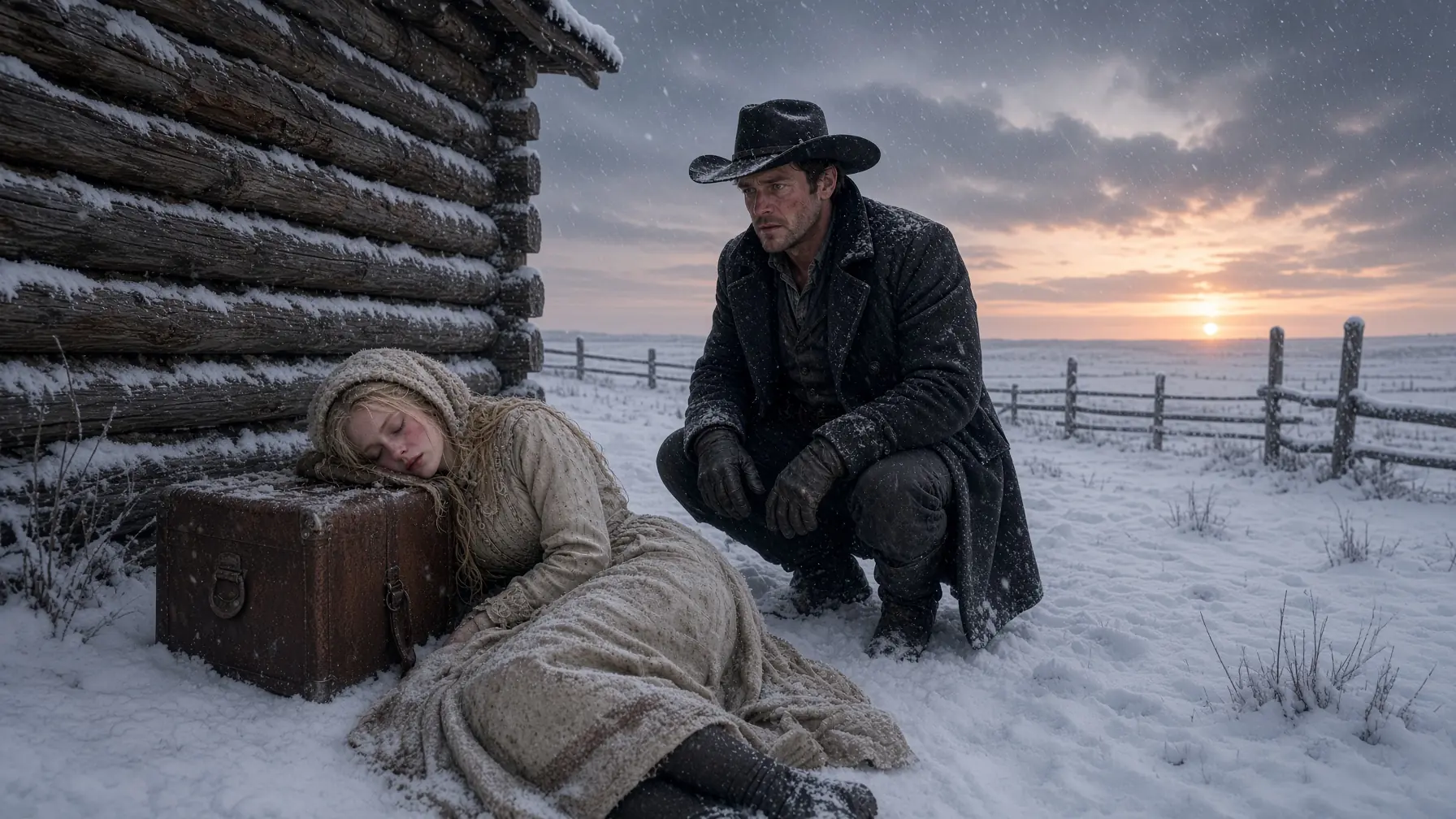
The blizzard came without warning, the way death often does in Montana territory. One moment Rosemary Caldwell could see the rudded road ahead through the stage coach window. Rose, as everyone had called her since childhood, preferred the shortened version. Rosemary felt too formal, too much like her mother's voice calling her to Sunday dinner. But out here, alone in the storm, with death creeping closer, even that small preference seemed meaningless.
The next the world dissolved into white fury. Wind screamed across the open prairie like something alive and hungry rattling the coach so violently she had to grip the wooden seat to keep from being thrown to the floor. She was the only passenger. That should have been her first warning. The driver had given her a long measuring look when she'd boarded in Helena that morning.
A look that said he knew something she didn't. But Rose had paid her fair $3.50 50 cents that she could barely afford, and the man had pocketed the money without comment. Now 6 hours into what should have been an 8-hour journey, she understood that look. The coach lurched to a stop. Rose peered through the window, but the glass had frosted over completely.
She could hear the driver climbing down from his perch, his boots crunching in what must already be deep snow. Then his face appeared at the window, weathered and hard, his eyes holding no apology whatsoever. He didn't bother opening the door, just shouted through the glass. End of the line, miss. Rose's stomach dropped.
We can't be in Thornfield yet. The advertisement said 8 hours from Helena. We're not in Thornfield. The driver's voice was flat matterof fact, as if he were discussing the price of grain rather than abandoning a woman in the wilderness. We're about three miles out.
Storm's getting worse. Horses can't make it through drifts this deep. You'll have to walk the rest. Walk. Rose pressed her hand against the cold glass.
In this better than dying out here when the coach gets stuck and the horses freeze. He turned away already dismissing her. There's a ranch about a mile northeast. Big place can't miss it if you follow the fence line. Tell Thorne I said you should have waited for better weather.
Rose shoved the door open, nearly falling as wind hit her like a physical force. Snow stung her face, tiny particles of ice that felt like needles against her skin. You can't just leave me here. But the driver was already back on his perch gathering the rains. He looked down at her one last time, and something that might have been pity flickered across his face.
Might have been. With men like this, it was hard to tell. You got warm clothes? Rose nodded, though her wool coat and traveling dress were designed for Boston winters, not Montana blizzards. Then you'll probably make it.
Follow the fence posts. Don't stop moving. Not even for a minute. You stop, you freeze. Simple as that.
He clicked his tongue at the horses. The coach lurched forward, wheels cutting through snow that was already past Rose's ankles. Within seconds, the dark shape of the stage coach had vanished into the white void, swallowed by the storm, as completely as if it had never existed. Rose stood alone on what might have been a road or might have been open prairie. In the white out, there was no way to tell.
Her traveling bag sat at her feet where the driver had tossed it. She picked it up, feeling the pathetic weight of everything she owned in the world. Two dresses, one night gown, her mother's silver brush, her father's veterinary instruments wrapped in oiled cloth, and $9 in coins sewn into the lining. $9 between her and starvation between her and the brothel where desperate women ended up when they had nowhere else to go. The wind screamed again, and Rose felt the cold begin to work its way through her coat. Her fingers were already numb inside her gloves.
She couldn't feel her toes. One mile northeast. Follow the fence posts. Rose turned squinting against the wind and began to walk. The world had narrowed to white and cold in the desperate need to keep moving.
Rose couldn't see more than a few feet ahead. Couldn't see the fence posts the driver had mentioned. Couldn't see anything except snow and more snow horizontal sheets of it driven by wind that felt strong enough to knock her down. She counted her steps to keep panic at bay. One, two, three, four.
At 100, she allowed herself to stop for three seconds, just long enough to catch her breath and wipe the ice from her eyelashes. Then she started counting again. Her father had taught her this during the war when he'd served as a cavalry veterinarian. He'd told her stories about winter campaigns, about soldiers who'd frozen to death within sight of camp because they'd stopped moving, about horses that had died standing up their blood turned to ice in their veins. The cold is patient Rossy girl," he'd said, his voice rough from the ldinum he'd needed for the pain in his leg.
The wound that had slowly killed him over 10 years infection eating away at muscle and bone until there was nothing left but a ghost of the man he'd been. It doesn't care if you're brave or scared. It just waits. And the moment you stop fighting, it takes you. Rose kept walking.
Her thoughts began to drift, which she knew was dangerous. This was how it started. This was how the cold got you. First the shivering stopped, which seemed like relief, but was actually your body giving up. Then the confusion set in the strange sleepiness that made you want to lie down in the snow and rest just for a moment.
She'd seen it once back in Boston, a drunk who'd passed out in an alley during a winter storm. By the time anyone found him the next morning, he'd been frozen solid, a peaceful expression on his face like he was having a pleasant dream. Rose's foot caught on something buried beneath the snow. She stumbled, went down hard on her knees. The impact jarred her traveling bag loose from her numb fingers.
It tumbled away, disappearing into a drift before she could grab it. Everything she owned, gone. For a long moment, Rose knelt in the snow, breathing hard, watching white particles settle on her dark coat. It would be so easy to stay here, so easy to just close her eyes and let the cold do its work. She was tired of fighting, tired of being afraid, tired of the knowing hunger in her belly, and the desperate calculations about how long $9 could last, and the crushing weight of knowing she was utterly, completely alone.
Her father was dead, had been dead for 6 months now, though the actual dying had taken years. Her mother was long gone, claimed by chalera when Rose was 12. She had no siblings, no cousins, no one in the world who would notice her care if she simply vanished into this white hell. She'd answered the advertisement because there was nothing left, because the factory where she'd worked as a clerk had closed, taking her 30 cents a day, wage with it, because her landlady had given her one week's notice, and Rose had spent five of those days writing letters to every possible employer in Boston, receiving nothing but silence in return. The advertisement had been simple, almost brutal in its honesty.
Rancher in Montana territory seeks educated woman for marriage. Must be practical, hardworking, and willing to adapt to frontier life. No romantic notions. This is a business arrangement. Reply to Wyatt Thornne Thornfield Station, Montana Territory.
Rose had replied, "Because she was practical, because she understood business arrangements, because romantic notions were luxuries for women who could afford them. And Rose Caldwell had exactly $9 and seven days before she'd be sleeping in the streets. " Wyatt Thorne had written back within two weeks. His handwriting was surprisingly elegant for a rancher his words carefully chosen. Miss Caldwell, I received your letter and find your qualification suitable. I own a horse ranch in Montana territory breeding quarter horses primarily for military contracts.
The work is demanding and the isolation considerable. I require a wife who can manage a household, potentially assist with business correspondence, and accept that this marriage will be one of partnership rather than romance. I am 32 years old, in good health, and financially stable. If these terms are acceptable, I will send funds for your travel. The arrangement will be legally binding upon your arrival.
Respectfully, Wyatt Thorne Rose had read that letter 20 times, parsing every word for hidden dangers. But there had been nothing overtly threatening. No promises of love she knew would be false. No flowery language designed to obscure harsh realities. Just a straightforward offer from a man who needed a wife and a woman who needed survival.
She'd written back accepting his terms. The travel funds had arrived one week later. $40 in Chris bills that represented more money than Rose had seen in months. She'd used $36.50 50 for the train ticket to Helena and the stage coach fair to Thornfield. The remaining $3.50 sat in her traveling bag, which was now buried somewhere in this white nightmare. Actually, no.
Rose looked down at her hands at the dark shape barely visible beneath the accumulating snow. Not buried right here. She must have fallen on it without realizing. She grabbed the bag's handle, hauled herself to her feet through sheer stubborn will. Her legs shook, her lungs burned with each breath of air so cold it felt like inhaling knives.
But she was standing, and standing meant she could walk. Rose took a step forward, then another. Started counting again. 1 2 3 4. Somewhere around step 467, she saw it.
A dark vertical line cutting through the white. A fence post exactly where the driver had promised it would be. Rose stumbled toward it, grabbed the rough wood with both hands, like it was salvation itself. The post was solid real proof that human beings lived in this frozen hell, and had built things that endured. If there was one post, there would be another, and another, a line of them leading to shelter.
She followed the fence line northeast, one hand trailing along the wire strung between posts, using it as a guide when the wind made seeing impossible. The wire cut through her glove in places araiding her palm. But the pain was good. Pain meant she was still alive, still feeling. Time stopped having meaning.
There was only the fence line and the snow and the mechanical process of lifting one foot, then the other. Rose's world had narrowed to this single task. Survive the next step, then the next, then the next. She almost walked past the gate. It was only because her hand hit a post that was thicker than the others, more substantial, that she stopped and looked, squinted through the white, and saw the shadow of cross beams overhead.
A gate, which meant a road, which meant somewhere worth going. Rose turned through the gate and followed what she hoped was a road. The fence line continued on her left, a guide through the chaos. Her breath came in ragged gasps now, each inhalation painful. She couldn't feel her feet at all anymore.