Don't let him wake up alone in the dark. She said that before she said her own name. The search dog found her first. His name was Copper. A blood hound, 11 years old, gray around the muzzle, and he pushed through a curtain of wet pine branches at 8:38 on a Saturday morning and simply stopped.
His handler, Gerald Patterson, a retired forest ranger with 22 years of UA search and rescue behind him, came through the brush 30 seconds later and stopped, too. Because what Gerald saw in that clearing did not look like a lost child. It looked like a decision someone had made and kept. Calla May Whitmore was 8 years old, 4 foot1, 52 pounds. She was sitting upright with her back against the rough bark of an oak tree, her head tilted back, eyes closed.
She had one yellow rubber boot on her left foot. Her right foot was in a mud soaked sock, the heel worn through, small toes pressing into cold, wet leaves. Her yellow raincoat, the one with the duck embroidered on the left pocket, the one her mother made her wear every time she entered the woods because the color meant she could be seen. Had a long tear down the left sleeve from thorny undergrowth. Both forearms were scratched from wrist to elbow.
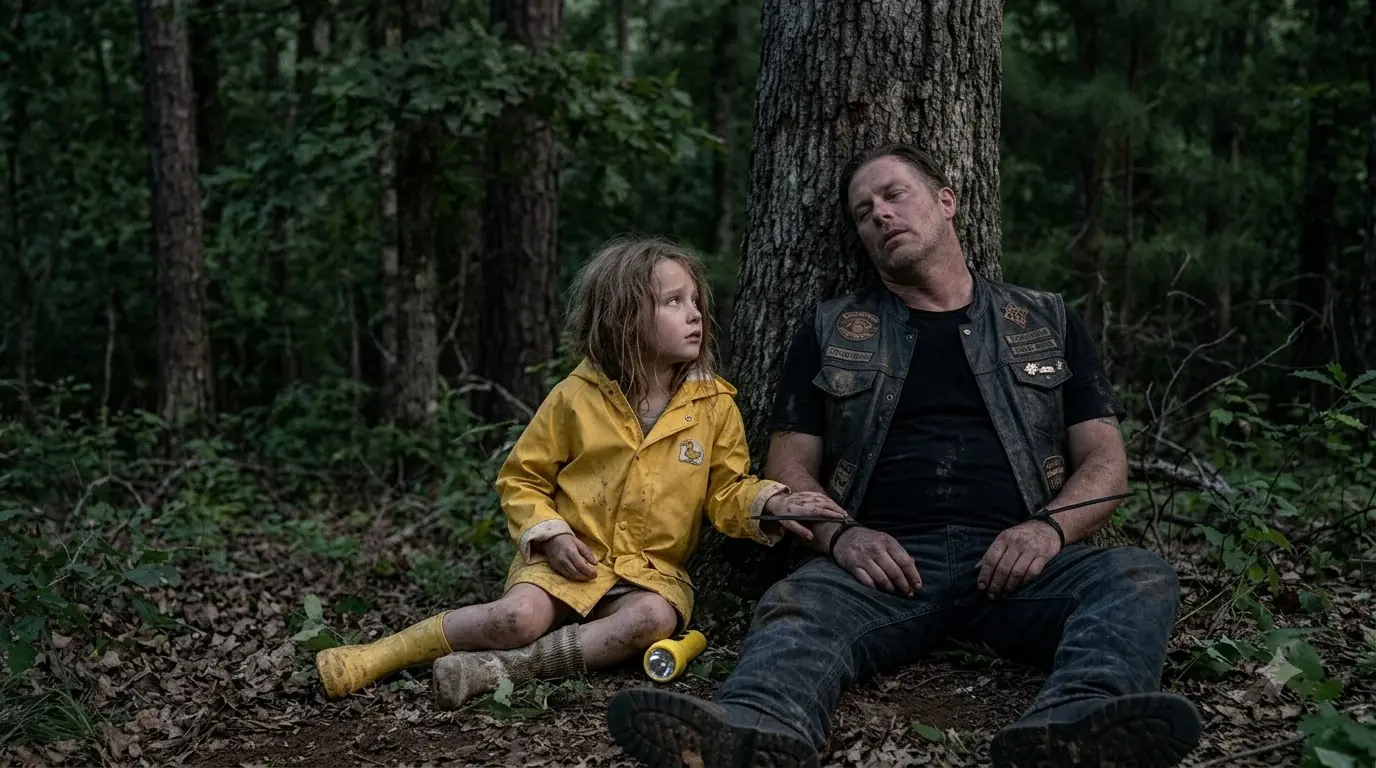
The skin dried dark where the thorns had caught her. Her right hand was slightly swollen around the knuckles from gripping a fallen branch through the night as a makeshift weapon she prayed she would never need. She was asleep sitting upright. And her right hand was loosely holding the wrist of the man bound to the tree beside her. Not gripping, not clutching, just resting there, present, chosen.
The kind of touch that says, "I am still here. " In a language that doesn't need consciousness to receive. The man's name was Marcus Webb. His brothers called him Ironside. He was 44 years old, 6'2, 230 lb, and he was alive, barely because of the 52lb girl asleep beside him. Gerald Patterson had seen 211 search and rescue operations in Pulk County.
He had found people in terrible shape. He had found people who didn't make it. He had never found a child who had stayed. He crouched down and he put his hand very gently on Kala's shoulder. She woke the way children wake when they've been frightened so long that sleep itself becomes a threat.
All at once, eyes fully open, scanning the treeine before she even registered where she was or who was beside her. And the first thing she said before her own name, before she asked for her mother, before she said a single word about herself, was, "Is he still breathing? " There is a small yellow plastic flashlight in this story. It matters more than it looks like it should. It was found in Kala's coat pocket when the paramedics arrived and began checking her for injuries. They worked through the scratches, the mild hypothermia, core temperature 94.3°, real but not critical.
And when they reached into her right pocket, the flashlight came out, still switched off, battery still full. She had carried it into the forest the afternoon before, the way her mother had always taught her, and she had not turned it on once across 14 hours of darkness. Gerald Patterson held that flashlight for a long moment. Then he sat down on a fallen log in the middle of the UA National Forest and put his face in both hands because he understood in that moment exactly what it had cost her not to use it. But to understand what Calame Witmore's 14 hours in those woods actually cost, and what it meant that she paid that cost willingly, you have to go back to the afternoon before Friday, late September.
School let out at 3:15. Calla, third grade, described by her teacher, Maria Hendris, as the kind of child who notices things grown-ups miss, walked home along Ridgeline Road, dropped her backpack on the porch, and told her mother she was going to the woods to work on her fort. Louise Whitmore said yes. She always said yes. The western edge of the UA, half a mile from Forest Service Road 38A, had been Kala's territory since she was old enough to walk there alone.
She knew which trees had good climbing branches. She knew which clearings caught the afternoon light. She knew those woods the way 8-year-olds know the things they love, not with maps, but in their bodies. She left the house at 4:47 p.m. With her yellow raincoat and her small flashlight and a peanut butter sandwich in her jacket pocket.
At 6:17 p.m., 0.3 mi from home, in a section of forest she had played in her entire life, she heard men's voices, and then the sound of something heavy striking something that couldn't strike back. What Kala saw in that clearing would later fill pages of investigators reports and court transcripts described in the careful clinical language those documents require. But what she experienced in those first few seconds was simpler and more absolute than any report could capture. A man was being hurt. He was very large and his jacket had writing on it and there were chains involved and the men doing it were saying things she didn't fully understand but understood enough.
And then one of them looked up and he saw her. She ran through underbrush, through thorns that caught her left sleeve and tore it open from shoulder to wrist, losing her right boot in the first 30 seconds of running, hitting the ground hard on both knees at one point and getting back up without pausing because the sounds behind her were still there. She ran until she found a section of dense timber brush thick enough to crawl inside, and she pressed herself flat against the cold ground, and went completely still. She tried once to signal toward the road with her flashlight, got it out of her pocket, aimed toward where the road should be, and saw through a gap in the trees one of the men scanning the tree line with binoculars. She switched it off.
She put it back in her pocket and she made a decision. Here is the part of this story that no one who hears it can quite get past. Calla May Witmore, age 8, in a torn raincoat with one boot, alone in a forest where men were actively searching for her, ran a calculation that would not have been out of place in a tactical briefing. If she ran, even if she got out safely, even if she found someone to help, she could not guarantee she could lead them back to the exact location. The forest at night was not the forest in the afternoon.
She understood that with the bone level certainty of a child who had spent years in those trees, and every minute she spent running and explaining and convincing was a minute the man in the clearing was losing. She had watched him. He was barely conscious. He was chained to that tree. He was not going to call for help himself.
So, she crawled back, not all the way to the clearing, far enough that the men who'd left wouldn't spot her if they returned, close enough to see the rise and fall of his chest. She pressed her back against the oak directly beside his tree, southeast side, and she put her right hand on his bound wrist, not tight enough to help him, just there, present, and she stayed for 14 hours and 23 minutes. She talked to him through the worst of it, barely above a whisper, never louder than that. She had learned within the first hour that silence was the only armor she had. She told him about her dog, a beagle mix named Biscuit, who snored at the foot of her bed in a way that was annoying and also comforting.
She told him about her teacher, who let students read under their desks on Fridays. She told him about the cedar tree she'd chosen for the back wall of her fort and the pine cones she'd been collecting to line the entrance path. She talked so she wouldn't run. He couldn't hear her. She talked anyway.
At 21:17 in the morning, something large moved through the brush to the north, heavy enough to snap branches, and Kala stood up. One boot on, one sock soaked through, torn raincoat, full flashlight in her pocket. She turned toward the direction of home. She looked back. His chest was still moving, slower than an hour before, but still moving.
She sat back down. She put her hand back on his wrist. "I'm still here," she whispered. "I'm not going anywhere. " The trauma surgeon at Pulk County Regional Medical Center, Dr. Elaine Foresight would later state for the record that Ironside's core temperature at discovery was 93.7°, blood loss estimated at 31% of total volume, and that without the approximate body warmth of another person, slowing the rate of temperature decline, cardiac event would have been probable between 11:30 p.m.
And 200 a.m. The child's presence was physiologically significant. She wasn't just a comfort. She was a variable in whether he survived. 8 years old, 52 lb, one rubber boot, a full flashlight.
She never turned on a variable. The scratch marks on her forearms came from running through thorns she tore through rather than slow down. The bruise forming on her right knee came from the fall she took at full speed and got back up from without stopping. The swelling in her right hand came from gripping a fallen branch as a weapon for 14 hours because she needed something to hold that wasn't her own terror. She cried quietly because silence was survival, but she cried.