Eli Porter always arrived at Juniper Diner at exactly 6:10 in the evening.
Not 6:05.
Not 6:15.
6:10.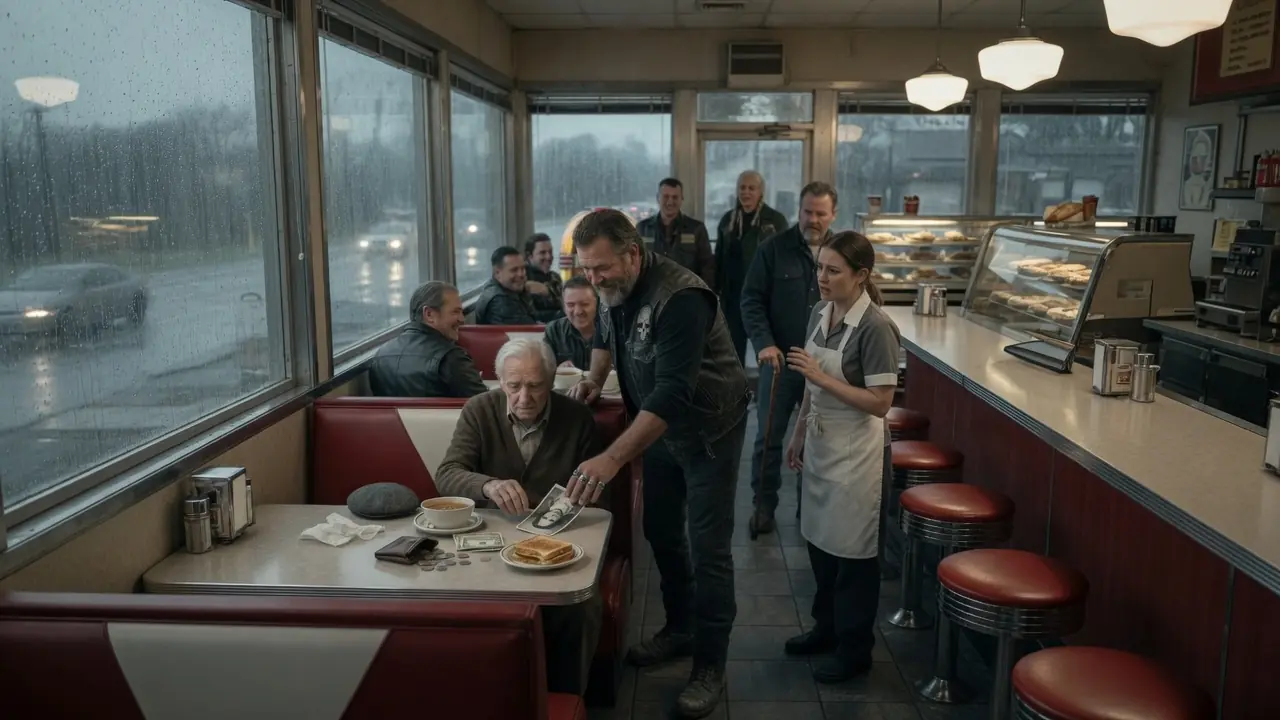
The waitresses joked that you could set the wall clock by the sound of his cane tapping across the old tile floor. Tap, pause, tap, pause, tap. Then the bell above the door would give its tired little ring, and there he would be, standing beneath the faded blue sign that read, “Seat Yourself, Stay Awhile.”
Eli was seventy-nine years old, thin as a fence rail, with white hair combed carefully to one side and shoulders that had rounded after decades of hard work. He wore the same brown cardigan almost every Thursday, no matter the season, along with pressed dark pants, polished shoes, and a gray flat cap that looked older than half the buildings in town.
People in Briar Creek, Missouri, knew him mostly as “Mr. Porter.”
Some remembered he had once driven the school bus before sunrise and after sunset, carrying generations of children over gravel roads and narrow bridges. Some remembered he had repaired porches for widows without sending a bill. Some remembered he had owned a small hardware store that closed when the big box place opened near the interstate.
But younger folks mostly knew him as the old man who sat in booth four at Juniper Diner, ordered vegetable soup, half a grilled cheese, and hot tea with lemon, then left exactly one dollar and twenty-five cents under the saucer no matter how tight money looked.
To Eli, booth four was not just a booth.
It faced the front window, where he could watch the road turn gold at sunset.
It sat close enough to the counter that Mara Jenkins could hear him if he needed more tea.
It had a small scratch near the edge where his late wife, Ruth, had once dropped her wedding ring while laughing too hard at one of his bad jokes.
Eli never told anyone about the scratch.
Some memories were not secrets, exactly. They were just too tender to explain.
That Thursday evening, the diner was busy in a gentle, ordinary way.
A family with two little boys occupied the round table near the pie case. Three road workers sat at the counter, their orange safety vests folded over their knees. A nurse from the county clinic ate chicken pot pie in the corner while reading messages on her phone. Near the jukebox, two high school seniors shared fries and pretended not to hold hands beneath the table.
Rain had threatened all afternoon but never fully arrived. The clouds hung low and gray over the highway, and the neon sign outside buzzed softly each time the wind pushed against it.
Mara was behind the counter when Eli came in.
She saw him before the bell finished ringing.
“There he is,” she called. “Six-ten sharp.”
Eli took off his cap and held it against his chest. “Evening, Miss Mara.”
“You know you can call me Mara.”
“I do know that.”
“And yet.”
He smiled faintly. “My mother raised me with habits. Some of them survived.”
Mara laughed and reached for a menu, though he had not opened one in years. “Booth four?”
“If it’s not spoken for.”
“It’s waiting on you.”
Eli nodded, grateful as if she had done him a great favor, and made his slow way across the diner.
Mara watched him go.
At thirty-one, she had worked at Juniper Diner long enough to recognize the different kinds of tired people carried. Some tiredness came from a long shift. Some came from bad sleep. Some came from bills, sickness, loneliness, or pretending not to need anyone.
Eli carried the quiet kind.
The kind that sat beside a person even when the room was full.
She brought him hot tea first, then a small glass of water, then the folded paper napkin he liked to place beneath the spoon.
“You eating the usual?” she asked.
“Yes, ma’am.”
“Full grilled cheese tonight?”
Eli looked down, smiling. “Half is plenty.”
“You sure?”
“More than plenty.”
Mara did not argue, but she made a note to tell Theo in the kitchen to cut the sandwich thick and call it half. Eli had lost weight again. His cardigan hung too loosely at the wrists, and the blue veins in his hands seemed more visible than they had the week before.
He opened the small coin purse he carried in his jacket pocket and counted bills beneath the table, careful to keep the movement private.
Mara pretended not to see.
That was part of dignity too.
Noticing without staring.
Helping without making a person feel helped.
When she returned to the counter, Theo leaned through the kitchen window. He was twenty-six, broad-faced, with flour on his sleeve and a towel thrown over one shoulder.
“Mr. Porter get the usual?”
“Usual, but make the sandwich generous.”
Theo nodded. “Always do.”
Mara glanced toward booth four.
Eli had unfolded a newspaper, but he was not reading. He was looking out the window toward the road, where the late evening light had begun to fade.
“Do you think he’s all right?” Mara asked.
Theo followed her gaze. “He’s old.”
“That’s not an answer.”
“No,” Theo admitted. “It’s not.”
Before Mara could say more, the front door opened and Daniel Price walked in.
He was forty-two, tall, clean-shaven, and dressed in a navy work jacket with the logo of Price & Sons Towing stitched over the chest. He carried himself like a man who had built his life one hard mile at a time and still remembered exactly where the gravel had cut him.
Mara smiled. “Evening, Daniel.”
“Evening.” His eyes moved automatically to booth four. “He here?”
“Six-ten sharp.”
Daniel’s expression softened.
He did not go to Eli immediately. He never did. He waited until Eli had tea, until his food arrived, until the old man had settled into the rhythm of the booth. Daniel seemed to understand something most people missed.
Some kindness had to stand at a distance first.
“Coffee?” Mara asked.
“Please.”
Daniel took a stool at the far end of the counter, where he could see Eli without crowding him. He came every other Thursday, ordered coffee, sometimes pie, and always paid Eli’s bill when he could do it without being noticed.
Mara had asked him once why.
Daniel had only said, “He paid mine first.”
She had never pushed for more.
At 6:37, Theo placed Eli’s soup and grilled cheese in the pass-through window.
Mara carried it to booth four.
“Careful,” she said. “Bowl’s hot.”
Eli folded his newspaper. “Smells better than it has any right to.”
“That’s because Theo thinks salt is a love language.”
From the kitchen, Theo shouted, “I heard that.”
“You were meant to,” Mara called back.
Eli chuckled softly.
Mara set the plate down. The grilled cheese had been cut into two large triangles, golden and crisp at the edges. Eli noticed the portion was bigger than usual, but said nothing. He only looked at Mara with eyes that were still bright despite age.
“Thank you,” he said.
“Enjoy.”
She returned to the counter, refilled Daniel’s coffee, then started wiping down the register area.
For a while, nothing happened.
The boys by the pie case argued about which dinosaur was fastest. The road workers debated whether rain would delay tomorrow’s bridge repair. The nurse laughed quietly at something on her phone. The jukebox hummed through an old country song about leaving home and coming back too late.
Then the motorcycles came.
The first engine growled into the parking lot like a warning.
Mara looked up.
The second joined it.
Then the third.
Within moments, the diner windows began to vibrate. The spoons in the metal cup beside the coffee machine trembled softly. Outside, headlights swung across the glass, bright and harsh in the gathering dusk.
Daniel turned on his stool.
Theo appeared in the kitchen window.
Eli did not move at first. Then he folded his hands beside his bowl and looked toward the door.
Seven motorcycles rolled into the lot. They parked badly, taking up nearly the entire front row. Engines revved once, twice, then shut off in staggered bursts.
The sudden quiet felt worse than the noise.
Men climbed from the bikes.
They wore leather vests darkened by road dust, heavy boots, denim, rings, chains, and patches showing a black crow perched on a cracked skull. The words beneath the patch read: Crowbar Saints.
Mara knew the name.
Everyone who worked along the highway did.
They were not the largest biker crew in the region, but they had a reputation for making themselves unforgettable in the worst ways. They did not always break things. Sometimes they only scared people enough that people broke their own rules trying to get them to leave.
The man leading them was called Flint Mercer.
Mara knew that too.
He was in his late forties, tall, thick through the shoulders, with a gray-streaked beard and eyes that seemed permanently amused by other people’s discomfort. He walked ahead of the group with his thumbs hooked in his belt, chin lifted, as if entering a diner were the same as claiming land.
The bell above the door rang.
Cold air came in with them.
So did the smell of gasoline, rain-soaked leather, and tobacco.
Flint stopped inside the entrance and looked around.
“Well,” he said loudly. “Ain’t this place precious?”
One of the riders behind him laughed. “Looks like my grandma decorated it.”
Another pointed at the pie case. “You think they got prune pie?”
More laughter.
Mara stepped forward, forcing her face into the kind of polite mask waitresses build from necessity.
“Evening,” she said. “Sit anywhere you like.”
Flint’s eyes landed on her, slid down to her name tag, then drifted past her to the room.
“Anywhere?”
“That’s right.”
His gaze stopped at booth four.
Eli was seated there with his tea, soup, and sandwich. He had not taken a bite yet.
Flint smiled.
It was not a happy smile.
It was the smile of a man who had found something smaller than himself.
“That booth,” he said. “We’ll take that booth.”
Mara’s shoulders tightened. “That booth is occupied.”
Flint looked at Eli as if noticing him for the first time.
The other bikers followed his gaze.
A few grinned.
Eli kept his hands folded, but Mara saw one thumb move slowly over the other.
Flint walked toward booth four.
The diner quieted around him.
The family near the pie case stopped eating. The nurse lowered her phone. The road workers turned on their stools but did not speak. Daniel remained at the counter, one hand around his coffee cup, his expression unreadable.
Flint stopped beside Eli’s table and leaned down slightly.
“Evening, grandpa.”
Eli looked up.
“Evening.”
Flint glanced at the soup, the half sandwich, the hot tea. “Big night out?”
Eli did not answer immediately. “Just supper.”
“Supper,” Flint repeated, giving the word to his men like a joke.
They laughed.
Mara moved closer. “Sir, there are plenty of tables.”
Flint held up one hand without looking at her. “Relax, sweetheart. We’re just talking.”
Eli picked up his spoon.
Flint placed two fingers on the edge of the bowl and pulled it an inch away from him.
Eli’s spoon paused in midair.
The laugh that moved through the bikers was low and ugly.
Mara’s face burned. “Don’t touch his food.”
Flint finally looked at her. “Or what?”
The simple question filled the room with fear.
Mara hated how quickly fear changed the shape of a place.
A diner was supposed to be ordinary. Coffee, plates, tired jokes, forks against ceramic, people passing through. But one cruel man could turn it into a stage, and suddenly every customer became an audience member deciding whether to look away.
Eli placed his spoon down.
“Miss Mara,” he said softly, “it’s all right.”
“No, it isn’t,” she replied.
Flint’s grin widened. “Hear that? Old man needs a waitress to fight for him.”
One of the bikers stepped closer to the booth and tapped Eli’s cane with his boot.
“What’s this, antique equipment?”
Another said, “Careful. He might chase you at three miles an hour.”
The men laughed louder.
Eli’s face remained calm, but Mara saw the color rising in his cheeks.
He reached for his cane.
Flint grabbed it first.
Mara’s heart jumped. “Give that back.”
Flint lifted the cane and examined it like a strange object. The handle was polished smooth from years of use.
“This handmade?”
Eli’s voice stayed even. “My son made it.”
“Son got tired of carrying you around?”
The words landed hard.
Eli’s eyes lowered to the table.
Mara knew enough about Eli’s son to feel the cruelty of it. Patrick Porter had left Briar Creek years ago and rarely visited. Nobody knew the whole story, but everyone knew Eli walked home alone from the clinic, bought groceries alone, and spent holidays alone unless someone remembered to invite him.
Flint did not know any of that.
He only knew he had found a soft place to press.
“Give him the cane,” Mara said.
Flint spun it once clumsily. “Maybe he should ask nice.”
Daniel’s hand tightened around the coffee cup.
Theo stepped out of the kitchen doorway, wiping his hands slowly on a towel.
Mara looked toward Daniel.
He had not moved yet.
That surprised her. Daniel was not a coward. Anyone in Briar Creek knew that. He owned tow trucks, pulled cars from ditches at two in the morning, and once stood in front of a drunk man yelling at a cashier until the man left without buying anything.
But now Daniel sat very still.
Watching.
Waiting.
Mara did not understand why.
Eli lifted his eyes to Flint. “May I have my cane back, please?”
The bikers chuckled.
Flint lowered the cane until the handle hovered just out of Eli’s reach.
“Say it like you mean it.”
Eli stared at the cane.
For one awful moment, Mara thought he might do it. Not because he was weak, but because age forces people into compromises younger people mistake for surrender. A man who needs his cane cannot always afford pride.
Then Eli sat back.
“No,” he said.
The laughter faded slightly.
Flint tilted his head. “No?”
“No.”
“You don’t want it back?”
“I do.”
“Then ask.”
“I already did.”
Flint’s smile hardened. “Old man’s got attitude.”
Eli’s hands were trembling now, but his voice remained quiet. “Old men have memories. Sometimes they’re heavier.”
The answer confused some of the bikers.
It angered Flint.
He dropped the cane.
It clattered onto the floor beneath the table.
Then he pushed it with his boot, sending it sliding across the tile toward the counter.
Mara moved to pick it up.
A biker stepped in her way.
“Leave it,” he said.
The room went still.
Eli looked at the cane on the floor. Without it, standing would be difficult. Everyone could see that.
That was why Flint had done it.
Flint slid into the booth across from him.
“Now,” he said, “since we’re friends, let’s talk about that seat.”
Mara’s voice shook with anger. “You need to leave him alone.”
“Need?” Flint looked around. “Anybody hear a need?”
The bikers laughed again.
The road workers at the counter shifted uncomfortably. One opened his mouth, then closed it. The nurse stood halfway, then sat when another biker turned toward her. The family near the pie case gathered the children close. Fear moved through the room like smoke.
Eli reached slowly for his soup bowl.
Flint took the grilled cheese from the plate.
He lifted one triangle, inspected it, took a bite, and made a face.
“Dry.”
He tossed it back onto the plate.
Mara felt something inside her snap.
“That’s enough.”
Flint looked at her, amused. “You keep saying that.”
“Because you keep proving you don’t understand it.”
The nearest biker stepped toward her. “Watch your mouth.”
Theo came farther out of the kitchen. “Don’t talk to her like that.”
The biker turned. “Cook wants in?”
Theo was big, but young. His anger was real, but so was his fear. He held the towel like he wished it were something heavier.
Daniel finally stood.
The stool legs scraped softly against the tile.
Everyone heard it.
Flint glanced over his shoulder.
Daniel did not raise his voice. “Put the cane back by his hand.”
Flint studied him for a second, then smiled. “Tow truck man.”
Daniel’s jaw moved once. “That’s right.”
“Price & Sons, isn’t it?”
“Yes.”
“Good. One of our bikes is making noise. You can look at it after we eat.”
“No.”
The word landed cleanly.
Flint’s brows lifted.
Daniel stepped away from the counter. “Not after you touched his cane. Not after you touched his food. Not after you made this room afraid for entertainment.”
One of the bikers laughed. “You think you’re going to stop us from eating?”
“No,” Daniel said. “I think you’re going to leave.”
The diner held its breath.
Flint slid out of the booth and stood slowly.
He was taller than Daniel, heavier too, with the careless confidence of a man used to people measuring his size before speaking.
“You ordering us around?”
“Yes.”
“Brave.”
Daniel’s eyes moved to Eli. “No. Late.”
Something flickered across Eli’s face.
Pain, maybe.
Recognition.
Flint noticed.
“Oh,” he said. “You two know each other?”
Daniel did not answer.
Flint looked delighted now. Cruel men loved connections because connections gave them new ways to pull.
He turned back to Eli. “This your boy?”
Eli’s face tightened. “No.”
“Grandson?”
“No.”
“Then what? You collect strays?”
Daniel stepped forward.
Eli spoke before he could.
“Daniel,” he said softly. “Please don’t.”
That made Flint grin.
“Daniel,” he repeated. “Please don’t.”
He mocked Eli’s thin voice so closely that one of the little boys near the pie case started crying.
Mara looked at the child, then at Eli.
Eli had gone pale.
The humiliation was no longer loud. It had become precise.
Flint was not just laughing at age now. He was laughing at the old man’s attempt to protect someone else while he himself sat without a cane, with his food touched and his dignity dragged into the room.
Daniel’s face hardened in a way Mara had never seen.
He walked to the counter, picked up Eli’s cane, and carried it back.
A biker moved to block him.
Daniel stopped inches away.
“You can stand there,” Daniel said, “or you can be smart.”
The biker looked at Flint.
Flint gave a small nod, curious now.
The biker stepped aside.
Daniel placed the cane gently beside Eli’s hand.
Eli closed his fingers around it but did not stand.
“Thank you,” he whispered.
Daniel leaned slightly closer. “I should have moved sooner.”
Eli looked at him. “You moved.”
The words seemed to hurt Daniel more than blame would have.
Flint clapped slowly.
“Well, ain’t that touching.” He looked around at the diners. “Everybody see that? Hero brought grandpa his stick.”
His men laughed, but less strongly now.
Daniel turned to him.
“His name is Eli Porter.”
“Congratulations.”
“And you’re standing in a town that knows him.”
Flint spread his arms. “Looks to me like this town’s sitting real quiet.”
That line cut through the room because it was true.
Mara saw shame land on faces one by one.
The road workers looked at their plates.
The nurse swallowed hard.
The teenagers near the jukebox stared at the floor.
Even Mara felt it, though she had spoken. She had spoken, yes, but she had also looked to Daniel. She had waited for someone bigger. Someone with a stronger voice. Someone less dependent on tips, less afraid of losing a shift, less trapped by the rules of customer service.
Flint fed on that shame.
He turned back to Eli. “Tell you what, Mr. Famous. Since the town knows you, why don’t you buy us dinner?”
Eli blinked. “What?”
“You heard me. You’re the local legend, right? Buy the Crowbar Saints dinner.”
Mara stepped forward. “Absolutely not.”
Flint ignored her. “How much you got on you, old man?”
Eli’s hand moved instinctively toward his jacket pocket.
Flint saw it.
Before anyone could stop him, he reached across the table and snatched the small coin purse from Eli’s pocket.
Eli gasped softly.
Daniel moved fast, but two bikers stepped between him and Flint.
“Easy,” one said.
Flint opened the coin purse and dumped its contents onto the table.
A few folded bills.
Some coins.
A small photograph.
Mara recognized Ruth Porter from the photograph. Eli’s wife. Younger, smiling, standing beside a rosebush with one hand shielding her eyes from the sun.
Flint picked up the photo.
“Now who’s this?”
Eli’s voice changed. “Put that down.”
The room went colder.
Flint turned the photo toward his men. “Lady friend?”
Eli reached for it.
Flint lifted it higher.
“Careful,” he said. “You’ll hurt yourself.”
Daniel’s voice was low. “Flint.”
Flint looked at him. “What?”
“Put the picture down.”
“Or what?”
Daniel did not answer.
The front door opened.
The bell rang.
Everyone turned.
A woman stepped inside wearing a dark green coat, jeans, and work boots. Her hair was pulled back in a silver-streaked braid, and rain dotted her shoulders. She was in her late forties, with a face that looked familiar to half the room but impossible to place at first.
Behind her stood two men in county uniforms.
Not sheriff’s deputies.
Emergency services.
The woman’s eyes swept across the diner and found Eli.
Then Flint holding the photograph.
Her expression changed.
“Give that back,” she said.
Flint looked annoyed. “Who are you?”
The woman stepped farther inside.
“My name is Rachel Moreno.”
A murmur moved through the diner.
Mara knew the name.
Everyone in Briar Creek did.
Rachel Moreno was the county commissioner now. Before that, she had been the first girl from Briar Creek High to earn a full scholarship to the state university. Before that, according to town stories, she had been a foster kid who nearly disappeared into trouble until somebody helped her stay in school.
Mara had never known who.
Rachel walked toward booth four with calm fury in every step.
Flint glanced at the county workers behind her, then at Daniel. “You calling politicians now?”
Daniel’s eyes remained on Eli. “I called people who owe him more than they can repay.”
Rachel stopped beside the table and held out her hand.
“The photograph.”
Flint gave a lazy smile. “You always this serious?”
“When a grown man steals from an old man? Yes.”
“Borrowed.”
“You stole it.”
The word struck the room with clean force.
Flint’s eyes narrowed.
Rachel did not blink.
For a second, Mara thought he might refuse. Then he looked past Rachel and saw the emergency workers standing by the door, phones out. He saw the teenage boy near the jukebox recording. He saw the nurse standing now, no longer seated. He saw one of the road workers finally rise from his stool.
He placed the photo on the table.
Rachel picked it up carefully and handed it to Eli.
Eli’s hands trembled around it.
“Thank you,” he whispered.
Rachel’s face softened. “Mr. Porter, are you hurt?”
“No.”
“Are you sure?”
“Yes.”
She glanced at his untouched soup, his disturbed coin purse, his cane gripped too tightly. “You’re not all right.”
Eli looked embarrassed. “I’m only old.”
Rachel’s voice gentled. “That is not a reason for people to be cruel.”
Flint groaned loudly. “This is getting boring.”
Rachel turned toward him. “Then leave.”
His riders shifted.
Flint laughed once. “You people really think a diner full of locals scares me?”
“No,” Daniel said.
He looked out the window.
Headlights were turning into the parking lot.
One truck.
Then another.
Then another.
Mara watched through the glass as vehicles pulled in from the highway and side road. Pickup trucks, old sedans, a school bus, a county maintenance van, two tow trucks from Price & Sons, and a fire department SUV. More people climbed out beneath the gray sky, some in work clothes, some in uniforms, some with children, some older than Eli himself.
They did not rush.
They simply came.
Flint stared.
“What is this?” he demanded.
Daniel looked at him. “A town that should have stood up sooner.”
The door opened again.
An older man in a postal jacket entered first, removing his cap. He looked at Eli and nodded.
“Mr. Porter.”
A woman in scrubs came behind him. “Mr. Porter.”
A man with a carpenter’s belt. “Eli.”
A young mother carrying a toddler. “Mr. Porter, are you okay?”
Then more voices.
“Mr. Porter.”
“Eli.”
“Sir.”
“Coach.”
“Bus Man.”
That last one came from a man in his thirties wearing a mechanic’s shirt, who smiled sadly as he said it.
The diner filled with people who had once been children on Eli’s bus, neighbors in his hardware store, families whose steps he had repaired, students he had quietly bought lunch for, adults who remembered being seen by him when they felt invisible.
Flint’s expression shifted.
For the first time, the room was not his stage.
It belonged to Eli.
Eli looked overwhelmed. “Daniel, what did you do?”
Daniel stood beside him. “What you did for me.”
“I didn’t call half the county for you.”
“No,” Daniel said. “You came alone.”
Rachel touched the back of Eli’s booth. “And that was enough.”
Flint snapped, “Everybody needs to back up.”
A county worker at the door said, “Sheriff’s on the way.”
One of the Crowbar Saints muttered, “We should go.”
Flint shot him a look. “Shut up.”
But the biker did not look convinced.
Cruelty worked best when it could isolate a person. It needed silence, distance, and the belief that no one cared enough to interfere. Now the diner was crowded with proof that Eli Porter was not alone, and the Crowbar Saints suddenly looked less like wolves and more like men who had wandered into the wrong yard.
Sheriff Tom Willis arrived three minutes later.
He came in with two deputies and the tired expression of a man who had expected trouble from Flint Mercer eventually and was almost relieved it had chosen a room full of witnesses.
“Flint,” the sheriff said.
Flint rolled his eyes. “Sheriff.”
“You bothering folks again?”
“We were trying to eat.”
Mara spoke before she could stop herself. “No, you weren’t.”
The sheriff looked at her. “Mara?”
She stepped forward, heart pounding. “They took Mr. Porter’s cane. Touched his food. Took his coin purse. Took a photograph from it. Tried to make him buy their dinner.”
The sheriff’s jaw tightened.
Theo added from the kitchen door, “They blocked me and Mara when we tried to help.”
The nurse stepped forward. “I saw it.”
The road worker raised his hand. “Me too.”
The teenage boy by the jukebox said, “I recorded the part with the cane.”
Flint looked around at all the faces now turned against him.
His smile was gone.
Sheriff Willis looked at Eli. “Mr. Porter, do you want to make a complaint?”
Eli looked down at Ruth’s photograph.
For a moment, Mara thought he would say no.
Not because it had not hurt him.
Because older men like Eli were often trained by life to absorb insult quietly. They did not want fuss. They did not want attention. They did not want to be the reason people gathered in anger.
But then Eli looked at the little boy near the pie case, still pressed against his mother’s side. He looked at Mara, whose face was flushed with fury and fear. He looked at Daniel, Rachel, Theo, and the room full of people who had come because somewhere in their lives, Eli Porter had refused to look away.
He lifted his chin.
“Yes,” he said.
The word was soft.
But it changed everything.
Sheriff Willis nodded once. “All right.”
Flint gave a bitter laugh. “You’re pressing charges over a cane and a sandwich?”
Eli looked at him.
“No,” he said. “Over me.”
The diner went silent.
Flint had no answer for that.
The deputies moved in.
No one fought. Not really. One biker cursed under his breath. Another protested that he had not touched anything. The man who had mocked the cane kept his eyes down while giving his name.
Flint was escorted out last.
At the door, he turned back toward Eli, trying to reclaim a little of the power he had lost.
“You think this makes you somebody?”
Eli’s hand tightened around his cane.
Before he could answer, Rachel did.
“He was somebody before you walked in,” she said.
Daniel stepped closer. “You were just too small to see it.”
The sheriff guided Flint through the door.
The bell rang behind him.
Then the room exhaled.
For a few seconds, nobody moved.
Outside, the deputies spoke with the bikers near their motorcycles. Inside, Eli sat in booth four with cold soup, a bitten sandwich, his coin purse spilled across the table, and Ruth’s photograph held against his chest.
Mara went to him.
“I’m so sorry,” she said.
Eli looked up at her, surprised. “You didn’t do it.”
“I know, but I’m sorry it happened here.”
Theo came from the kitchen carrying a fresh bowl of soup and a new grilled cheese.
He set them down carefully.
“Hot,” he said, though his voice was rough. “And this time it’s a full sandwich. Don’t argue.”
Eli looked at the plate.
Then at the room full of people watching him with concern.
His mouth trembled slightly.
“I can’t pay for all this.”
Daniel sat across from him before anyone else could speak.
“You paid already.”
Eli frowned. “I did not.”
Daniel leaned forward, elbows on the table, eyes shining with something old and unhealed.
“Yes,” he said. “You did.”
The diner grew quiet again, but this silence was different. Gentle. Waiting.
Eli looked at him. “Daniel.”
“No,” Daniel said. “They all came, and most of them know pieces. But I don’t think you ever understood what you did.”
Eli looked uncomfortable. “This isn’t necessary.”
“It is to me.”
Rachel sat at the edge of the next booth. “And to me.”
Mara stayed beside the table, not wanting to intrude but unable to walk away.
Daniel took a long breath.
“I was fifteen when I first came into this diner,” he said. “Not this building exactly. The old one across the road. My mother had left town, my father was drinking more than working, and I had not eaten since the day before.”
Eli looked down.
“You were sitting near the counter,” Daniel continued. “You had a blue work shirt on with Porter Hardware stitched over the pocket. I tried to order fries with eighty-seven cents. The waitress told me it wasn’t enough.”
Mara glanced at Eli.
His face had changed.
He remembered.
Daniel smiled faintly. “You asked me if I could help you carry some boxes at the hardware store. Said you’d pay me with supper. I knew you were lying. There weren’t any boxes that couldn’t wait. But I went because I was hungry.”
A few people in the room shifted quietly.
“You fed me that night,” Daniel said. “Then the next night. Then every Tuesday and Thursday for almost a year. You never called it charity. You called it work. You gave me a broom, a shelf to organize, screws to sort, windows to wash. You gave me a reason to stand somewhere that wasn’t a street corner.”
Eli’s eyes glistened.
Daniel’s voice tightened. “When I dropped out of school, you drove to my house and sat on the porch until I came outside. You didn’t lecture me. You handed me a sandwich and said, ‘A hungry boy can’t think straight, but a smart boy can still come back.’”
A soft sound came from someone near the counter.
Daniel wiped one hand over his mouth.
“I came back,” he said. “Because of you.”
Eli whispered, “You did that yourself.”
“No.” Daniel shook his head. “I walked. You opened the door.”
Rachel folded her hands.
“My turn,” she said.
Eli looked startled. “Rachel, no.”
“Yes.” She smiled through tears. “You don’t get to hide tonight.”
A few people laughed softly.
Rachel looked around the diner.
“I was sixteen when my third foster placement ended. I had a garbage bag of clothes and a file folder full of reasons adults called me difficult.” Her voice remained steady, but her hands gripped one another. “I missed the bus after school one afternoon because I didn’t want to go back to a house where nobody wanted me. Mr. Porter was driving then.”
Eli closed his eyes.
“He parked the bus after the route and found me sitting behind the gym. He didn’t ask what I did wrong. That was the first thing. Most adults started there.” Rachel swallowed. “He asked if I had eaten.”
Daniel smiled sadly. “That sounds like him.”
“He took me to the diner. Bought me soup. Then he called a woman named Mrs. Caldwell, who ran the library program. He said, ‘This girl needs a desk, not another door slammed in her face.’”
Rachel looked at Eli.
“I slept in the library office that night with Mrs. Caldwell sitting in the chair beside the door. It wasn’t official. It probably broke six rules. But it kept me safe until the county found a better placement.”
The diner was silent except for the hum of the lights.
Rachel’s voice broke. “I graduated because you kept showing up at every meeting until people stopped losing my paperwork.”
Eli wiped at one eye quickly, embarrassed by the attention.
“I only made some calls.”
“You made the right calls,” Rachel said.
The postal worker stepped forward next.
“You fixed my mama’s ramp when she couldn’t get out of the house.”
The nurse said, “You gave my brother a winter coat and told him it was extra stock.”
A man by the jukebox added, “You caught me stealing nails from the hardware store and gave me a Saturday job instead of calling the sheriff.”
The room began filling with memories.
Small ones.
Precise ones.
A loan never recorded.
A ride home.
A repaired heater.
A school lunch paid for.
A tire changed.
A funeral suit borrowed and quietly gifted.
Each story placed another piece of Eli Porter back into the world, piece by piece, until the old man Flint had mocked became impossible to reduce to trembling hands and a cane.
Mara stood near the booth with tears running openly now.
She had known Eli was kind.
She had not known he had been quietly holding up half the town for decades.
Eli looked overwhelmed by it all.
“I didn’t do much,” he said.
Daniel laughed softly, but there was pain in it. “That’s what you always say.”
“Because it’s true.”
“No,” Rachel said. “It was never true. You just did big things in small ways.”
Theo set a fresh cup of tea beside Eli.
“Then maybe tonight,” Theo said, “we do one small thing back.”
He picked up the check from the table, tore it in half, and dropped it into his apron pocket.
Mara looked at him. “Theo.”
“What?” he said. “I’m the cook. I have authority over grilled cheese.”
That brought a real laugh from the room.
Eli looked at the torn check, then at Mara. “I don’t want special treatment.”
Mara wiped her face with the back of her hand. “Too bad. You’re getting respectful treatment. There’s a difference.”
Daniel nodded. “And we need to talk about more than dinner.”
Eli’s expression sharpened with suspicion. “Daniel.”
“Your porch steps are loose.”
“They’re fine.”
“They lean left.”
“So do I.”
Another soft laugh moved through the diner.
Rachel leaned forward. “Your roof needs work. Your clinic rides are too far to walk. And you’ve been choosing half sandwiches because you’re trying to make the grocery money stretch.”
Eli looked away.
That truth was harder for him than the laughter had been.
Mara understood. Humiliation could come from cruelty, but it could also come from being seen too clearly in need.
Daniel lowered his voice. “We’re not taking over your life.”
“I should hope not.”
“We’re asking to be allowed in it.”
Eli stared at the table.
“My Ruth used to say I was bad at receiving,” he murmured.
Rachel smiled. “She was a smart woman.”
“The smartest.”
Daniel reached across the table but stopped short of touching Eli’s hand, giving him the choice.
Eli looked at the offered hand for a long moment.
Then he placed his hand over Daniel’s.
The diner did not cheer.
It would have been too much.
Instead, people simply began doing what people do when they finally decide care must become practical.
The carpenter made a note about porch steps.
The nurse offered to arrange clinic rides.
The postal worker promised to check the mailbox placement because Eli’s walk to the road was too long in winter.
Rachel said the county had a senior home repair fund and she would personally make sure the paperwork did not disappear under a stack of excuses.
Theo packed two containers of soup.
Mara added pie when Eli was not looking.
By the time the sheriff returned to take Eli’s statement, booth four had become less like a place where he had been mocked and more like a small command center of kindness.
Sheriff Willis removed his hat before approaching.
“Mr. Porter,” he said, “you still feel up to talking?”
Eli nodded. “Yes.”
His voice was steadier now.
Mara stayed nearby in case he wanted tea. Daniel sat with him while he gave the statement, but did not speak for him. That mattered. Eli had been rescued, not replaced.
He described the cane.
The food.
The coin purse.
The photograph.
When he reached the part where Flint asked if Ruth was his “lady friend,” he paused for a long time.
Daniel’s jaw tightened.
Rachel looked down.
Eli held the photograph carefully.
“My wife,” he said at last. “Her name was Ruth. She would not have liked that man.”
The sheriff’s mouth softened. “No, sir. I imagine she would not.”
After the statement, people slowly began to leave.
Not because they wanted to abandon him, but because the diner had to become a diner again. Children needed bedtime. Workers needed morning alarms. Rain finally began tapping lightly against the windows.
Mara cleared the disturbed plates from booth four and brought fresh tea.
Eli had eaten only half his sandwich.
A real half this time.
Daniel remained across from him.
For a while, they said nothing.
Then Eli looked at him. “You were angry.”
Daniel laughed once. “That’s one word.”
“You waited before standing up.”
Daniel’s face changed. “I know.”
“I wasn’t criticizing.”
“I am.” He looked toward the window, where the last patrol car’s lights disappeared down the road. “When he took your cane, I should have moved. When he touched your food, I should have moved. I sat there thinking about the best way, the safest way, the way that wouldn’t make things worse.”
Eli studied him. “That’s not cowardice.”
“It felt like it.”
“Fear usually does.”
Daniel looked at him then.
Eli wrapped both hands around his tea. “When you were fifteen, sitting outside the hardware store, I watched you for ten minutes before I spoke. Ten whole minutes. You were hungry that entire time.”
Daniel’s eyes softened.
“I was trying to think of the right thing to say,” Eli continued. “Wasted time trying to make kindness sound casual. Your stomach didn’t need casual. It needed food.”
Daniel’s mouth trembled into a sad smile. “You did feed me.”
“Eventually.”
“That was enough.”
Eli looked at him with quiet meaning. “You moved tonight. Eventually. And it was enough.”
Daniel lowered his head.
The two men sat like that, old grief and new shame passing between them without needing many words.
Mara pretended to wipe the counter longer than necessary.
She had learned something that night she knew she would carry for years. Rescue was not always instant. People hesitated. Fear made even good people slow. But there was a difference between hesitation and abandonment. Daniel had moved. Rachel had come. The town had followed.
And Eli Porter had said yes to being defended.
That might have been the bravest thing of all.
One week later, Juniper Diner put a small brass sign on booth four.
Reserved for Mr. Eli Porter at 6:10 on Thursdays.
Eli complained the moment he saw it.
“You can’t reserve a booth in a diner.”
Mara stood with her hands on her hips. “Watch me.”
“What if someone else wants to sit there?”
“They can sit in any of the other eleven booths.”
“That’s favoritism.”
“That’s correct.”
Theo leaned through the kitchen window. “I voted for a throne, but Mara said the budget was tight.”
Eli tried to look stern, but failed.
The first Thursday after the incident, more people came than usual.
Not all at once. Not in a way that crowded him. They had clearly organized themselves, though no one admitted it. Daniel came at 6:20. Rachel came at 6:35. The nurse stopped by at 6:50 to drop off clinic ride forms. The carpenter arrived at 7:05 with porch measurements. A former student brought a bag of oranges because she remembered Eli used to keep them on the bus for kids who missed breakfast.
Eli protested every gift.
He accepted every one.
By the end of the month, his porch steps were repaired. His roof was patched. His mailbox was moved closer to the house. A neighbor began driving him to the clinic on Tuesdays. Someone filled his freezer with meals labeled in large handwriting. Daniel installed a better handrail by the back door and pretended it was “extra stock from a job.”
Eli knew that lie.
He let it stand.
The Crowbar Saints did not return to Briar Creek.
Flint Mercer faced charges for theft, harassment, and disorderly conduct. More complaints followed from other towns once people heard what happened at Juniper Diner. A gas station clerk came forward. So did a motel owner. So did a young cashier who had been too afraid to report them before.
Eli did not follow every legal detail.
He did not want revenge.
He wanted quiet.
But quiet felt different now.
Less empty.
One evening in early autumn, about four months after the bikers had laughed at him, Eli arrived at Juniper Diner at 6:10 and found a young boy sitting near booth four.
The boy was maybe twelve, thin, with dark hair falling over his eyes and a backpack patched with duct tape. He sat at the counter counting coins, his lips moving silently.
Mara stood behind the register watching him with the same careful expression she had once worn with Eli.
Eli paused by the door.
Tap, pause, tap.
The boy looked up at the sound of the cane.
Mara smiled. “Evening, Mr. Porter.”
“Evening, Miss Mara.”
“Booth four is waiting.”
Eli looked at the boy’s coins.
Then at the menu in his hand.
Then at the way his shoulders curved inward as if trying to take up less space in the world.
“How much is the chili tonight?” the boy asked Mara.
“Four dollars.”
His face fell.
He counted again anyway.
Eli remembered a fifteen-year-old Daniel sitting hungry in the old diner across the road. He remembered Rachel behind the school gym. He remembered all the small moments that had not felt large until other people carried them back to him like lanterns.
He walked to the counter.
“Miss Mara,” he said, “I could use some help carrying a box from my car.”
Mara blinked.
Eli did not own a car anymore.
Daniel, sitting two stools down, looked up from his coffee.
Understanding moved across his face.
The boy glanced at Eli. “What kind of box?”
“Canned peaches,” Eli said.
Mara’s mouth twitched.
Theo ducked back into the kitchen, coughing to hide a laugh.
The boy looked uncertain. “I can carry it.”
“Good,” Eli said. “I pay in chili.”
The boy stared at him.
“I’m not asking for charity,” the boy said quickly.
“I didn’t offer any.”
Daniel smiled into his coffee.
Mara leaned on the counter. “Mr. Porter is very strict about labor laws. One imaginary box equals one bowl of chili.”
The boy frowned, confused but hungry enough to follow.
Eli led him outside beneath the soft orange sky. There was no box, of course. Only Daniel’s tow truck, Mara’s small sedan, and the road stretching past the diner.
Eli stopped near the porch rail.
The boy looked around. “Where’s the box?”
Eli rested both hands on his cane.
“I may have misremembered.”
The boy’s eyes narrowed.
“But,” Eli continued, “I still need someone to sit with me while I eat. Old men get tired of their own company.”
The boy looked at the diner window.
Inside, Mara was already placing a bowl of chili at the counter.
The boy swallowed.
“My name’s Caleb,” he said.
Eli smiled. “Eli Porter.”
“I know. There’s a sign on your booth.”
“Yes,” Eli said, slightly embarrassed. “People got carried away.”
Caleb looked at him seriously. “Were you really bullied by bikers?”
Eli sighed. “News travels too fast.”
“Were you scared?”
The question was so direct that Eli considered softening the truth.
Then he decided the boy deserved better.
“Yes,” he said. “I was.”
Caleb seemed surprised. “But you’re old.”
Eli laughed gently. “Fear doesn’t retire.”
The boy thought about that.
“What happened?”
“People came.”
“Why?”
Eli looked through the window at Daniel, Mara, Theo, and booth four glowing under the hanging lamp.
“Because I needed them,” he said.
Caleb looked down at his shoes. “I don’t like needing people.”
“Most of us don’t.”
“Do you?”
“No.”
“Then what do you do?”
Eli took a slow breath. “I’m learning.”
They went back inside.
Caleb ate chili like someone trying not to look desperate. Eli ate soup and half a grilled cheese. Daniel paid for both meals, but Mara told Eli the register had made another “secret price mistake,” and no one argued too hard.
At 7:30, Rachel came in and saw Caleb at the counter. By 8:00, she had learned he was staying with an aunt who worked nights and often missed supper. By 8:15, she had connected him with a school meal program, though she called it “paperwork help” because dignity still mattered.
Eli watched it happen.
A small thing.
A large thing.
The same thing.
Later, when the diner had quieted and Caleb had gone home with a packed container of chili, Daniel slid into booth four across from Eli.
“You know what you did, right?”
Eli stirred his tea. “Misremembered a box.”
Daniel smiled. “Of course.”
Eli looked toward the window.
The road outside was dark now. Headlights passed occasionally, brief and bright, then gone. He could see his reflection in the glass: an old man with a cane, a gray cap on the seat beside him, and a face lined by years that had not always been gentle.
For a long time after Ruth died, Eli had thought his life had narrowed to a small routine.
Tea.
Soup.
Half a sandwich.
Booth four.
Home before dark.
He had not understood that kindness, once given, does not stay where you leave it. It grows in other people. It waits down roads you may never travel. It gathers names, faces, trucks, county forms, repaired steps, and bowls of chili. It returns, sometimes, on the very night cruelty tries to convince you that you are alone.
Flint Mercer had laughed at an old man in a diner.
But he had not seen the bus routes.
He had not seen the hardware store.
He had not seen the hungry boys, the foster girls, the widows, the students, the neighbors, the small repairs, the quiet meals, the doors held open at just the right moment.
He had seen only age.
Only a cane.
Only a man he thought could be made small.
He had been wrong.
Eli looked at Daniel.
“I suppose,” he said slowly, “a person never really knows what they’ve built.”
Daniel’s eyes softened. “Sometimes other people have to show him.”
Mara came by with the teapot. “More?”
Eli covered his cup. “No, thank you.”
She glanced at his plate. “You finished the sandwich.”
“It was half a sandwich.”
“It was not.”
“I suspected as much.”
Theo shouted from the kitchen, “No refunds.”
Eli laughed.
It surprised him, the ease of it.
A real laugh.
Not because the world had become harmless. It had not. Cruel men still existed. Fear still came. Age still made ordinary tasks harder. Loneliness still waited in the corners of his house some nights.
But something had changed.
He knew now that needing rescue did not erase a person’s dignity.
Being defended did not make him weak.
Letting people help did not mean he had failed to stand on his own. It meant he had lived long enough, and loved quietly enough, that when he finally could not stand alone, others remembered how to stand with him.
At 8:05, Eli placed one dollar and twenty-five cents beneath his saucer.
Mara immediately slid it back.
He gave her a look.
She gave him one right back.
“Respectful treatment,” she said.
He sighed. “You are stubborn.”
“I had a good teacher.”
Eli looked across the diner at Daniel, Rachel, Theo, Caleb’s empty stool, the brass sign on booth four, and the small scratch on the table where Ruth had once laughed until her ring slipped from her finger.
He touched the scratch lightly.
Maybe Ruth would have liked this.
Not the cruelty. Not the fear. Not the sight of him sitting humiliated while strangers laughed.
But this.
The way the room had answered.
The way kindness had come back wearing many faces.
The way an old man, nearly convinced he had become invisible, had been seen so clearly that a whole town stepped through the rain to say his name.
Eli put on his gray cap and stood carefully with his cane.
Daniel rose too, but did not reach for him unless asked.
Eli noticed.
That was another kind of respect.
At the door, he paused beneath the faded sign.
Seat Yourself, Stay Awhile.
Mara called from behind the counter, “See you next Thursday?”
Eli turned.
The diner was warm behind him, full of ordinary light.
“Six-ten,” he said.
“Sharp?”
He smiled.
“Sharp.”
The bell rang as he stepped outside.
The night air was cool. The highway hummed softly beyond the parking lot. Somewhere far away, a motorcycle engine passed on the interstate, but it did not stop. It faded into the dark, powerless here.
Eli walked toward Daniel’s truck, cane tapping against the pavement.
Tap, pause, tap.
Not weak.
Not hurried.
Not alone.
And inside Juniper Diner, booth four waited for him, not as a monument to the night he was mocked, but as proof of what the bikers had failed to understand.
An old man’s worth is not measured by the strength in his hands, the speed of his steps, or the volume of his voice.
It is measured by the lives that rise when his name is spoken.
And when Eli Porter’s name had been spoken, a town rose.