When seventeen-year-old Cassie Graham pushed open the warped wooden door of Rusty’s Bar on a cool October afternoon, she had rehearsed exactly what she intended to say.
She had practiced in front of her bedroom mirror. She had practiced while brushing her teeth, while walking to school, even while sitting alone in the parking lot twenty minutes earlier with both hands gripping the steering wheel of her mother’s aging sedan.
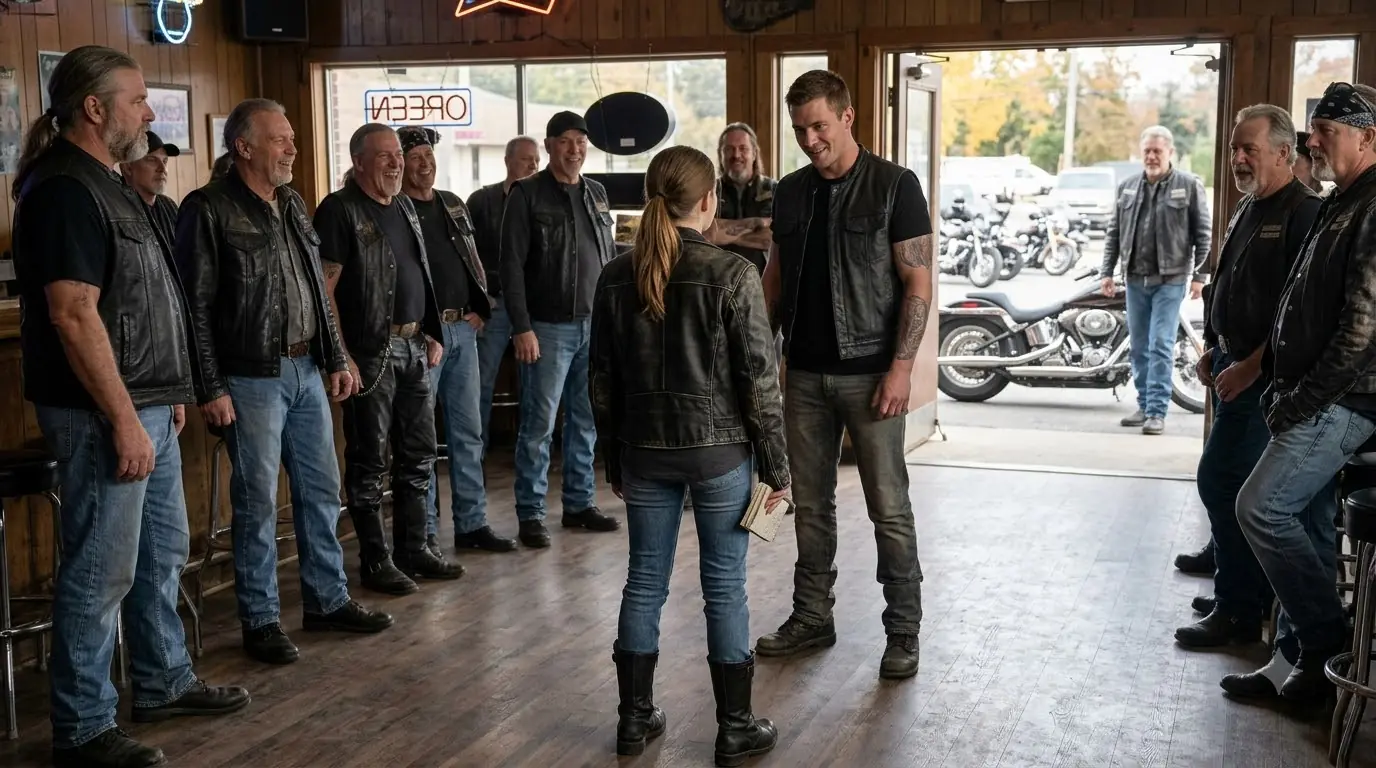
In every version she imagined, she walked inside calmly, introduced herself, explained her senior project, and convinced a room full of bikers to let her document their lives.
What she had not practiced was being laughed at.
The door groaned behind her as it swung shut.
A strip of autumn sunlight briefly cut through the dim interior, illuminating decades of cigarette haze suspended beneath the ceiling. The bar smelled of old wood, motor oil, coffee, beer, leather, and something fried in the kitchen that had probably been on the menu since the place opened.
Conversation died almost immediately.
Nearly thirty people turned toward her.
Cassie stopped just inside the doorway.
At barely five feet tall, she was easy to underestimate. Her dark brown hair was pulled into a practical ponytail, and she wore faded jeans, white sneakers, a green canvas jacket, and a backpack that looked more appropriate for a high school library than a motorcycle clubhouse. Against her chest, she held a black notebook filled with handwritten questions.
For several seconds, nobody spoke.
Then a broad man with a gray-streaked beard leaned an elbow against the bar.
“Lose your parents, sweetheart?”
Laughter rolled through the room.
Cassie tightened her grip on the notebook.
“No.”
Another man called, “Girl Scouts sell cookies around February.”
More laughter.
A younger rider sitting backward on a chair grinned at her. His name, she would later learn, was Derek Cole. He was twenty-nine, muscular, tattooed from wrist to shoulder, and carried himself with the exaggerated confidence of someone accustomed to winning arguments through volume.
“This ought to be good,” Derek said.
Cassie felt her face warming.
She had expected suspicion.
She had expected resistance.
But standing alone beneath thirty amused expressions made every prepared sentence suddenly feel ridiculous.
Still, she had not driven forty minutes to turn around.
She stepped farther into the room.
“I’m looking for the Iron Wolves Motorcycle Club.”
Someone laughed again.
The gray-bearded man pointed around the room.
“You found them.”
Cassie nodded.
“My name is Cassie Graham. I’m a senior at Lincoln High School, and I’m working on my final humanities project.”
Derek tilted his head.
“A school project?”
“Yes.”
The room erupted again.
Cassie waited.
She had learned from her father that sometimes silence forced people to eventually listen.
When the laughter faded, she continued.
“My project is about American subcultures and the communities people build outside traditional institutions. I want to spend several months documenting the Iron Wolves. Your history, your rides, your members, your traditions.”
Derek raised both eyebrows.
“So you want to study us.”
“I want to understand you.”
“Like zoo animals?”
“No.”
“Because I don’t do tricks.”
Several riders laughed.
Cassie fought the urge to look toward the door.
An older woman sitting near the pool table finally spoke.
“Leave her alone, Derek.”
Her name was Maria Alvarez.
She was sixty-seven, with silver hair tied beneath a black bandanna and weathered hands that looked capable of repairing an engine or sewing a wound with equal confidence.
Maria studied Cassie carefully.
“You ever been on a motorcycle?”
“Yes.”
“What kind?”
Cassie hesitated.
“Harley.”
A few riders nodded mockingly.
Maria continued.
“What model?”
Cassie answered immediately.
“1971 Harley-Davidson FLH Electra Glide.”
This time, the reaction was different.
Hank Turner, the gray-bearded man at the bar, slowly lowered his beer.
Derek’s smirk remained, but it weakened.
Maria narrowed her eyes.
“That’s a specific answer.”
“It’s a specific bike.”
Derek leaned forward.
“And whose bike would that be?”
Before Cassie could answer, a sound rolled across the parking lot.
At first it was faint.
Then every experienced rider in the building recognized it.
The deep irregular thunder of an old Harley engine.
Several heads turned toward the windows.
Hank stood straighter.
The engine grew louder.
Cassie felt some of the tension leave her shoulders.
A motorcycle rolled into the parking lot and stopped outside.
The engine cut.
For the first time since Cassie entered, nobody laughed.
Heavy boots crossed the porch.
The door opened.
Graham Graham stepped inside.
Cassie’s father was seventy-two years old, though strangers often assumed he was younger. He stood just over six feet, broad through the shoulders despite age, with silver threaded heavily through a beard that had once been nearly black. His left knee bothered him in cold weather, two fingers on his right hand never fully straightened anymore, and there were scars on his forearm that Cassie had never been given explanations for.
But none of that was what changed the room.
It was the leather vest he wore.
The cut was old enough that the black leather had faded almost brown in places. Patches covered the back, some frayed, others carefully restored over decades.
At the top:
IRON WOLVES MC.
Below it sat the club emblem.
And beneath that, stitched in faded gold:
FOUNDING MEMBER
1971
Hank stared.
“Graham.”
Maria rose slowly.
“Well, I’ll be damned.”
Derek looked from Graham to Cassie.
Graham crossed the room without hurry.
He stopped beside his daughter.
Cassie looked up.
“Dad.”
The word landed harder than any engine.
Someone near the pool table muttered, “Oh, hell.”
Derek’s expression collapsed completely.
Hank rubbed a hand over his beard.
“You might’ve mentioned your last name meant something.”
Cassie looked at him.
“I told you my last name.”
That earned the first genuine laugh of the afternoon.
Graham glanced around the clubhouse.
“You folks treating my daughter well?”
Nobody answered immediately.
Derek suddenly became interested in examining the floor.
Cassie nudged her father lightly.
“I can handle myself.”
“I know.”
Graham’s expression softened, but only briefly.
Then he looked at the room.
“She asked me not to make introductions for her.”
Maria smiled.
“Of course she did.”
Graham turned toward Cassie.
“You want to tell them why you’re really here, or should I?”
Cassie’s heartbeat returned.
Her father had brought her through the door.
Now she had to earn the next step herself.
She opened her notebook but then closed it again.
“I told you this was for school.”
Derek muttered, “We heard.”
Cassie ignored him.
“That’s true, but it isn’t the whole reason.”
She looked at her father.
“My dad served in Vietnam.”
Several expressions changed.
Many people in the room already knew.
Others were newer members.
“He came home in 1971.”
Cassie continued.
“He was twenty years old.”
Graham looked away slightly.
Cassie had heard fragments of his history her entire life but never a complete version.
“He doesn’t talk about the war much.”
Graham gave a small humorless smile.
“There isn’t much worth saying.”
Cassie looked back toward the club members.
“But I know what happened afterward.”
She paused.
“He couldn’t sleep.”
Nobody laughed now.
“He couldn’t hold a job for more than a few months. He drank too much. He stopped visiting his parents. Sometimes he disappeared for days.”
Cassie had learned most of this from her mother, not Graham.
“I know that when doctors couldn’t help him and his family didn’t understand him, he found other veterans who did.”
Graham’s eyes moved toward Hank.
“And those veterans became the Iron Wolves.”
Cassie’s voice strengthened.
“This club gave my father somewhere to go when he didn’t know where home was anymore.”
She glanced around.
“I grew up hearing motorcycles leave our driveway on Sunday mornings.”
“Sometimes my father came back after six hours.”
“Sometimes twelve.”
“But he always came back different.”
“Calmer.”
“More present.”
“More like my dad.”
Several older riders lowered their eyes.
Cassie continued.
“So no, I’m not here because leather jackets look interesting.”
“I’m here because I want to understand what saved him.”
Silence settled over the clubhouse.
A different silence.
Not mockery.
Recognition.
Graham took a slow breath.
Then he spoke.
“When I came home from Saigon, I thought surviving meant I was lucky.”
He looked toward the bar.
“Took me about two weeks to realize surviving was the easy part.”
Nobody moved.
“I couldn’t sleep unless the television was on. Couldn’t stand fireworks. Couldn’t sit with my back toward a door.”
Graham looked down at his hands.
“I’d be standing in a grocery store and forget where I was.”
Cassie had never heard him say that.
He continued.
“My mother would ask what happened over there.”
“I didn’t know how to answer.”
“My father told me to forget about it and get back to work.”
“I tried.”
He gave a faint shrug.
“Didn’t work.”
Hank finally spoke.
“You nearly killed that Ford pickup.”
Graham laughed softly.
“That truck deserved it.”
A ripple of restrained laughter moved through the room.
Graham looked at Cassie.
“Six of us started riding together because none of us knew what else to do.”
“We didn’t call it therapy.”
“We wouldn’t have gone if someone did.”
Several older members smiled.
“But the road was quiet.”
“The engine was loud enough to drown out memories.”
“And if somebody woke up at three in the morning needing to ride, one of us answered the phone.”
Hank lifted his beer.