Arthur McCall stopped at Wexler’s Gas & Mart at 9:46 on a cold Friday night because his old truck was almost out of gas, his right knee was aching, and his granddaughter wanted chocolate milk.
That was the whole reason.
Not destiny.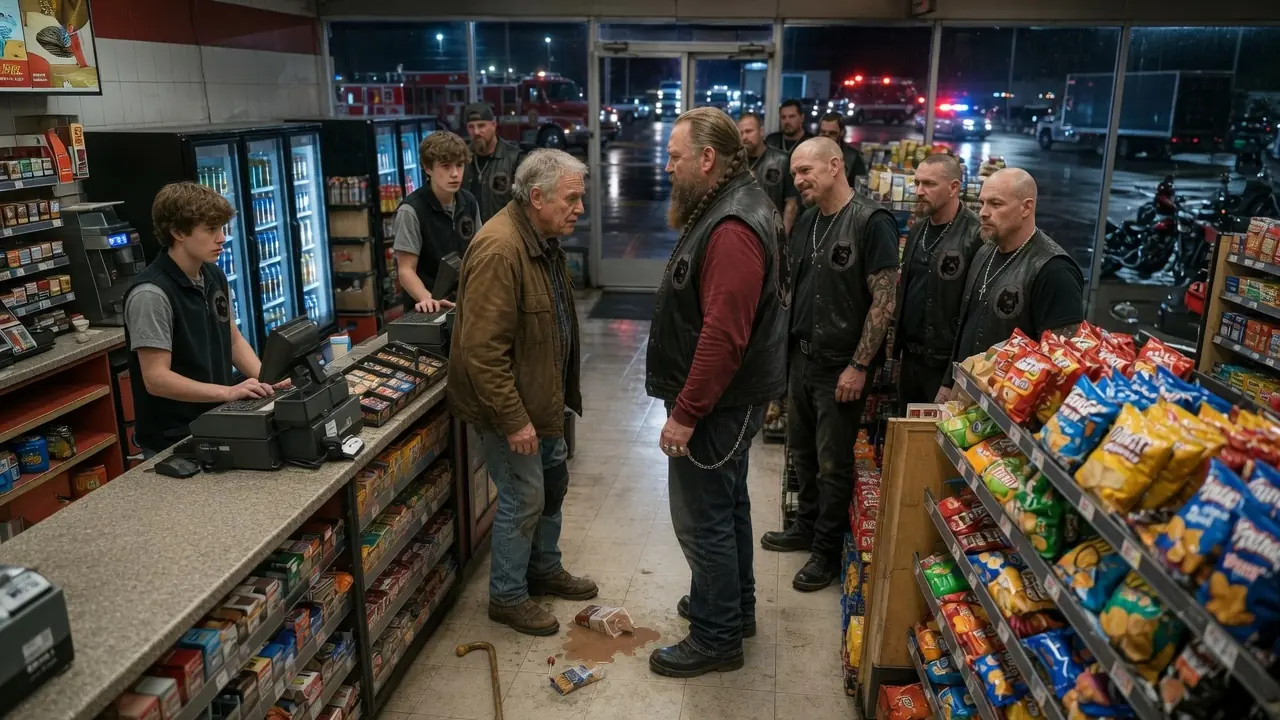
Not bravery.
Not some grand turn in a story.
Just an old man with a stiff knee, a nearly empty gas tank, and a seven-year-old girl waiting at home under a blanket, recovering from a fever and believing her grandfather could fix almost anything if he came through the door with the right little carton of chocolate milk.
Arthur had promised.
So he drove the twelve miles from his farmhouse to the last gas station before the county road narrowed into dark fields, parked beside pump three, and sat for a moment with both hands on the steering wheel.
The truck ticked softly as the engine cooled.
Outside, the night air pressed against the windows. It was early November in western Kentucky, the kind of cold that did not freeze the ground but found every old injury and tapped on it like a bill collector. The gas station canopy lights glared white over wet pavement. Beyond the pumps, the highway ran black and empty, with only the occasional pair of headlights passing like ghosts.
Arthur rubbed his right knee.
It was not his original knee, not all of it. A metal brace supported the joint beneath his faded jeans, and when the weather turned sharp, pain moved through it with a memory older than he liked to discuss.
He picked up his cane from the passenger seat.
It was hickory, handmade, polished smooth where his palm rested. His son had carved it years ago before leaving for a construction job in Ohio. The handle had a small notch near the top where Arthur’s granddaughter, Sophie, had once tied a pink ribbon and declared it “fancy.”
The ribbon was gone now, but the notch remained.
Arthur opened the door and stepped down carefully.
His boots touched the pavement.
He waited for his knee to agree with the rest of him.
“Come on,” he muttered. “We’ve done harder things.”
The gas station was quiet. Only one other car sat near the air pump, an old blue sedan with a missing hubcap. Inside the store, a teenage clerk leaned behind the counter, reading a paperback beneath the yellow light. A rack of chips stood near the door. A coffee machine hissed in the back. A handwritten sign taped to the window read, “Fresh Biscuits 5 a.m. - 10 a.m.”
Arthur filled the truck slowly.
He did not like paying at the pump. Machines had become too eager to ask questions. Zip code, receipt, rewards number, card type, approval pending. He preferred people. People at least looked embarrassed when they refused you.
So he pumped twenty dollars in gas, replaced the nozzle, and made his way toward the store.
Tap.
Step.
Tap.
Step.
The cane clicked against the pavement.
Inside, the bell above the door gave a soft ring.
The clerk looked up.
“Evening, Mr. McCall.”
“Evening, Benny.”
Benny Wilkes was seventeen, skinny, nervous, and trying to grow a mustache that looked more like a rumor than a fact. His mother worked nights at the hospital, and his father had been gone long enough that people had stopped asking about him. Arthur had known Benny since he was small enough to ride in the grocery cart at Piggly Wiggly.
“You out late,” Benny said.
“Sophie’s got a fever. She requested chocolate milk.”
Benny nodded solemnly. “Emergency supplies.”
“Exactly.”
Arthur moved slowly down the aisle, picked up a carton of chocolate milk from the cooler, then added a small pack of crackers and a strawberry lollipop because Sophie had asked for neither, which meant she would be delighted by both.
He also took a small bottle of aspirin from the medicine shelf, though he hesitated before placing it on the counter.
Benny noticed.
“You need anything else?”
Arthur shook his head. “This will do.”
Benny rang up the items. “That’ll be nine forty-two.”
Arthur opened his wallet.
There were three bills inside: a ten, a five, and a folded dollar that had been in there so long it had grown soft at the edges. He counted slowly, not because he could not count, but because pride becomes careful when money is thin.
Benny looked away politely.
Arthur placed the ten on the counter.
“Keep the change for the little cup by the register,” he said.
Benny glanced at the plastic donation cup for the high school band trip. “That’s almost sixty cents.”
“Then the trumpet section owes me a song.”
Benny smiled.
Arthur picked up the small bag and turned toward the door.
That was when the motorcycles arrived.
He felt them before he saw them.
A low vibration rolled through the glass, deep enough to rattle the metal shelves. The drink cooler hummed harder. A bag of chips trembled on its hook.
Benny’s smile faded.
Arthur looked toward the window.
Headlights swept across the pumps.
One motorcycle turned into the lot.
Then another.
Then another.
Seven bikes rolled in beneath the canopy, their engines loud enough to drown out the quiet country station. Chrome flashed. Tires hissed over damp pavement. The riders parked in a loose line near the front doors, blocking the nearest parking spaces.
They revved their engines once, twice, almost in rhythm.
Arthur sighed.
He had known good bikers in his time. Men who rode to veterans’ funerals. Women who delivered toys at Christmas. Retired mechanics, nurses, pastors, welders, grandmothers with leather jackets and better manners than half the people in church.
A motorcycle did not tell you what kind of heart sat above it.
But men who made their engines scream outside a gas station at nearly ten at night were usually trying to tell the world something.
Arthur had learned, over many years, that the louder a man announced himself, the less he often had worth hearing.
The engines died.
For one second, the silence rang.
Then boots hit pavement.
Laughter came next.
Benny whispered, “Oh, man.”
Arthur looked at him. “You know them?”
Benny swallowed. “They came through last month. Took beer without paying. Mr. Wexler said if they came back, call the sheriff.”
Arthur glanced toward the phone behind the counter. “Then call.”
Benny reached for it.
The door opened before he touched the receiver.
The bell rang too brightly.
Cold air pushed inside, carrying the smell of gasoline, wet leather, tobacco, and road dust. The men entered in a pack, broad shoulders filling the narrow aisles. They wore dark leather vests over flannel shirts and denim jackets, boots heavy with mud, rings flashing under fluorescent light. On their backs was a patch of a black dog with red eyes and a chain around its neck.
The words beneath it read, “Black Hounds.”
The man in front was tall and thick, with a gray beard braided at the chin and pale eyes that smiled before his mouth did. His vest hung open over a red shirt. A name patch over his chest read: Maddox.
He stopped just inside the door and looked around the store.
His eyes passed over Benny.
Then stopped on Arthur.
Arthur recognized the look.
Not because he had seen Maddox before.
Because cruelty has a family resemblance.
It looks for the person in the room least likely to strike first.
“Well,” Maddox said. “Look what we got here.”
One of the bikers behind him laughed. “Grandpa made it out past bedtime.”
Arthur did not answer.
He held his paper bag in one hand and his cane in the other.
Benny stood behind the counter, frozen halfway between the register and the phone.
Maddox stepped aside so the others could enter. They spread through the small store, grabbing chips, opening cooler doors, knocking one another with shoulders, laughing too loudly. One slapped the lottery machine. Another leaned over the hot dog roller and sniffed with exaggerated disgust.
“Smells like a dead raccoon,” he said.
Benny’s voice came out thin. “Can I help y’all?”
Maddox looked at him. “You can start by relaxing.”
The bikers laughed.
Arthur moved toward the door.
He did not want trouble. He had chocolate milk in the bag, a child waiting at home, and enough years behind him to know that pride often charges interest.
Maddox stepped into his path.
Arthur stopped.
The door was three feet behind the man.
“Excuse me,” Arthur said.
Maddox looked down at the cane. “What’s your hurry?”
“My granddaughter is waiting.”
“That right?”
“Yes.”
Maddox’s smile widened. “Ain’t that sweet? Boys, grandpa’s got a date.”
More laughter.
Arthur waited.
There was no reason to feed it. Cruel men liked reactions the way stray dogs liked scraps. Give them one, and they came closer.
He shifted his grip on the bag.
“Need to get by,” he said.
Maddox did not move. “You military?”
Arthur’s face remained still. “Used to be.”
One of the bikers pointed at the old cap folded in Arthur’s coat pocket. It had a small faded patch from his Army unit, nearly worn smooth by years of rain, sun, and handling.
“Old soldier,” the biker said. “Must be dangerous.”
Another chuckled. “Careful, he’s got a stick.”
Maddox reached out and tapped Arthur’s cane with one boot.
Arthur’s hand tightened around the handle.
Benny saw it.
“Sir,” Benny said, voice shaking, “please don’t bother him.”
Maddox slowly turned his head toward the counter.
“Boy, nobody asked you.”
Benny went pale.
Arthur lifted one hand slightly. “It’s all right, Benny.”
“No,” Benny said, but his voice was barely there.
Maddox looked back at Arthur. “Benny? You two friends?”
Arthur did not answer.
Maddox leaned closer. “I asked you something.”
Arthur looked him in the eye. “He is a good young man.”
The sentence was simple.
It landed wrong with Maddox.
His smile disappeared for half a second.
One of the bikers near the cooler laughed. “Good young man. Hear that? Old man’s giving report cards.”
Maddox’s smile returned, sharper now. “What about us? We good young men?”
Arthur looked around the store. At the muddy boot prints. At the opened cooler doors. At Benny’s terrified face. At the way one rider had already slipped a beef jerky stick into his vest pocket without paying.
“No,” Arthur said.
The word was quiet.
But the store heard it.
Benny’s eyes widened.
The biker near the hot dogs stopped laughing.
Maddox’s head tilted. “No?”
Arthur shifted the paper bag to his other hand. “No.”
“You got a problem with us?”
“I have a problem getting past you.”
Maddox stared at him.
Then he laughed.
It started low and spread to the other riders. The small store filled with it. The sound bounced off the glass doors and tile floor until it felt larger than seven men.
Maddox stepped closer, close enough that Arthur could see rainwater caught in his beard.
“Old soldier still thinks he’s got orders to give.”
Arthur said nothing.
Maddox looked down at his knee brace.
“What happened there?”
“Age.”
“Age put metal on your leg?”
Arthur’s jaw tightened.
Another biker came around the aisle and looked at the brace. He had a shaved head and a silver chain around his neck. His name patch read Crowder.
“Maybe he got kicked by a mule.”
Maddox looked amused. “Nah. He probably tripped getting out of a recliner.”
The men laughed again.
Arthur had been mocked before. Age made people bold in strange ways. Some spoke slowly to him as if his hearing and mind had failed together. Some took his elbow without asking. Some called him “young man” in voices sweet with pity. He disliked all of it, but he had learned to let most of it pass.
This was different.
This was not ignorance.
This was sport.
Maddox reached for the paper bag in Arthur’s hand.
Arthur pulled it back.
“What’s in there?” Maddox asked.
“Medicine and milk.”
“For the granddaughter?”
“Yes.”
Maddox looked at his men. “Should we inspect it? Make sure grandpa ain’t smuggling weapons?”
Crowder grabbed the bag before Arthur could stop him.
The carton of chocolate milk, aspirin, crackers, and lollipop tumbled onto the counter display beside the gum.
The lollipop rolled across the floor.
Arthur’s face changed.
Not much.
But enough.
Maddox noticed. “Uh-oh. We lost the candy.”
Crowder bent, picked up the lollipop, and held it between two fingers. “This for the sick little girl?”
Arthur held out his hand. “Give it back.”
Crowder lifted it higher. “Ask nice.”
Arthur looked at him.
He saw a grown man holding a child’s lollipop out of reach and grinning because he could. The pettiness of it was almost more insulting than the cruelty. There were men in the world who wanted power but had no idea what to do with it except make smaller lives harder.
“Give it back,” Arthur said.
Maddox clicked his tongue. “That wasn’t nice.”
Benny moved behind the counter toward the phone.
One of the bikers near the register saw him.
“Hey.”
Benny froze.
The biker reached over the counter and yanked the phone cord from the wall.
Benny stumbled back.
Arthur’s eyes sharpened.
Maddox saw that too.
“What?” Maddox said. “You mad now?”
Arthur did not move.
He knew the arithmetic of the room. Seven men. One teenage clerk. One old veteran with a bad knee and a cane. No phone. No other customers. A highway that might stay empty for twenty minutes.
Bravery was not the absence of calculation.
Sometimes it was calculation with no good numbers.
Arthur reached for the chocolate milk and aspirin. Crowder slapped his hand away.
Not hard enough to injure.
Hard enough to humiliate.
Benny gasped.
The bikers laughed.
Arthur slowly lowered his hand.
Maddox leaned close. “What branch?”
Arthur did not answer.
“What branch, old man?”
“Army.”
“Army,” Maddox repeated. “You fight?”
Arthur’s eyes went distant for one brief moment.
Then returned.
“Some.”
“Some,” Maddox mocked. “That mean you were a hero?”
“No.”
“No? Then what were you?”
Arthur looked at the broken phone cord, then at Benny, then at the lollipop in Crowder’s hand.
“Tired,” he said.
That was not the answer Maddox wanted.
His expression tightened.
He reached for Arthur’s cane.
Arthur held firm.
Maddox’s hand closed around the shaft.
“Let go,” Arthur said.
“Or what?”
The cane became a line between them.
For a second, Arthur thought about refusing. He thought about planting the cane behind Maddox’s ankle, using the man’s weight against him, doing one of the ugly little things a younger version of himself still remembered. But his right knee trembled beneath him, and Benny stood behind the counter with fear written across his face.
If Arthur fought and fell, they would laugh harder.
If he fought and one of them turned on Benny, he would never forgive himself.
Maddox pulled.
Arthur held on.
Crowder kicked lightly at Arthur’s brace.
The old man’s knee buckled.
The cane slipped from his grip.
He caught the edge of the counter with one hand, but the paper bag tore beneath his other. The chocolate milk carton hit the floor and burst at the corner, spilling brown liquid across the tile.
The store went silent for one breath.
Then the bikers erupted.
Maddox held the cane above his head like a trophy.
Arthur stood bent over the counter, breathing through pain, his face pale.
Benny came around the counter. “Mr. McCall!”
Arthur lifted one hand to stop him. “Stay back.”
Maddox laughed. “Look at that. Still giving orders.”
Crowder nudged the broken milk carton with his boot. “Granddaughter’s going to be thirsty.”
Something in Arthur’s chest tightened.
He could endure being mocked.
He could endure pain.
He could endure old memories pulled into a cheap gas station by men who did not know enough to fear them.
But Sophie’s feverish face flashed in his mind. Her trust. Her small voice asking, “Grandpa, can you get the chocolate kind?” The fact that she believed promises were simple things because nobody had taught her yet how easily the world could break them.
Arthur straightened slowly.
He was unsteady without the cane.
Benny moved closer again, but Arthur shook his head once.
“Give me the cane,” Arthur said.
Maddox leaned it across his shoulders. “Say please.”
Arthur looked at him for a long time.
Then he said, “Please.”
The word cut deeper than anger.
Benny looked like he might cry.
Maddox smiled. “See? Manners.”
He lowered the cane but did not hand it over.
Instead, he tossed it toward the aisle.
It hit a rack of motor oil and clattered to the floor.
Arthur turned carefully, trying to shift weight onto his stronger leg.
Crowder stepped forward and blocked his way.
“Where you going?”
Arthur’s breath came shallow. “To pick up my cane.”
“Maybe crawl.”
The words hung there.
Even some of the bikers did not laugh at first.
Then Maddox did, and the others followed because cruelty in groups often survives on permission.
Arthur looked at the cane lying on the floor.
Ten feet away.
A stupid distance.
A battlefield distance.
A lifetime distance when your leg could not carry you without help and every person in the room was watching.
Benny’s voice broke. “Stop it.”
Maddox turned. “Boy, you want to join him on the floor?”
Benny stopped.
Arthur saw the shame hit the boy immediately.
He knew that shame. The shame of being afraid when someone else needs courage. The shame of standing still because your body has decided survival before your heart has finished arguing.
Arthur did not want Benny carrying that.
So he looked at him and said softly, “You are doing fine.”
Benny’s eyes filled.
Maddox snorted. “Ain’t that precious.”
Then headlights swept across the front windows.
Not one pair.
Several.
Maddox glanced toward the glass.
Outside, vehicles were turning into the gas station lot. A white pickup. A red SUV. A county fire department truck. Then another pickup with emergency lights mounted inside the windshield.
The bikers saw them.
Benny saw them.
Arthur closed his eyes briefly.
He had not called anyone.
No phone. No alarm.
But someone had seen.
The front door opened.
The bell rang.
A woman stepped inside wearing a dark blue fire department jacket over jeans and work boots. She was in her late thirties, tall, with brown skin, black hair pulled into a tight bun, and eyes that went instantly to Arthur.
Her face changed.
“Mr. McCall?”
Arthur blinked.
He knew the voice before he placed the face.
Then he saw it.
A little girl in a yellow raincoat, standing in floodwater up to her knees, crying for her mother while a younger Arthur lifted her into the back of a rescue truck.
It had been twenty-nine years.
Her name came out of him as a whisper.
“Lena Brooks.”
The woman crossed the store in three fast steps.
Her eyes dropped to the spilled chocolate milk, the torn bag, the cane on the floor, Arthur gripping the counter, and Maddox standing with that cruel half-smile.
The half-smile faded under her stare.
Lena bent and picked up the cane.
She placed it gently in Arthur’s hand.
Only after he had a grip on it did she turn toward the bikers.
“What happened here?” she asked.
Maddox recovered. “Nothing that concerns the fire department.”
The door opened again.
Three firefighters entered behind Lena, all wearing jackets from Harrow Creek Fire and Rescue. Behind them came a county deputy, then another. Outside, more trucks arrived. A few townspeople stood beneath the canopy, watching through the windows.
Benny exhaled so hard his shoulders sagged.
Lena’s voice stayed calm. “I was across the road at the training hall when one of my firefighters saw seven motorcycles crowding the pumps and an old man being cornered inside.”
Maddox looked toward the windows.
A young firefighter outside held up a phone.
Recording.
Crowder muttered, “Damn.”
Lena stepped closer to Maddox. “So I’ll ask again. What happened?”
Arthur spoke before anyone else.
“They were making trouble,” he said.
Lena turned toward him. “Did they touch you?”
Arthur hesitated.
Maddox watched.
The hesitation made him smile again.
Arthur knew why. Men like Maddox relied on the dignity of the people they humiliated. They counted on old men not wanting to admit they had been made helpless. They counted on veterans swallowing pain because they had survived worse. They counted on silence wearing the mask of pride.
Arthur looked at Benny.
The boy was waiting too.
Arthur tightened his hand around the cane.
“Yes,” he said.
The store went still.
“They took my cane,” Arthur continued. “Knocked my leg. Took my bag. Broke my granddaughter’s milk. Ripped out the phone cord when Benny tried to call for help.”
The deputy moved his hand to his radio.
Lena’s face hardened in a way that changed the temperature of the room.
Maddox lifted both hands. “That’s dramatic.”
“No,” Lena said. “That is specific.”
Crowder tried to slip the lollipop into his pocket.
Lena’s eyes snapped to him.
“Put that on the counter.”
Crowder froze.
Lena did not raise her voice.
“Now.”
He placed the lollipop on the counter.
Benny stared at her like she had just performed magic.
Lena looked at him. “You all right?”
Benny nodded, then shook his head, then nodded again. “I don’t know.”
“That’s fair.”
Maddox scoffed. “This is ridiculous. We’re customers.”
“You are trespassers if the clerk wants you out,” the deputy said.
Benny swallowed.
Everyone looked at him.
His face went pale again.
Arthur wanted to spare him, but he also knew there were moments a young man needed to hear his own voice work.
Lena seemed to know it too.
She spoke gently. “Benny, do you want them to leave?”
Benny’s lips trembled.
Maddox stared.
The bikers stared.
The whole small store seemed to lean toward the boy.
Benny gripped the edge of the counter.
“Yes,” he said. “I want them to leave.”
The deputy nodded. “That’s enough.”
Maddox’s jaw tightened. “You going to arrest us over spilled milk?”
Lena pointed to the broken phone cord. “That is not milk.”
She pointed to Arthur’s cane. “That is not milk.”
Then to Arthur’s leg brace. “And that is not milk.”
The second deputy stepped forward. “Hands visible. All of you.”
The Black Hounds shifted uneasily.
Outside, another vehicle pulled in.
Then another.
Arthur looked through the glass and saw faces he recognized. Ruthie Vale from the pharmacy. Pastor James from the little white church near the creek. Tommy Alvarez from the feed store. Two high school football players still in practice hoodies. Sophie’s school principal. An older woman who lived on the road behind his farm.
People kept arriving.
Not because they knew the whole story.
Because Lena had called.
Or because one person saw trouble and told another.
Or because, in small towns, fear travels fast, but so can care when somebody finally sends it moving.
Maddox looked around and realized the room had changed.
When he arrived, he had seen an old man, a teenage clerk, and an empty road.
Now he saw uniforms, cameras, witnesses, and a whole town pressing against the windows like judgment made flesh.
The deputy took names.
Another officer entered.
The bikers were separated. Some argued. One claimed they were “just joking.” Crowder said he did not know the old man’s leg was bad. Maddox insisted Arthur had “gotten dramatic” over nothing.
Arthur stood beside the counter, both hands on his cane.
His knee throbbed.
His heart hurt worse.
Not because he had been frightened. He had been frightened many times. Fear was no stranger.
But humiliation had a different taste in old age.
It made a man feel as if all the years behind him had been erased, as if every job, every sacrifice, every morning he had gotten up in pain and kept going had been reduced to a cane on the floor and a broken milk carton.
Lena seemed to sense it.
She stood beside him while the deputies worked, not too close, not touching him without asking.
“You remember me?” she asked quietly.
Arthur looked at her. “Yellow raincoat. Flood of ‘94. You wouldn’t let go of a stuffed rabbit.”
Her eyes softened. “His name was Mr. Buttons.”
“I remember that too.”
Her smile trembled. “You carried me out of my grandmother’s house.”
“Water was rising.”
“You came back for my grandmother.”
“So did half the county.”
“But you went through the window first.” She looked down for a second. “My mother told that story every year on my birthday.”
Arthur shifted uncomfortably. “I was just part of the rescue crew.”
Lena looked at the cane in his hands. “That’s what heroes always say when they don’t want anyone to notice the cost.”
He shook his head. “No hero.”
“Then what were you?”
He gave the answer he had given Maddox.
“Tired.”
This time, the word made Lena smile sadly.
“Tired people can still save lives.”
Before Arthur could answer, the deputy led Maddox toward the door. The biker paused, turning his pale eyes toward Arthur.
For a second, the old cruelty returned.
“You feel big now?” Maddox asked.
The store went quiet.
Arthur felt every eye turn toward him.
He could have let Lena answer.
He could have let the deputies push Maddox through the door.
But the question had been thrown at him, and there were too many young people watching. Benny behind the counter. The football players at the window. Lena’s young firefighters. Maybe even Sophie someday, if the story reached her.
Arthur lifted his chin.
“No,” he said. “I feel old. I feel sore. I feel sorry for men who need seven bikes and six friends to feel brave in front of one grandfather.”
Nobody laughed.
Maddox’s face darkened.
The deputy guided him outside.
The bell rang behind them.
The Black Hounds were taken out one by one. Some received citations. Maddox and Crowder were placed in separate patrol cars because of the phone cord, the cane, and the theft of the lollipop, small as it seemed. The deputy called it intimidation and destruction of property. Benny called Mr. Wexler, who arrived red-faced and furious within ten minutes.
Inside, the store felt too bright after the bikers left.
Benny came around the counter with a mop and stared at the spilled chocolate milk.
“I’m sorry,” he said.
Arthur looked at him. “For what?”
“I froze.”
Arthur leaned on his cane. “You were scared.”
“I should’ve called faster.”
“You tried.”
“I should’ve done more.”
Arthur watched the boy kneel with paper towels, hands shaking. He remembered being nineteen and terrified in a place far from home. He remembered the first time he had seen a brave man freeze. He remembered judging him for half a second before realizing his own hands were shaking too.
“Benny,” he said.
The boy looked up.
“Fear is not failure. Letting it teach you nothing is failure.”
Benny swallowed. “I don’t want to be like that.”
“Then you won’t be.”
Lena crouched and helped wipe the milk.
Benny looked horrified. “Chief Brooks, you don’t have to do that.”
“I know.”
“Then why are you?”
She looked at Arthur. “Because somebody still needs chocolate milk.”
Benny jumped to his feet. “I’ll get another one.”
He ran to the cooler and returned with two cartons.
Then he added a new pack of crackers, another strawberry lollipop, and a small chocolate bar.
“No charge,” he said.
Arthur opened his wallet.
Benny shook his head hard. “No, sir.”
“Benny.”
“No.” The boy’s voice steadied. “Please let me do this.”
Arthur looked at him.
Then he closed his wallet.
“Thank you.”
Benny’s shoulders eased, as if accepting thanks had completed something inside him.
Outside, the parking lot had filled with people despite the cold. The firefighters stood near their truck. Townspeople talked quietly beneath the canopy. Someone had brought Arthur’s truck closer to the door. Someone else had checked the tires. Pastor James was speaking with the deputy. Ruthie from the pharmacy had her arms folded and looked ready to scold the entire world.
Arthur stepped outside slowly.
Cold air hit his face.
The crowd quieted.
He hated that.
He hated being the center of anything.
Then a small voice called from near the front of the crowd.
“Mr. Arthur?”
He turned.
Sophie stood there in a pink coat over her pajamas, wrapped in a blanket, holding her grandmother’s hand.
Arthur’s heart lurched.
His daughter-in-law, Claire, looked apologetic and worried. “Lena called me. I’m sorry. Sophie heard your name and wouldn’t stay home.”
Sophie ran to him before anyone could stop her.
Arthur bent carefully and caught her with one arm.
“You’re supposed to be in bed,” he said.
“You were late.”
“I know.”
“You promised chocolate milk.”
He looked at Lena, who handed him the new bag.
Arthur took out the carton and showed it to Sophie.
“Promise kept.”
Sophie looked at the gas station, the firefighters, the deputies, the people gathered around. Then she looked at his cane.
“Did you fall?” she asked.
Arthur’s throat tightened.
“No.”
“Did bad people come?”
Arthur looked around.
Every adult suddenly became very interested in the wet pavement.
He knelt slowly, with effort, until he was closer to her height. His knee protested, but he ignored it.
“Some men were unkind,” he said.
Sophie frowned. “To you?”
“Yes.”
Her little face tightened with outrage. “But you’re Grandpa.”
A soft sound moved through the crowd, half laugh, half ache.
Arthur brushed a curl from her forehead. “That is a strong argument.”
“Did Miss Lena help?”
“Yes.”
Sophie looked at Lena with serious gratitude. “Thank you for helping my grandpa.”
Lena crouched too. “He helped me first, a long time ago.”
Sophie’s eyes widened. “He did?”
“He did.”
Sophie turned back to Arthur. “You never told me.”
Arthur cleared his throat. “Must have slipped my mind.”
Claire laughed softly through tears. “A lot slips your mind when it makes you look good.”
Arthur gave her a look.
Sophie touched the notch on his cane where the pink ribbon had once been. “Can I put another ribbon on it?”
Arthur’s eyes softened. “I think it needs one.”
The crowd slowly dispersed after that, but not before everyone found a way to help too much.
Tommy from the feed store insisted on following Arthur home to make sure the truck ran right. Ruthie from the pharmacy gave Claire a small bag of fever medicine and cough drops, refusing payment with a look so severe nobody challenged her. Pastor James offered to replace the gas station phone cord. The football players cleaned the muddy boot prints from the store floor while pretending they had not been told to by their coach, who also happened to be Lena’s husband.
Arthur wanted to object.
He did not.
He was too tired.
More truthfully, he was learning, far too late in life, that refusing every hand offered could become its own kind of pride.
Lena drove behind Arthur’s truck all the way to his farmhouse.
The road curved through dark fields and bare trees. The porch light glowed when they pulled in. Claire carried Sophie inside, chocolate milk and all, while Arthur remained beside the truck for a moment, looking up at the stars appearing between clouds.
Lena stood near him.
“You okay?” she asked.
He almost said yes.
Old habit.
Instead, he said, “No.”
Lena nodded.
The honesty sat between them without panic.
“My knee hurts,” he said. “My pride hurts worse.”
“That makes sense.”
“I keep thinking about the cane on the floor.”
Lena said nothing.
Arthur swallowed. “I couldn’t reach it.”
Her voice was gentle. “They made sure you couldn’t.”
“That is what stays with me.”
“I know.”
He looked at her then. “Do you?”
Lena leaned against the fire department SUV and crossed her arms against the cold. “When I was eight, in that flood, I was standing on my grandmother’s kitchen table with water around my legs. I could see my stuffed rabbit floating away. I remember screaming for it. Not because it mattered more than living, but because everything was out of my control, and that rabbit was the last small thing that still felt mine.”
Arthur remembered the rabbit. Brown, soaked, one button eye hanging loose.
“You went back for it,” Lena said.
He looked away. “After you were safe.”
“You handed it to me and said, ‘A girl should not have to lose everything on the same day.’”
Arthur closed his eyes.
He had forgotten the words.
Or maybe he had buried them with all the other things he did not know how to carry.
Lena’s voice softened. “Tonight, that cane was your rabbit.”
Arthur inhaled slowly.
The comparison should have embarrassed him.
It did not.
It helped.
He looked toward the house, where Sophie’s small silhouette moved past the curtain.
“I am tired of needing things,” he said.
“I know.”
“I used to be the one people called.”
“You still are.”
He gave her a sad smile. “Not tonight.”
“Tonight you were the one we came for.” Lena stepped closer. “That is allowed.”
Arthur looked at her for a long moment.
Then he nodded once.
The next morning, Sophie tied a pink ribbon around the notch in his cane.
She made a serious ceremony of it, sitting cross-legged on the kitchen floor while Arthur drank coffee and pretended not to be emotional.
“This ribbon means no bad guys can touch it,” she said.
Arthur raised an eyebrow. “Powerful ribbon.”
“It is.”
Claire stood at the sink, smiling into her coffee.
The ribbon was bright, crooked, and tied with too many knots.
Arthur left it there.
By noon, half the town had heard what happened at Wexler’s Gas & Mart.
By Monday, Mr. Wexler had installed a new phone, a working panic button, and a large sign by the register that read, “Harassment of staff or customers will be reported immediately.”
Benny told Arthur he had helped choose the wording.
Arthur approved.
The Black Hounds did not return.
Maddox faced charges for intimidation, theft, and property damage. Crowder faced charges too. The others were banned from Wexler’s and several nearby businesses after the gas station security footage was shared with local owners. More stories came out afterward, as they often do when fear finally sees someone else speak first. A waitress from the next county reported them. A motel clerk did too. A young mechanic admitted they had forced him to repair a bike for free.
One act of cruelty had pulled a thread.
The whole pattern began to show.
Arthur did not follow every detail.
He had no taste for revenge.
But he did start stopping at Wexler’s more often.
Not at night at first.
Daylight was easier.
He would buy coffee, talk to Benny, and sit on the bench outside the store beneath the awning. Sometimes Sophie came with him and chose a lollipop from the jar Benny kept stocked behind the counter. Sometimes Lena stopped by in her fire department SUV, always claiming she was “just passing through,” though Arthur noticed she passed through with suspicious regularity.
A month after the incident, Arthur found Benny standing outside beside a young woman with a flat tire.
The woman looked about nineteen, wearing a fast-food uniform and a panic-stricken expression. Her little brother sat in the passenger seat hugging a backpack. The spare tire lay on the ground, but the jack was still in the trunk.
Benny held the tire iron awkwardly.
Arthur parked and stepped out.
“Problem?” he asked.
Benny looked embarrassed. “I’m trying to help, but I don’t know where to put the jack.”
Arthur looked at the car, then at the girl.
“You need to get somewhere?”
“Work,” she said. “I’m already late.”
Arthur nodded. “Benny, bring the jack here.”
Together, slowly, they changed the tire.
Arthur could not do the heavy lifting the way he once had, but he knew where everything went. He showed Benny how to find the frame point, how to loosen lug nuts before lifting, how to tighten them in a star pattern after lowering the car. The girl tried to pay him with three crumpled dollars.
Arthur shook his head.
“Pay attention next time someone else needs help,” he said. “That’ll cover it.”
She looked like she might cry.
Benny watched her drive away, then looked at Arthur.
“I froze that night,” he said suddenly.
Arthur leaned on his cane. The pink ribbon fluttered in the wind. “I remember.”
“I keep thinking about it.”
“That can be useful.”
“How?”
“Thinking about what you wish you had done can prepare you for what you will do.”
Benny looked toward the highway.
Then he nodded.
Winter came slowly.
The town moved on, as towns do, but not completely. Wexler’s remained a little more watchful. The fire department held a safety night for local businesses. Lena invited Arthur to attend as an honored guest, which he refused three times until Sophie said she wanted to see the fire trucks.
He went.
The training hall was warm and crowded. Store clerks, waitresses, gas station attendants, motel workers, and late-shift employees came for coffee, donuts, and practical advice on handling harassment, calling for help, and protecting one another without escalating danger.
Arthur sat near the back.
Lena introduced him anyway.
“This is Arthur McCall,” she said. “Some of you know him. Some of you know someone he helped. Tonight, we’re talking about what it means to notice trouble early and answer it together.”
Arthur wanted the floor to swallow him.
Then Benny stood and raised his hand.
“I want to say something,” the boy said.
Lena nodded.
Benny faced the room, nervous but determined.
“When those bikers came into the station, I got scared. I tried to call, but when they pulled the phone, I froze. Mr. McCall told me fear wasn’t failure if it taught me something.” He looked at Arthur. “So I’m learning.”
The room was quiet.
Benny continued. “I don’t think people should work alone at night with no working alarm. I don’t think old people should have to act tough so nobody messes with them. I don’t think customers should get away with being cruel just because workers need jobs.”
A woman in a diner uniform whispered, “Amen.”
Benny’s voice steadied. “That’s all.”
Arthur looked down at his hands.
The pink ribbon on his cane blurred.
After the meeting, several business owners agreed to update phones and alarms. A volunteer ride list was created for late-shift workers. Lena set up a countywide text alert system for roadside businesses. People called it the Ribbon List because Sophie drew a pink ribbon on the sign-up sheet and refused to let anyone remove it.
Arthur pretended to find the name silly.
Secretly, he loved it.
By spring, Wexler’s Gas & Mart no longer felt like the place where Arthur had been humiliated.
It became the place where the town learned to answer faster.
One evening in April, Arthur stopped there with Sophie after her school program.
She wore a yellow dress, white sneakers, and a proud gap-toothed smile because she had remembered every line of her song. Arthur bought her chocolate milk, himself black coffee, and Benny a candy bar because the boy was studying for finals behind the counter.
They sat on the bench outside beneath a soft pink sunset.
The highway hummed quietly.
A motorcycle passed in the distance.
Sophie looked up.
“Is that a bad one?” she asked.
Arthur listened as the engine faded.
“No,” he said. “Just a motorcycle.”
“How can you tell?”
“You can’t always.” He took a slow sip of coffee. “But you don’t judge the machine. You judge what the person does with it.”
She considered this with the seriousness of seven.
“Like strong people?”
“What about them?”
“You said strong people can use strong wrong.”
Arthur smiled faintly. “I did say something like that.”
“And Miss Lena uses strong right.”
“She does.”
“And Benny is learning strong.”
“Yes.”
“And you?”
Arthur looked at his cane.
The pink ribbon had faded a little over the months, but it still held.
“I suppose I am learning a different kind.”
“What kind?”
He watched cars move along the highway, headlights beginning to glow as evening settled over the fields.
“The kind that lets people come when you need them,” he said.
Sophie leaned against his side. “That’s good strong.”
Arthur rested one hand gently on her shoulder.
“Yes,” he said. “I think it is.”
The gas station door opened, and Benny stepped outside.
“Mr. McCall?”
Arthur looked over.
A rider stood by pump two beside a motorcycle with a dusty saddlebag. She was middle-aged, wearing a plain brown leather jacket and a worried expression. Her bike would not start. She kept glancing toward the road, clearly embarrassed to ask for help.
Benny smiled slightly.
“Thought maybe you could talk me through it,” he said.
Arthur stood slowly.
His knee ached, as always.
He took his cane.
Tap.
Step.
Tap.
Step.
He walked toward the pump with Sophie skipping beside him.
The rider looked at the old man, the pink ribbon on his cane, the little girl at his side, and Benny following with a flashlight.
“My battery’s dead,” she said. “I’m sorry to bother you.”
Arthur glanced at the motorcycle.
Then at Benny.
Then at Sophie.
“No bother,” he said. “A thing needing doing does not always care whose job it is.”
Sophie giggled. “That sounds like Grandpa.”
“It does,” Benny said.
They helped the rider call for a jump. Benny brought out coffee while they waited. Sophie offered the woman her extra lollipop. Arthur stood beneath the canopy lights, the same place where Maddox had once tried to make him feel small, and watched the evening settle gently around them.
No engines screamed.
No one mocked.
No one touched what was not theirs.
The place had not become safe because bad people no longer existed. It had become safer because good people had learned to stop pretending not to see them.
Arthur understood that now.
A cruel man had taken his cane and thrown it across a gas station floor.
But a woman he had once carried from floodwater had picked it up and placed it back in his hand.
A teenage clerk had found his voice.
A granddaughter had tied a ribbon around the old wound.
A town had turned a moment of humiliation into a promise.
And Arthur McCall, who had spent so much of his life being the one called to rescue others, finally learned that being rescued did not make him less of a man.
It made him part of something human.
Something stronger than pride.
Something louder than motorcycles.
Something that came when one person saw another being made small and decided the room would not stay silent.
The rider’s tow truck arrived just as the first stars appeared.
Benny helped guide it in.
Sophie leaned against Arthur’s leg, sleepy now, her chocolate milk half-finished in both hands.
Arthur looked down at her.
“Ready to go home?”
She nodded. “Can we come back tomorrow?”
“To the gas station?”
“Yes. Benny said the band cup is almost full.”
Arthur smiled.
“We’ll see.”
She touched the pink ribbon on his cane.
“Grandpa?”
“Yes?”
“I’m glad Miss Lena saved you.”
Arthur looked across the lot at the highway, at the place where fear had once stood, at the door that now held a sign telling cruelty it would be named.
“So am I,” he said.
Then he took his granddaughter’s hand and walked to the truck.
Tap.
Step.
Tap.
Step.
Not hurried.
Not ashamed.
Not alone.