The courtroom had never been this quiet. Two hundred people packed into the polished oak benches of Atlanta's Fulton County Superior Court, and not one of them made a sound. They were all staring at the same thing, a man standing alone at the defense table. His suit was slightly wrinkled, his hands were flat on the table in front of him, and his eyes were fixed straight ahead at nothing. Ethan Brickley, thirty-four years old, self-made billionaire, founder of BrixTech, one of the fastest-growing green companies in the United States.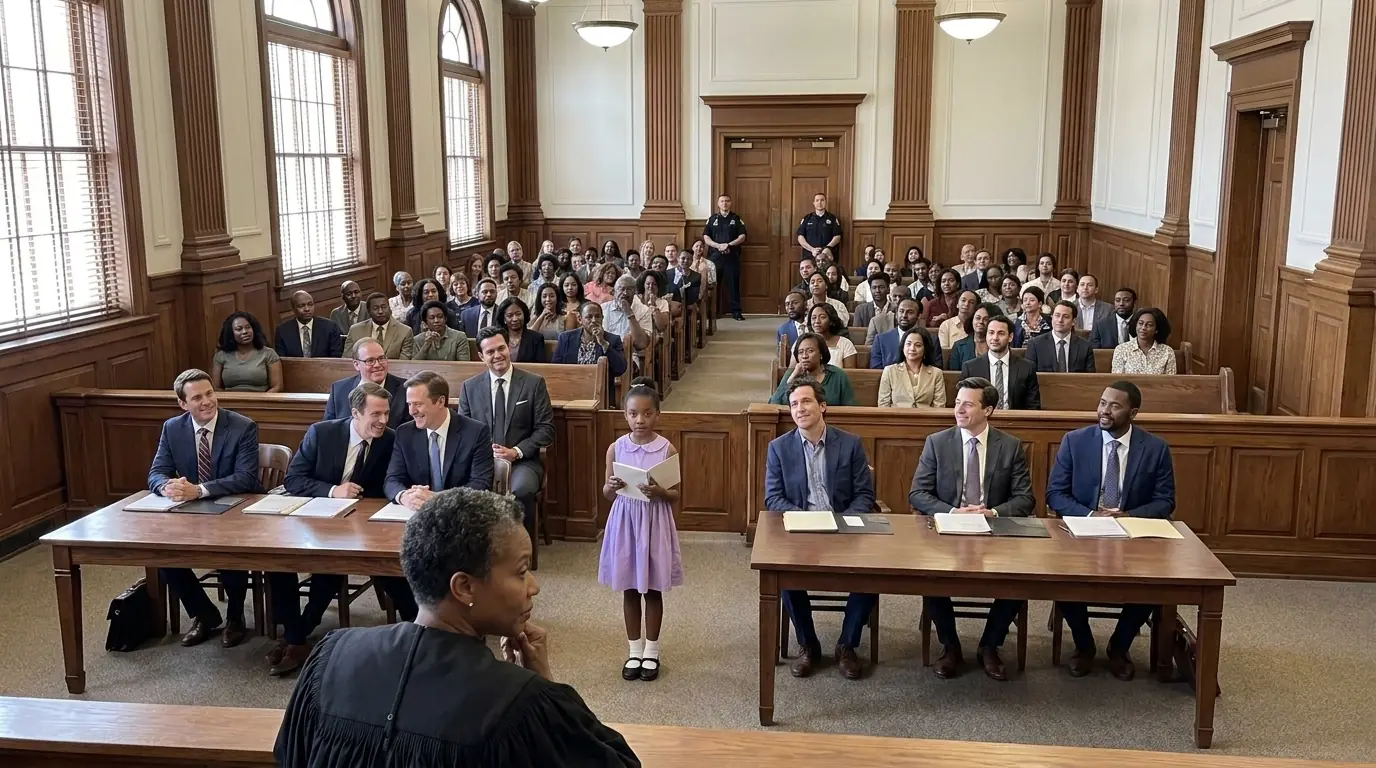
His face had appeared on the cover of Forbes, and his company had been valued at $1.8 billion just eighteen months earlier. A man who had started with nothing and built everything. And right now he had no one. His attorney had walked out of that courtroom twenty minutes before the session began.
No warning, no explanation beyond a single text message that read, "I can no longer represent you. Seek alternative counsel." Just like that. Gone. The judge, the honorable Eleanor Hayes, peered over her reading glasses at the defense table. The prosecution sat across the room, organized, polished, ready. Victor Crane, the man who had accused Ethan of fraud, sat behind him with a quiet smile on his face.
The kind of smile a man wears when he already knows how the story ends. Judge Hayes cleared her throat. Mr. Brickley, I'll ask one more time. Do you have legal representation or shall this court proceed?
Ethan opened his mouth, closed it. The silence stretched like a wire pulled too tight. And then from the middle of the public gallery, from somewhere between the whispers and the stares, a small voice cut through the entire room. "Your Honor." Everyone turned. Standing on the wooden bench, chin lifted, both hands clasped neatly in front of her, was a little girl. Eight years old, with dark skin and natural hair pulled back with a yellow barrette, wearing a lavender dress with white buttons down the front.
She couldn't have been taller than four and a half feet. She looked like she belonged at a school recital, not a courtroom. But her eyes, her eyes were steady, calm, older than her years by decades. "Your Honor," she said again, her voice clear and unhurried. "I would like to represent Mr. Brickley." For exactly 3 seconds, nobody reacted.
And then the courtroom erupted. Laughter, murmuring, a few gasps. Someone near the back said, "You've got to be kidding me." Victor Crane's smile widened into something closer to delight. One of the prosecution attorneys leaned over to his colleague and whispered something that made them both snicker. The little girl did not sit down.
She stood on that bench in her lavender dress, in the middle of all that laughter, and did not move a single inch. Her name was Amara Johnson, and before that day was over, she would change everything. The story of Ethan Brickley and Amara Johnson did not begin in a courtroom. It began on a Tuesday night in November three years earlier on the corner of Peachtree Street and 14th in the middle of a rainstorm that came down so hard the gutters overflowed and the sidewalks turned into shallow rivers. Ethan had been working late as he always did back then.
BrixTech was two years old burning through its series B funding, and he never left the office before midnight. That particular Tuesday he had stayed until nearly 1:00 a.m. reviewing contract language with his founding team. By the time he finally stepped outside umbrella in hand, the city was deserted. Almost deserted. 50 ft from the entrance of his building beneath the narrow ledge of a closed pharmacy sat a woman and a little girl.
The woman she looked to be in her early 30s hair soaked flat against her face. A garbage bag at her feet stuffed with what appeared to be everything she owned had her arm wrapped tightly around the child. The child was pressed into her side, a thin jacket pulled over her head, her small sneakers soaked through. Between them on the wet concrete set a cardboard box. Inside the box wrapped in a plastic grocery bag was a stack of books.
Ethan almost walked past them. He was tired. He had a 7:00 a.m. call with investors in Singapore. His driver was already waiting at the curb. He had taken three steps toward the black SUV before something stopped him. He looked back. The little girl had lowered the jacket from her head. She was staring at him. Not crying. Not begging.
Are you all right? The woman looked up. Her eyes were red rimmed exhausted. We're fine. She said the automatic answer of someone who had learned that asking for help rarely helped. You're sitting in the rain. The overhang is keeping us dry. It's 44°. She didn't answer that. Ethan looked at the little girl.
What's your name? The girl studied him for a moment with those calm measuring eyes. Amara, she said. Amara Johnson and this is my mom Diane. Hi Amara, I'm Ethan. He looked at the box of books. Are those yours? Yes. A pause. I didn't want to leave them behind.
Something about the way she said it matter-of-fact, no drama, just a quiet statement of what mattered, made Ethan's chest tighten further. He stood up and looked at Diane. There's a hotel two blocks from here. Nothing fancy, but it's warm and it's safe. Let me get you a room for tonight.
No strings, no conditions, just get out of the rain. Diane shook her head slowly. We don't take charity. It's not a charity. Consider it a business decision.
I can't walk into my building tomorrow knowing I left two people outside in 44° weather. It would bother me all day, and I have a very important call at 7:00. He offered a small careful smile. Help me out. Diane looked at him for a long moment.
She was trying to find the angle to catch the hidden cost. Ethan held her gaze and waited. It was Amara who decided it. "Mom," she said quietly, "his shoes are getting wet, too. He came back even when he didn't have to." Diane looked down at her daughter. Something in her expression shifted, not breaking but bending.
She picked up the garbage bag. "One night," she said. "One night," Ethan agreed. That one night became a week while Diane found stable housing through a city assistance program Ethan quietly pointed her toward. He didn't make a show of it.
He didn't tell anyone at the office. He simply made sure they were safe, and then he stepped back. But Amara had other ideas. Three days into their stay at the hotel, Ethan stopped by to check in. He found Amara sitting cross-legged on the bed, the cardboard box of books open in front of her, working through something with a yellow highlighter.
He leaned in to look at the book's cover. It was Black's Law Dictionary, the full edition, nearly a thousand pages of dense legal terminology. Ethan stared at it. Then he stared at her. "How old are you, Amara?" "Five," she said without looking up, "and three quarters." "And you're reading Black's Law Dictionary?" "I'm not just reading it." She finally looked up.
"I'm learning it. There's a difference." Ethan sat down carefully on the edge of the bed. "What's the difference?" "Reading is when the words go in your eyes. Learning is when the words stay in your brain and you can use them." She turned back to the page. "I want to be a lawyer, so I'm learning the words now so I'm ready." Ethan was quiet for a moment. "Where did you get that book?" "The library was giving away old copies. Mom said we couldn't take it because we had too much to carry." Amara smoothed her hand over the page. "I carried it anyway in my backpack the whole time." Ethan looked at this five-year-old girl who had carried a thousand-page law dictionary through a rainstorm rather than leave it behind.
"You know," he said carefully, "I have a whole library at my office, business books mostly, but there are some law books in there, too. Real ones, not donated copies. If you ever want to come see them." Amara's eyes went wide. Just for a second, that brief unguarded flash of a child who wanted something very much. Then the composure came back. "That would be acceptable," she said. Ethan laughed.
It was the first real laugh he'd had in weeks. Over the following months as Diane found her footing and eventually joined Brick's tax administrative team, a position she earned entirely on the strength of her own resume, Amara became a quiet fixture in Ethan's world. Not in a showy way. Diane was fiercely protective of her daughter's dignity and would never have allowed it otherwise. But Ethan had a standing arrangement every other Saturday morning.
If Diane agreed and Amara wanted to come, the little girl could sit in his office library and read for two hours. She always wanted to come. She never wasted a single minute. By the time Amara was six, she had worked her way through two books on constitutional law and one on civil procedure. She asked Ethan questions that stopped him cold, not because they were childish, but because they weren't.
She wanted to know why hearsay evidence was generally excluded. She wanted to understand the difference between preponderance of the evidence and beyond a reasonable doubt. She wanted to know what made a contract void versus voidable. Ethan started looking forward to those Saturday mornings more than he expected. There was something clarifying about explaining complex things to someone who had no patience for vague answers.
Amara accepted nothing she didn't understand. She would sit with a question, turn it over, come back to it. "You're going to be dangerous someday." Ethan told her once watching her annotate a page with careful, precise handwriting. Amara looked up at him with those steady, dark eyes. "I'm going to be a lawyer." she said.
"That's the same thing." He laughed again, and he thought not for the first time that this child was going to be something this world wasn't fully ready for. He had no idea on that rainy Tuesday night on Peachtree Street that 3 years later he would be standing alone in a courtroom and that the someone who came back for him would be her.
Victor Crane had always been good at two things: making himself look indispensable and making other people look guilty. He had met Ethan 7 years ago at a venture capital summit in San Francisco back when BrixTech was nothing more than a pitch deck and a dream. Victor was older by 9 years, polished in the way that private school educations and inherited connections made a man polished. He had money and network and just enough technical knowledge to sound credible in the right rooms. He had approached Ethan after his presentation with a firm handshake and a simple offer, "I can open doors you don't even know exist yet. Let me come in as co-founder." Ethan had hesitated.
He hadn't built BrixTech to share it. But Victor's network was real. Within 6 months of bringing him on, BrixTech had closed deals with three major utility companies that Ethan had been chasing for over a year. The company scaled faster than Ethan had projected. By year three, BrixTech was operating in 11 states, generating $340 million in annual revenue, and fielding an acquisition offers from two Fortune 500 energy conglomerates.
Ethan had turned them all down. He wasn't building BrixTech to sell it. He was building it to last. That was the part Victor could never accept. Because Victor had always intended to sell.
He had come into BrixTech as a bridge, not a builder. His plan, a patient, meticulous, and invisible until it wasn't, was to position himself for a massive payout the moment the right buyer appeared. And when Ethan kept refusing those acquisition offers, kept steering the company toward independence and long-term impact, Victor realized the only way to get what he wanted was to remove the obstacle standing in front of him.
The first sign of trouble came 14 months before the trial in a quarterly audit that flagged irregular transfers between two of BrixTech's subsidiary accounts. Ethan had flagged it to the finance team who reported back that the transactions appeared to originate from his personal authorization credentials. Ethan had stared at that report for a long time. He had authorized no such transfers. He brought it to Victor.
Victor, Ethan laid the audit report on the conference table between them. These transfers, do you know anything about them? Victor picked up the report with the calm of a man who had already read it. I saw them flagged last week. I was going to bring it to you.
Were you? Of course. Victor set the papers back down. My guess, someone on the finance team made an input error. Probably assigned your credentials by accident.
It's happened before in companies this size. $42 million in input errors. Victor met his eyes without blinking. I'll have legal look into it. Don't worry about it, Ethan. You've got enough on your plate.
Ethan left that meeting with something sitting wrong in his stomach. He hired an independent forensic accountant 3 days later quietly without telling Victor. The accountant needed 6 weeks. Before those 6 weeks were up, Ethan received a registered letter from the U.S.
Attorney's Office, Northern District of Georgia. He was being investigated for wire fraud securities fraud and misappropriation of corporate funds totaling $42 million. The room tilted. He called his attorney Marcus Webb, a senior partner at one of Atlanta's most respected white-shoe firms, a man Ethan had paid a $180,000 retainer to for precisely this kind of situation. Marcus was calm, reassuring, professional. Don't say anything to anyone. I'll handle this. Trust me. Ethan trusted him. He should not have.
Over the following months as the investigation deepened and the case moved toward indictment, Ethan noticed something troubling about Marcus's strategy. Every motion filed seemed slightly mistimed. Every piece of exculpatory evidence Ethan flagged was met with reasons why it couldn't be submitted yet. The forensic accountant's report, which showed clear signs of credential spoofing, someone using Ethan's login information from IP addresses he had never accessed, was repeatedly pushed to a secondary position in the defense documentation. Then 2 weeks before trial, Victor Crane settled his own civil liability quietly and separately paying a $6 million fine to the SEC while admitting no wrongdoing.
The criminal case against Ethan, however, continued at full speed. Ethan confronted Marcus in his office. "He walks away with a fine," Ethan said, his voice tight, "and I'm still facing federal charges. How is that possible? Marcus straightened the papers on his desk. Victor cooperated with investigators. Cooperation gets different treatment. He set me up. My own credentials were used without my knowledge. The forensic report proves that. The report raises questions. It doesn't prove anything definitively. Then why aren't you pushing harder on it? Marcus looked at him for a long moment. Something shifted in the man's expression. Not guilt, exactly. Something colder than guilt. Something that looked like a decision already made. Ethan, he said carefully, sometimes the best outcome in a case like this is a negotiated plea. Reduced charges, minimal prison time. You preserve some of your assets. Ethan stood up from his chair. I didn't steal anything. I know what you believe. I didn't steal anything. His voice was flat. Final. I am not pleading to something I didn't do. Marcus said nothing further. He straightened his tie and looked out the window at the Atlanta skyline as though the conversation was already behind him. Three days before trial at 6:47 in the morning, Ethan's phone buzzed on his nightstand. A text from Marcus Webb's number. I can no longer represent you. Seek alternative counsel. That was all. No call. No explanation. No return of the $180,000 retainer. Just nine words and a disconnected phone line. By the time Ethan's hands stopped shaking, he had tried three other attorneys. Two couldn't take a federal case on three days notice. One quoted him a $300,000 emergency retainer he could access technically, but not without triggering a court freeze on his accounts that would delay proceedings by weeks. The trial date could not be moved. Judge Hayes had made that unmistakably clear. He arrived at Fulton County Superior Court that morning carrying nothing but a leather folder, a yellow legal pad, and the cold hollow understanding that the system he had spent his entire adult life building within had been turned against him with surgical precision. He sat at the defense table alone. Across the room, Victor Crane sat comfortably behind the prosecution team dressed in a charcoal suit, silver cufflinks catching the courtroom light. He didn't look at Ethan. He didn't need to. The message was already written on every surface of that room and every polished file folder and every practiced expression on the prosecution's side of the aisle. This was over before it began. And then the small voice rang out from the gallery. Ethan turned slowly toward the little girl standing on the bench in the lavender dress with the yellow barrette. Her hands were clasped, her chin lifted, and her eyes were locked on his with an expression that belonged to someone three times her age. His throat tightened. "Amara," he said, barely above a whisper. She looked directly at him across the length of that courtroom, still steady, still unafraid. Around her, people were laughing, whispering, shaking their heads at the absurdity of the moment. Victor Crane's quiet smile had widened. The prosecution attorneys had stopped pretending to review their notes. But Amara Johnson did not look at any of them. She looked only at Ethan, and she gave him the smallest, most certain nod he had ever seen in his life. "I've got you."
Judge Eleanor Hayes had presided over Fulton County Superior Court for 19 years. She had seen everything a courtroom could produce: sobbing defendants, grandstanding attorneys, witnesses who lied with the confidence of people who had practiced in the mirror. She had watched powerful men crumble and quiet men surprise her. She had presided over cases that made the front page and in that deserved to. In 19 years, she believed she had lost the capacity to be genuinely surprised by anything that happened inside her courtroom.
She was wrong. She looked down from the bench at the little girl still standing on the gallery bench. The child had not moved, had not wavered. While the room erupted around her laughter, whispers, a few outright dismissive groans, she stood with her hands clasped and her eyes forward as though the noise simply did not apply to her. Judge Hayes removed her reading glasses slowly.
"Order." She said. The room did not settle immediately. Someone near the back was still chuckling. The lead prosecutor, a sharp-faced man named Daniel Forsyth, had turned fully in his seat to observe the spectacle, one eyebrow arched in polite amusement. Victor Crane said nothing, but the line of his mouth had curved into something satisfied.
"I said order." Judge Hayes's voice came down like a gavel without the gavel, and the room went quiet. She studied the child for a long moment. "Young lady." Her tone was measured, neither unkind nor indulgent. "Do you understand where you are?" "Yes, Your Honor." The girl's voice was clear. No trembling, no hesitation.
"This is Fulton County Superior Court, Courtroom 7. You are the Honorable Eleanor Hayes, appointed to the bench in 2005. The case before you is United States versus Ethan Brickley, docket number CR-24-0871." A beat of silence. "And you are?" Judge Hayes asked. "Amara Johnson. I'm eight years old. I live at 4412 Cascade Road Southwest, Atlanta. And I would like to represent Mr. Brickley in these proceedings." Daniel Forsyth set down his pen. "Your Honor, this is with all due respect, this is not a school exercise. This is a federal fraud case. The court cannot permit Mr. Forsyth." Judge Hayes raised one hand without looking at him. Her eyes stayed on Amara.
"I'll determine what this court permits." She leaned forward slightly. "Ms. Johnson, are you aware that to practice law in the state of Georgia an individual must hold a Juris Doctor degree and pass the Georgia Bar examination?" "Yes, Your Honor." Amara nodded once. "However, under Georgia Code Section 15-19-51, a non-attorney may represent a party in court proceedings under limited circumstances, including when a licensed attorney is unavailable and the court determines it is in the interest of justice to allow a lay advocate to proceed temporarily." She paused. "Mr. Brickley has no representation. I am asking for the opportunity to be heard. That's not the same as practicing law." The courtroom had gone very still.
Judge Hayes looked at the child for a long moment without speaking. Then she looked at Ethan Brickley, who sat at the defense table with an expression that was no longer hollow. Something had come back into his eyes, something that looked against all reasonable odds like hope. She looked back at Amara. "Come forward, Ms. Johnson." From the gallery came an audible murmur, surprise, skepticism, more than a few sounds of disbelief.
Daniel Forsyth opened his mouth and then thought better of it. Victor Crane's satisfied expression flickered just briefly before settling back into place. He wasn't worried. Not yet. Diane Johnson sat in the gallery with both hands pressed flat against her thighs, her knuckles pale, her lips pressed together.
She watched her daughter climb down from the bench, straighten the front of her lavender dress with both hands, pick up the small spiral notebook she had been writing in, and walk calmly through the low wooden gate that separated the gallery from the well of the court. Amara walked to the defense table and stood beside Ethan. He looked down at her. She looked up at him. Whatever passed between them in that moment was private, the compressed language of two people who had spent enough time together to speak without words.
"I've been taking notes since the beginning," she said quietly. "I found something." Ethan exhaled slowly. "Okay," he said, "I trust you." Judge Hayes spoke from the bench. "Miss Johnson, I'm going to allow you five minutes to present whatever it is you believe is relevant to this case. I want to be clear, this is not standard procedure. This is not a precedent. This is the court exercising its discretion in an extraordinary circumstance. Do you understand?" "Yes, Your Honor. five minutes is enough." Another murmur from the gallery. Daniel Forsyth leaned toward his co-counsel and whispered something quickly.
The co-counsel shook his head with a small smile as though they were watching a child's talent show that had run a few minutes longer than expected. Victor Crane straightened his cufflinks. Amara set her spiral notebook on the defense table. She opened it to a page dense with her careful small handwriting notes she had been making for the past 40 minutes while sitting in the gallery watching the prosecution lay out its opening framework. She had written in two columns, one for what was said, one for questions the statements raised.
She turned to face the bench. She was 4 feet 5 inches tall. The podium was not built for someone her size. She didn't try to use it. She simply stood in the open space between the defense table and the judge's bench.
Her notebook was held in both hands, her back straight, as she began. “Your Honor, the prosecution’s case rests on three categories of evidence: financial transaction records attributed to Mr. Brickley’s authorization credentials, internal communications that allegedly show his awareness of the transfers, and testimony from a cooperating witness.” She spoke without rushing. “I would like to address the first category because, without it, the other two have no foundation.”
Judge Hayes had her hands folded on the bench. She was listening. “The prosecution submitted Exhibit 3A, a log of thirty-seven wire transfers totaling $42 million, each flagged as authorized by Mr. Brickley’s user credentials between March and September of last year,” Amara continued. “I noticed that the exhibit was submitted as a certified true copy. But on page eleven, the document-properties metadata printed in the footer shows a file-creation date of October 14.”
She let that sit for exactly two seconds. “The final transfer in the log is dated September 28. But the document itself was created sixteen days later. A real-time transaction log cannot be created after the transactions it supposedly recorded. That is not how logging systems work. This means the document was not exported directly from the original system. It was created separately after the fact.”
The courtroom was silent in a different way now. Not the silence of amusement or of a room waiting for a punch line, but the silence of a room that had just felt the floor shift beneath it. Daniel Forsyth recovered first. He was a twenty-two-year veteran of the U.S. Attorney’s Office, a man who had tried more than one hundred federal cases and lost fewer than a dozen. He was not accustomed to being caught off guard, especially not by a child in a lavender dress.
He rose with practiced composure. “Your Honor, the child’s observation, while creative, reflects a fundamental misunderstanding of how document certification works. Certified copies are produced by the certifying office at the time of submission, not at the time of the original transaction. A creation date of October 14 simply means the certified copy was prepared in October. It says nothing about the authenticity of the underlying data.”
Amara turned to look at him. She did not appear rattled or uncertain. If anything, she looked as though she had expected exactly that response. “That is correct for a standard certified copy,” she said, then turned back to the judge. “But Exhibit 3A was not submitted as a standard certified copy, Your Honor. It was submitted under the prosecution’s certification as a system-generated export, meaning the document was represented to this court as a direct output from BrixTech’s financial-management software, not a manually prepared copy.”
She opened her notebook to a specific page and held it up. “That distinction appears in the prosecution’s own exhibit cover sheet, page one, second paragraph. The phrase used is ‘authentic system-generated record exported directly from source.’ If the document is a direct system export, its creation date should match the final transaction it contains. It does not.”
Forsyth’s jaw tightened almost imperceptibly. “Furthermore,” Amara continued, “a system-generated export from financial software carries an embedded checksum—a verification code confirming that the data has not been altered since export. I reviewed the footer of every page in the exhibit. There is no checksum anywhere in Exhibit 3A. A genuine system export would have one. Its absence means either the document was not exported directly from the source system, contradicting the prosecution’s own representation, or the checksum was removed. Both possibilities raise serious questions about the document’s integrity.”
The room was no longer quiet in the polite, waiting way it had been during her first observation. It was quiet because everyone was still working out what her statement meant. Judge Hayes looked at Forsyth. “Mr. Forsyth, would you like to respond?”
Forsyth was already on his feet, hands flat on the table. “Your Honor, this line of argument requires technical verification that cannot be conducted in open court by”—he paused visibly, choosing his words—“a lay observer. We would need a forensic digital examiner to assess these claims.”
“Then perhaps,” Judge Hayes said, her voice entirely neutral, “we should have one.”
Victor Crane shifted in his seat, just enough for the person beside him to notice. His attorney leaned in and murmured something in his ear. Victor did not respond. Amara was not finished.
“Your Honor, I also want to address the IP-address discrepancy in the transaction log.” She turned a page in her notebook. “The prosecution’s exhibit shows thirty-seven transfers authorized through Mr. Brickley’s credentials. Twenty-nine were initiated from IP addresses in the range 172.16.0.0 through 172.31.255.255. That is a private network range consistent with BrixTech’s internal corporate network.”
She paused for exactly the right beat. “But eight transfers, totaling $31 million of the $42 million, were initiated from an address beginning with 203.0.113. That range is reserved under Internet Engineering Task Force RFC 5737 exclusively for documentation and examples. It cannot function as a real active network address. It is technically impossible for a genuine transaction to originate from it.”
She closed her notebook. “Someone built a fake transaction log and did not know enough about network addressing to use a real IP-address range. The eight largest transfers in this exhibit are technically impossible. They never happened.”
For a long moment, no one in Courtroom Seven made a sound. Then Judge Hayes set down her pen very deliberately on the bench in front of her and looked at Daniel Forsyth with an expression that had moved well past neutral. Mr. Forsyth, she said, I am going to ask you a direct question and I expect a direct answer. Was this exhibit independently verified by a forensic digital examiner prior to submission? Forsyth stood with both hands still flat on the table. A muscle worked in his jaw. The exhibit was verified by our office's standard authentication process, Your Honor. That is not what I asked. A pause that lasted too long. No, Your Honor. It was not independently verified by a forensic digital examiner. The gallery erupted. Judge Hayes brought her gavel down twice hard. Order. I will clear this room. The noise subsided. Amara stood at the defense table with her notebook closed in both hands. She had not moved during the commotion. Beside her, Ethan Brickley sat very still, his hands folded on the yellow legal pad he had never written on, his eyes fixed on the middle distance. He was breathing slowly and carefully, like a man who had been underwater for a long time and had only just broken the surface. Victor Crane was no longer adjusting his cufflinks. He was no longer leaning back in his chair. He sat forward, elbows on his knees, his attorney's hand on his arm, in the quiet urgent way attorneys touch their clients when they are telling them to stay calm. His face had changed. Judge Hayes turned back to Amara. Her expression had shifted, still guarded, still the face of a judge who would not be moved by anything except evidence and procedure, but something else was there beneath it. Something that looked like the careful private acknowledgement a person makes when they have witnessed something they did not expect and cannot entirely account for. "Ms.
Johnson," she said, "you have exceeded your five minutes considerably. However," she glanced at the prosecution table and then back, "what you have raised cannot be set aside. I am ordering an emergency forensic examination of Exhibit 3A by a court-appointed digital forensics expert before these proceedings continue." She looked at both sides of the room. "We are in recess until 9:00 tomorrow morning. At that time, I expect the court's forensic examiner to be present and prepared." She brought the gavel down once.
The room broke open with sound and motion. Reporters in the gallery were already on their phones. The prosecution team was huddled in a tight cluster, voices low and urgent. Victor Crane sat motionless as his attorney spoke rapidly into his ear. Diane Johnson stood at the gallery railing, both hands gripping the wooden bar, tears running silently down her face.
Amara walked back through the gate and straight to her mother. Diane pulled her daughter in without a word, just held her, one hand pressed to the back of Amara's head, her eyes closed. "You were supposed to just watch," Diane whispered. "You were only supposed to watch." Amara's voice was muffled against her mother's shoulder. "I know," she said, "but watching wasn't enough." The court-appointed forensic examiner was a woman named Dr.
Patricia Oshei. She arrived at Fulton County Superior Court at 8:15 the following morning, 4five minutes before the session was scheduled to resume. She was compact and precise in the way that people who spend their careers working with data tend to be efficient in her movements, economical with her words, carrying a black hard-sided case that contained the equipment she would need to do her work properly. She had a PhD in computer forensics from Georgia Tech, with 18 years of experience testifying as an expert witness in federal cases. She had been called by Judge Hayes's clerk at 6:30 the previous evening and had reviewed the exhibit materials through most of the night.
She needed three hours with Exhibit 3A. At 11:47 a.m., she stood at the witness stand and delivered her findings in the flat precise language of someone who understood that every word she said was being recorded and would be examined by people looking for any room to maneuver. There was no room. “Exhibit 3A,” Dr. Oshei said, “is not a system-generated export from BrixTech’s financial-management platform. I obtained the actual system export logs from BrixTech’s server administrator under emergency subpoena this morning. Comparing those authentic records with Exhibit 3A reveals seventeen data-field discrepancies, including timestamp-formatting inconsistencies, absent verification checksums, and IP-address entries from a non-routable block that cannot exist in any real network environment.”
She looked up from her report. “In my professional opinion, Exhibit 3A was manually constructed. It was not generated by an automated financial system. The metadata confirms that the document was created on October 14 using a standard spreadsheet application, not exported from the source platform. The data it contains does not reflect actual transaction records.”
Silence filled Courtroom Seven. “Furthermore,” Dr. Oshei continued, “the authentic export logs show no record of the thirty-seven transfers listed in Exhibit 3A. The actual transaction history for the accounts in question shows normal operating transfers consistent with BrixTech’s documented business activity. There is no evidence in the authentic system records of any unauthorized movement of funds attributable to Mr. Brickley’s credentials.”
Judge Hayes looked at the prosecution table. Daniel Forsyth sat with his hands folded on the table in front of him. He was very still. Beside him, his co-counsel had a legal pad open but was not writing anything on it. "Mr.
Forsyth," Judge Hayes said, "in light of this testimony, does the prosecution wish to address the court?" Forsyth stood. He was a careful man and a proud one, and both of those things were visible in the controlled, deliberate way he rose from his chair. "Your Honor, the prosecution requests a brief recess to confer with our office regarding these findings." "You have thirty minutes." What happened during those thirty minutes would only become fully clear in the days and weeks that followed. But when Forsyth returned to the courtroom, the expression on his face had changed in a way that told the room everything before he said a single word.
"Your Honor," he said, "the U.S. Attorney's Office is withdrawing all charges against Ethan Brickley effective immediately. We are simultaneously referring the matter of Exhibit 3A's origins to our office's internal integrity division for investigation." He paused. "We have also been in contact with the FBI's financial crimes unit, who will be opening a separate investigation into the source and circumstances of the fraudulent exhibit." He sat down. The gallery did not erupt this time. The sound that moved through the room was quieter than an eruption, more like a long collective exhale, the release of breath that a room holds when it has been waiting for something to resolve, and it finally does.
Ethan Brickley sat at the defense table with both hands pressed flat against its surface. His head bowed, his shoulders shaking once, just once, before he brought himself still again. Judge Hayes looked at him. "Mr. Brickley, all charges against you are dismissed with prejudice. You are free to go." Ethan raised his head. His eyes were wet.
He nodded once, unable to speak. Then he turned. Amara was sitting in the front row of the gallery on the other side of the low wooden gate, her spiral notebook open in her lap. She had been there since 8:45 that morning. She and her mother had arrived before almost anyone else.
She had watched Dr. Oshei's testimony with complete attention, her pen moving steadily across the page, still taking notes even when the outcome was no longer in doubt, because that was who she was. She finished things. When Ethan turned and looked at her, she closed the notebook. He walked to the gate.
She stood up. And when he crouched down to her eye level, this man worth nearly two billion dollars in this federal courtroom, in front of 200 people, there was nothing performative about it. He was simply trying to look at her properly. "Amara," he said. His voice was not steady.
He didn't try to make it steady. "You didn't have to do that." She considered this with the careful honesty she brought to everything. "No," she agreed, "but you came back into the rain, even when you didn't have to." He closed his eyes for a moment. When he opened them, she could see that he understood that she had been keeping count all this time of the things that mattered. "Thank you," he said.
Just that. Just two words, but he said them the way a person says something they have been saving up for a long time. Amara looked at him steadily. You're welcome, Uncle Ethan. It was the first time she had ever called him that.
Behind her, Diane Johnson pressed one hand over her mouth. Her shoulders shook. In the back of the courtroom, Victor Crane was being led out by two federal agents who had arrived during the recess. He did not look toward the defense table as he passed. He kept his eyes forward and his chin up, the last performance of a man who had run out of roles to play.
His attorney walked beside him, speaking quietly and urgently. Victor said nothing. The silver cufflinks caught the light one final time as he passed through the doors, and then he was gone. Reporters crowded the hallway outside. Questions came from every direction.
Cameras, microphones, the noise of a story breaking open in real time. But inside Courtroom Seven, in the moment just before the crowd spilled in, there was a stillness. The three of them, Ethan and Amara and Diane standing together in the well of the court, while the world outside rearranged itself around what a little girl with a spiral notebook and a yellow barrette had done. Amara looked up at the high ceiling of the courtroom, at the carved wood and the tall windows letting in the late morning light, and she looked like what she was, a child. Eight years old, a child who had walked into a room full of adults and done something none of them had done.
She had paid attention. The story did not end when Victor Crane walked out of Fulton County Superior Court in the custody of federal agents. Stories like this one never end in a single moment. They end slowly in pieces, the way a tide goes out, not all at once, but steadily until the shoreline is completely changed and you can barely remember what it looked like before.
In the weeks that followed, the investigation moved quickly. The FBI's Financial Crimes Unit, working alongside the U.S. Attorney's Internal Integrity Division, traced the origins of Exhibit 3A to a private server registered under a shell company that Victor Crane had incorporated in Delaware 14 months earlier. Digital forensics recovered deleted files showing multiple drafts of the fraudulent transaction log, early versions with errors, later versions with corrections.
The methodical work of someone who had taken considerable time and care to build a trap. The credential spoofing software used to generate the fake authorization signatures was traced to a vendor Victor had paid through a third-party account. Marcus Webb, Ethan's former attorney, was arrested 6 weeks after the trial. He had received $340,000 in three separate wire transfers from one of Victor's shell companies payments spread across 18 months beginning around the same time Victor had started constructing the fraudulent exhibit. The payments were framed in Victor's records as consulting fees.
They were not consulting fees. Marcus Webb was charged with obstruction of justice, bribery, and conspiracy to commit fraud. He surrendered his law license before the arraignment. Victor Crane was indicted on 11 federal counts including wire fraud, securities fraud conspiracy, evidence tampering, and bribery of a legal professional. His attorney negotiated for months.
There was no favorable deal to be found. The evidence was too complete, too documented, too thoroughly dismantled by the forensic trail that Amara Johnson had first identified in a spiral notebook with a yellow barrette in her hair. Victor was convicted on nine of 11 counts. He was sentenced to 14 years in federal prison. At sentencing, the judge, not Eleanor Hayes, but a federal district judge named Raymond Caldwell, noted for the record that the initial unraveling of the fraudulent evidence had been initiated by an 8-year-old child acting as a lay advocate in open court.
He called it in his written opinion one of the most remarkable moments in the recent history of the Northern District of Georgia, Ethan Brickley got BrixTech back. The company had been in operational limbo during the investigation, its board frozen by uncertainty, several key contracts suspended pending resolution of the criminal case. When the charges were dismissed and the truth of Victor's scheme became public, the board voted unanimously to restore Ethan as sole controlling executive. Three of the suspended contracts were reinstated within 30 days. Two new utility partnerships reached out with proposals within 6 weeks of the verdict.
BrixTech was worth $2.3 billion by the end of that fiscal year. But the first thing Ethan did before the board meeting, before the press conference, before any of it, was drive to 4412 Cascade Road in Southwest Atlanta on a quiet Saturday morning. Diane answered the door. She looked at him for a moment without speaking, and then she stepped aside to let him in.
Amara was at the kitchen table, her spiral notebook open in front of her, working through something with focused concentration. She looked up when Ethan appeared in the doorway. She did not look surprised. She looked the way she always looked, steady, attentive, present. "Hi, Uncle Ethan," she said.
"Hi, Amara." He sat down across from her at the kitchen table. He had not rehearsed what he wanted to say, and that was deliberate. With Amara, rehearsed things never landed the way real things did. She heard the difference. "I want to do something," he said.
"And I want to ask you before I do it because it's about you, and it should be your decision." She set down her pen. She gave him her full attention. "I want to create a foundation," Ethan said, "for kids in the city who are where you and your mom were three years ago in that corner. Kids who are brilliant and driven and have everything they need to be extraordinary except the resources and the space to grow into it. I I to fund scholarships, legal education programs, Saturday library access, safe places to read and learn and ask questions. He paused. I want to call it the Amara Foundation. The kitchen was very quiet. "Will kids actually get to go to good schools?"" she asked. "Yes."
"Will there be real law books, not donated copies with pages missing?" "Full editions, updated every year." She was quiet for another moment, turning it over the way she always turned things over thoroughly without rushing. "Okay," she said. "You can use my name." Diane, standing in the kitchen doorway with a dish towel in her hands, made a sound that was somewhere between a laugh and a sob. She turned away quickly, pressing the dish towel to her face. Ethan looked at Amara across the kitchen table.
"What do you want to be when you grow up?" She picked up her pen. She looked at her notebook. She looked back at him. "I already told you," she said, "a lawyer." A pause. "But the dangerous kind." He smiled.
It was the same smile she had pulled from him three years ago in a hotel room over a well-worn copy of Black's Law Dictionary. Real and unguarded and surprised by itself. "Then let's make sure you get there," he said. The Amara Foundation launched 6 months later with an initial endowment of $15 million. In its first year, it funded full scholarships for thirty-seven students from underserved Atlanta communities.
It opened two after-school legal literacy programs in Southwest Atlanta, the neighborhoods where Amara and her mother had once carried everything they owned in a garbage bag and a cardboard box through the rain. Amara attended the launch event in a yellow dress. She stood at the podium, adjusted to the right height, and spoke for 4 minutes without notes. She did not talk about herself. She talked about the kids who would come after her.
The audience gave her a standing ovation. She accepted it with a small, dignified nod, the way she accepted everything. As something real, not something to perform. As for Judge Eleanor Hayes, she retired two years later. In her farewell remarks, she mentioned that in 19 years on the bench, she had witnessed a great many things that surprised her.
Only one of them, she said, had made her genuinely reconsider what was possible. She did not say the name. She didn't need to. Everyone in the room already knew. There was a moment in this story that I keep coming back to.
Not the moment Amara stood up on the bench. Not the moment the forensic examiner confirmed the fraud. Not even the moment the charges were dismissed and Ethan Brickley was free to go. The moment I keep returning to is smaller than all of those. It is the moment on a rainy Tuesday night in November when a tired man heading toward a warm car and an early morning meeting took three steps away from two people sitting on a wet sidewalk in 44° weather and then stopped and turned around and walked back.
He didn't know what that decision would cost him. He didn't know what it would return to him. He didn't know that the little girl watching him from beneath that thin jacket would one day stand in a federal courtroom and say with the certainty of someone who had been keeping careful count, "You came back in the rain even when you didn't have to." He just knew that walking away felt wrong. So, he didn't. That is the whole story, really.
Everything else, the foundation, the verdict, the standing ovation, the 14-year sentence, all of it flows from that single moment of a person choosing to turn around. We talk a lot about power, about who has it and who doesn't, about the systems that protect certain people and grind others down. And those conversations matter. But sometimes inside all of that, there is a smaller and more personal truth that the way we treat the people the world has decided don't matter says more about us than anything else we will ever do. Ethan treated a five-year-old girl like her questions were worth answering seriously.
He treated a woman with nothing like someone with dignity. He came back in the rain when no one was watching and no one would have blamed him for walking on. And when the world turned against him, the person who turned it back was the one he had treated like she mattered. Think about the people in your own life, the ones who showed up when it cost them something, the ones who turned around, the ones who took your questions seriously before you had anything to offer in return. And think about the people you might walk past today on a corner, in a hallway, in a classroom, who are carrying something important that no one has bothered to notice yet.
Amara Johnson was eight years old. She was carrying a spiral notebook and a yellow barrette and three years of Saturday mornings in a library where someone had told her over and over that her mind was something real. That is all it took.